ACH Payments in Dental Practices: A Complete Guide
ACH Payments in Dental Practices: A Complete Guide
ACH payments in dental practices are defined as electronic bank-to-bank transfers that move funds directly between patient and practice accounts through the Automated Clearing House network. Nacha, the governing body for the ACH network, reports that dental EFT adoption reached 33% in 2026, with 309 million EFT payments processed in 2024 alone. That figure represents an 11.2% increase year over year. Medical practices, by comparison, operate at 78% EFT adoption. The gap tells you exactly where the opportunity sits. Dental practices that shift to ACH payment processing gain lower transaction costs, faster settlement, and a billing workflow that does not depend on paper checks or card swipe fees.
How ACH payment processing works in dental practices
ACH transactions follow a defined path through the banking system. Your practice acts as the originator. The patient’s bank is the receiver. Nacha’s rules govern every step, including authorization requirements, SEC (Standard Entry Class) codes, and return handling. ACH processing involves your originating depositary financial institution transmitting the payment file to an ACH operator, which then routes it to the patient’s receiving depository financial institution for settlement.

Settlement timing and Same-Day ACH windows
Standard ACH transactions typically settle within one to two business days. Same-Day ACH moves faster, but timing matters. Same-Day ACH cutoff times fall at 10:30 a.m., 2:45 p.m., and 4:45 p.m. ET. A payment submitted after the 4:45 p.m. window rolls to the next business day. For dental practices managing end-of-month collections or urgent patient refunds, missing a cutoff has a direct cash flow consequence.
Recurring payment authorization for dental plans
Recurring ACH payments work especially well for in-house dental membership plans or payment plans for large treatment cases. You collect a signed or electronically verified authorization from the patient before the first debit. That authorization must specify the amount, frequency, and account details. Practice management platforms like Dentrix, Eaglesoft, and Curve Dental can store these authorizations and trigger scheduled debits automatically. The result is predictable revenue without manual follow-up calls.
Payment posting and reconciliation workflow
After settlement, your billing team posts the received funds against the correct patient ledger. This step is where many practices lose accuracy. Each ACH transaction carries a trace number that links back to the original payment file. Matching trace numbers to ERA (Electronic Remittance Advice) records keeps your ledger clean and your days sales outstanding (DSO) low. Practice management software that integrates directly with your ACH processor eliminates the manual matching step entirely.
Pro Tip: Set up a daily reconciliation report that compares your ACH settlement file against posted payments in your practice management system. Catching discrepancies the same day prevents billing errors from compounding over weeks.
What are the benefits of ACH vs. credit cards for dental billing?
The financial case for ACH over credit cards is direct. Credit card processing fees typically run 2.5%–3.5% per transaction. ACH fees are a fraction of that, usually a flat per-transaction rate or a small percentage well below 1%. Shifting 40–50% of payments from credit cards to ACH or zero-fee bank transfers can save dental practices thousands of dollars annually. For a practice processing significant monthly patient payments, that difference compounds quickly.
ACH vs. checks: speed and security
Checks introduce delays, manual handling, and the risk of returned items that take days to surface. Nacha describes EFT as “easier and safer than checks” for dental payment collection. An ACH debit confirms settlement within one to two business days. A returned check may not surface for three to five business days, and the administrative cost of chasing it adds up fast.
Key advantages at a glance
- Lower fees. ACH transaction costs run well below credit card interchange rates of 2.5%–3.5%.
- Faster confirmation. Settlement occurs within one to two business days, compared to three to five for paper checks.
- Predictable cash flow. Recurring ACH debits for membership plans or payment plans arrive on schedule.
- Reduced administrative work. Automated posting reduces manual data entry and billing staff time.
- Better security. ACH transactions do not expose card numbers, reducing PCI DSS compliance scope.
- Industry savings potential. Full EFT adoption across dental practices could save the industry $246 million annually in administrative costs.
Payment method comparison
| Payment Method | Typical Fee | Settlement Time | Return Risk | Admin Burden |
|---|---|---|---|---|
| ACH / EFT | Low flat rate or under 1% | 1–2 business days | Low with clean data | Low with automation |
| Credit card | 2.5%–3.5% per transaction | 1–2 business days | Chargeback risk | Moderate |
| Paper check | Near zero direct fee | 3–5 business days | High, delayed discovery | High |
| Virtual credit card | 2.5%–3.5% (paid by provider) | 1–2 business days | Low | Moderate |
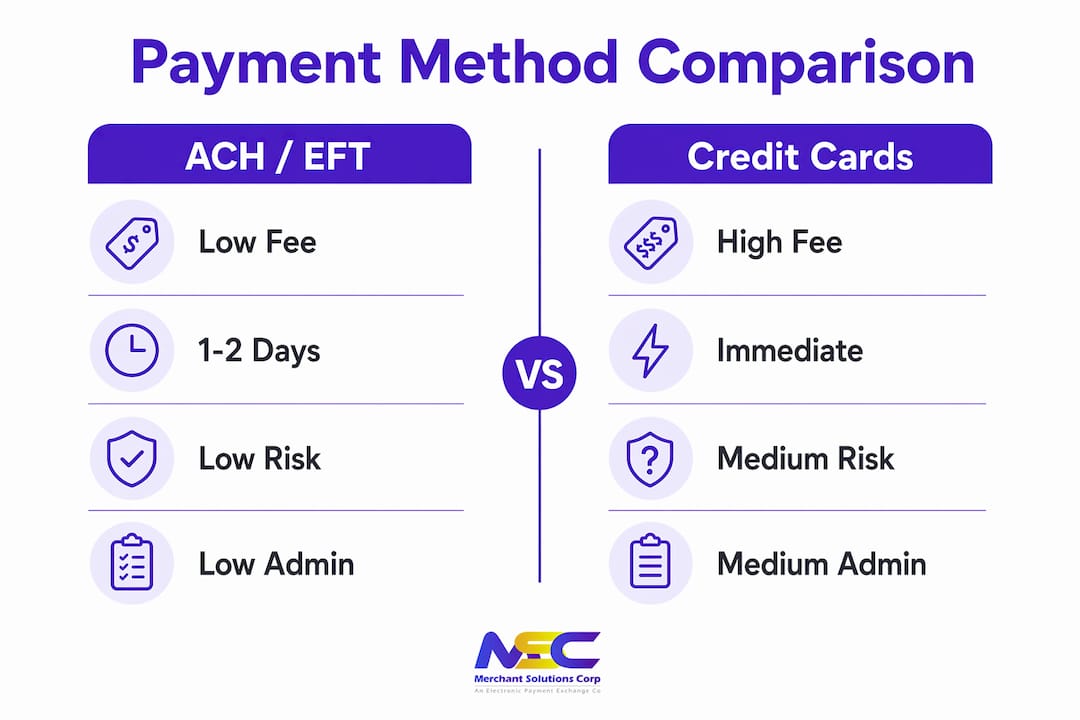
Dental practices that reject virtual credit cards in favor of EFT improve financial outcomes directly. Virtual cards charge the provider the full interchange fee, while ACH shifts that cost burden away entirely.
What are the common challenges with ACH payments in dental practices?
ACH returns are the most common operational challenge. A return occurs when a payment cannot be completed, and each return carries a specific code that tells you why. Common return codes include R03 (no account or unable to locate account), R04 (invalid account number), and R05 (unauthorized debit on a consumer account). Each code requires a different response from your billing team.
Return timelines and patient communication
Most data-related returns, such as R03 and R04, appear within two banking days. Unauthorized consumer debit returns under code R05 carry a 60-day return window. That extended window means a patient can dispute a charge nearly two months after it posts. Your authorization documentation is your primary defense. A signed or electronically confirmed authorization with a clear description of the debit protects your practice if a dispute arises.
- Verify account and routing numbers at the point of collection, before submitting any ACH file.
- Use the correct SEC code. PPD (Prearranged Payment and Deposit) applies to consumer accounts. CCD (Corporate Credit or Debit) applies to business accounts. Mismatched codes trigger returns.
- Document all authorizations. Store signed forms or electronic consent records in the patient file.
- Monitor return rates closely. High return rates can cause your bank to restrict or revoke your ACH origination privileges.
- Communicate proactively. When a payment returns, contact the patient within 24 hours to resolve the issue before it affects their treatment schedule.
Managing Same-Day ACH cutoffs for cash flow
Missing a Same-Day ACH window delays settlement by a full business day. For practices running tight end-of-month collections, that delay affects payroll timing and vendor payments. Build your submission schedule around the 10:30 a.m. ET cutoff for maximum same-day coverage. Payments submitted before that window settle the same afternoon in most cases.
Pro Tip: Batch your recurring patient ACH debits to submit before 10:00 a.m. ET on collection days. That buffer gives your processor time to transmit before the first Same-Day ACH cutoff and keeps your settlement predictable.
How to implement ACH payments in your dental practice
A structured implementation prevents the most common mistakes. Follow these steps to set up ACH payment processing that integrates cleanly with your existing billing workflow.
-
Select a processor with dental billing integration. Choose a payment processor that connects directly to your practice management software. Merchantsolutionscorp offers ACH and eCheck processing with integration support for dental billing environments. Direct integration eliminates manual file exports and reduces posting errors.
-
Establish patient authorization procedures. Create a standardized consent form that covers the debit amount, frequency, and account details. For recurring plans, include language that covers future debits at the same amount. Collect authorization before the first transaction, not after.
-
Configure recurring payment schedules. Set up automatic debits for in-house membership plans and treatment payment plans inside your practice management system. Platforms like Dentrix and Eaglesoft support recurring payment scheduling when connected to a compatible processor.
-
Train your billing staff on return codes and reconciliation. Your team needs to recognize return codes, understand the response timeline, and know how to update patient records. A one-hour training session covering the top ten return codes prevents most downstream billing errors.
-
Integrate ERA/EOB posting with ACH settlement. Tight integration between payment acceptance and reconciliation is the single biggest factor in ACH success. When ERA files post automatically against ACH settlements, your DSO drops and your ledger stays accurate.
Processor selection criteria
| Criteria | What to look for |
|---|---|
| Practice management integration | Direct API connection to Dentrix, Eaglesoft, or Curve Dental |
| ACH fee structure | Flat per-transaction rate with no hidden monthly minimums |
| Return handling support | Automated return notifications with code descriptions |
| Same-Day ACH availability | Intraday processing with clear cutoff time disclosure |
| Compliance support | NACHA rule adherence and SEC code guidance included |
Key Takeaways
ACH payments give dental practices a direct, lower-cost path to faster settlement, predictable cash flow, and reduced administrative work compared to credit cards and paper checks.
| Point | Details |
|---|---|
| Industry adoption gap | Dental EFT adoption sits at 33% vs. 78% for medical, showing significant room to gain competitive advantage. |
| Cost savings potential | Shifting 40–50% of payments to ACH avoids credit card fees of 2.5%–3.5% and can save thousands annually. |
| Return management is critical | High ACH return rates risk losing bank origination privileges; clean data and proper authorization prevent most returns. |
| Reconciliation drives cash flow | Tight integration between ACH settlement and ERA posting keeps DSO low and ledger accuracy high. |
| Same-Day ACH timing matters | Missing the 10:30 a.m. ET cutoff delays same-day settlement; batch submissions early to protect cash flow. |
Why reconciliation is the part most practices get wrong
Most dental practices focus entirely on getting ACH set up and forget that acceptance is only half the equation. The real financial gain comes from what happens after the money moves. Payment posting quality and accurate reconciliation are where cash flow actually improves or erodes.
I have seen practices adopt ACH, reduce their card fees significantly, and still struggle with DSO because their billing team was manually matching payments to ledgers three days after settlement. The ACH trace number exists precisely to automate that match. When your processor and practice management system share that data in real time, you eliminate the lag entirely.
The other mistake is treating authorization as a formality. A patient who disputes an ACH debit and wins under the R05 return code does not just cost you the payment. The return counts against your origination record with your bank. Accumulate enough returns and your bank restricts your ability to originate ACH transactions at all. That is a serious operational risk that most practice administrators do not consider until it happens.
The practices that get the most value from ACH are the ones that treat it as a billing system upgrade, not just a payment method swap. That means integrating it with your ERA workflow, training your front desk on authorization collection, and reviewing your return rate monthly. The payment posting and reconciliation workflow is not a back-office detail. It is the mechanism that turns ACH acceptance into actual cash flow improvement.
— Jonathan
Merchantsolutionscorp supports dental practices with ACH processing
Merchantsolutionscorp provides ACH and eCheck processing built for practices that need lower transaction costs and cleaner billing workflows. The platform connects with dental practice management systems to reduce manual posting and keep reconciliation accurate. For dental administrators managing recurring patient payment plans or insurance EFT collections, Merchantsolutionscorp offers dental payment processing with EMR integration and direct ACH support. You can also review full payment processing options to find the right structure for your practice volume and billing setup. Setup is straightforward, with onboarding support included from day one.
FAQ
What is ACH payment processing in a dental practice?
ACH payment processing is the electronic transfer of funds between a patient’s bank account and the dental practice’s account through the Automated Clearing House network. It replaces paper checks and reduces credit card processing fees for routine patient billing.
How long does an ACH payment take to settle for dental practices?
Standard ACH payments settle within one to two business days. Same-Day ACH settles within hours if submitted before the 10:30 a.m., 2:45 p.m., or 4:45 p.m. ET cutoff windows.
What causes ACH payment returns in dental billing?
The most common causes are incorrect account numbers (R03, R04) and unauthorized debits (R05). Data errors typically return within two banking days, while unauthorized consumer debits carry a 60-day return window.
How much can a dental practice save by switching to ACH?
Shifting 40–50% of payments from credit cards to ACH avoids typical credit card fees of 2.5%–3.5% per transaction and can save a practice thousands of dollars annually depending on payment volume.
Does ACH work for recurring dental membership plan payments?
Yes. ACH is well suited for recurring debits tied to in-house dental membership plans or multi-payment treatment agreements. Proper patient authorization and correct SEC code selection are required before the first scheduled debit.