ACH Payments for Hotels: A Complete 2026 Guide
ACH Payments for Hotels: A Complete 2026 Guide
ACH payments are defined as electronic funds transfers that move money directly between bank accounts through the Automated Clearing House network, a federally regulated system overseen by Nacha (formerly NACHA). For hotels, this means processing guest deposits, vendor invoices, and recurring charges without relying on paper checks or card networks. The result is lower transaction costs, stronger security, and far less manual work for your accounting team. Hotels increasingly use ACH transactions for lodging payments because card processing fees typically run 2.5–5.0% per transaction, while ACH fees are a fraction of that cost. Understanding how ACH payments work gives hotel owners and managers a direct path to better margins and cleaner financial operations.
How do ACH payments work in hotels?
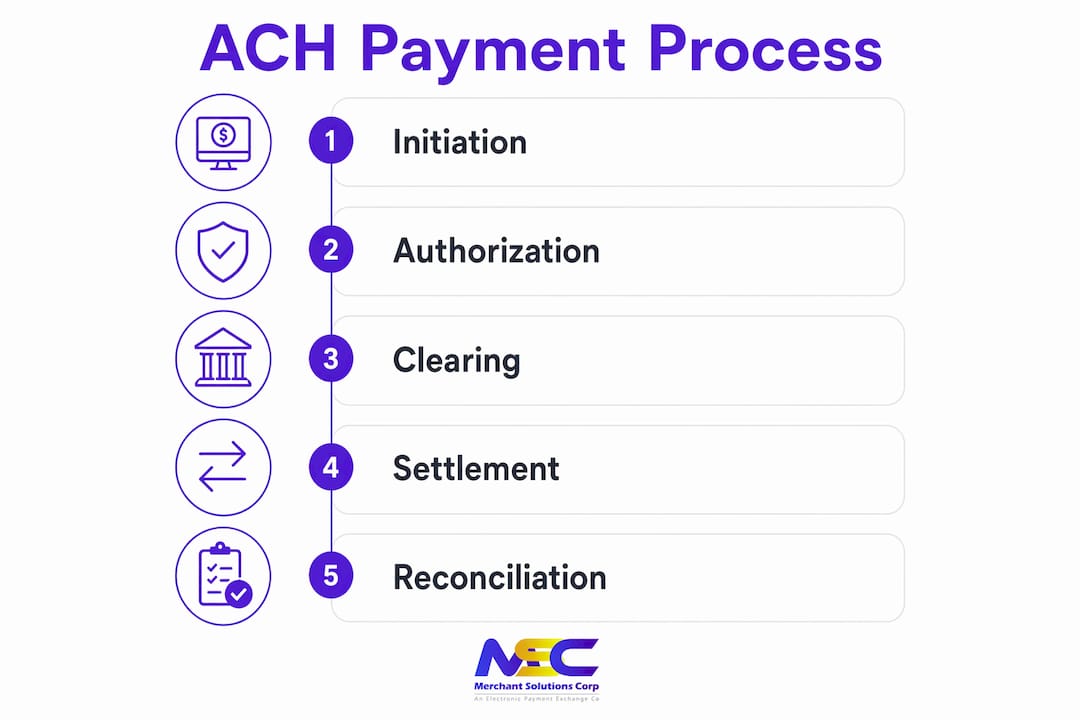
ACH payment processing in hotels follows a structured flow from initiation to settlement, and each stage has a direct impact on your cash position and workload.

The ACH payment process moves through four core stages: authorization, authentication, capture, and settlement. In a hotel context, authorization happens when a guest or corporate client provides their bank account and routing number. Authentication confirms the account details are valid. Capture records the transaction amount against the reservation or invoice. Settlement is where the actual funds move between banks, and this is where ACH does its primary work.
Here is how the process unfolds step by step:
- Guest or vendor authorization. The guest or vendor signs an ACH authorization form, either digitally or on paper, granting permission to debit or credit their account.
- Transaction initiation. Your front desk or accounts payable team enters the payment into your Property Management System (PMS) or accounting software, which sends the transaction to your ACH processor.
- Batch submission. Your processor bundles the transaction with others and submits it to the Automated Clearing House network, typically once or twice per business day.
- Bank-to-bank transfer. The ACH network routes the transaction to the guest’s or vendor’s bank for processing.
- Settlement and confirmation. Funds clear in 1–2 business days and post to your hotel’s account, with a confirmation record tied to the original invoice or reservation.
Hotels use ACH for several specific payment types. Guest deposits and pre-authorizations for extended stays work well because the amounts are predictable. Corporate and group bookings benefit from ACH because companies prefer direct bank transfers over card payments. Vendor and supplier payments, including linen services, food distributors, and maintenance contractors, are ideal candidates because they recur on a schedule.
Security is built into the ACH process. PCI DSS compliance and encryption protect electronic payment data, reducing guest data exposure compared to manual methods like scanning and emailing payment information. ACH eliminates the physical handling of checks, which removes a significant fraud risk from your back office.
Pro Tip: Set up ACH authorization forms as part of your digital check-in workflow. Capturing bank details at booking removes friction at the front desk and speeds up settlement for the entire stay.
What are the financial and operational advantages of using ACH for hotels?
ACH payments deliver measurable cost savings that card and check processing simply cannot match. Card processing fees typically run 2.5–5.0% per transaction. ACH fees are generally a flat rate or a small percentage, making them significantly cheaper for large or recurring payments like group bookings and vendor invoices.
The operational savings are just as significant. Manual check processing requires printing, signing, mailing, and reconciling paper documents. Each step adds labor cost and introduces error risk. ACH eliminates all of those steps and replaces them with automated, auditable digital records.
“Adoption of ACH payment solutions can reduce hotel processing costs by nearly 30% across multiple properties within five months. That kind of reduction, achieved across 10 properties, reflects what happens when manual workflows are replaced with a centralized, automated payment platform.”
That 30% cost reduction is not a theoretical projection. It reflects what hospitality operators have achieved by replacing outdated processes with ACH infrastructure. The savings compound across properties because each location benefits from the same automated workflows.
Cash flow predictability improves significantly with ACH. Because payments run on a fixed schedule, your finance team can forecast incoming and outgoing funds with accuracy. That predictability reduces the need for short-term credit lines to cover gaps between check clearance and actual cash availability.
Replacing manual payment workflows with secure ACH platforms also eliminates insecure practices like scanning and emailing sensitive guest payment data. That change alone reduces your exposure to data breaches and the regulatory penalties that follow. ACH payments also support audit-ready workflows because every transaction generates a digital record linked to a specific reservation or invoice, making compliance reporting straightforward.
Hotels that process ACH transactions for lodging at scale report reduced reconciliation workloads and fewer payment disputes. When your accounting team spends less time chasing checks and correcting errors, they spend more time on analysis and planning.
How does ACH payment processing integrate with hotel management systems?
Integration between your ACH payment processor and your Property Management System is the single most important factor in getting full value from ACH. Without it, your team manually matches payments to reservations, which creates errors and wastes hours every week.
Centralizing payments and tying transactions to reservations or invoices within your PMS reduces hours of manual reconciliation work. The best integrations push payment confirmations directly into the reservation record, so your front desk and accounting team see the same data in real time.
Auto-matching is the gold standard for hotel accounts payable. Manual matching of ACH payments to invoices often causes duplicate payments or misallocations, especially across multi-property portfolios. Automated AP software with auto-match functionality compares incoming ACH confirmations against open invoices and applies them without human intervention.
Key capabilities to look for when evaluating ACH providers for hotel integration:
- PMS compatibility. Confirm the processor integrates directly with your existing system, whether that is Oracle Opera, Cloudbeds, or another platform.
- Auto-match functionality. The system should automatically match ACH payments to invoices or reservations without manual input.
- Multi-property support. If you manage more than one property, the platform must handle separate accounts and reporting for each location.
- Approval workflows. Vendor payments above a set threshold should require manager approval before the ACH is submitted.
- Real-time reporting. Your finance team needs a dashboard showing pending, cleared, and failed ACH transactions at any time.
- Audit trail. Every transaction should generate a timestamped record linked to the originating invoice or reservation.
| Integration Feature | Why It Matters for Hotels |
|---|---|
| PMS direct connection | Eliminates manual data entry between systems |
| Auto-match for invoices | Prevents duplicate payments and misallocations |
| Multi-property reporting | Gives finance teams a single view across locations |
| Approval workflow | Adds a control layer for large vendor payments |
| Audit trail | Supports compliance and dispute resolution |
Automated AP software that supports auto-matching ACH payments against invoice data is critical for multi-property chains. A payment applied to the wrong property creates accounting errors that take days to unwind.
Pro Tip: Before signing with an ACH provider, request a live demonstration of the PMS integration using your actual system. A demo with generic software tells you nothing about real-world compatibility.
What are common challenges with ACH payments in hotels and how to address them?
ACH payments are reliable, but they come with specific challenges that hotel managers need to anticipate. Knowing these issues in advance lets you build processes that prevent them rather than react to them.
The most common challenges and their solutions:
- Settlement timing. ACH settlement takes 1–2 business days, which means same-day payment is not possible. Schedule ACH payments two business days before funds are needed to avoid cash flow gaps.
- Failed and returned payments. A guest or vendor account with insufficient funds triggers a returned ACH, which carries a fee and delays payment. Build a returned payment policy into your guest agreement and follow up within 24 hours of any return notification.
- Authorization compliance. Nacha rules require written or digital authorization before debiting any account. Keep signed authorization records for every ACH transaction. Missing authorizations expose your hotel to disputes and potential fines.
- Data security. Even though ACH is more secure than paper checks, your team must protect bank account and routing numbers. Store this data only in encrypted systems and limit access to authorized staff.
- Staff training gaps. Front desk and accounting staff who are unfamiliar with ACH workflows make errors that create reconciliation problems. Document every ACH process step and train staff before go-live.
- Vendor onboarding friction. Some vendors resist switching from checks to ACH because they are unfamiliar with the process. Provide a simple one-page guide explaining the benefits and the authorization steps to accelerate adoption.
Pro Tip: Run a parallel period during your ACH rollout. Process payments through both your old method and ACH for the first two weeks. This gives your team a safety net while they build confidence with the new system.
Dispute resolution for ACH payments follows a defined process under Nacha rules. If a guest disputes an ACH debit, they have a specific window to file a claim with their bank. Your hotel needs documentation of the original authorization to defend the charge. Keeping digital copies of all authorization forms, linked to the reservation record, is the most effective defense.
Key Takeaways
ACH payments reduce hotel processing costs, eliminate manual workflows, and improve cash flow predictability when integrated directly with your Property Management System and accounts payable software.
| Point | Details |
|---|---|
| Cost reduction potential | Hotels have achieved nearly 30% cost reductions within five months of ACH adoption across multiple properties. |
| Settlement timeline | ACH payments clear in 1–2 business days, requiring advance scheduling for time-sensitive vendor payments. |
| PMS integration is critical | Linking ACH directly to reservations and invoices prevents duplicate payments and reduces reconciliation work. |
| Authorization compliance | Nacha rules require documented authorization for every ACH debit, making record-keeping a legal requirement. |
| Security advantage | ACH eliminates paper check handling and manual data sharing, reducing fraud risk and supporting PCI DSS compliance. |
Why ACH adoption in hospitality is worth taking seriously in 2026
The hospitality industry has spent years treating payment processing as a back-office afterthought. That approach is expensive. Card fees quietly erode margins on every transaction, and manual check workflows consume accounting hours that could go toward revenue analysis or vendor negotiations.
What I find most telling is the gap between what hotels know about ACH and what they actually do with that knowledge. The financial case is clear. A 30% reduction in processing costs across a portfolio of properties is not a marginal improvement. It is the kind of number that changes budget conversations. Yet many hotel managers still default to card payments for everything because ACH feels unfamiliar or technically complex.
The complexity is real but manageable. The biggest barrier is not the technology. It is the absence of a clear integration plan between the ACH processor and the PMS. Hotels that skip this step end up with two disconnected systems and a team doing manual reconciliation anyway, which defeats the purpose entirely.
My honest assessment is that the hotels winning on payment efficiency in 2026 are the ones that treated ACH as an operational priority, not an IT project. They involved their finance team, their front desk managers, and their AP staff in the rollout. They documented their processes, trained their people, and built authorization compliance into their standard operating procedures from day one.
The role of ACH payments in motels and smaller lodging properties is equally significant. You do not need a 90-location portfolio to benefit. Even a single property processing vendor payments and corporate bookings through ACH will see meaningful cost and time savings within the first quarter.
The technology is ready. The cost case is proven. The only question is whether your hotel has a payment processing partner with the hospitality expertise to make the integration work from day one.
— Jonathan
How Merchantsolutionscorp supports hotel ACH payment processing
Merchantsolutionscorp provides hotel and lodging payment processing built for the operational realities of hospitality businesses. The platform supports ACH and eCheck processing alongside credit card acceptance, giving your property a unified payment infrastructure with lower per-transaction costs and direct integration support.
For hotels managing vendor payments, guest deposits, and corporate billing, Merchantsolutionscorp offers full payment processing solutions with $0 upfront hardware options, dual pricing to offset fees, and dedicated onboarding support. Whether you manage a single property or a multi-location portfolio, the setup is configured to your workflow before you go live. Contact Merchantsolutionscorp to see how ACH processing fits your hotel’s payment needs.
FAQ
What is an ACH payment in the context of hotel billing?
An ACH payment is an electronic bank-to-bank transfer processed through the Automated Clearing House network. Hotels use ACH for guest deposits, vendor payments, and corporate billing as a lower-cost alternative to card transactions.
How long does ACH payment settlement take for hotels?
ACH payments typically settle in 1–2 business days from the time the transaction is initiated. Hotels should schedule ACH payments in advance to avoid cash flow gaps on time-sensitive invoices.
Are ACH payments secure enough for hotel guest data?
ACH payments are protected by PCI DSS compliance standards and encryption, making them more secure than paper checks or manual data sharing. Eliminating physical payment handling reduces guest data exposure and fraud risk.
Can small hotels and motels benefit from ACH payments?
ACH payments benefit properties of any size. Even a single-property motel processing vendor invoices and corporate bookings through ACH will reduce processing costs and manual reconciliation work compared to check-based payments.
What happens when an ACH payment is returned or fails?
A returned ACH occurs when the originating account has insufficient funds or incorrect details. Hotels should have a written returned payment policy, follow up within 24 hours of any return notification, and keep signed authorization records to resolve disputes under Nacha rules.