Avoid 60 Calendar Day Disputes: ACH Return Codes for Merchants
Avoid 60 Calendar Day Disputes: ACH Return Codes for Merchants
ACH return codes are the three-character “R” codes an RDFI issues to explain why it bounced back an ACH transaction. When one lands in your system, classify it immediately: retriable codes like R01 deserve a second attempt, but unauthorized codes like R05, R10, or R11 mean stop and investigate. NACHA sets the rules behind every code, and processors like Merchantsolutionscorp handle ACH transactions built around them.
TL;DR:
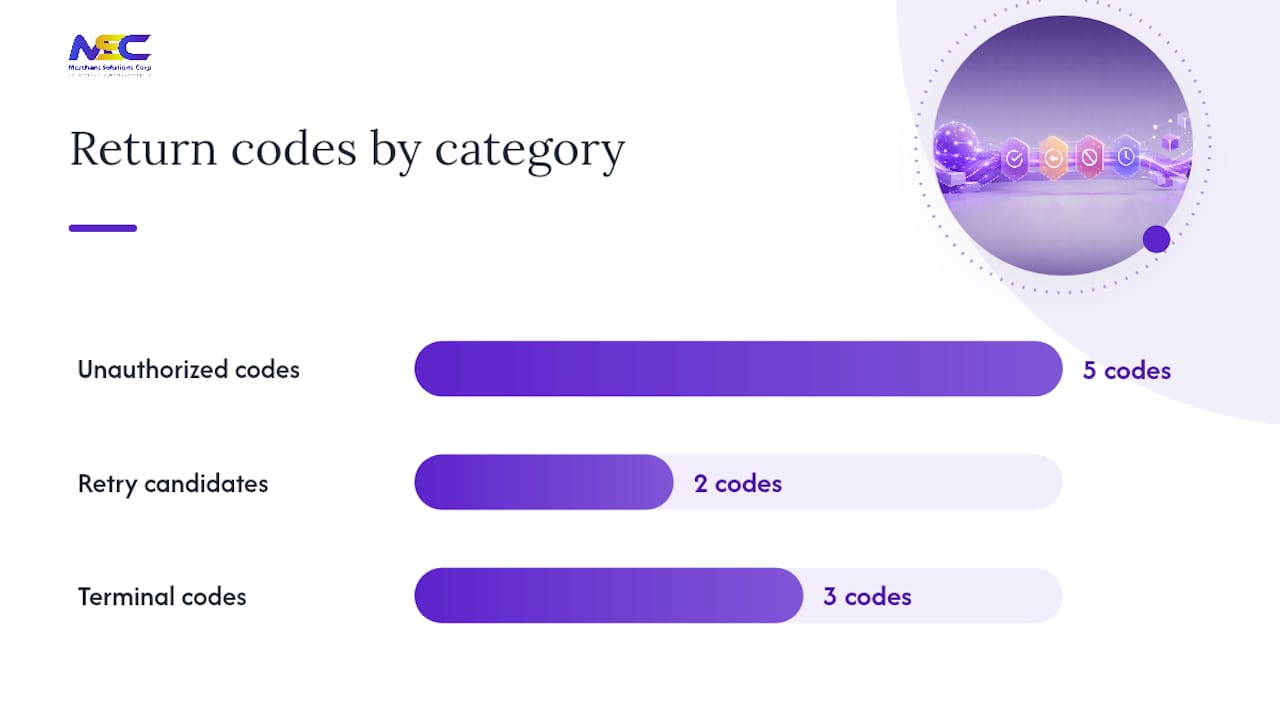
- Most ACH return codes can be classified into retriable ones like R01 and R09, which should be attempted again with proper timing, versus terminal ones such as R02, R03, and R04 requiring account correction.
- Unauthorized claims like R05, R07, R10, R11, and R29 demand immediate collection of authorization documentation and should not be retried without resolution.
- Administrative and consumer unauthorized returns must be addressed within two banking days, while consumer disputes can take up to 60 days to surface, impacting retry strategies.
- Proper prevention methods, including prenotes, bank account verification, and correct SEC code selection, significantly reduce return rates and related operational costs.
- Merchants should have transparent, upfront ACH processing fees and support tools that help both prevent returns and manage disputes efficiently.
Table of Contents
- What Is an ACH Return Code and How Does the Return Process Work?
- The Complete Reference: ACH Return Codes by Category
- The Codes That Actually Drive Your Operations
- How Long Do You Have to Watch for a Return?
- Handling a Return: A Step-by-Step Workflow for Payments Teams
- Preventing Returns Before They Happen
- The Regulatory Backdrop: NACHA Rules and Regulation E
- Why Return Rates Are a Business Problem, Not Just a Technical One
- Get ACH Processing Built to Handle Returns the Right Way
- Primary Sources and Further Reading
- Sources
- FAQ
What Is an ACH Return Code and How Does the Return Process Work?
Every ACH return code follows the same format: the letter “R” followed by two digits, and roughly 85 distinct codes exist to cover everything from a closed account to a fraud claim. Each one tells you why a payment bounced, but the code alone rarely tells the whole story behind it.
The return process runs through three players. The Originating Depository Financial Institution (ODFI) sends the payment on behalf of the merchant or business. The Receiving Depository Financial Institution (RDFI) holds the customer’s account and decides whether to accept or reject the debit or credit. The ACH operator, typically the Federal Reserve or The Clearing House, moves the file between them and passes the return code back down the chain to the originator.
Return codes fall into a handful of broad categories:
- Administrative returns cover account-level problems like closed accounts, invalid account numbers, or insufficient funds.
- Unauthorized returns flag customer disputes claiming they never approved the transaction.
- Extended returns cover corporate account disputes with longer investigation windows.
- IAT and non-standard returns apply to international ACH transactions and specialized formatting cases.
Where the code shows up in your system depends on your processor’s reporting tools, but most modern platforms surface it directly in the transaction record within a day or two of the return.
The Complete Reference: ACH Return Codes by Category
Scanning a return code report is faster when you already know which bucket a code falls into. The table below groups the most common codes so you can spot terminal issues versus ones worth a retry.
Beyond these, you’ll encounter narrower codes for things like frozen accounts (R16), non-transaction accounts (R20), and specific IAT formatting failures in the R80 series. Most merchants only ever deal with a dozen or so codes in daily operations. The full return code guide from NACHA covers all of them in detail, but the codes above account for the overwhelming majority of returns businesses see.
One pattern worth remembering: format and addenda errors in the R25 to R28 range are almost always preventable with file validation before submission, not something to fix after the fact.
The Codes That Actually Drive Your Operations
Ten codes account for most of the returns a merchant will ever handle. Here’s what each one means, what evidence to gather, and what to do next.
-
R01, Insufficient Funds. The customer’s account didn’t have enough money at settlement. A gym membership debit that hits three days before payday is a textbook example. Retry once, ideally aligned with the customer’s typical pay cycle, and flag the account if it repeats.
-
R02, Account Closed. The account no longer exists. This is terminal. Contact the customer for updated banking details before submitting anything new.
-
R03, No Account or Unable to Locate Account. The account number and name don’t match anything at the RDFI. Common with mistyped digits or a customer who switched banks. Terminal until you get corrected information directly from the customer.
-
R04, Invalid Account Number. The account number fails the bank’s own validation check, often a transposed digit. Terminal. Request a voided check or verified account details before resubmitting.
-
R05, Unauthorized Debit to Consumer Account. The customer claims they never gave authorization for a debit under a Standard Entry Class code requiring one, most often WEB. This is a formal unauthorized claim. Pull your signed authorization record and timestamped consent log immediately. Do not retry.
-
R07, Authorization Revoked by Customer. The customer previously authorized the debit but has since withdrawn permission, distinct from R05 because authorization did exist at some point. Document when and how they revoked it, then stop all further debits on that account.
-
R09, Uncollected Funds. Funds are technically in the account but not yet available, often due to a pending deposit. This is one of the few codes worth retrying quickly, usually within a few business days.
-
R10, Customer Advises Not Authorized. The customer disputes the transaction entirely, claiming no authorization ever existed. Treat this the same as R05: gather your Written Statement of Unauthorized Debit (WSUD) documentation and stop retries. This code carries real compliance weight if it happens repeatedly.
-
R11, Entry Not in Accordance with the Terms of the Authorization. This is the code most merchants misunderstand. NACHA re-purposed R11 to mean the customer authorized something, but the transaction didn’t match those terms, wrong amount, wrong date, or wrong frequency. In many cases you can correct the error and resubmit without collecting new authorization. But if the customer disputes the underlying authorization itself rather than a processing error, treat it like R10 and get fresh consent.
-
R29, Corporate Customer Advises Not Authorized. The business equivalent of R10, used for corporate accounts under SEC codes like CCD or CTX. Corporate disputes typically move faster and carry different documentation requirements than consumer claims.
Pro Tip: Keep a running log that separates R10 and R11 disputes by outcome. If R11 corrections keep failing and converting into R10 claims, that’s a signal your authorization language or payment terms need clarification, not just a system fix.
How Long Do You Have to Watch for a Return?
Return timing starts counting from the settlement date, not the day you originated the file, and that distinction matters more than most AP teams realize.
Most administrative returns, including R01 through R04, must come back within two banking days of settlement. Consumer unauthorized returns, R05, R07, R10, and R11, can surface up to 60 calendar days after settlement, giving customers a full two months to dispute a debit they say they never approved. Corporate unauthorized returns like R29 follow the shorter two-banking-day window, since businesses are expected to monitor accounts more closely than individual consumers.
- 2 banking days: most administrative codes (R01–R04), corporate unauthorized (R29)
- 60 calendar days: consumer unauthorized codes (R05, R07, R10, R11)
- Varies by SEC code: WEB, PPD, and TEL entries follow consumer rules; CCD and CTX follow corporate rules
A return that arrives outside its allowed window is a timeliness dispute in itself, and RDFIs that miss the deadline can lose the right to return the item through normal channels. That’s a rare event, but it’s worth knowing the window exists before you assume every return is automatically valid.
Handling a Return: A Step-by-Step Workflow for Payments Teams
A return notice isn’t the end of the transaction, it’s the start of a short investigation. Treat every return the same way, in the same order, every time.
- Classify the code immediately. Pull it against your reference table and sort it into retriable or terminal before doing anything else.
- Pull your documentation. For any unauthorized claim (R05, R07, R10, R11, R29), retrieve the signed authorization, timestamped consent record, and any communication log tied to that customer.
- Decide on retry eligibility. R01 and R09 are the main candidates for a retry, and both work best with a short delay timed to the customer’s pay cycle rather than an immediate resubmission.
- Contact the customer directly. For terminal codes like R02, R03, and R04, reaching out for updated account details resolves the issue faster than any automated retry sequence.
- Apply retry limits. Most processors cap retries at two or three attempts. Beyond that, request a new payment method instead of continuing to hit a failing account.
- Escalate unauthorized disputes to your ODFI when needed. If a customer’s unauthorized claim looks disputable, or if you have strong evidence the authorization was valid, prepare your documentation for representment through your originating bank.
- Log everything in your reconciliation system. Every return, its code, and its resolution should tie back to the original transaction record for audit purposes.
Pro Tip: Don’t wait for a pattern to become obvious before pulling authorization records. Grab them the moment a code like R10 or R11 comes in, evidence gets harder to reconstruct the longer you wait.
Escalation to your ODFI matters most when a dispute looks contestable. If you have a signed authorization, a clear timestamp, and a delivery record showing the customer received notice of the debit terms, that’s the foundation for a representment case. Without it, most disputes resolve in the customer’s favor by default.
Preventing Returns Before They Happen
Reducing your return rate starts before the first ACH file ever goes out.
Prenotes and micro-deposits verify that an account number and routing number are valid before you run a full transaction. Prenotes take a few days to clear and catch R03 and R04 type errors early. Micro-deposits work similarly for consumer accounts but add friction to onboarding, so many businesses reserve them for higher-dollar recurring payments rather than every transaction.
Bank account verification APIs check account ownership and status in near real time. They catch closed accounts and invalid numbers effectively, but they generally can’t predict whether a customer will later dispute authorization or run short on funds at settlement. Verification reduces R02, R03, and R04 exposure, not R05 or R10 exposure.
SEC code accuracy matters more than most merchants assume. Using the wrong Standard Entry Class code, consumer versus corporate, mismatched can trigger returns like R35 or R36 and even affect which dispute window applies. Get the SEC code right at setup, and file formatting discipline, especially addenda records, matters just as much for avoiding the R25 through R28 family of errors.
- Run prenotes on new recurring accounts before the first live debit.
- Validate SEC codes against the actual relationship (consumer vs. business).
- Set return-rate velocity alerts so a spike in any code family triggers a manual review, not a shrug.
Pro Tip: Pause any account that generates two consecutive unauthorized returns before attempting a third debit. That third attempt is often the one that pushes your unauthorized return rate over a compliance threshold.
The Regulatory Backdrop: NACHA Rules and Regulation E
NACHA’s Operating Rules govern every return code and every originator’s obligations around them, and two developments matter most for merchants managing disputes today.
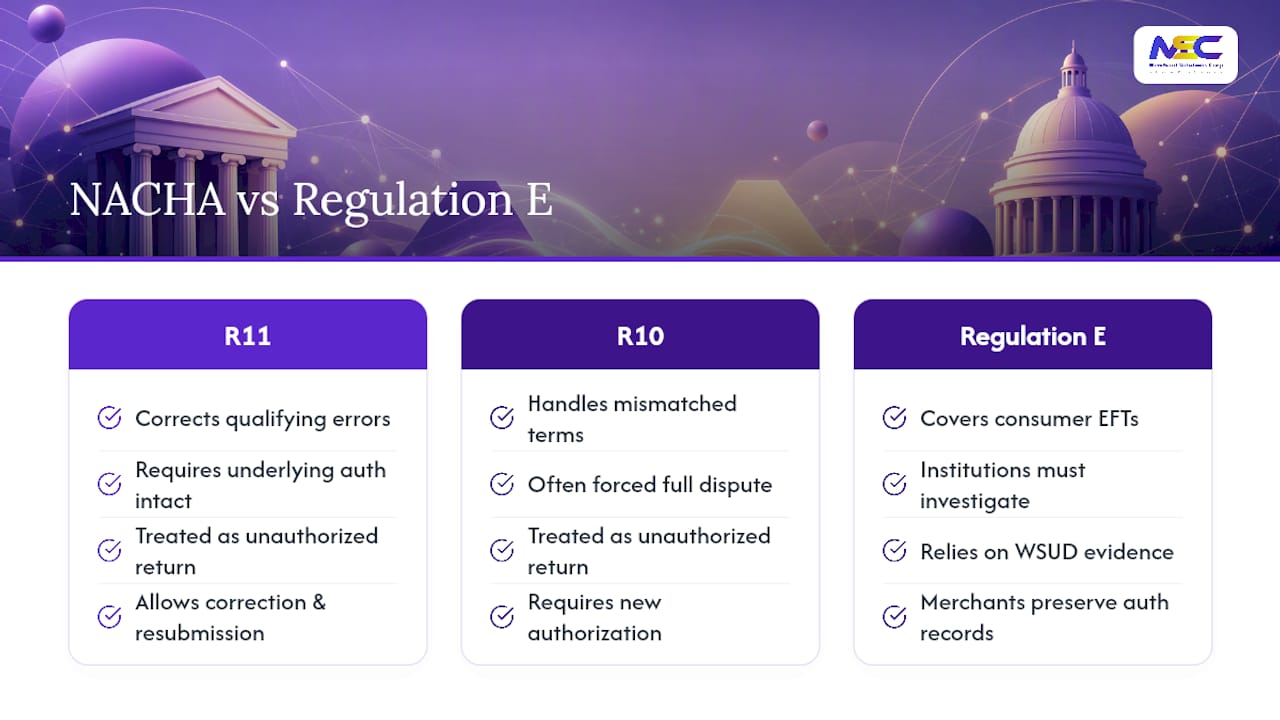
The R11 re-purposing, phased in starting April 1, 2020, changed how originators handle correctable errors. Before the change, any mismatch between a transaction and its authorization terms often forced a full R10 style dispute. Now, R11 lets originators correct qualifying errors and resubmit without collecting a brand-new authorization, provided the underlying authorization itself isn’t in question.
R11 shares many of the same requirements as R10 and is still treated as an unauthorized return under the NACHA Rules, even when correction and resubmission are permitted. The distinction between “wrong terms” and “no authorization at all” is the whole point of the rule.
For consumer transactions, Regulation E governs unauthorized electronic fund transfers and requires financial institutions to investigate consumer disputes, often relying on a Written Statement of Unauthorized Debit (WSUD) as supporting evidence. Merchants should treat their own authorization records as the first line of defense against a Regulation E claim, not an afterthought gathered after the fact. For full rule text and technical detail, NACHA’s own ISO 20022 mapping guides remain the authoritative reference.
Why Return Rates Are a Business Problem, Not Just a Technical One
Recurring ACH returns don’t just cost a transaction fee, they put your entire origination privileges at risk. Exceed NACHA’s thresholds for unauthorized returns, and you’re looking at penalties or a lost ability to originate ACH debits altogether.
That’s the piece most finance teams underestimate: a return code isn’t a one-off nuisance, it’s a data point your bank and processor are watching in aggregate. Payments partners that support both prevention and remediation, account verification on the front end, documentation support and representment guidance on the back end, turn returns from a recurring liability into a manageable operational line item. Some ACH and eCheck processing tools are built around exactly that kind of support, from onboarding through the day-to-day handling of returned items.
— Jonathan
Get ACH Processing Built to Handle Returns the Right Way
Chasing down authorization records and retry windows manually eats hours every month that most AP and treasury teams don’t have to spare. Merchantsolutionscorp’s ACH & eCheck processing is priced at $25 per month for the Gateway + eCheck plan, with return-related fees, including a $15 return fee, a $25 reject fee, a $15 Notification of Change fee, and a $25 unauthorized return fee, disclosed upfront rather than buried in fine print. That kind of transparency matters when a single unauthorized dispute can otherwise turn into a surprise cost.
Some providers support onboarding and verification work that prevents returns in the first place, plus documentation structures that help when a dispute occurs. If you’re tired of return codes eating into cash flow and staff time, explore ACH processing solutions and request pricing details to see how the setup fits your existing systems.
Primary Sources and Further Reading
- NACHA’s Return Reason Code Guide covers every official code definition and update.
- Plaid’s ACH return reference offers a practical breakdown of timeframes and common codes.
- NACHA’s ISO 20022 technical guides explain how return codes map into corporate reporting formats like pain.002 and camt.053.
This article is general information, not a substitute for advice from a qualified financial advisor. Consult a qualified financial professional about your own circumstances before acting on anything here.
FAQ
What Does an ACH Return Code Mean?
An ACH return code is a three-character code the receiving bank sends back to explain why it rejected a transaction, covering everything from insufficient funds to a customer dispute over authorization. There are roughly 85 distinct codes in active use.
How Long Does a Bank Have to Return an ACH Transaction?
Most administrative returns must come back within two banking days of settlement, while consumer unauthorized returns can surface up to 60 calendar days later. Corporate unauthorized returns follow the shorter two-day window.
Which ACH Return Codes Signal Fraud or an Unauthorized Transaction?
R05, R07, R10, R11, and R29 all indicate a customer or business disputing authorization for the debit. R05 and R10 are the most severe, since they claim no authorization ever existed at all.
Can I Retry a Payment After an ACH Return?
Only certain codes are worth retrying. R01 (insufficient funds) and R09 (uncollected funds) can often succeed on a second attempt timed to the customer’s pay cycle, but codes like R02, R03, R04, R10, and R29 are effectively terminal and need corrected account information or new authorization.
Does Merchant Solutions Corp Offer ACH Processing With Return Support?
Yes. Merchantsolutionscorp’s ACH and eCheck processing is available for $25 per month on the Gateway + eCheck plan, with disclosed return, reject, and unauthorized return fees rather than hidden charges.