Credit Card Interchange Fees: What Merchants Really Pay
Credit Card Interchange Fees: What Merchants Really Pay
Credit card interchange is the fee a merchant’s bank (the acquirer) pays the cardholder’s bank (the issuer) every time a customer swipes, taps, dips, or types in a card number. It exists to compensate the issuing bank for fraud risk, credit risk, and the cost of running the card program, and it lands on your monthly statement as the largest single piece of your processing cost.
Ranges vary by card type and how the transaction is entered, but U.S. merchants typically see credit interchange fall somewhere around 1.2% to 2.5% of the transaction, plus a small per-transaction fee. Debit is different: regulated debit interchange is capped for large banks, while debit from smaller, exempt issuers generally carries higher rates. Visa, Mastercard, and the Federal Reserve’s Regulation II all shape these numbers, and no single rate applies to every business.
Key Takeaways
Interchange is largely non-negotiable in rate, but merchants control the mix of transactions, data quality, and pricing structure that determine their effective cost.
| Point | Details |
|---|---|
| Know the split | Interchange goes to the issuer; assessments go to the network; markup goes to your processor. |
| Ranges, not fixed rates | Expect roughly 1.2%–2.5% for credit, with debit lower and capped for large issuers under Regulation II. |
| Classification drives cost | Correct MCC, entry method, and Level 2/3 data submission prevent costly downgrades. |
| Route big invoices off cards | ACH and eCheck often beat card interchange on large B2B payments. |
| Audit before you renegotiate | Merchant Solutions Corp offers statement audits and interchange-plus pricing to expose hidden markup. |
Table of Contents
- What Are Credit Card Interchange Fees, and Who Sets Them?
- How Interchange Fee Rates Are Calculated
- Typical Interchange Rate Ranges and Sample Calculations
- How Interchange Costs Squeeze Merchant Margins
- How to Reduce Interchange and Processing Costs
- Regulation and Recent Interchange Trends
- Reading Visa and Mastercard Interchange Tables
- How Merchant Solutions Corp Helps Lower Effective Interchange Costs
- Why Merchants Get Interchange Wrong
- Get a Clearer Picture of Your Processing Costs
- Sources
- FAQ
What Are Credit Card Interchange Fees, and Who Sets Them?
Three parties touch every card transaction: the issuer (the bank that gave your customer their card), the acquirer (your merchant bank or processor), and the card network (Visa, Mastercard, Discover, or American Express) that routes the transaction and publishes the rate tables. The network doesn’t keep the interchange fee. It sets the rate and lets the issuer collect it.
Understanding credit card fees starts with knowing where the money actually goes:
- The issuer receives the interchange fee itself, the largest slice of the total cost.
- The card network collects a separate, much smaller assessment fee for running the rails.
- The acquirer or processor adds its own markup on top, which is the part you can actually negotiate.
A simplified funds-flow for a $100 sale looks like this: the customer pays $100, the acquirer routes the transaction through the card network, the network passes the interchange portion to the issuing bank, and the issuer settles the rest back down the chain. What lands in your business bank account is $100 minus interchange, minus the network assessment, minus your processor’s markup. Investopedia notes that interchange is typically the largest component of your total processing bill, often dwarfing the processor’s own fee.
How Interchange Fee Rates Are Calculated
Every interchange rate follows the same basic formula: (transaction amount × a percentage) + a fixed cent amount. A $100 transaction at a hypothetical 1.95% plus $0.10 works out to $2.05 in interchange, according to a breakdown of the standard calculation formula. That formula stays constant. What changes, transaction to transaction, is which row of the rate table applies.
Several factors decide the applicable row:
- Card tier — a basic consumer credit card qualifies for a lower rate than a rewards or premium card.
- Entry method — card-present (chip, tap, swipe) generally qualifies for lower interchange than card-not-present (phone, online).
- Merchant category code (MCC) — your business classification affects eligibility for preferential rates.
- Transaction size — some rate tiers scale with the average ticket.
- Level 2/3 data submission — B2B transactions with extra line-item data often qualify for lower commercial-card rates.
- PIN versus signature debit — PIN debit routes differently and can carry different costs.
- Issuer size — banks under $10 billion in assets are exempt from the Durbin debit cap, so their debit cards can carry higher interchange.
Pro Tip: Get your MCC and entry method verified once a year with your processor. A misclassified business type or a card-not-present transaction incorrectly coded as card-present triggers a downgrade, and downgrades push you into a higher, more expensive interchange tier without any change in what you’re actually selling.
Typical Interchange Rate Ranges and Sample Calculations
Rates vary by channel and card type, and no legitimate source publishes one fixed number that applies across the board. Here’s how the ranges typically break down:
| Channel / Card Type | Typical Interchange Range |
|---|---|
| Card-present credit (standard) | a low to mid single-digit percentage plus a small per-transaction fee |
| Card-not-present credit (online/phone) | a higher range within the low to mid single-digit percentages plus a small per-transaction fee |
| Regulated debit (large issuers) | capped, flat plus small percentage |
| Exempt debit (smaller issuers) | generally higher than regulated debit |
| Premium/rewards credit | among the highest percentage ranges |
The Kansas City Fed’s interchange update shows these ranges shift by merchant category and card program, so treat any number here as directional, not a quote for your business.
Three quick examples show how this plays out in practice:
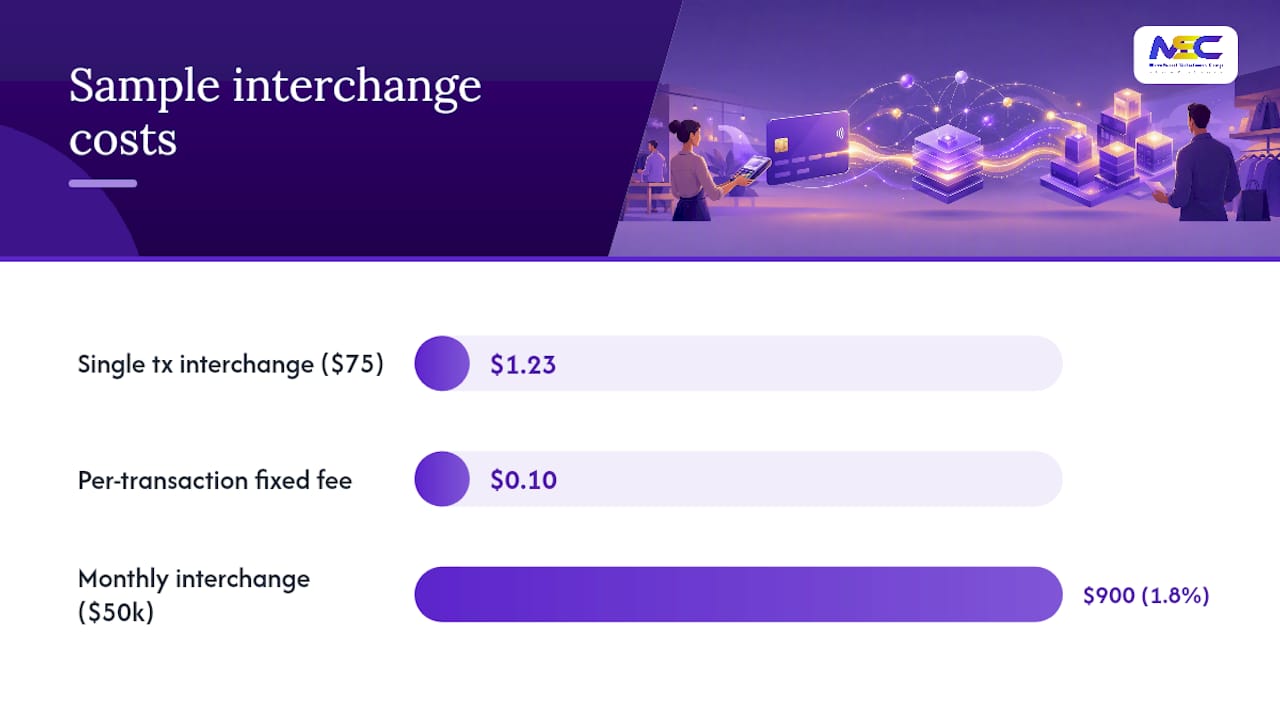
- Single transaction: A $75 card-present purchase at roughly 1.5% plus $0.10 costs about $1.23 in interchange.
- Monthly rollup: A retailer processing $50,000 a month with a blended rate near 1.8% pays roughly $900 in interchange before assessments or processor markup.
- Net effect: After adding network assessments (a fraction of a percent) and the processor’s own margin, total processing costs typically land noticeably above the interchange figure alone. That gap is exactly what interchange-plus pricing is designed to make visible.
How Interchange Costs Squeeze Merchant Margins
Interchange isn’t a background number. It shows up directly in your bottom line and shapes real decisions.
- Gross margin takes the first hit. Every percentage point of interchange comes straight off your revenue before you even count rent, payroll, or inventory.
- Pricing gets adjusted upward. Many businesses build interchange into retail prices rather than absorb it, which affects competitiveness.
- Minimum-ticket policies appear. A $5 minimum on card purchases exists because the fixed cent component makes small transactions disproportionately expensive.
- Channel steering becomes a strategy. Businesses often nudge customers toward debit, ACH, or in-person payment to avoid the higher card-not-present rates.
A high-margin service business absorbs interchange more easily than a low-margin retailer or convenience store running on thin unit economics. And refunds add insult to injury: when you issue a return, you typically don’t get the original interchange fee back, so a refunded sale can cost you twice.
How to Reduce Interchange and Processing Costs
You can’t eliminate interchange, but you can meaningfully lower your effective rate. Work through these in order:
- Accept cards in person whenever possible. EMV chip and contactless (NFC) transactions consistently qualify for better rates than manually keyed or online entries.
- Submit Level 2/3 data on B2B transactions. Adding purchase order numbers, tax amounts, and line-item detail on commercial card transactions unlocks lower commercial rates.
- Use tokenization and network tokens. Replacing raw card numbers with tokens reduces fraud exposure and can help transactions qualify for better rates over time.
- Move to interchange-plus pricing and audit your statement. Flat-rate and tiered pricing often bury markup inside the rate; interchange-plus separates the two so you can see exactly what your processor charges above cost.
- Route large invoices to ACH or eCheck. A $10,000 B2B invoice paid by card carries meaningful interchange; the same invoice paid by ACH often costs a small flat fee instead.
- Consider dual pricing or cash discount programs where allowed. These programs offset card acceptance costs by adjusting price at the point of sale, and they’re legal in most states with proper disclosure.
Before your next contract renewal, ask your processor these questions: What is your actual interchange-plus markup, in basis points? Can you show line-item interchange versus markup on my statement? What’s causing my downgrades, if any? Am I on the correct MCC?
Pro Tip: Batch your transactions daily. Settling batches late is one of the most common, entirely avoidable reasons merchants get bumped into a higher interchange tier. The U.S. Chamber of Commerce’s guide to reducing processing fees covers similar ground on negotiating with processors.
Regulation and Recent Interchange Trends
The Durbin Amendment, enacted through Regulation II, caps debit interchange for issuers holding more than $10 billion in assets. It has no equivalent cap on credit interchange, which is why credit rates float freely while debit from large banks stays regulated.
Watch these developments:
- Network rate table updates from Visa and Mastercard happen on a regular cycle, typically twice a year.
- Ongoing settlements between networks and merchant groups continue to reshape surcharging and dual-pricing rules state by state.
- Tokenization adoption is accelerating, partly because it reduces fraud costs that interchange is designed to offset.
Reading Visa and Mastercard Interchange Tables
Both major networks publish their own interchange rate tables online, updated periodically. When you pull one up, check these fields before assuming a rate applies to you:
- Your merchant category code (MCC)
- Entry method (card-present versus card-not-present)
- Card product tier
- Qualifying criteria, like Level 2/3 data or PIN entry
Match each line item on your monthly statement against the published table for your card mix. Any mismatch is worth a call to your processor.
How Merchant Solutions Corp Helps Lower Effective Interchange Costs
Merchant Solutions Corp works directly with merchants to bring effective processing costs down, not just quote a headline rate. Services include interchange-plus pricing structures that separate true cost from markup, full statement audits to catch downgrades and hidden fees, and dual-pricing or cash-discount programs built to offset card costs entirely.
For businesses handling B2B or high-ticket invoices, Merchant Solutions Corp supports ACH and eCheck processing and Level 2/3 data submission to qualify commercial transactions for lower rates. On the hardware side, EMV and contactless-ready POS configuration helps ensure more of your volume lands in the lowest available interchange tier instead of drifting into card-not-present pricing by default.

Businesses that move from tiered or flat-rate pricing to interchange-plus, combined with correct MCC classification and Level 2/3 setup, typically see a measurable reduction in effective processing cost. Onboarding is built to move fast, with support carrying through from setup to daily operations.
Why Merchants Get Interchange Wrong
Most merchants treat interchange as a fixed cost of doing business, something to shrug off because “that’s just what cards cost.” That assumption costs money. The rate tables published by Visa and Mastercard have dozens of tiers, and where a given transaction lands depends heavily on decisions the merchant controls: how the card is entered, whether Level 2/3 data gets submitted, whether the MCC is accurate.
The conventional advice, “shop around for a lower processing rate,” misses the bigger lever. Processor markup is often a smaller piece of the bill than interchange itself, so negotiating a percentage point off your processor’s fee matters less than fixing a downgrade pattern that’s been quietly inflating your interchange tier for a year. Statement audits find this constantly.
If you take one thing from this guide, make it this: request interchange-plus pricing and an itemized statement before you do anything else. You can’t optimize what you can’t see, and tiered or flat-rate pricing exists specifically to keep that visibility away from you.
Get a Clearer Picture of Your Processing Costs
Shopping for a slightly lower flat rate rarely moves the needle the way fixing your interchange tier does. Merchant Solutions Corp starts with an actual statement audit, not a generic quote, so you see exactly what’s interchange, what’s assessment, and what’s markup on your current setup.
From there, Merchant Solutions Corp builds out interchange-plus pricing, dual-pricing programs to offset fees, and POS configurations tuned for EMV and contactless acceptance so more of your volume qualifies for the lowest available rate. Businesses steering large invoices off cards entirely can also move to ACH and eCheck processing, a route payment partners in adjacent industries have used to stabilize recurring revenue and cut card costs at the same time.
Start with a payment processing pricing review to see what your current statement is actually costing you.
Sources
- Mastercard interchange rates and fees
- Credit and Debit Card Interchange Fees Assessed to Merchants in the United States — August 2025 update
- Average interchange fee and Regulation II information — Federal Reserve
Cross-check any rate your processor quotes against these tables before signing a new agreement.
FAQ
What Are Typical Visa and Mastercard Interchange Rates?
Rates vary by card type, entry method, and merchant category, but U.S. credit interchange typically falls around 1.2% to 2.5% of the transaction plus a small per-transaction fee. Both networks publish official rate tables that update periodically.
Why Are Credit Card Interchange Fees So High?
Interchange compensates issuing banks for fraud risk, credit risk, and the cost of running rewards programs and credit lines, and there’s no federal cap on credit interchange the way there is for debit. Card tier, entry method, and transaction data quality all push the rate up or down.
What Are the Current Credit Card Interchange Rates in the USA?
Current U.S. Regulated debit from large issuers is capped under Regulation II, while debit from smaller, exempt issuers runs higher.
Which Card Type Has the Highest Interchange Rate?
Premium rewards credit cards typically carry the highest interchange rates because issuers price in the cost of cash-back, travel points, and other perks. Card-not-present transactions on any premium card sit at the top of most rate tables.
Can Merchant Solutions Corp Help Lower My Effective Interchange Cost?
Yes. Merchant Solutions Corp offers statement audits, interchange-plus pricing, dual-pricing programs, and Level 2/3 data support designed to reduce downgrades and expose hidden processor markup.