Credit card processing for attorneys: boost revenue & get paid faster
Credit card processing for attorneys: boost revenue & get paid faster

Law firms that accept credit cards collect 33% more revenue and get paid four times faster than those relying on checks and wire transfers alone. Yet many attorneys still hesitate, fixating on processing fees of 1.5% to 3.5% while quietly absorbing uncollected work losses of 11% to 14%. That math simply does not add up in favor of avoiding card payments. This guide walks you through the real benefits of credit card processing for law firms, the compliance rules you must follow, how to compare processors, and a practical implementation plan. By the end, you will have everything you need to make a confident, informed decision for your practice.
Table of Contents
- Why attorneys should accept credit card payments
- Understanding compliance: IOLTA, surcharges, and ethical pitfalls
- Comparing payment processors for law firms
- Step-by-step guide to implementing credit card processing in your firm
- What most law firms get wrong about credit card processing
- Find the right credit card processing partner for your firm
- Frequently asked questions
Key Takeaways
| Point | Details |
|---|---|
| Boosted revenue | Accepting credit cards increases collected revenue and reduces unpaid invoices for law firms. |
| Faster payments | Firms get paid up to four times faster when offering credit card options. |
| Compliance essentials | Proper handling of IOLTA funds and fee allocation is critical to avoid ethical pitfalls. |
| Tailored solutions matter | Choose processors with features specifically built for law firm requirements. |
| Implementation steps | Systematic rollout and staff training maximize the value of credit card adoption. |
Why attorneys should accept credit card payments
The legal industry has been slower than most to adopt card payments, and the hesitation is understandable. Attorneys are trained to scrutinize costs. When a processing fee appears on every transaction, it feels like a direct hit to the bottom line. But that framing misses the bigger picture entirely.
Consider what happens when clients cannot pay by card. They delay. They forget. They dispute invoices. Some simply never pay. Firms collecting by card report collection rates of 91% compared to the 86% industry average, and they get paid in roughly 15 days versus 60 or more. That difference in cash flow is not trivial. It affects payroll, overhead, and your ability to take on new cases without financial strain.
What clients actually expect in 2026
Client expectations have shifted. People pay their rent, their medical bills, and their taxes by card. When they hire an attorney, they expect the same convenience. Offering card payments signals professionalism and reduces friction at a moment when clients are already stressed. Removing that friction is good for your relationship with them and good for your collections.
Here are the core benefits attorneys consistently report after adopting card payments:
- Faster collections: Payments clear in 1 to 2 business days instead of weeks
- Higher revenue collected: Fewer unpaid invoices mean more of your earned fees actually land in your account
- Reduced administrative burden: Less time chasing payments means more time on billable work
- Improved client satisfaction: Flexible payment options reduce client stress and improve the overall experience
- Better cash flow: Predictable income supports smarter firm budgeting and growth planning
“The 1.5% to 3.5% processing fee feels significant until you compare it to the 11% to 14% of work that goes uncollected without card payment options. The math clearly favors acceptance.”
Pro Tip: If your firm handles contingency cases or high-volume billing cycles, the cash flow improvement from card acceptance can be significant enough to reduce your reliance on a line of credit entirely.
The shift to payment processing solutions designed for professional services also means you are not stuck with generic retail tools. Modern processors offer features built specifically for law firms, including trust account separation, invoice-linked payment links, and detailed transaction records that support your billing documentation.
The bottom line is straightforward. Accepting credit cards is not a cost center. It is a revenue protection strategy. Firms that recognize this early gain a real competitive edge in client acquisition and retention.
Understanding compliance: IOLTA, surcharges, and ethical pitfalls
Understanding the benefits is only half the equation. The other half is knowing the rules, and for attorneys, those rules carry serious professional consequences if ignored.
The most critical compliance area involves IOLTA accounts. IOLTA stands for Interest on Lawyers Trust Accounts, and these accounts hold client funds that have not yet been earned. When a client pays a retainer by credit card, that money must go into the IOLTA account intact. Processing fees cannot be deducted from trust funds. The fee must be absorbed by the firm’s operating account, not the client’s retainer balance. Mishandling this is not a bookkeeping error. It is an ethics violation.
Key compliance rules every law firm must follow
- IOLTA integrity: Never allow processing fees to reduce funds held in trust. Your processor must support split-fee handling between operating and trust accounts
- Surcharging restrictions: Passing processing fees to clients is prohibited or heavily restricted in states like California and New York. Check your state bar rules before implementing any surcharge program
- Chargeback protection: Detailed billing records, signed engagement letters, and itemized invoices are your best defense if a client disputes a charge
- High-value retainer handling: Retainers above $2,500 require extra documentation and secure transaction handling to reduce fraud exposure
- PCI DSS compliance: Your processor must meet Payment Card Industry Data Security Standard requirements to protect cardholder data
“Compliance is not optional, and the consequences of getting it wrong extend beyond fines. A single ethics complaint tied to trust account mismanagement can affect your license.”
Pro Tip: Ask any processor you consider whether they offer IOLTA-specific account separation as a built-in feature, not an add-on. If they cannot clearly explain how they handle trust fund transactions, that is a red flag.
Working with professional services payment systems that understand the legal industry means you are not piecing together a compliance framework on your own. The right partner has already solved these problems for firms like yours. They know the rules, they build them into the platform, and they provide documentation trails that protect you during audits or bar inquiries.
Compliance does not have to be intimidating. With the right processor and clear internal protocols, it becomes a routine part of your billing workflow rather than a source of anxiety.
Comparing payment processors for law firms
With compliance requirements clear, the next step is evaluating which processors are actually equipped to serve law firms well. Not all payment processors are built the same, and the differences matter significantly in a legal context.
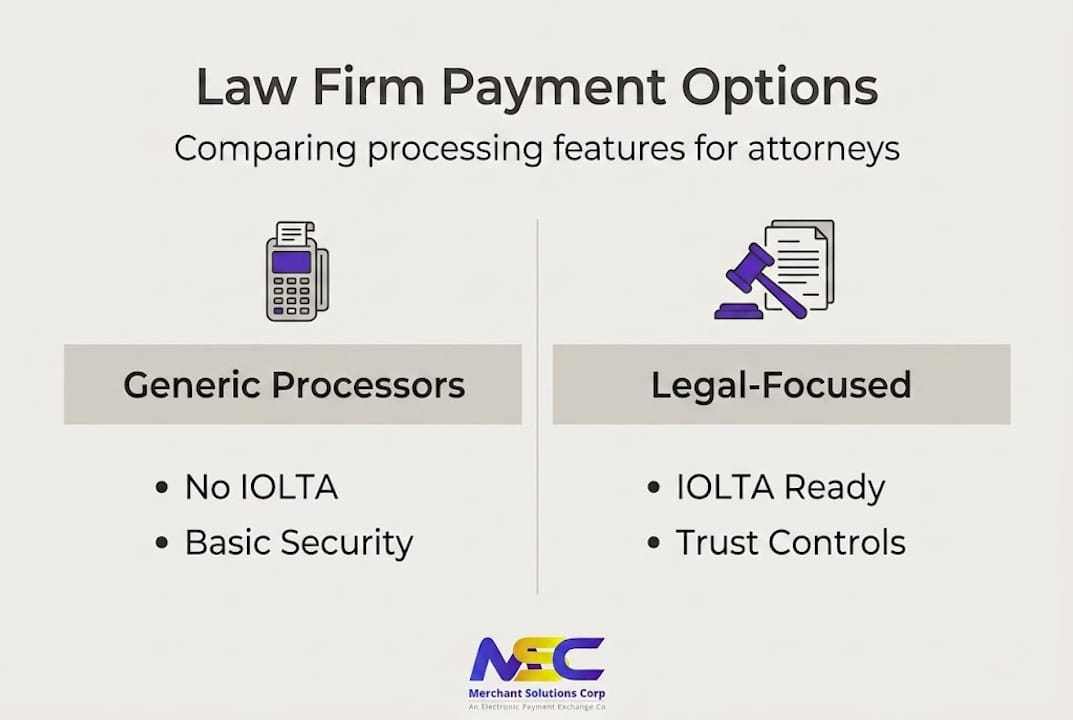
The most important factor is IOLTA compliance readiness. A processor must be able to route funds correctly between trust and operating accounts without manual intervention. Firms must ensure processors can handle IOLTA compliance and support high-value transactions without flagging them as suspicious or placing unnecessary holds.
What to look for in a legal payment processor
- IOLTA account separation: Automatic routing of trust funds away from operating fees
- Surcharge controls: Ability to configure or disable surcharging based on your state’s rules
- Billing system integration: Compatibility with tools like Clio, MyCase, or QuickBooks Legal
- Chargeback support: Dispute resolution assistance and detailed transaction records
- Transparent pricing: No hidden fees, clear interchange-plus or flat-rate structures
- Dedicated support: Access to a real person who understands legal industry requirements
Processor comparison for law firms
| Feature | Generic processors | Legal-focused processors | Merchant Solutions Corp |
|---|---|---|---|
| IOLTA account separation | Rarely included | Standard feature | Built-in support |
| Surcharge configuration | Limited | State-aware controls | Configurable by state |
| High-value transaction support | Often flagged | Handled routinely | Supported with documentation |
| Billing software integration | Basic | Broad compatibility | Flexible integrations |
| Legal industry expertise | None | Moderate | Dedicated team |
| Pricing transparency | Variable | Clear | Transparent flat and interchange |
A Clover POS for attorneys offers a practical hardware and software combination that handles in-person retainer payments, recurring billing, and detailed reporting in one place. For firms that also manage physical office payments, this kind of integrated setup eliminates the need for separate systems.
Avoid processors designed primarily for retail payment processing unless they have a clearly documented legal services track record. Retail-focused tools often lack the trust account logic and compliance documentation that attorneys require. The wrong processor can create more compliance risk than it solves.
Step-by-step guide to implementing credit card processing in your firm
Once you have chosen the right processor, implementation is more straightforward than most attorneys expect. The key is following a structured approach that covers both the technical setup and the staff and client communication sides.

Getting paid faster and more efficiently means following both business and regulatory best practices from the start. Cutting corners during setup creates compliance gaps that are harder to fix later.
Implementation steps for law firms
- Assess your firm’s needs: Identify your payment volume, average transaction size, billing software, and state-specific surcharge rules before contacting any processor
- Vet processors for legal compliance: Confirm IOLTA separation capability, PCI DSS certification, and experience with professional services firms
- Set up account routing: Configure your processor to direct earned fees to your operating account and unearned retainers to your IOLTA account automatically
- Integrate with billing tools: Connect your payment system to your practice management software to automate invoice matching and reduce manual entry
- Train your staff: Cover transaction procedures, how to handle client questions about fees, and what to do if a chargeback occurs
- Communicate with clients: Update your engagement letters, fee agreements, and website to reflect card payment availability and any applicable policies
- Monitor and review: Track collection rates, payment timelines, and processing costs monthly to confirm the system is working as intended
Pro Tip: Send a short email to existing clients announcing that you now accept credit cards. Framing it as a convenience upgrade rather than a policy change keeps the tone positive and often prompts clients with outstanding balances to pay immediately.
Implementation timeline reference
| Phase | Task | Typical timeframe |
|---|---|---|
| Planning | Needs assessment and processor research | 1 to 2 weeks |
| Setup | Account configuration and software integration | 3 to 5 business days |
| Training | Staff onboarding and procedure review | 1 week |
| Launch | Client communication and first transactions | Ongoing |
| Review | Performance monitoring and adjustment | Monthly |
Exploring industry payment solution savings specific to professional services can also reveal cost-reduction opportunities you may not have considered, including dual pricing programs that offset fees without violating state bar rules.
What most law firms get wrong about credit card processing
Here is an uncomfortable truth. Most law firms that resist credit card payments are not making a financial decision. They are making an emotional one. The processing fee is visible. The uncollected invoice is not. It sits in a spreadsheet labeled “accounts receivable” until someone quietly writes it off months later.
That invisible loss is where firms actually bleed money. A 2.5% processing fee on a $5,000 retainer costs you $125. An uncollected $5,000 invoice costs you $5,000. The math is not complicated, but the psychology is.
There is also a misconception that compliance makes card acceptance too risky. In reality, the risk of non-compliance comes from not having the right systems, not from accepting cards in the first place. With a processor that understands IOLTA rules and a clear internal protocol, compliance becomes routine. The firms that struggle are the ones who bolt a generic retail processor onto a legal billing workflow and hope for the best.
Another overlooked reality is that payment flexibility affects client acquisition. Prospective clients compare firms. If your competitor accepts cards and you do not, that friction matters, especially for individuals who are already managing financial stress during a legal matter.
The real edge in payment strategy is not squeezing out every basis point of cost. It is building a system that collects more of what you earn, faster, with less administrative effort. Reviewing your professional services payment myths and assumptions is the first step toward a payment strategy that actually serves your firm’s growth.
We encourage you to look at your last 12 months of accounts receivable and ask honestly: how much did payment friction cost you? The answer will likely reframe the conversation entirely.
Find the right credit card processing partner for your firm
You have done the hard work of understanding the benefits, the compliance requirements, and the implementation steps. Now it comes down to choosing a partner who can execute alongside you.

Merchant Solutions Corp works with law firms and professional services businesses across the country to build payment systems that are compliant, efficient, and built for growth. From IOLTA-aware account routing to transparent pricing and dedicated onboarding support, we handle the complexity so you can focus on practicing law. Whether you are ready to start with payment processing or want to review processing pricing details before committing, we make it easy to move forward with confidence. Visit Merchant Solutions Corp to learn more and get started today.
Frequently asked questions
Can attorneys pass credit card processing fees to clients?
In many states, attorneys cannot pass processing fees directly to clients, particularly when payments are going into IOLTA trust accounts. Passing fees to clients is restricted in states like California and New York, so always verify your state bar’s specific rules before implementing a surcharge.
What should law firms look for in a credit card processor?
Prioritize processors with built-in IOLTA compliance, transparent pricing structures, support for high-value transactions, and seamless integration with your billing software. Firms must ensure processors can handle trust account rules and provide documentation support for chargebacks.
How much do credit card processing fees cost for law firms?
Fees typically range from 1.5% to 3.5% per transaction depending on the card type and processor. These costs are generally outweighed by the benefit of faster collections, since uncollected work can represent 11% to 14% of total billable revenue.
Are there compliance risks with using credit card payments in law firms?
Yes, but they are manageable with the right setup. The most common pitfalls involve fees charged to IOLTA accounts and failing to account for state-specific restrictions on passing fees to clients. A processor with legal industry experience significantly reduces these risks.