
Gaming Payment Processing: A 2026 Guide to Secure, High-Volume Growth
Did you know that global losses from payment fraud in the gaming sector are projected to surpass $12 billion by 2025? For developers and platform owners, this statistic isn't just a number; it represents the constant battle against friendly fraud and the threat of bank fines that can cripple a growing business. Finding reliable gaming payment processing is often the difference between a successful global launch and a frozen merchant account. You've worked hard to build an engaging experience, and you shouldn't have to worry that your processor will pull the plug right when your traffic peaks.
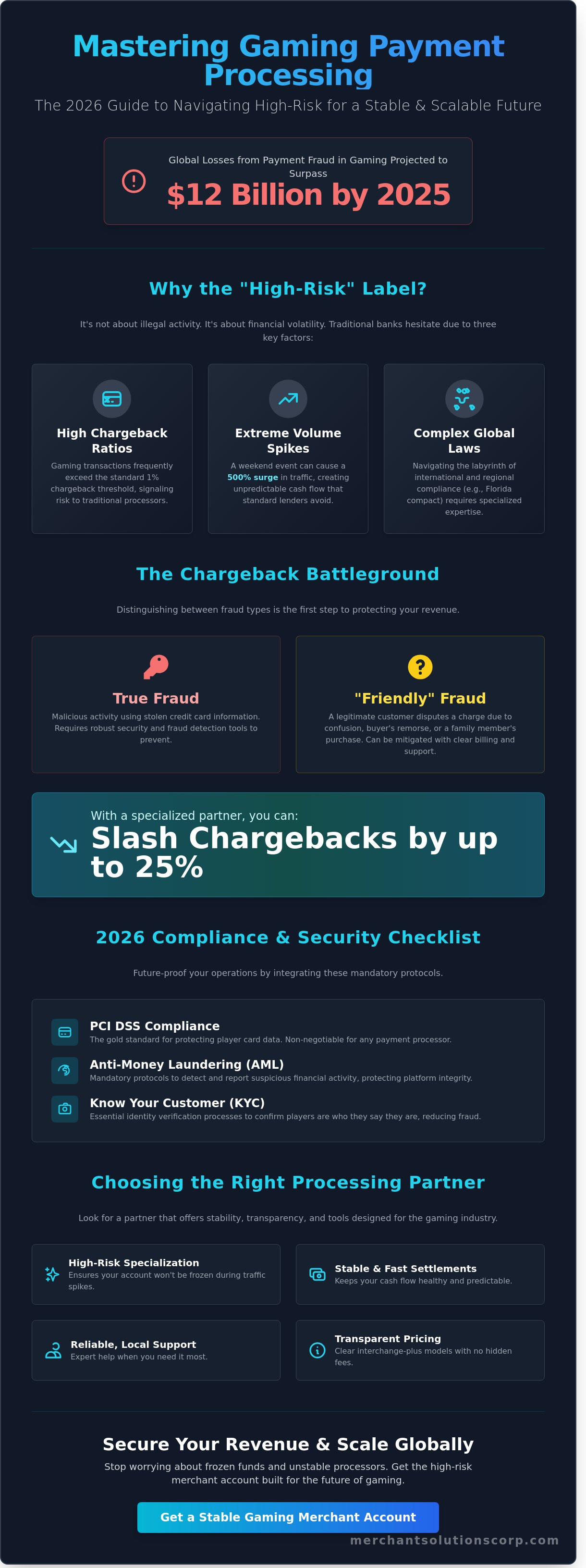
We agree that the high-risk label feels like an unfair barrier to entry when you're simply trying to scale your operations. This 2026 guide promises to help you master these complexities, from slashing chargeback rates by up to 25% to securing stable settlement times that keep your cash flow healthy. We'll preview the essential steps for selecting a partner that won't freeze your funds, alongside strategies for seamless gateway integration and maximizing authorization rates for every player transaction.
Key Takeaways
- Learn why the gaming sector is flagged as high-risk and how specialized merchant services can stabilize your high-velocity cash flow.
- Discover technical strategies to optimize microtransactions and minimize the impact of flat-rate fees on your real-time revenue.
- Protect your bottom line by distinguishing between "true fraud" and "friendly fraud" to lower your chargeback ratios significantly.
- Master the art of selecting a secure gaming payment processing partner that offers transparent interchange-plus pricing and reliable local support.
- Future-proof your operations with cutting-edge 2026 compliance tools designed to prevent frozen funds and ensure long-term stability.
What Is Gaming Payment Processing and Why Is It Labeled High-Risk?
Gaming payment processing refers to the specialized financial infrastructure designed to handle the high-velocity, high-volume transactions common in the digital entertainment sector. Unlike standard retail, these systems must process microtransactions, subscription renewals, and in-game purchases instantly without disrupting the player experience. Developers often leverage diverse video game monetization models to scale their revenue, which requires a robust backend capable of managing rapid-fire data packets across global borders.
Traditional banks often hesitate to support these businesses because of three primary factors: chargeback ratios that frequently spike above the standard 1% threshold, massive fluctuations in daily transaction volume, and the labyrinth of global jurisdictional laws. While a local boutique might see consistent, predictable sales, a gaming platform can experience a 500% surge in traffic during a single weekend event. This volatility makes standard lenders nervous, leading them to classify the industry as high-risk.
To better understand the challenges and shifts in this space, watch this helpful video:
The underwriting process for gaming merchants differs significantly from low-risk retail. While a standard merchant account focuses on credit scores and basic business history, high-risk underwriting involves a deep dive into fraud mitigation protocols and liquidity reserves. Specialized processors look for evidence that a merchant can optimize their checkout flow while maintaining enough capital to withstand a sudden wave of refund requests.
The High-Risk Label: Myths vs. Reality
Labeling an industry as high-risk doesn't imply illegal activity; instead, it reflects financial volatility and the potential for merchant insolvency. A high-risk merchant account acts as a fundamental tool for operational stability rather than a penalty for your business type. These accounts provide a vital buffer against sudden account freezes that often plague gaming startups using aggregate processors. By securing a dedicated high-risk account, operators ensure their cash flow remains uninterrupted even during peak traffic periods or localized regulatory shifts.
Regulatory Compliance in 2026
As we enter 2026, compliance requirements have become more stringent across North America and the Caribbean. PCI DSS compliance remains the gold standard for protecting player data, but modern operators must also account for regional shifts. For example, local operators must adhere to Florida-specific laws following the 2021 gaming compact updates, which reshaped how digital wagers are processed within state lines. Additionally, robust Anti-Money Laundering (AML) and Know Your Customer (KYC) protocols are mandatory to verify player identities. Integrating these checks into your gaming payment processing workflow is essential for maintaining your license and protecting your bottom line from fraud.
Technical Essentials: Gateways, Microtransactions, and Global Reach
High-performance gaming requires more than just low latency; it demands a payment infrastructure that keeps pace with real-time action. Modern gaming payment processing must handle thousands of concurrent transactions without a single millisecond of lag. When a player buys a "skin" or a "battle pass," the transaction must be invisible and instantaneous. Any friction during this process leads to abandoned carts and lost revenue. In 2024, specialized APIs allow developers to bridge the gap between game engines like Unity or Unreal and the financial network, ensuring that the player experience remains uninterrupted.
Optimizing the Gaming Payment Gateway
A reliable payments gateway serves as the vital link between your game's store and the banking system. Security is paramount here. We use tokenization to replace sensitive card data with unique digital identifiers. This allows for "one-click" purchases where players don't have to re-enter details, which can increase conversion rates by 25% for mobile titles. To prevent downtime during massive game launches, we implement load balancing across multiple merchant accounts. This redundancy ensures that if one processor faces a surge, traffic shifts automatically to maintain 100% uptime.
Handling Microtransactions and Small Tickets
Microtransactions are the lifeblood of the industry. Juniper Research predicts that total spending on in-game purchases will reach $76 billion by 2025. However, flat-rate fees can devastate profit margins on small tickets. If a player buys a $0.99 item, a standard $0.30 transaction fee consumes nearly a third of the revenue. Smart gaming payment processing strategies involve transaction batching or specialized micro-payment pricing. By aggregating several small purchases into a single settlement, developers protect their bottom line while keeping entry costs low for players.
Alternative Payment Methods (APMs)
Global eSports and mobile platforms require a localized approach to payments. Digital wallets like Apple Pay and Google Pay now account for over 50% of global e-commerce spend, making them essential for mobile gaming. In the Caribbean and North American markets, players often look for familiar local options. For high-stakes gaming or large-scale tournament payouts, ACH and eCheck processing is becoming a preferred method. It offers lower overhead than credit cards and provides a secure way to move larger sums of money without the risk of traditional chargebacks.
Success in the gaming space requires a technical setup that scales as fast as your player base. It's often helpful to review specialized pricing models that align with your specific volume and average ticket size to ensure long-term profitability.
The Chargeback Challenge: Protecting Your Gaming Revenue
Gaming operators face a unique financial hurdle that most retail businesses never encounter. Current industry data shows that gaming sees a 1.8% chargeback rate. This figure is nearly double the standard e-commerce average. High transaction volumes and the digital nature of the assets make gaming payment processing a frequent target for disputes. To scale safely in 2026, you must understand the mechanics of these losses and how to stop them before they drain your bottom line.
Distinguishing between "true fraud" and "friendly fraud" is the first step in a professional defense strategy. True fraud involves the use of stolen credit cards or hacked accounts to make unauthorized purchases. Friendly fraud is more nuanced and often more damaging. It occurs when a legitimate player makes a purchase, such as a loot box or a character skin, and later regrets the spending. Instead of seeking a refund through your support team, they contact their bank to claim the charge was unauthorized. This buyer's remorse accounts for a significant portion of the disputes in the gaming sector.
The financial impact of these disputes extends far beyond the lost sale. Every chargeback triggers a fee from the acquiring bank, often ranging from $20 to $100 per instance. You also lose the digital inventory and the marketing spend used to acquire that player. If your chargeback ratio stays above 1% for an extended period, you risk merchant account jeopardy. Banks may place your business in a high-risk monitoring program or terminate your ability to process payments entirely, effectively halting your revenue stream.
Advanced Fraud Prevention Tools
Proactive protection starts with 3D Secure 2.0. This protocol provides a frictionless authentication experience while shifting the liability for fraudulent transactions back to the issuing bank. It uses data-rich exchanges to verify the player's identity without slowing down the checkout flow. Implementing behavioral analytics adds another layer of security by flagging suspicious spending patterns. If a player who typically spends $10 a month suddenly attempts five $100 transactions in an hour, the system can trigger an immediate manual review. Point-to-point encryption (P2PE) ensures that sensitive payment data is converted into unbreakable code at the moment of entry, making it impossible for hackers to steal usable information at the source. Using a secure payments gateway allows you to integrate these tools into a single, cohesive defense.
Dispute Resolution and Mitigation
Effective gaming payment processing requires a robust reactive strategy for when disputes inevitably occur. Clear billing descriptors are your best defense against "unrecognized charge" claims. Ensure your game's name or recognizable brand appears on the player's bank statement, rather than an obscure corporate holding name. You should also utilize automated chargeback alerts. These services notify you the moment a dispute is initiated, giving you a window to issue a refund and avoid a formal chargeback strike against your record.
When you choose to fight a dispute, evidence is everything. Use detailed player logs, IP tracking data, and device fingerprints to prove the player accessed the digital goods. If you can show the bank that the user logged into the game and utilized the purchased item from their verified home IP address, your chances of winning the representment case increase significantly. This data-driven approach protects your reputation and keeps your processing accounts in good standing.
Choosing the Right Gaming Payment Processor for Your Business
Selecting a partner for gaming payment processing isn't just about finding the lowest rate. It's about long-term stability. In high-risk sectors, flat-rate pricing models often hide "hidden surcharges" that erode your margins. Interchange-plus pricing offers the transparency you need. It shows the exact cost from card brands plus a fixed markup. This clarity is vital when you're managing high-volume transactions across different jurisdictions. You need to know exactly where every cent goes to maintain a healthy bottom line.
Support matters when your revenue is on the line. A Florida-based partner provides localized expertise that generic offshore banks can't match. If your system goes down on a Friday night, you need a team that understands your time zone and local regulations. Scalability is equally critical. Your processor must handle a 500% spike in volume during peak tournament play without flagging legitimate transactions as fraud. For physical locations like arcades or hybrid casinos, integrating online payments with Clover POS systems ensures a unified experience for every guest. This hardware is built for speed and handles thousands of micro-transactions without lag.
Underwriting and Fast Onboarding
Speed to market depends on your preparation. You'll need your articles of incorporation, three months of processing statements, and a clear business model description. Transparency speeds up the approval process because underwriters hate surprises. You should disclose your expected monthly volume and average ticket size upfront. Many new operators fall into the Square trap. These platforms often approve accounts instantly but shut them down after 90 days once their risk algorithms flag the gaming activity. Dedicated high-risk merchant accounts prevent these sudden cash flow freezes that can bankrupt a growing startup.
Omnichannel Gaming Solutions
Modern gaming isn't confined to a single device. You need to bridge the gap between your mobile app and your physical venue. Using Dejavoo or Ingenico terminals allows for seamless on-site ticket or token sales. These devices support contactless payments and digital wallets, which are expected to account for 60% of all gaming transactions by 2026. Centralized reporting is the final piece of the puzzle. It lets you view every online and offline transaction in one dashboard, making reconciliation simple. This unified approach reduces administrative overhead by up to 30% for multi-location operators.
Ready to secure your revenue with a partner who understands the high-risk landscape? Compare our transparent gaming merchant account rates today.
The Merchant Solutions Corp Advantage: Stability in High-Risk Markets
High-risk industries require more than just a standard gateway. Gaming, gambling, and eSports firms face unique scrutiny from card networks; they need a partner that understands these specific pressures. Merchant Solutions Corp provides specialized infrastructure to manage the volatility of high-volume digital transactions. Our approach ensures you don't get bogged down by administrative hurdles. We handle the technical complexity of 2026 compliance standards and upcoming security protocols. This allows your team to focus on game development and user acquisition. By integrating our robust gaming payment processing architecture, you gain a system built for stability and massive scale.
The 2026 regulatory environment demands advanced fraud detection. Merchant Solutions Corp implements real-time monitoring and tokenization to safeguard every transaction. We utilize cutting-edge tools to prevent chargebacks before they happen. This proactive stance is essential for high-risk merchants who cannot afford high dispute ratios. Our transparent pricing models scale with your growth; you won't face hidden penalties as your volume increases. We prioritize clarity so you can forecast your revenue with accuracy. We handle the heavy lifting of security so your platform stays online and profitable.
Dual Pricing: Offsetting High-Risk Costs
Profit margins in high-volume gaming often get squeezed by interchange fees and high-risk premiums. Our dual pricing and cash discount programs provide a strategic way to mitigate these overheads. Dual pricing stands as the ultimate margin-protector for high-volume gaming by allowing businesses to pass processing costs directly to the transaction. This model is fully compliant with Florida's 2023 legal precedents and broader US regulations. It ensures transparency for the player while protecting the merchant's bottom line. By offering a cash discount or a credit price, you empower the user while shielding your revenue from the 3% to 5% bite taken by traditional processors.
- Eliminate up to 100% of processing fees entirely.
- Maintain full compliance with state and federal surcharging laws.
- Provide clear, honest pricing at the point of sale for every player.
Dedicated Support and Partnership
Success in the gaming world depends on uptime and rapid response. We provide local expertise focused on the North Miami and Caribbean gaming landscape. This regional knowledge is vital for navigating the specific regulatory nuances of offshore and domestic operations. Our partnership programs are built for gaming developers and platform providers who need a scalable, white-label ready environment. We don't just act as a vendor; we function as a strategic ally providing specialized gaming payment processing support. Our team understands that a three-second delay in a transaction can mean a lost customer. We're here to ensure that never happens.
Ready to secure your revenue? Book a call with our gaming specialists today.
Future-Proof Your Revenue Strategy for 2026
The gaming industry is evolving at a breakneck pace. Market analysts at Newzoo project global gaming revenues will surpass $200 billion by 2026. This massive growth brings intense pressure to manage high-volume microtransactions and global player bases without falling victim to rising fraud rates. Recent industry data shows that every dollar lost to a chargeback actually costs merchants $3.75 in associated fees and lost inventory. Securing your gaming payment processing infrastructure isn't just a technical requirement; it's a vital defensive strategy for your profit margins.
Merchant Solutions Corp offers the stability your business deserves. We provide specialized high-risk underwriting designed specifically for the unique needs of the gaming sector. You can rely on our no hidden fees promise to keep your overhead predictable while our local North Miami support team handles the technical heavy lifting. We've built our reputation on helping merchants skip the hassle of restrictive banking relationships. It's time to streamline your operations and scale your platform with confidence. Your players deserve a seamless experience, and your business deserves a partner that understands the high-risk landscape.
Get Started with Secure Gaming Payment Processing Today
Frequently Asked Questions
Why is gaming considered a high-risk industry for payment processing?
Gaming is classified as high-risk because it faces 30% more fraud attempts than traditional retail sectors according to 2024 industry reports. High transaction volumes and cross-border regulatory shifts create financial volatility that standard banks avoid. Specialized gaming payment processing is necessary to manage these complexities while protecting your revenue from sudden shifts in compliance laws.
Can I use a standard processor like Stripe or PayPal for my online casino?
You can't use standard processors like Stripe or PayPal for online casinos because their terms of service strictly prohibit gambling activities. Attempting to run casino transactions through these platforms usually results in an immediate account freeze and a 180 day hold on your funds. You need a dedicated high-risk merchant account that's specifically designed to handle the legal requirements of the iGaming world.
How long does it take to get a gaming merchant account approved?
Approval for a gaming merchant account typically takes between 7 and 14 business days. This timeframe depends on the speed of your KYC verification and the specific jurisdiction of your gaming license. We've optimized our application flow to meet 2026 underwriting standards, helping you gather the right documentation early to avoid unnecessary delays during the bank's review process.
What is the average chargeback rate for gaming businesses in 2026?
The average chargeback rate for gaming businesses in 2026 is 1.2%, which is notably higher than the 0.5% average seen in standard e-commerce. Card networks like Visa and Mastercard require merchants to stay under a 1% threshold to avoid being placed in monitoring programs. Using 3D Secure 2.0 and real-time fraud filters is the best way to keep your rates within acceptable limits.
Can I accept international payments from players in the Caribbean?
You can definitely accept payments from players in the Caribbean by using a gateway that supports regional acquiring and multi-currency settlement. As of 2025, countries like Jamaica and the Bahamas have significantly upgraded their digital banking infrastructure to better support international gaming. Our platform allows you to settle funds in over 150 different currencies, ensuring a localized experience for every player.
How does a payment gateway integrate with my existing game engine?
A payment gateway integrates with engines like Unity or Unreal through RESTful APIs and specialized mobile SDKs. You'll connect your game's backend to the gateway using secure webhooks that provide instant transaction confirmations. This architecture ensures a seamless flow where players can purchase in-game currency or items without being redirected to an external browser, which keeps your conversion rates high.
Will my account be frozen if I have a sudden spike in transaction volume?
Your account won't be frozen during a spike if you use a processor that's built for high-volume scalability and proactive limit management. Most standard aggregators flag 200% volume increases as suspicious, but we work with you to forecast growth before major launches. This communication ensures your gaming payment processing stays active during your most profitable tournaments or seasonal events.
What are the best ways to reduce high-risk processing fees?
The most effective way to reduce fees is to maintain a chargeback ratio below 0.9% for at least six consecutive months. Consistent, low-risk processing history gives you the leverage to negotiate better interchange-plus pricing with your acquirer. You can also lower costs by implementing Level 2 and Level 3 data processing, which provides the card networks with more detail and reduces the perceived risk of each transaction.