Gas Station Payment Security Tips for Operators
Gas Station Payment Security Tips for Operators
Card skimming at gas pumps costs U.S. consumers and financial institutions over $1 billion annually, making fuel dispensers the single most targeted payment environment in retail. Gas station payment security tips are not optional guidance. They are the operational standard that separates compliant, fraud-resistant stations from those that absorb chargebacks, lose customer trust, and face PCI DSS penalties. The industry term for this discipline is payment security management, and it covers physical device integrity, technology upgrades, staff protocols, and customer communication. This guide gives you the specific practices that protect your revenue and your customers’ card data.
1. Gas station payment security tips start with daily inspection routines
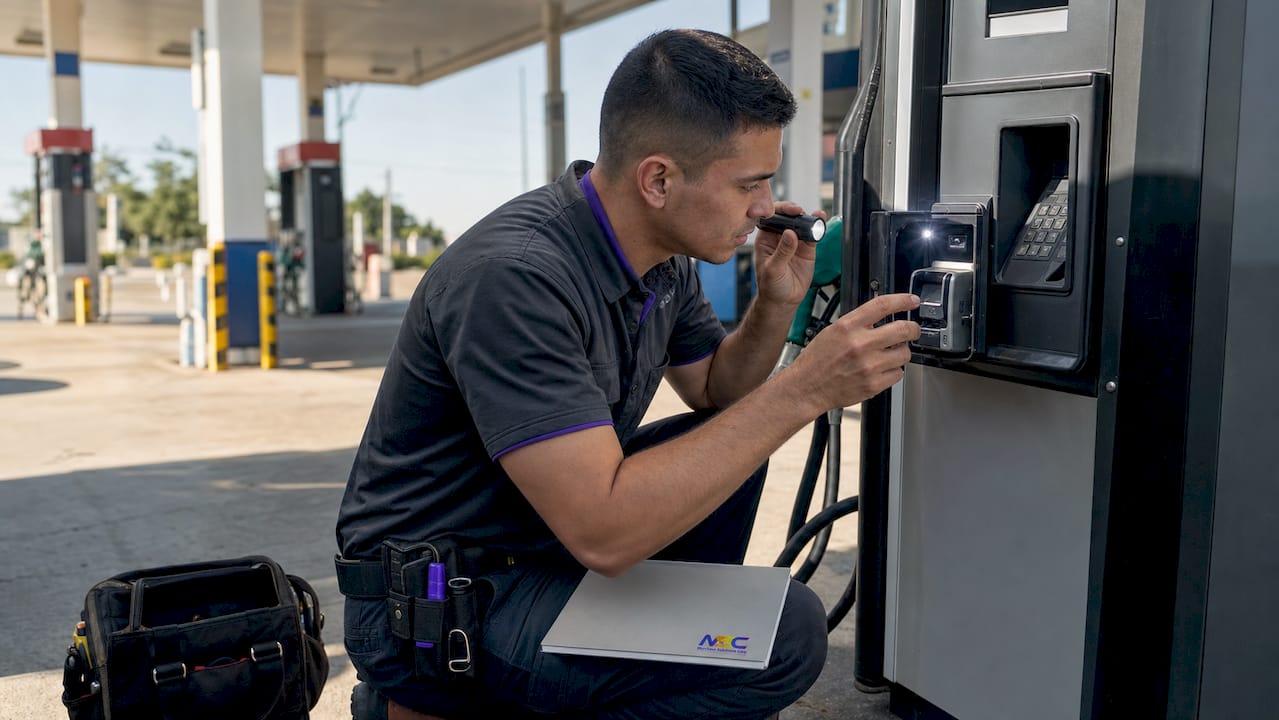
The most effective deterrent to card skimming is a daily visual inspection that compares each pump device against a documented baseline. Criminals install skimmers incrementally, making small changes that a rushed glance will miss. A structured daily walk-around catches those changes before a single card is compromised.
Your daily inspection checklist should include:
- Card reader comparison. Check each reader against a reference photo taken when the device was certified clean. Look for added overlays, misaligned bezels, or color mismatches.
- Keypad inspection. Press the keypad firmly. A skimmer overlay sits slightly higher than the original and may flex or shift.
- Housing integrity. Run your hand along panel seams. Loose housings, fresh glue residue, or new scratches around screws signal tampering.
- Tamper-evident seal check. Verify that serial-numbered seals on panel doors are intact and match your log. Seal swapping fraud is only stopped by strict serial number tracking.
- Cable and wiring visibility. Where visible, confirm no new wires or connectors have appeared inside access panels.
PCI DSS 4.0 requires fuel retailers to conduct quarterly documented inspections that verify serial numbers and physical condition of all Point-of-Interaction devices. That quarterly requirement is a compliance floor, not a ceiling. Daily checks are your real defense.
Pro Tip: Photograph every pump reader at the start of each shift and store images in a dated folder. When a new employee does the inspection, they compare against the photo rather than relying on memory.
2. Upgrade to EMV chip readers and contactless payment terminals
EMV chip transactions encrypt card data at the point of contact, making intercepted data useless to fraudsters. Magnetic stripe readers transmit static card numbers that skimmers capture and clone. The shift to chip and contactless technology is the single largest technical upgrade a fuel retailer can make.
Contactless Tap-to-Pay payments eliminate card data exposure entirely. The terminal generates a one-time transaction token using NFC (near-field communication), so even if a criminal intercepts the signal, the data has no reuse value. Mobile wallets like Apple Pay and Google Pay work on the same tokenization principle.
Key operational points for enabling these technologies:
- Confirm your EMV-compliant terminals support both contact chip and contactless NFC modes.
- Update terminal firmware regularly. Outdated firmware can leave known vulnerabilities open even on modern hardware.
- Display clear signage at the pump showing which payment methods are accepted. Customers who know Tap-to-Pay is available will choose it.
- Test contactless acceptance monthly. A terminal that silently fails to process NFC transactions pushes customers back to mag-stripe.
Contactless payments do not expose real card numbers during the transaction. A skimmer placed on a contactless-enabled pump captures nothing usable from an NFC transaction. Enabling Tap-to-Pay is therefore both a customer convenience and a direct fraud reduction measure.
A common misconception is that contactless payments are less secure because they require no PIN. The opposite is true at the pump. The tokenization layer means the card number never travels across the connection in a form that can be reused.
3. Replace universal dispenser locks with high-security keyed locks
Fuel dispensers commonly use universal locks that criminals purchase legally online and use to open pump cabinets without any sign of forced entry. This is how internal skimmers get installed. Replacing universal locks with unique, high-security keyed locks is a low-cost, high-impact defense.
Internal skimmers are the most dangerous variant because they are invisible from the outside. Internal devices transmit stolen card data over Bluetooth or cellular connections, so criminals never need to return to the pump to retrieve a physical device. Standard external inspections will not catch them.
Your physical access control protocol should cover:
- Lock replacement. Install unique locks on every dispenser cabinet. Keep a master key log with named accountability for each key holder.
- Key access policy. Limit cabinet access to a named list of authorized staff and licensed technicians. No exceptions.
- Technician visit logging. Record every service visit with the technician’s name, company, date, time, and which pumps were accessed.
- Camera coverage. Position cameras to cover all pump faces and cabinet sides with clear, unobstructed lines of sight. Visible cameras deter opportunistic tampering.
- Seal replacement log. Every time a cabinet is opened, replace the tamper-evident seal with a new serial-numbered one and record the old and new serial numbers in your log.
Pro Tip: After any technician visit, inspect the pump immediately before returning it to service. Do not assume a licensed technician’s visit means the pump is clean. Verify the seal, check the reader, and photograph the interior if you have access.
4. Implement network segmentation and encrypted data transmission
Payment security for gas stations extends beyond the physical pump. Your back-office network, POS systems, and payment terminals all share infrastructure that needs protection. Cybersecurity best practices for POS environments include network segmentation, encrypted transmissions, regular vulnerability testing, and multi-factor authentication.
Network segmentation means your payment terminals operate on a separate network segment from your general business systems. If a criminal compromises your office Wi-Fi, they cannot reach the payment network. This is a PCI DSS requirement, not a recommendation.
Encrypted transmission protects card data as it moves from the terminal to the payment processor. End-to-end encryption (E2EE) and point-to-point encryption (P2PE) are the two recognized standards. P2PE solutions certified by the PCI Security Standards Council provide the strongest protection because they encrypt data at the point of swipe or tap before it ever reaches your system.
Multi-factor authentication on any system that accesses payment data adds a second layer of verification. A stolen password alone is not enough to gain access. Pair this with regular vulnerability scans, ideally quarterly, to identify open ports or outdated software before attackers do.
5. Train staff to recognize tampering and enforce response protocols
Technology cannot prevent all fraud without human vigilance. Staff who know what to look for and what to do when they find it are your most reliable fraud prevention asset. Training is not a one-time event. It is a recurring practice built into your operational calendar.
Your staff training program should cover these numbered steps:
- Baseline familiarization. Every new employee reviews reference photos of each pump in its certified clean state before their first solo inspection shift.
- Tamper recognition. Train staff to identify loose card reader overlays, misaligned keypads, unexpected wires, broken seals, and glue residue around panel edges.
- Immediate response. When tampering is suspected, the pump goes out of service immediately. No customer transactions until the device is cleared by a qualified technician.
- Law enforcement notification. Proper incident response includes notifying local law enforcement and preserving the device as evidence. Do not remove a suspected skimmer yourself.
- Complaint and chargeback tracking. Log every customer complaint about unauthorized charges and cross-reference with inspection records and chargeback data. Cross-referencing complaint data detects fraud patterns before they escalate.
- Incident documentation. Record the date, time, pump number, staff member who found the issue, and all actions taken. This log supports law enforcement and your PCI DSS compliance documentation.
- Customer communication. Post clear signage at pumps advising customers to check for tampering, use contactless payment where available, and report concerns to staff. Informed customers are an extension of your inspection team.
Documenting suspicious activity and customer complaints in a centralized log gives you a data-driven view of fraud risk across your location. A cluster of chargebacks tied to one pump on specific dates is a pattern your log will surface.
6. Conduct quarterly PCI DSS 4.0 compliance audits
PCI DSS 4.0 compliance is not a background administrative task. It is a structured, recurring process that fuel retailers must treat as a core operational function. Quarterly documented inspections of all Point-of-Interaction devices are mandatory, covering serial number verification and physical condition assessment.
Fuel retailers frequently experience compliance drift. This happens when initial certification is achieved but ongoing maintenance slips. EMV and PCI certification lifecycle management requires active planning, not passive assumption that a certified terminal stays compliant indefinitely. Firmware updates, hardware replacements, and network changes all trigger re-evaluation requirements.
Your quarterly audit should produce a written record that includes:
- Serial numbers of all Point-of-Interaction devices, verified against your asset register
- Physical condition notes for each device
- Tamper-evident seal serial numbers, with old and new numbers logged for any replacements
- Network segmentation verification confirming payment systems remain isolated
- Review of all incident reports and chargeback data from the prior quarter
Pair your internal audit with an annual review by a qualified security assessor if your transaction volume requires it. Staying ahead of the compliance calendar protects you from fines and keeps your payment processor relationship intact.
7. Educate customers on secure payment choices at the pump
Customer behavior directly affects your fraud exposure. A customer who swipes a magnetic stripe card on a compromised pump becomes a fraud victim and a chargeback for your station. Guiding customers toward safer payment methods reduces that risk without requiring them to understand the technical details.
Post clear, simple messaging at every pump. “Tap to pay for faster, safer transactions” is more effective than a technical explanation of tokenization. Customers respond to speed and simplicity. Security is the benefit they get without needing to ask for it.
Advise customers through pump screen prompts and physical signage to:
- Use contactless payment or a mobile wallet when available
- Check the card reader for anything loose or misaligned before inserting a card
- Cover the keypad when entering a PIN
- Report anything unusual about the pump to the attendant immediately
Your gas station payment terminals can display custom prompts at the start of each transaction. Use that screen real estate to reinforce safe payment habits. A one-line prompt costs nothing and reduces your liability exposure.
Key takeaways
Gas station fraud prevention requires layered defenses: daily physical inspections, upgraded payment technology, strict access controls, trained staff, and documented PCI DSS 4.0 compliance audits working together.
| Point | Details |
|---|---|
| Daily inspections are the first line of defense | Compare pump devices against baseline photos every shift to catch incremental tampering early. |
| Contactless payments reduce skimmer success | NFC tokenization means intercepted data has no reuse value, cutting skimmer effectiveness. |
| Universal locks are a known vulnerability | Replace dispenser cabinet locks with unique high-security locks and maintain a strict key access log. |
| PCI DSS 4.0 requires quarterly device audits | Document serial numbers, physical condition, and seal replacements at least every quarter. |
| Staff training closes the human gap | Trained employees who follow clear incident response protocols preserve evidence and stop fraud faster. |
Why payment security at the pump is an ownership responsibility, not an IT task
The stations that get hit hardest by skimming fraud share one trait: they treated payment security as someone else’s problem. The processor handles the transactions. The technician handles the hardware. The manager handles compliance paperwork once a year. That fragmented ownership is exactly what criminals count on.
What actually works is treating every pump as a piece of equipment you are personally responsible for, the same way you manage fuel inventory or staff scheduling. Daily inspections become routine when they are built into the opening checklist, not assigned to whoever has time. Lock upgrades happen when the owner decides they are non-negotiable, not when a technician mentions it in passing.
The technology side matters enormously. Stations that have completed their EMV gas station upgrades and enabled contactless payment have measurably fewer successful skimming incidents. But technology without operational discipline drifts. A certified terminal that never gets inspected and runs outdated firmware is not a secure terminal.
The operators who build real resilience combine three things: consistent daily routines, technology that reduces card data exposure, and staff who know exactly what to do when something looks wrong. None of those three elements works well without the other two. That combination is what fuel pump payment security actually looks like in practice.
Meeting PCI compliance standards is the floor. Building a culture where every employee treats a suspicious card reader as an emergency is the ceiling. The gap between those two levels is where most fraud happens.
— Jonathan
How Merchantsolutionscorp supports secure payment operations at gas stations
Merchantsolutionscorp provides nationwide payment processing and POS solutions built for fuel retailers who need both compliance support and reliable hardware. The platform supports EMV chip processing, contactless NFC payments, and secure payment processing with end-to-end encryption across all terminal types. Gas station operators get fully configured equipment, onboarding support, and ongoing updates that keep pace with evolving PCI DSS requirements. Free hardware programs with $0 upfront options mean you can upgrade dispenser terminals without a large capital outlay. Merchantsolutionscorp also offers dual pricing solutions to offset processing fees, reducing the cost burden of running a compliant, modern payment environment. Talk to the team about gas station payment solutions designed for your operation.
FAQ
What is card skimming at gas stations?
Card skimming is the theft of payment card data using a device secretly attached to or installed inside a fuel dispenser. Skimmers capture magnetic stripe data or PIN entries, which criminals use to clone cards or make fraudulent transactions.
How often should gas station operators inspect payment terminals?
Daily visual inspections are the most effective deterrent, with formal documented inspections required at least quarterly under PCI DSS 4.0. Each inspection should verify serial numbers, physical condition, and tamper-evident seal integrity.
Does contactless payment prevent skimming at the pump?
Contactless Tap-to-Pay payments use NFC tokenization, which means no real card number is transmitted during the transaction. A skimmer placed on a contactless-enabled pump captures no usable data from an NFC transaction.
What should a gas station operator do if they find a skimmer?
Take the pump out of service immediately, do not remove the device, and notify local law enforcement. Preserving the skimmer as evidence supports criminal investigation and protects your compliance documentation.
What is PCI DSS 4.0 and why does it matter for fuel retailers?
PCI DSS 4.0 is the current payment card industry data security standard. It requires fuel retailers to conduct quarterly documented inspections of all Point-of-Interaction devices and maintain records of serial numbers, physical condition, and any tampering incidents.