Streamline high-risk payment solutions: lower fees & boost efficiency
Streamline high-risk payment solutions: lower fees & boost efficiency

If you operate in a high-risk industry, you already know that payment processing is rarely straightforward. While standard merchants pay 1.5–2.9% per transaction, high-risk businesses routinely face rates of 3.5–6.5% plus per-transaction fees, rolling reserves, and stricter account requirements. Many small business owners in sectors like CBD, supplements, or online travel are genuinely surprised when they discover how much these costs add up each month. The good news is that understanding the system puts you back in control. This guide breaks down exactly what drives high-risk classification, how fee structures work, and the practical strategies you can use to lower your costs, secure approval, and keep your account running smoothly.
Table of Contents
- What makes a business high-risk for payment processing?
- Understanding high-risk payment solution costs and structures
- Securing reliable approval and maintaining your account
- Advanced strategies to minimize fees and boost efficiency
- Future trends and common pitfalls for high-risk payment solutions
- Our perspective: What most high-risk payment guides don’t tell you
- Explore affordable, reliable high-risk payment solutions with us
- Frequently asked questions
Key Takeaways
| Point | Details |
|---|---|
| High-risk means higher costs | Businesses in high-risk categories pay significantly more in processing fees and face stricter requirements than standard merchants. |
| Approval requires preparation | Ensuring strong compliance, low chargebacks, and complete documentation increases your chances for account approval and stability. |
| Alternative solutions can cut fees | Consider ACH, eCheck, or negotiating with providers to reduce costs and diversify payment risks. |
| Stay proactive, not reactive | Building close relationships with your provider and regularly updating compliance measures can help prevent costly account disruptions. |
What makes a business high-risk for payment processing?
The term “high-risk” gets used loosely, but for payment processors, it has a precise meaning. A business is classified as high-risk when it presents a statistically elevated chance of chargebacks, fraud, regulatory action, or financial instability. That classification is not just about what you sell. It also reflects how you sell it, where your customers are, and how long you’ve been in business.
Payment processors evaluate several core factors when making this determination:
- Chargeback rate: A chargeback ratio above 1% triggers penalties, stricter monitoring, and in some cases, account termination. New businesses often face volume caps and rolling reserves before they build a clean history.
- Industry type: Certain sectors carry elevated risk by definition. CBD products, dietary supplements, adult content, online gaming, travel services, firearms, and subscription billing models are consistently flagged by processors.
- Business model volatility: Subscription services, free trials, and businesses with high average ticket values generate more disputes, making processors nervous about potential financial exposure.
- MATCH list inclusion: The MATCH list (Member Alert to Control High-Risk) is essentially a blacklist for merchants who have had accounts terminated for fraud or excessive chargebacks. Inclusion makes approval very difficult.
- Cross-border sales: Selling internationally introduces currency risk, varying consumer protection laws, and elevated fraud exposure.
- Business age and financial history: Startups without processing history are harder to evaluate, so they often start with higher rates and tighter reserves.
Understanding high-risk merchants explained on a deeper level helps you see that classification is not a permanent label. It reflects your current risk profile, which you can actively manage.
“High-risk classification is not a judgment on your business quality. It’s a statistical prediction based on your industry, volume, and history. Change the data, and you can change the outcome.”
For businesses operating in challenging sectors, checking out the full high-risk industry profiles gives you a clearer picture of where you stand before you even approach a processor.
Pro Tip: Monitor your chargeback ratio consistently and aim to keep it below 0.9%. Even a slight buffer below the 1% threshold gives you negotiating power and protects your account from sudden restrictions.
It’s also worth noting that the same product sold in two different ways can generate different risk classifications. A brick-and-mortar supplement retailer and a subscription-based online supplement store may face very different approval experiences, even though they sell the same items. Business processes matter as much as the product itself.
Understanding high-risk payment solution costs and structures
Knowing you’re classified as high-risk is one thing. Understanding exactly what that means for your bottom line is another. The fee structures attached to high-risk accounts are more layered than standard merchant accounts, and missing even one cost category can leave you with a very different effective rate than you expected.
Here’s how typical high-risk fees compare to standard merchant accounts:
| Fee type | Standard merchant | High-risk merchant |
|---|---|---|
| Processing rate | 1.5–2.9% | 3.5–6.5% |
| Per-transaction fee | $0.10–0.20 | $0.25–0.50 |
| Monthly fee | $0–$30 | $10–$75 |
| Setup fee | $0–$50 | $100–$300 |
| Chargeback fee | $15–$25 | $25–$50 |
| Rolling reserve | None | 5–20% held 90–180+ days |
These high-risk merchant fees represent the floor, not the ceiling. When you factor in reserves and dispute penalties, total costs can reach a much higher effective percentage of revenue.
Beyond the rate card, there are several hidden costs that catch business owners off guard:
- Rolling reserves: A percentage of your revenue is withheld for 90 to 180 days or longer. This is not a fee; it’s a cash flow constraint that can quietly strangle growing businesses.
- Fund holds during dispute spikes: If your chargeback volume jumps suddenly, your processor may freeze funds pending investigation, sometimes for weeks.
- Onboarding delays: High-risk underwriting takes longer. Delays in getting approved mean delayed revenue, especially for new businesses.
- Early termination fees: Some high-risk contracts include steep penalties for leaving early, which locks you into unfavorable terms even if a better provider emerges.
According to research on small merchant revenue, high-risk fees can total 3–15% of revenue, with smaller businesses paying higher effective rates because fixed fees represent a larger share of lower transaction volumes.
To calculate your true effective processing cost, add up all monthly fees, multiply your processing rate by total volume, factor in any reserve withheld, and divide by gross revenue processed. Many business owners are surprised to find their effective rate is 2 to 3 percentage points higher than the headline rate they were quoted.
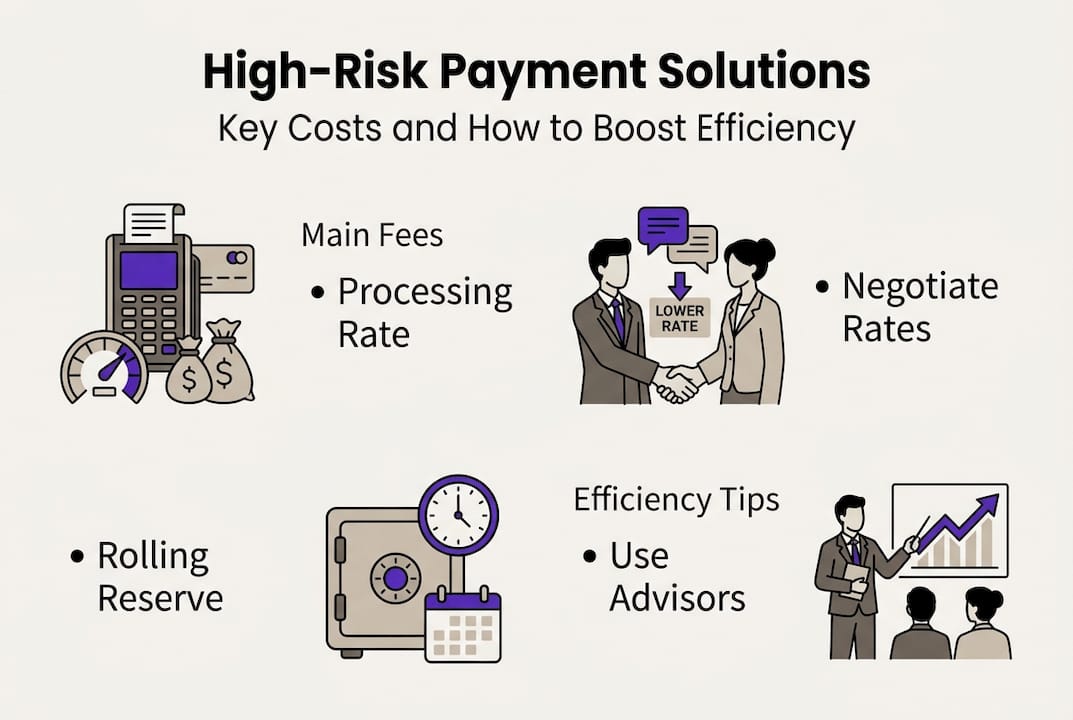
Reviewing a detailed processing pricing breakdown before signing any agreement can help you spot hidden charges early and negotiate from a more informed position.
Securing reliable approval and maintaining your account
Getting approved for a high-risk merchant account requires more preparation than a standard application. Processors are underwriting real financial exposure, so they need to see that your business is stable, compliant, and organized. Here’s how to give yourself the best possible chance.
Steps to improve your approval odds:
- Prepare your legal documentation. Gather your business license, government-issued ID, EIN, voided check or bank letter, and three to six months of bank statements before you apply.
- Ensure your website is fully compliant. Your site must have clear refund and return policies, terms and conditions, a privacy policy, and visible contact information. Missing any of these is a fast path to rejection.
- Present your chargeback history honestly. Processors will find it regardless. A compliant website and low chargebacks below 0.9% significantly boost your approval odds, especially for complex cases.
- Work with a specialist provider. Generalist processors like Stripe are not designed for true high-risk scaling. Specialist providers understand your industry and have underwriting relationships that support more nuanced applications.
- Be transparent about your business model. Explain your subscription billing terms, trial offers, or cross-border sales upfront. Surprises discovered during underwriting slow approvals and reduce trust.
Maintaining your account after approval is equally important. Processors monitor accounts continuously, and a sudden shift in your processing patterns can trigger a review.
Common pitfalls that lead to account suspension:
- Sudden and unexplained spikes in monthly sales volume
- Hiding or downplaying aspects of your business model during onboarding
- Letting compliance documentation like terms of service or privacy policies become outdated
- Ignoring chargeback alerts until they escalate
Exploring high-risk merchant services built for your industry ensures you have a provider that understands these dynamics rather than one treating you as an exception to standard procedures.

Pro Tip: If you anticipate a promotional spike or seasonal surge, notify your provider in advance. Proactive communication prevents the kind of automated flags that freeze accounts during your busiest periods.
Staying current with security and compliance requirements is not a one-time task. Regulations evolve, and an outdated policy can create liability in a dispute. Also, if you run any online sales, reviewing ecommerce payment tips helps you address the digital-specific vulnerabilities that often drive up chargeback rates.
Advanced strategies to minimize fees and boost efficiency
Once your account is live, the real work of managing costs begins. There are several strategies that experienced high-risk merchants use to reduce their effective rates and protect their cash flow that most guides skip over entirely.
Negotiate based on volume and history. Most high-risk merchants accept the initial rate as fixed. It isn’t. After three to six months of clean processing history and consistent volume, you have real leverage. Negotiating from volume and history can lower your effective fees meaningfully, especially if your chargeback ratio has stayed well below the threshold.
Here’s a quick comparison of payment solution types for high-risk merchants:
| Solution type | Processing fee | Reserve requirement | Best for |
|---|---|---|---|
| Traditional merchant account | 3.5–6.5% | 5–20% rolling | Established businesses |
| ACH / eCheck | 0.5–1.5% flat | Lower or none | Recurring billing |
| Payment aggregator (e.g., Stripe) | 2.9% + flat fee | Account holds common | Low-volume only |
| Crypto/fiat gateway | 0.5–2% | Often none | Tech-savvy, volatile risk |
Alternatives worth considering:
- ACH and eCheck processing: For businesses with recurring billing or B2B customers, ACH dramatically lowers per-transaction costs. Exploring ACH and eCheck options is one of the most underused cost-reduction moves available to high-risk merchants.
- Alternative payment methods (APMs): Digital wallets and region-specific payment methods can reduce friction and chargebacks by giving customers familiar checkout experiences.
- Diversify your processors: Relying on a single provider creates single-point-of-failure risk. Running a secondary processor as a backup protects revenue continuity if your primary account is reviewed or suspended.
A word of caution on payment aggregators: platforms like Stripe are fast to set up, but they are not designed for high-risk businesses at scale. They use blanket underwriting across all their merchants, meaning one complaint spike can trigger account termination without warning.
Fiat-to-crypto gateways do offer lower fees and often no rolling reserves, but they introduce volatility in settled amounts and new compliance questions around AML and KYC requirements. These are viable tools for the right business, but they require careful evaluation.
Working with specialized high-risk services gives you access to advisors who already know which combinations of tools work for your specific industry and volume.
Pro Tip: Diversifying across two or three payment solutions is not just a backup plan. It’s a negotiating tool. When a processor knows you have alternatives, they’re more motivated to offer competitive terms.
Future trends and common pitfalls for high-risk payment solutions
The high-risk payment landscape is shifting, and staying ahead of those changes is as important as managing your fees today. Technology is reshaping how risk is assessed, and that creates both opportunity and new vulnerabilities.
Emerging trends to watch:
- AI-powered risk scoring: Processors are adopting machine learning models that evaluate real-time transaction patterns. This can accelerate onboarding for clean businesses but can also trigger faster automated holds when anomalies appear.
- Instant onboarding platforms: Some newer providers claim near-instant approval using automated underwriting. These can be convenient but often come with less favorable reserve terms buried in the fine print.
- Regulatory expansion: Cross-border and recurring payment models face increasing regulatory scrutiny in 2026, particularly around consumer disclosure and subscription cancellation practices.
- Open banking integrations: Direct bank-to-bank payment options are emerging as lower-cost alternatives, especially for high-ticket transactions.
The most common pitfall is complacency. Businesses that find a stable provider and stop monitoring their account health often get blindsided. Providers emphasize stability for small businesses, but the same agreements that promise scalability often include provisions for sudden reserves and holds during dispute spikes.
“Stability is not the same as safety. A payment account can run smoothly for months, then face a reserve hold that locks up weeks of revenue with very little notice. Vigilance is not optional in high-risk processing.”
Reviewing security best practices regularly is one of the simplest ways to protect yourself from both fraud-driven chargebacks and processor-initiated holds. Audit your refund policies, terms, and compliance documents at least once a quarter.
Our perspective: What most high-risk payment guides don’t tell you
We’ve worked with hundreds of high-risk businesses, and the pattern we see most often is this: owners spend enormous energy chasing the lowest possible rate and almost no time building the provider relationships and compliance infrastructure that actually determine long-term costs.
The uncomfortable truth is that the cheapest rate rarely stays the cheapest rate. A processor offering an aggressive introductory rate to win your business has usually built their margin elsewhere, whether in reserve requirements, chargeback fees, or contract clauses that give them broad discretion to hold funds. True savings come from stability, consistent processing history, and an account structure matched to your actual business model.
What most guides also miss is the value of hands-on provider relationships. Not just having an account manager’s email, but building a direct line to someone who understands your business cycle, can advocate for you during a dispute spike, and gives you real advance notice when policy changes are coming.
Pro Tip: Ask your provider for a named payment consultant, not just a general support line. That single relationship is worth more than a 0.5% rate discount when something goes wrong.
The right mindset for navigating high-risk payments is anticipation, not reaction. Proactively managing your chargeback ratio, keeping your compliance documentation current, and communicating with your processor before problems emerge will save you more money and stress than any rate negotiation. Reviewing smart navigation strategies gives you a practical framework for building that kind of proactive approach into your daily operations.
Explore affordable, reliable high-risk payment solutions with us
Managing high-risk payment processing doesn’t have to mean accepting high fees and constant uncertainty. At Merchant Solutions Corp, we work with high-risk businesses across the US and Canada to build payment setups that are transparent, stable, and structured around your actual needs.

We offer tailored high-risk payment options with clear fee structures and no hidden surprises. For businesses with recurring billing or B2B customers, our ACH processing for high-risk merchants is one of the most effective ways to cut costs while maintaining reliability. And for businesses that need a specialist who understands the nuances of your industry, our high-risk merchant services team is ready to walk you through options, timelines, and expectations from day one. Book a consultation and find out what a payment setup built specifically for your business actually looks like.
Frequently asked questions
What are typical processing fees for high-risk payment solutions?
High-risk payment solutions generally charge 3.5–6.5% plus $0.25–0.50 per transaction, along with rolling reserves of 5–20% held for 90–180 days or longer.
How can high-risk businesses improve approval odds for a payment account?
Maintaining a chargeback ratio below 0.9%, ensuring your website has full compliance documentation, and providing strong business records are the most effective ways to improve your approval chances.
Are there ways to lower high-risk processing fees?
Yes. Negotiating based on volume and clean processing history, using ACH or eCheck for recurring payments, and working with specialized providers can all reduce your effective cost meaningfully.
What are rolling reserves and how do they affect cash flow?
Rolling reserves are a percentage of your revenue withheld by the processor for 90–180 days, creating a cash flow gap that can strain growing businesses even when sales are strong.
Can crypto payment gateways help high-risk merchants?
Fiat-to-crypto gateways may lower fees and remove reserve requirements, but they introduce price volatility and new compliance obligations around AML and KYC that require careful planning.