HVAC payment solutions: options, pros, and best choices
HVAC payment solutions: options, pros, and best choices

Running an HVAC business means you’re constantly moving. You’re dispatching technicians, managing job sites, ordering parts, and trying to get paid quickly after every call. The challenge is that customers now expect multiple ways to pay, from tapping a card on a mobile reader to financing a $12,000 system replacement. Pick the wrong payment setup and you’re losing jobs to competitors, eating chargeback losses, or spending hours each week on manual invoicing. This article walks you through the most practical payment solutions available to HVAC contractors today. You’ll get a clear breakdown of card processing, checks, financing, and integrated billing software, along with honest comparisons and specific recommendations based on job type and business size.
Table of Contents
- How to evaluate payment solutions for HVAC service calls
- Credit and debit card processing: Mobile and tap-to-pay on the job
- Accepting checks and bank transfers: Pros, pitfalls, and guarantee services
- Customer financing and payment plans: Boosting close rates and average tickets
- Integrated billing and payment software: Streamlining the entire workflow
- The overlooked edges: Making payment solutions work for real HVAC business growth
- Unlock faster, easier payments for your HVAC business
- Frequently asked questions
Key Takeaways
| Point | Details |
|---|---|
| Customer financing boosts sales | Offering financing and payment plans can increase close rates and drive higher average tickets for HVAC jobs. |
| Mobile payments improve speed | Accepting cards and tap-to-pay onsite speeds up billing and improves customer satisfaction. |
| Integrated software saves hours | Using payment-enabled HVAC software can cut admin work by 40% and simplify the entire transaction process. |
| Check guarantees reduce risk | Check guarantee services protect contractors from bounced payments on large-ticket projects. |
| Picking the right fit matters | The best payment solution balances speed, convenience, risk, and software integration for your specific HVAC business model. |
How to evaluate payment solutions for HVAC service calls
Before you commit to any payment platform, you need a clear set of criteria. Not every solution that works well for a retail store or restaurant will hold up in the field. HVAC jobs range from a $150 filter replacement to a $20,000 commercial installation, and your payment tools need to handle both ends of that range without friction.
Here are the core factors to weigh when evaluating any payment solution:
- Transaction speed: Can your technician collect payment on-site the moment the job is done? Delays create collection headaches.
- Mobile compatibility: Does the solution work on a smartphone or tablet in the field? A solution that requires a wired terminal is a non-starter for most service calls.
- Reliability: What happens when the internet is spotty in a basement or rural property? Offline processing capability matters more than most contractors realize.
- Fee structure: Are fees flat-rate, interchange-plus, or tiered? Each model affects your margins differently depending on average ticket size.
- Integration with your existing tools: Does the payment solution sync with your scheduling software, QuickBooks, or field service management platform?
- Chargeback and fraud protection: High-ticket jobs attract more disputes. Your platform should offer tools to reduce and fight chargebacks.
- Customer experience: Does the checkout process feel professional? A clunky payment experience reflects poorly on your brand.
The integration piece deserves special attention. Integrated billing software reduces admin by 40%, which is a significant time savings when you’re managing dozens of jobs per week. Syncing payments directly with your invoicing and accounting tools removes the manual data entry that bogs down office staff and leads to billing errors.
Mobile and contactless payments are no longer optional for HVAC businesses. Customers increasingly expect to tap a card or pay via digital wallet on the spot. If your technicians are still writing paper receipts or calling in card numbers, you’re creating unnecessary friction at the most important moment of the customer relationship.
Watch for these common pitfalls:
- Chargebacks on large jobs: Without signed authorization forms and clear job documentation, disputes can cost you the full invoice amount plus fees.
- Bounced checks on residential installs: Even well-intentioned customers sometimes have insufficient funds. This is especially risky on jobs over $3,000.
- Admin bottlenecks: Manual invoicing after the fact delays cash flow and creates reconciliation errors.
Pro Tip: Before signing with any payment processor, ask specifically about offline transaction capability and chargeback dispute support. These two features separate field-ready solutions from office-only tools. Explore your payment processing overview to understand what a full-featured solution looks like before you compare vendors.
Credit and debit card processing: Mobile and tap-to-pay on the job
Card processing is the baseline expectation for any HVAC business in 2026. Customers want to pay with a tap, a chip, or a digital wallet. They don’t want to write a check or wait for an invoice. If your team can’t accept cards on-site, you’re creating a friction point that costs you money and customer satisfaction.
Modern mobile card readers are small, durable, and connect via Bluetooth to a smartphone or tablet. Your technician finishes the job, pulls up the invoice on their phone, and the customer taps their card in seconds. The payment is captured, the receipt is sent by text or email, and the funds are typically deposited within one to two business days.
Key features to look for in a mobile card processing solution:
- EMV chip support: EMV (Europay, Mastercard, Visa) chip technology reduces counterfeit card fraud. Any terminal you use should be EMV-ready.
- NFC/contactless capability: Near-field communication (NFC) allows tap-to-pay transactions from cards and digital wallets like Apple Pay and Google Pay.
- Offline processing: When your technician is in a rural area or a basement with no signal, the terminal should queue the transaction and process it when connectivity is restored.
- PCI DSS compliance: Payment Card Industry Data Security Standard (PCI DSS) compliance is non-negotiable. Your processor should handle this on your behalf.
- Receipt delivery: Instant email or SMS receipts reduce disputes and improve the customer experience.
Card processing supports tap, chip, EMV-ready, and offline fallback, with fees typically ranging from 2.5% to 4% per transaction. That range matters when you’re doing high-volume work. On a $500 service call, a 2.5% fee costs $12.50. On a $10,000 system replacement, the same rate costs $250. Understanding your average ticket size helps you negotiate better rates or consider dual pricing strategies that offset processing costs.
Dual pricing, sometimes called cash discounting, passes the processing fee to customers who pay by card while offering a lower price for cash or check. This approach is legal in most US states and can significantly reduce your monthly processing costs.
Pro Tip: Use terminals with 3D Secure authentication for card-not-present transactions, such as when you’re collecting payment over the phone or via an online invoice link. 3D Secure adds an extra verification step that dramatically reduces chargeback risk on disputed transactions.
Your payment processing for HVAC setup should also include access to reporting dashboards so you can track transaction history, identify disputes early, and reconcile payments against your job schedule. Pairing mobile card processing with capable POS systems gives your team a complete field-to-office payment workflow.
Accepting checks and bank transfers: Pros, pitfalls, and guarantee services
Checks haven’t disappeared from HVAC. For large commercial contracts, multi-phase projects, or customers who simply prefer traditional payment methods, checks and bank transfers remain a practical option. The key is managing the risks that come with them.
Why checks still make sense for certain HVAC jobs:
- No card processing fees: A check costs you nothing to receive, which matters on a $15,000 commercial job.
- No card limits: Some customers have daily spending limits on their credit cards that don’t cover large HVAC invoices.
- Familiar for commercial clients: Many property managers and facilities directors still operate on net-30 or net-60 payment terms with checks.
- ACH transfers offer a digital alternative: Automated Clearing House (ACH) bank transfers carry much lower fees than cards, typically $0.25 to $1.50 per transaction, and are well-suited for recurring maintenance contracts.
The risk is real, though. Check guarantee services reduce bounce risk, which affects 3% to 5% of checks accepted without protection. On a $10,000 job, a bounced check doesn’t just delay payment. It triggers bank fees, collection costs, and hours of follow-up that eat into your margin.
Key insight: Check guarantee services work by verifying the check at the point of acceptance and guaranteeing payment to you even if the customer’s account doesn’t cover it. The service provider takes on the collection risk in exchange for a small per-transaction fee, usually 1% to 2% of the check amount.
When to require a check guarantee service:
- Any residential job over $2,500
- First-time commercial clients without an established payment history
- Customers who request extended payment timelines
- Jobs in areas where you’ve experienced previous collection issues
ACH transfers are worth promoting to your regular commercial clients. They’re faster than waiting for a check to clear, cheaper than card processing, and easy to set up through most modern payment platforms. You can send an invoice with an ACH payment link, and the customer authorizes the transfer directly from their bank account.
For high-risk payment services, including large-ticket transactions or businesses with higher-than-average chargeback histories, working with a processor that specializes in your industry gives you better protection and more flexible terms than a generic payment provider.
Customer financing and payment plans: Boosting close rates and average tickets
Financing has shifted from a nice-to-have to a standard expectation in HVAC sales. When a homeowner is facing a $14,000 system replacement, the ability to spread payments over 60 months often determines whether they hire you or wait another season with a failing unit.
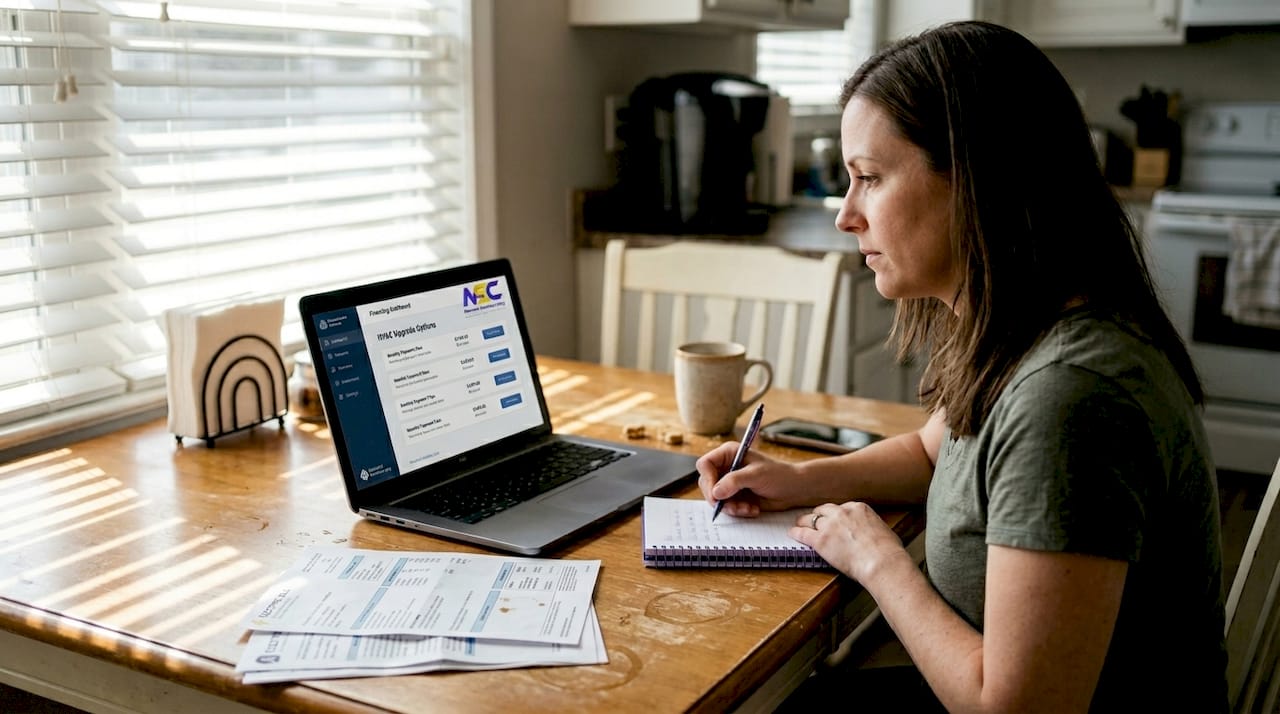
Offering financing boosts close rates by 35% to 55%, increases financed sales by 18%, and raises the average ticket by 42%. Those numbers are hard to ignore. Financing doesn’t just help customers afford bigger jobs. It helps you win more of them.
Types of financing to consider offering:
- Deferred interest plans: The customer pays no interest if the balance is paid within a promotional period, typically 6 to 18 months. Popular for mid-range jobs.
- Fixed-rate installment loans: Set monthly payments over a defined term. Predictable for the customer, reliable for you.
- Buy now, pay later (BNPL): Shorter-term plans, often 3 to 12 months, with instant approval decisions. Growing fast in home services.
- In-house payment plans: You carry the financing yourself, collecting monthly payments. Higher risk but no dealer fees.
Here’s a comparison of common financing types for HVAC contractors:
| Financing type | Dealer fee | Approval speed | Best for |
|---|---|---|---|
| Deferred interest | 3% to 8% | Same day | Mid-range residential |
| Fixed-rate installment | 5% to 12% | Same day | Large system replacements |
| BNPL | 2% to 6% | Instant | Small to mid jobs |
| In-house plan | 0% | Immediate | Repeat customers |
Dealer fees for financing range from 0% to 12% depending on the plan type and lender. Factor these costs into your pricing before you present options to customers. A 6% dealer fee on a $10,000 job costs $600, but if financing helps you close the job at all, the math still works in your favor.
Pro Tip: Present financing at every sales call, not just when a customer hesitates on price. Many customers who could pay in full will still choose monthly payments to preserve their cash. Offering it proactively signals that you’re a professional operation and removes the awkward conversation about affordability. Connect financing options to your broader retail payment options strategy for a consistent customer experience.
Integrated billing and payment software: Streamlining the entire workflow
Card processing, checks, and financing all solve the customer-facing side of getting paid. But there’s another layer that many HVAC contractors overlook: the back-office workflow that ties all of those payment methods together. This is where integrated billing and payment software earns its place.
Integrated billing platforms designed for field service businesses combine scheduling, invoicing, payment capture, and accounting sync into a single workflow. When your technician completes a job, they capture payment on-site, the invoice is automatically generated, and the transaction syncs to QuickBooks or your accounting platform without anyone touching a spreadsheet.
What integrated billing and payment software typically offers:
- On-site payment capture: Collect payment at job completion via mobile card reader, digital invoice, or financing link.
- Instant invoice generation: Automatically create and send itemized invoices the moment a job is marked complete.
- QuickBooks and accounting sync: Eliminate double entry by connecting your payment platform directly to your books.
- Scheduling and dispatch integration: Link payments to specific jobs, technicians, and service types for clean reporting.
- Customer payment history: See what each customer owes, has paid, and prefers, all in one place.
Integrated billing and payment software can reduce admin time by 40%, which translates to real dollars when you’re paying office staff by the hour. Platforms like Workiz Pay and ServiceTitan embed payment processing directly into the service workflow, eliminating the gap between job completion and invoice delivery.
| Feature | Standalone payment tool | Integrated billing platform |
|---|---|---|
| On-site payment capture | Yes | Yes |
| Auto invoice generation | No | Yes |
| Accounting sync | Manual | Automatic |
| Job-level reporting | Limited | Full |
| Customer payment history | No | Yes |
| Admin time required | High | Low |
Standalone payment tools like a basic card reader get the job done for simple transactions. But as your team grows and your job volume increases, the manual work of reconciling payments, chasing invoices, and updating your books becomes a serious drag on productivity. Integrated payment processing platforms scale with your business instead of creating new bottlenecks.
The competitive edge here is real. HVAC companies that automate their billing and payment workflows collect faster, have fewer disputes, and spend less time on administrative tasks. That time goes back into the field, into sales, and into customer service.
The overlooked edges: Making payment solutions work for real HVAC business growth
Most articles about HVAC payment solutions stop at listing options and comparing fees. But the contractors who actually grow their businesses understand something deeper: the hidden costs of the wrong payment setup often exceed the visible fees of the right one.
Consider chargebacks. A single disputed $8,000 job can cost you the full invoice amount, a $25 to $100 chargeback fee, and hours of documentation work. That’s a loss no flat-rate processing fee comparison will show you. High-risk and large transactions require distinct handling, and financing and checks both carry hidden risks that don’t show up in a standard fee schedule.
Most HVAC businesses dramatically underuse financing. They offer it only when a customer pushes back on price, which frames it as a last resort rather than a professional service. The contractors closing the most jobs present financing as a standard option on every call, the same way a car dealership presents monthly payments before the sticker price.
Integrated billing software gets dismissed as too expensive or too complex by smaller operations. But the 40% reduction in admin time is not a feature for enterprise businesses. It’s a lifeline for a five-technician team where the owner is doing the books at midnight.
Our honest take: pick your payment solutions based on your workflow first, not your customers’ preferences. A payment method your technicians won’t use consistently is worse than no payment method at all. Reliability and adoption matter more than feature lists. Work with a provider that understands high-risk merchant services if your jobs regularly exceed $5,000, because standard processors will leave you exposed when disputes arise.
Unlock faster, easier payments for your HVAC business
You’ve now seen how the right combination of card processing, check management, financing, and integrated billing can transform how your HVAC business gets paid. The next step is finding solutions built specifically for the way field service businesses operate.
At Merchant Solutions Corp, we work with HVAC contractors and service businesses across the US and Canada to set up payment systems that fit the job. From mobile card readers with offline fallback to payment processing for HVAC that syncs with your existing tools, we configure everything before it reaches your team. Our all-in-one POS systems include free hardware options with $0 upfront, dual pricing to offset processing fees, and full onboarding support. Contact us today to find the right setup for your operation.
Frequently asked questions
What is the most cost-effective payment solution for small HVAC jobs?
Mobile credit and debit card processing is the top choice for small jobs, offering on-site speed and convenience with fees from 2.5% to 4% per transaction and no monthly minimums on many platforms.
How do check guarantee services help HVAC contractors?
Check guarantee services protect you from bounce risk affecting 3% to 5% of unverified checks, ensuring you receive payment even if the customer’s bank account can’t cover the amount.
Does offering financing really improve HVAC sales?
Yes. Industry data shows financing can increase close rates by up to 55% and raise the average ticket by 42%, making it one of the highest-impact tools in an HVAC sales conversation.
What are the main risks with credit card payments in HVAC?
Chargebacks are the primary risk, especially on large or disputed jobs. Using 3D Secure authentication and maintaining detailed job documentation significantly reduces your exposure.
Can integrated payment software really save time for HVAC teams?
Integrated billing and payment platforms can reduce admin time by 40% by automating invoice creation, payment capture, and accounting sync across every job your team completes.
Recommended
- Merchant Solutions Corp | Payment Processing & POS Systems
- Merchant Solutions Corp | Payment Processing & POS Systems
- Merchant Solutions Corp | Payment Processing & POS Systems
- Merchant Solutions Corp | Payment Processing & POS Systems
- Affordable Heating and Air: My Guide to Quality Comfort Home Therapist Cooling, Heating, and Plumbing
- HVAC Services - FullyOps