Save 80–130 Basis Points With Level 3 Processing for B2B in 2026
Save 80–130 Basis Points With Level 3 Processing for B2B in 2026
Level 3 processing lowers interchange costs on qualifying commercial, purchasing, and government cards by supplying issuers with detailed line-item data. Finance and accounts-receivable teams in B2B and B2G payments see the biggest gains when commercial-card share and average ticket size are both meaningful. The move that matters right now: pull your last statement, check your card mix, and confirm your gateway actually supports Level 3 fields before assuming you already qualify.
TL;DR:
- Only commercial cards like P-cards, corporate cards, and government purchasing cards qualify for Level 3 processing; consumer cards do not benefit from lower rates.
- Accurate submission of header and line-item fields, including tax, commodity codes, and totals, is essential to maintain qualification and avoid higher interchange fees.
- Moving from unqualified to qualified rates can save merchants several thousand dollars annually on high-volume commercial-card transactions.
- Verification under Visa’s 2026 CEDP program demands complete, clean data submissions; malformed or incomplete data risks penalties and losing preferred rates.
- Many gateways support Level 3 data submission but often require enablement and proper mapping; merchants should confirm support and run test transactions beforehand.
Table of Contents
- What Is Level 3 Processing and Why Does It Lower Interchange?
- What Fields Does Level 3 Data Require?
- Which Cards and Merchants Actually Qualify?
- How Do You Implement Level 3 Processing?
- Why Do Level 3 Transactions Get Downgraded?
- When Should You Prioritize Level 3 Enablement?
- Get a Level 3 Readiness Review From Merchant Solutions Corp
- Sources
- FAQ
What Is Level 3 Processing and Why Does It Lower Interchange?
Card networks price interchange based on risk, and risk drops when the issuer knows more about the transaction. A basic swipe carries only an amount and a card number. Level 3 processing adds a purchase order number, tax detail, freight charges, and a line-by-line breakdown of what was actually bought. That extra context lets Visa and Mastercard route the transaction into a lower interchange tier reserved for verified commercial data.
The savings are not trivial. Typical spreads between standard commercial rates and properly qualified Level 3 transactions run roughly 80 to 130 basis points. On $1 million in annual commercial-card volume, that gap can translate into substantial avoided fees.
Statistic Callout: A merchant processing about one million dollars a year in eligible purchasing-card volume, moving from unqualified to Level 3 rates, could plausibly save several thousand dollars annually, depending on card mix and current tier.
The savings show up as a lower interchange line item on an interchange-plus statement, not as a separate rebate:
- Your processor’s markup stays the same.
- The interchange component drops because the transaction qualifies for a better category.
- The net effect appears as a smaller total processing cost per transaction.
What Fields Does Level 3 Data Require?
Level 3 submissions need both header-level and line-item detail. Miss a required field, or format one incorrectly, and the transaction settles at a higher tier even if you meant to submit enhanced data.
Header fields typically include the purchase order number, order date, freight or shipping amount, destination postal code, and duty amount when applicable. Line-item fields go deeper:
- Commodity or product code for each item
- Item description
- Quantity and unit of measure
- Unit cost and extended line total
- Line-level tax amount and tax rate
Integrity checks matter as much as the fields themselves. Line totals must mathematically reconcile with the transaction total, and tax fields need either a real, non-zero tax amount or an explicit tax-exempt flag. A blank tax field or a mismatched sum is one of the fastest ways to lose qualification. Field names and formats differ slightly between Visa and Mastercard, so gateway configuration has to account for both.
The stakes changed in 2026. Visa folded its legacy Level 2 and Level 3 programs into the Commercial Enhanced Data Program, or CEDP, under Product 3, and introduced a Verified merchant status.
Verified merchants who submit clean, complete data receive preferred Product 3 rates. Unverified merchants, or those submitting malformed data, risk penalties instead of partial credit. There is no longer a safe middle ground for sloppy submissions.
Which Cards and Merchants Actually Qualify?
Not every card in your batch is eligible. Level 3 rates apply to commercial products: purchasing cards (P-cards), corporate cards, government purchasing cards, and fleet or commercial fuel cards. Standard consumer credit and debit cards never qualify, no matter how complete your line-item data is.
To estimate your real opportunity, pull a BIN-level or card-type breakdown from your processor’s reporting. That report shows exactly what share of your volume is commercial versus consumer, which is the number that actually drives your savings math.
The return on investment tends to concentrate in a few profiles:
- Wholesale and distribution businesses billing other companies
- Government contractors selling to federal, state, or municipal purchasing cards
- B2B service providers with large average tickets
- Any merchant where invoices, not walk-in sales, drive revenue
How Do You Implement Level 3 Processing?
Three integration paths cover most merchants. A gateway-native API accepts Level 3 data arrays directly for merchants processing through their own systems. An ERP or invoicing integration passes line-item data automatically, since the invoice already contains everything Level 3 needs. Virtual terminal or terminal mapping handles keyed and phone orders where line data has to be entered or mapped manually.
Pro Tip: Many merchants already have a gateway capable of Level 3 submissions but never enabled the fields. Check with your provider before assuming you need a new platform.
A practical rollout looks like this:
- Confirm your gateway or processor supports Level 3 field submission and request it be enabled.
- Map your invoice or ERP line items to the required Level 3 fields.
- Validate formats against network specs, particularly tax and commodity-code fields.
- Run test transactions and review the settlement-level interchange category that actually posted.
- Confirm with your processor that the qualified rate, not just the submitted data, shows up on your statement.
Loop in your accounts-receivable lead, your ERP or IT contact, and your processor’s integration team early. A short test batch, run before full deployment, catches formatting errors before they cost you a month of unqualified transactions.
Why Do Level 3 Transactions Get Downgraded?
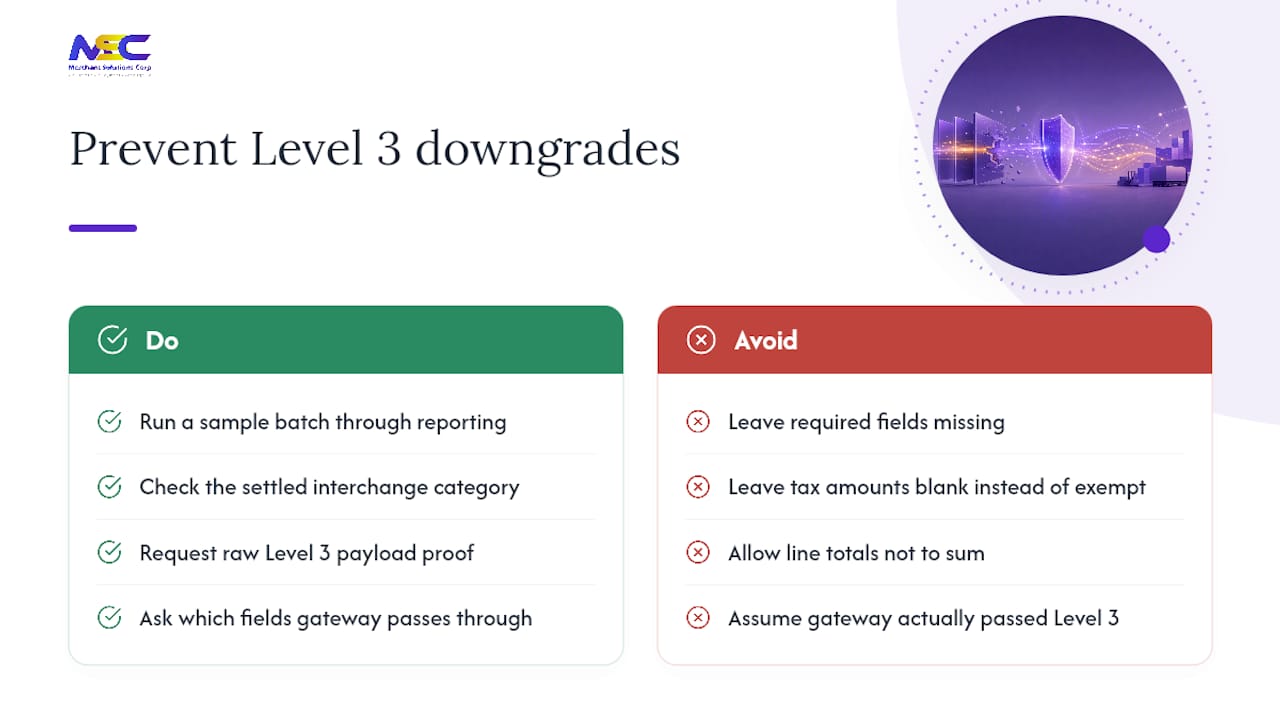
Downgrades usually trace back to a handful of repeat offenders: missing required fields, tax amounts left blank instead of flagged exempt, line totals that don’t sum to the transaction total, gateway settings that silently strip Level 3 data before it reaches the network, and cards that were never eligible in the first place.
Run a sample batch through your reporting and check the actual interchange category each transaction settled at, not just what your gateway claims it submitted. That gap between submitted and settled data is where most merchants lose money without noticing.
Pro Tip: Ask your processor for proof of pass-through, meaning the raw Level 3 payload as it left your gateway. If they can’t produce it, the data likely never made it to the network.
Good questions for your account rep or developer: Which fields does our gateway currently pass through automatically? Can you show settlement data confirming Product 3 qualification, not just submission? What percentage of our commercial-card volume is settling at Level 3 today versus six months ago?
When Should You Prioritize Level 3 Enablement?
Level 3 enablement earns its cost fastest when commercial-card share is high, average tickets are large, or government contracting volume is significant. Below that threshold, the ERP integration path still tends to be worth it, since it captures data you’re already generating.
A provider connects gateway, POS, and ERP systems for merchants pursuing this, with onboarding and testing support built into setup. Processing coverage and industry-specific configurations for high-risk and specialty businesses support B2B and B2G merchants chasing Verified status under Visa’s Product 3 framework.
— Jonathan
Get a Level 3 Readiness Review From Merchant Solutions Corp
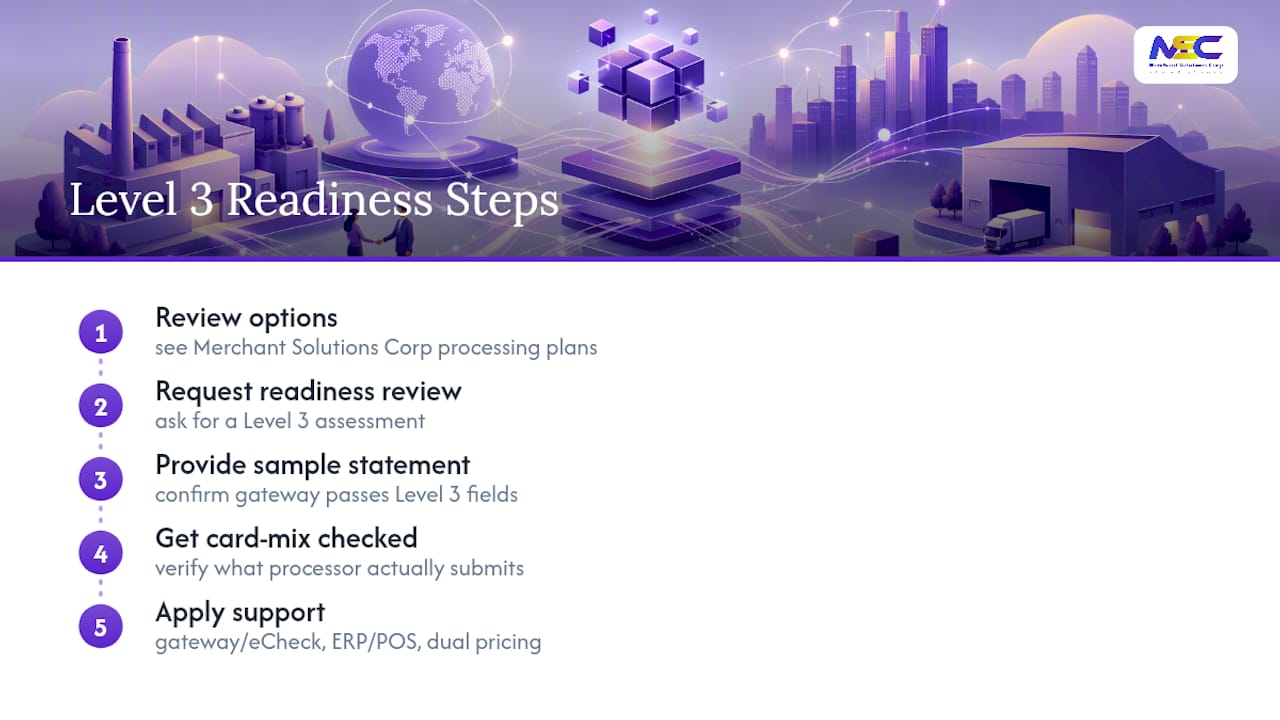
Merchant Solutions Corp gives commercial and government-facing merchants a direct path to Verified Level 3 data instead of guessing whether their current setup qualifies. Support spans gateway and eCheck processing, ERP and POS integrations, and dual pricing programs that offset processing costs on top of any interchange savings.
If you’re not sure whether your current gateway is actually passing Level 3 fields through to settlement, a sample-statement review is the fastest way to find out. Request a Level 3 readiness review and get your card-mix breakdown checked against what your processor is really submitting. Start by reviewing Merchant Solutions Corp’s processing options and requesting a statement analysis today.
Sources
For field-level specs, consult Clover’s Level 3 developer documentation. For endpoint and API patterns, see FortisPay’s Level 3 data guide. For network-specific comparisons, review Checkout.
- Level 2 and Level 3 data: How B2B merchants unlock lower rates (GuidingDecisions)
- Understanding level 3 data (Clover developer docs)
- Level 3 Data endpoint guide (FortisPay docs)
FAQ
What Is Level 2 and Level 3 Processing?
Level 2 processing adds basic commercial data like tax amount and customer code to a transaction. Level 3 processing goes further, adding full line-item detail such as product codes, quantities, and freight, which qualifies eligible commercial and government purchasing cards for lower interchange rates.
What Is L2 and L3 Data, Exactly?
L2 data covers header-level detail like tax amount and a customer reference code. L3 data adds per-line detail including commodity codes, unit cost, and quantity, which is required for the deepest interchange discounts available on commercial cards.
Are Third-Party Payment Processors High Risk?
Risk depends on the processor’s compliance practices and data-handling standards, not simply on being a third party. Merchants should confirm any processor supports proper Level 3 field validation and settlement reporting, since incomplete data submission creates compliance and reconciliation risk regardless of who processes the transaction.
What Are the Top Payment Processors for Level 3 Data?
The right processor depends on your card mix, ERP setup, and industry, since Level 3 support varies by gateway configuration. Merchant Solutions Corp offers gateway, POS, and ERP integrations built to support commercial-card data submission for B2B and government contracting merchants.
Will Visa’s 2026 Changes Affect My Current Setup?
Yes, if you process commercial cards through Visa. The shift to CEDP and Product 3 means merchants now need Verified status and clean data to access preferred rates, and unverified or malformed submissions can trigger penalties instead of partial qualification.