Merchants: Batch, Hit Cutoffs, Reconcile to Get Next Day Funding
Merchants: Batch, Hit Cutoffs, Reconcile to Get Next Day Funding

Next-day funding gets eligible card-sale proceeds into your bank account the next business morning, as long as you close your payment batch before your processor’s cutoff time. It shortens what is often a two-to-three business day wait down to a single overnight cycle. The main catches are the batch cutoff, weekends and federal holidays, and your account’s eligibility status, since new or higher-risk accounts sometimes face holds instead.
TL;DR:
- Batch cutoff times are the most critical factor; missing this time can delay deposits by a day or more even if processing is otherwise on schedule.
- ACH processing does not operate on weekends or federal holidays, causing delays especially for batches closed on Fridays or before holidays.
- New or high-risk accounts often face holds or reserves, which prevent immediate next-day funding until a positive processing history is established.
- Properly setting and confirming your batch close time in writing can significantly improve the reliability of next-day deposits.
- Upgrading to same-day funding from most processors is expensive and only suitable for high-volume, time-sensitive businesses; for others, optimizing batch timing is more cost-effective.
Table of Contents
- What Next-Day Funding Means (And How It Differs From Same-Day and Standard Settlement)
- How Next-Day Funding Actually Works: Batching, Cutoffs, and Settlement Rails
- Eligibility, Holds, and Why Your Deposit Might Be Delayed
- Costs and Tradeoffs: When Paying for Speed Makes Sense
- How to Qualify for and Optimize Next-Day Funding
- How Merchant Solutions Corp Supports Reliable, Faster Funding
- The Operational Playbook Beats the Marketing Promise
- Get Next-Day Funding Set Up Right From the Start
- Sources
- FAQ
What Next-Day Funding Means (And How It Differs From Same-Day and Standard Settlement)
Next-day funding, sometimes labeled T+1, means a card transaction processed today lands in your bank account on the next business day. Standard settlement, often called T+2 or T+3, spreads that same deposit across two or three business days instead. Same-day funding, when a processor offers it, tries to post the deposit within hours, but it usually costs more and only fits merchants with steady, high transaction volume.
The three tiers break down like this:
- Standard (T+2/T+3): Lowest cost, slowest access to cash, common with basic merchant accounts.
- Next-day (T+1): Balanced speed and cost, the default for most established processors.
- Same-day: Fastest, priced at a premium, usually reserved for qualified high-volume merchants.
If your business runs on tight margins between payroll and inventory restocking, next-day funding is generally the better fit. It closes most of the cash-flow gap without the added expense that same-day options carry.
How Next-Day Funding Actually Works: Batching, Cutoffs, and Settlement Rails
Every card transaction gets grouped into a batch before it moves anywhere. Your terminal or gateway closes that batch, either automatically on a schedule or manually, and sends it to the processor. Batch cutoff time is the single most impactful setting for funding speed in the entire chain. Miss it, even by a few minutes, and your batch rolls into the next processing cycle, commonly turning a next-day deposit into a two-day wait.
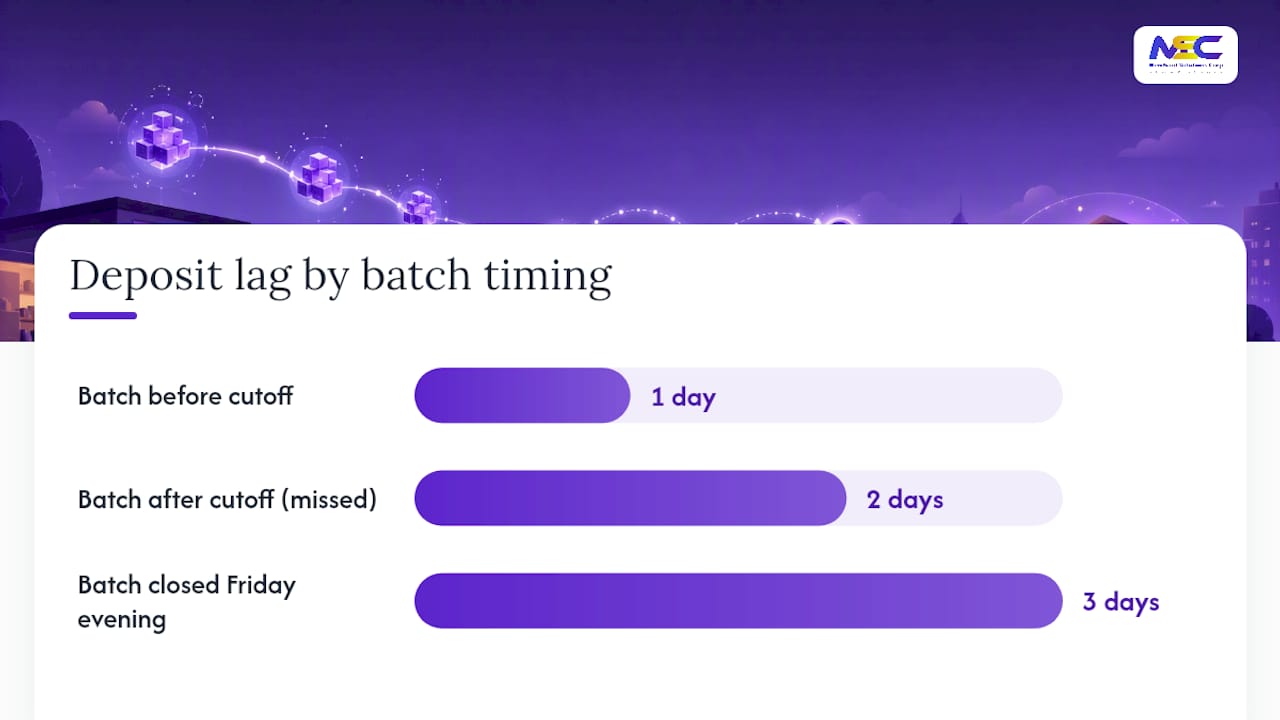
Batch cutoff windows typically fall within typical late afternoon to late evening hours, varying by processor, though the exact time varies by processor. That window matters more than almost any other setting on your account.
Most next-day funding runs on the ACH network. Once your processor submits the batch, ACH rules and your bank’s posting windows determine when the money actually shows up as available funds. A typical timeline looks like this:
- Customer pays at 3:00 PM Tuesday.
- Batch closes at 9:00 PM Tuesday, before the processor cutoff.
- Processor submits the ACH file overnight.
- Funds post to your account Wednesday morning.
Miss that Tuesday cutoff and the same transaction might not post until Thursday. Standard ACH does not process on weekends or federal holidays, so a batch closed Friday evening typically doesn’t land until the following Monday, and a batch closed the day before Thanksgiving or Christmas can slide even further out.
Eligibility, Holds, and Why Your Deposit Might Be Delayed
Not every account gets next-day funding by default. Processors run risk checks that can push newer or higher-risk merchants onto slower settlement schedules or attach reserves to their deposits. Common triggers include:
- A newly opened merchant account without a processing history.
- High average ticket sizes relative to your stated monthly volume.
- Industry classification in a higher-risk category (travel, subscription services, certain specialty retail).
- A sudden spike in transaction volume or an unusual refund pattern.
- Chargebacks above the processor’s threshold in a rolling window.
Some processors respond to risk by offering conditional next-day funding: it works normally until an anomaly trips a manual review, then a batch gets held for verification. Others apply a rolling reserve, holding back a percentage of each deposit for a set period as a buffer against disputes. Processor funding schedules commonly default new or high-risk categories to holds rather than next-day terms until the account builds a track record.
Pro Tip: Ask your processor these three questions before you sign anything: What is my exact batch cutoff time? Is next-day funding standard or conditional for my industry? What triggers a reserve, and how is it released?
Costs and Tradeoffs: When Paying for Speed Makes Sense
Faster funding usually comes at a price, and processors structure that price a few different ways:
- A small percentage uplift added to your standard processing rate.
- A flat per-deposit fee charged each time funds move.
- A bundled package where next-day access is baked into a higher-tier plan.
Rates vary widely by processor and risk profile, so treat any number you see quoted as a starting point for negotiation, not a fixed cost. The premium tends to pay for itself for seasonal sellers who need inventory cash fast, service businesses timing deposits against payroll runs, and any merchant whose supplier terms demand quick turnaround. If your margins are thin and your sales volume is steady and predictable, standard settlement might cost less overall, even if it means waiting an extra day or two. The decision comes down to whether faster access to your own money is worth more to you than the fee.
How to Qualify for and Optimize Next-Day Funding
Getting reliable next-day deposits is less about finding the right processor and more about controlling the variables you actually manage day to day.
- Set your batch close time deliberately. Push it as late in your business day as your processor allows, so you capture the maximum number of transactions before cutoff.
- Turn on auto-batching with a buffer. Manual batch closes get forgotten. Automate the process and build in a 30 minute cushion before the hard cutoff.
- Reconcile deposits daily. Match your bank statement against your processor’s reporting every morning, not once a week, so a missed deposit surfaces fast.
- Get the cutoff time in writing. Ask your processor to confirm it by email or in your contract, not just verbally during onboarding.
- Ask about Same Day ACH or weekend coverage. Some processors offer alternate rails at a premium for qualified merchants who need weekend deposits.
- Confirm your bank’s posting behavior. Some banks post ACH credits the moment they receive the file; others hold until a nightly batch runs, adding invisible delay on their end.
Pro Tip: If a deposit is late, check your batch close timestamp first, not the ACH network. Most “missed” next-day deposits trace back to a batch that closed one minute after cutoff, not a processing failure.
Evening-heavy businesses, like bars, salons, and late-service restaurants, often see the biggest improvement from adjusting batch timing rather than upgrading to a same-day plan, since an earlier close or a second daily batch usually solves the delay more cheaply than paying for speed.
How Merchant Solutions Corp Supports Reliable, Faster Funding
Merchant Solutions Corp works with restaurants, retail, healthcare, and service businesses nationwide to set up processing that supports consistent next-day deposits. That starts with the fundamentals:
- Card and ACH processing configured around your actual batch schedule, not a generic default.
- POS integrations across Clover, Square, and other supported systems, so batch close settings are visible and adjustable from day one.
- Onboarding support that walks through cutoff times, eligibility, and reserve policies before you sign, not after.
- Free hardware program options that remove upfront equipment cost as a barrier to getting set up correctly the first time.
Getting the industry-specific setup right matters more than most merchants realize, since a high-risk classification or a mismatched terminal configuration is often what pushes an account onto a slower settlement track in the first place. For businesses in personal care and similar service categories, timing deposits against payroll and supply costs is its own discipline worth setting up correctly from the start, a challenge covered well in payment guidance for barbershops and service businesses.
The Operational Playbook Beats the Marketing Promise
Every processor advertises next-day funding. Far fewer merchants actually get it consistently, and the gap almost always comes down to operations, not marketing. The batch cutoff time deserves more attention than most business owners give it. It is the one lever you control directly, yet most merchants never ask their processor to state it in writing.
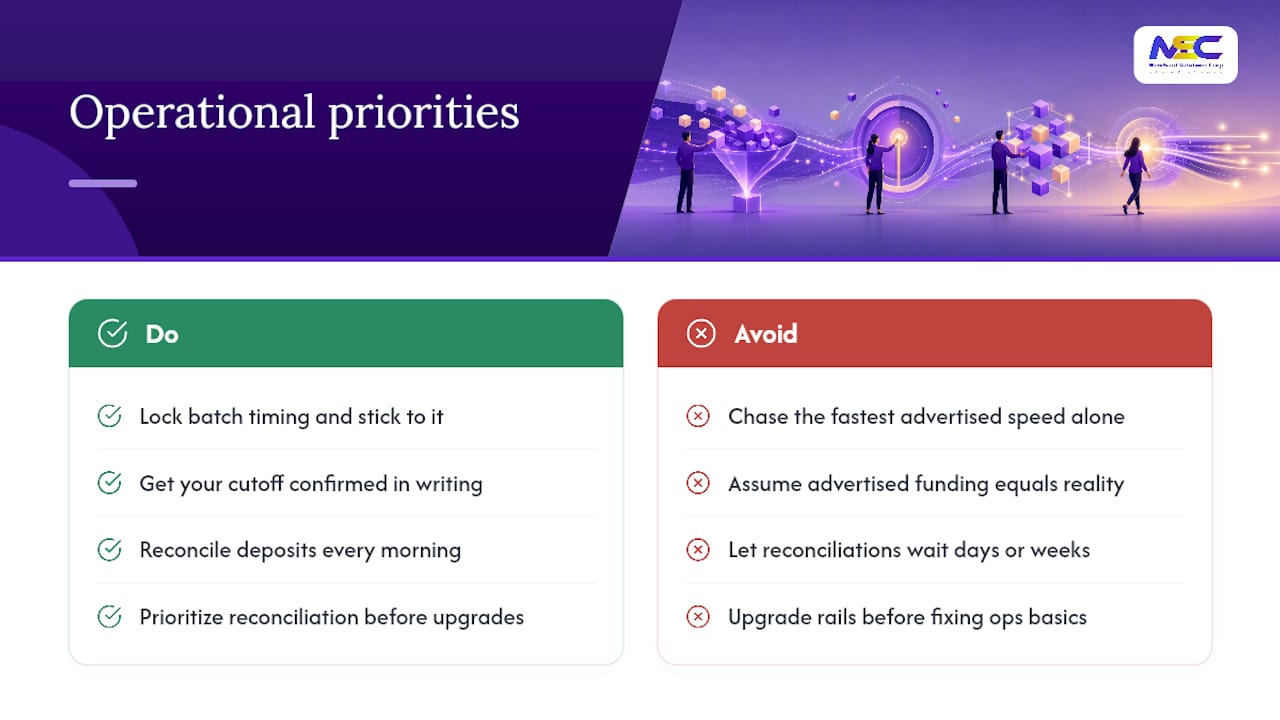
Conventional advice tells merchants to chase the fastest advertised funding speed. That advice skips the more useful question: can you actually hit the cutoff every single day? A same-day plan does nothing for you if your batch closes ten minutes late three times a week.
Prioritize reconciliation first. A missed deposit caught the same morning is a five-minute fix. A missed deposit caught a week later is a cash-flow problem you’re explaining to a supplier. Get your batch timing locked in, confirm your cutoff in writing, and reconcile daily. Everything else, including which rail your processor uses or whether you upgrade to same-day, is a secondary decision once those basics are solid.
— Jonathan
Get Next-Day Funding Set Up Right From the Start
Merchant Solutions Corp is the practical alternative to guessing your way through a processor’s fine print. Instead of discovering your batch cutoff after a missed deposit, onboarding walks you through the exact settings, from terminal batch timing to ACH posting behavior, before you ever run your first transaction.
The setup includes nationwide card and ACH processing, POS integrations across supported systems, and free hardware program options in many cases. Whether you run a restaurant, a retail storefront, or a service business, the goal is the same: predictable next-day deposits without surprises.
Check your funding options and start the payment processing signup today, or explore the POS systems overview to see how terminal settings affect your batch timing before you switch.
Sources
- What Is Next-Day Funding? – Definition & Guide | Tagada
- Settlement Timing: Why Your Deposits Vary | GuidingDecisions
- Deposit Schedules Overview – Shift4 Knowledge
FAQ
How can I get funds immediately from card sales?
Same-day or instant options exist through select processors and premium rails, but next-day funding is the more reliable and affordable standard for most small businesses. True same-day access typically requires qualifying volume and comes at a higher cost than T+1 settlement.
How can I get $500 immediately if I’m waiting on a deposit?
If a next-day deposit hasn’t posted yet, check your batch close time and contact your processor’s support line directly rather than waiting. For an urgent cash gap, a short-term working capital option like a business loan can bridge the timing without disrupting your regular settlement schedule.
Why is my next-day funding taking two days instead of one?
The most common cause is a batch that closed after the processor’s cutoff time, which pushes the entire deposit into the next processing cycle. Weekends and federal holidays also extend timelines, since standard ACH does not process on those days.
Does next-day funding work on weekends?
Standard next-day funding through ACH does not post on weekends or federal holidays, so a Friday evening batch typically arrives the following Monday. Some processors offer weekend coverage through alternate rails, usually at a premium and limited to qualified higher-volume merchants.
Is next-day funding available to new merchant accounts?
New accounts are sometimes placed on standard settlement or a conditional next-day schedule until they build a processing history. Ask your processor directly during onboarding whether your account qualifies for next-day funding immediately or after a review period.