Get SMBs Approved: Merchant Solutions Corp Online Gambling Payments
Get SMBs Approved: Merchant Solutions Corp Online Gambling Payments
In this guide, “online gambling payment processing” means eCommerce and card-not-present payment processing for small and mid-sized merchants, not payment rails built for casinos or sportsbooks. If you run a restaurant, retail shop, or service business and want to accept payments online, the fastest path is an all-in-one gateway and processor that handles cards, digital wallets, and ACH/eCheck. Start there, then filter every option by PCI compliance and effective fee cost.
TL;DR:
- Small businesses should prioritize all-in-one payment providers that bundle gateway, processor, and merchant account services to simplify setup and reduce support issues.
- ACH and eCheck options can lower costs significantly for large-volume invoices and high-ticket transactions, often costing less than card processing fees.
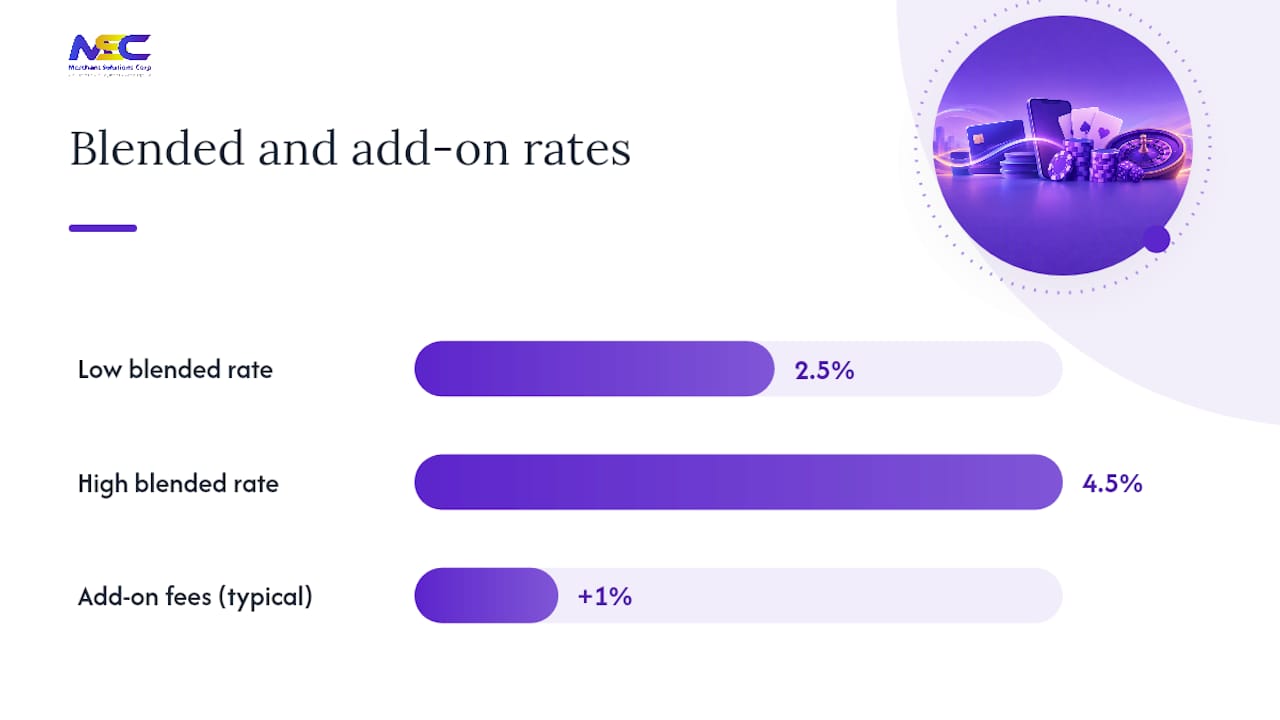
- Effective rates usually range from 2.5% to 4.5%, but fixed fees impact smaller transactions more, and shifting to interchange-plus can save money at higher volumes.
- Security measures like tokenization, AVS, CVV, and 3D Secure help prevent fraud, with the tradeoff between conversion rates and verification strength depending on transaction size.
- International and cross-border sales add fees and risks, including currency conversion spreads and longer settlement times, which should be clarified before expanding into global markets.
Table of Contents
- What Does Online Payment Processing Actually Include?
- How Do Processing Fees Really Add Up?
- What Security and Compliance Should You Require?
- How Do You Set Up Online Payments for an Existing Business?
- Why Merchant Solutions Corp Fits This Setup
- What Compliance Rules Apply to Regulated and High-Risk Merchants?
- How Do You Prevent Fraud on Higher-Risk Online Transactions?
- What Cross-Border and Currency Issues Should You Expect?
- How Fast Do Online Transactions Settle?
- How Are Payment Disputes Handled for Online Sales?
- The Real Filter Isn’t Features. It’s Fit.
- Ready to Start Accepting Payments Online?
- Sources
- FAQ
What Does Online Payment Processing Actually Include?
Card-not-present processing covers every transaction where the customer isn’t standing in front of you swiping a card. That means website checkouts, phone orders, invoices you text a link for, and recurring billing. Four pieces make it work, and mixing them up costs merchants money and headaches.
- Payment gateway: encrypts card data at checkout, sends it to the processor for approval, and returns a yes or no in seconds. Business confirms this encryption and authorization step is mandatory for any business touching card data, which is why PCI compliance isn’t optional.
- Payment processor: the engine that actually moves money between the card networks, the issuing bank, and your merchant account.
- Merchant account: the holding account where your funds land before they settle into your business bank account.
- Virtual terminal: a browser-based screen your staff can use to key in a card for a phone order, plus payment links for invoicing without a shopping cart.
For small businesses, chasing three separate vendors for these pieces creates more support tickets than it solves. An all-in-one provider bundling gateway, processor, and merchant account under one login and one support line cuts setup time and reduces the number of places something can break. That same business.com research notes that hosted or integrated checkout pages also shrink how much of the raw card data ever touches your own servers.
ACH and eCheck deserve a specific mention here. For B2B invoices, high-ticket service contracts, or recurring memberships, ACH/eCheck runs at a meaningfully lower cost than card rails, and it settles directly from a bank account rather than through card networks. If you invoice clients for $500 or more, offering ACH alongside cards is one of the simplest cost levers available.
How Do Processing Fees Really Add Up?
Advertised rates are marketing numbers, not your actual cost. Every processor quotes a percentage plus a fixed fee per transaction, and that fixed fee hits small tickets much harder than large ones.
Ecommerce merchants typically land between 2.5% and 4.5% of online revenue once card mix, average order value, and add-on fees are factored in, with smaller merchants often running toward the higher end.
Here’s why the math shifts so much by business type. A coffee shop with a $6 average ticket feels a $0.10 to $0.30 fixed fee far more than a furniture retailer selling $800 items. Independent rate comparisons show the same pattern across providers: the percentage rate barely moves, but the fixed fee’s bite depends almost entirely on your average order value.
A handful of factors push your blended rate higher, regardless of your base pricing plan:
- Cross-border and currency conversion fees when customers pay from outside the U.S.
- The card network premium tied to American Express transactions.
- Buy Now, Pay Later fees, which typically run higher than standard card rates.
- Chargeback and dispute fees, charged per incident regardless of outcome.
- Refund processing, which some providers still charge on even when the original sale fee isn’t returned.
Detailed pricing breakdowns of what a $100 sale actually nets show cross-border and BNPL fees can add a full percentage point or more to your effective rate.
As a rule of thumb: flat-rate pricing wins when your volume is modest and your transaction mix is simple. Once you’re running higher volume, interchange-plus pricing tends to beat flat-rate once you clear roughly $15,000 to $20,000 a month, because the savings on markup outweigh the added complexity. Calculate your own blended rate quarterly. Volume and card mix shift, and yesterday’s best plan won’t stay the best plan forever.
What Security and Compliance Should You Require?
Every business that accepts online cards falls under PCI DSS requirements, but how much of that burden lands on you depends on your setup. Hosted checkout pages and tokenized card fields keep raw card numbers off your servers entirely, which shrinks your compliance scope down to a simpler self-assessment questionnaire instead of a full infrastructure audit.
Before signing with any payment partner, confirm these five things:
- Whether checkout fields are tokenized or hosted, not built and stored on your own servers.
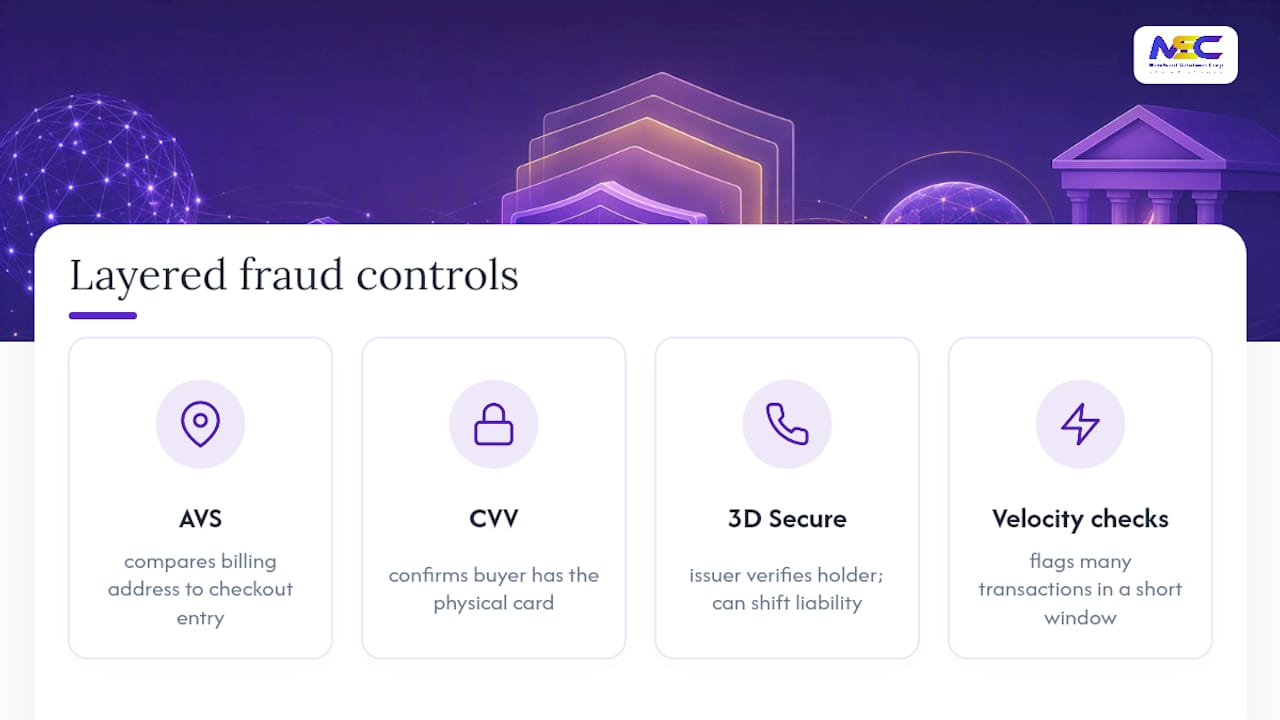
- What fraud screening tools are active by default: AVS, CVV verification, 3D Secure, and velocity checks.
- What the chargeback and dispute fee is, and whether it’s waived on wins.
- Whether receipts and billing descriptors are clear enough to prevent “I don’t recognize this charge” disputes.
- How refund timing and fees are handled.
Pro Tip: Set your billing descriptor to match your actual business name and phone number exactly as customers would search it. A vague descriptor is one of the most common, and most avoidable, causes of chargebacks.
Fraud tools like 3D Secure add a verification step that can shave a percent or two off conversion, so weigh that tradeoff against your actual fraud exposure rather than turning on every filter by default.
How Do You Set Up Online Payments for an Existing Business?
Moving from cash-and-card-in-hand to online acceptance follows a predictable sequence. Skipping steps is what causes delayed approvals and awkward mid-launch surprises.
- Confirm platform compatibility. Check whether your site runs on Shopify, WooCommerce, or a custom build, and decide between a hosted checkout page or an integrated in-page form.
- Choose your rails. Decide whether you need cards and wallets alone, or whether adding ACH/eCheck makes sense for invoices, plus whether BNPL fits your average ticket size.
- Prepare your application. Have your projected monthly volume, average ticket, and business documentation ready; incomplete applications are the top cause of onboarding delays.
- Test in sandbox. Run test transactions, confirm tokenization is active, and verify webhook notifications fire correctly before going live.
- Soft launch and monitor. Start with limited volume, track your effective rate and dispute rate in the first 60 days, and revisit pricing once you cross a volume threshold.
Why Merchant Solutions Corp Fits This Setup
Merchant Solutions Corp operates as a nationwide payment processing and POS provider serving restaurants, retail, and service businesses across the U.S. and Canada. That national footprint matters if you’re opening a second location or shifting between in-person and online sales channels.
The platform bundles the pieces most small merchants juggle separately:
- Credit card and ACH processing under one account.
- POS systems including Clover, Square, and mobile terminals, with hardware programs and upfront options on qualifying setups.
- Dual pricing programs that help offset processing costs.
- Online ordering, self-serve kiosks, and kitchen display systems for restaurant operations.
Merchant Solutions Corp also builds industry-specific setups for high-risk and specialty businesses, which matters if your business falls outside the standard retail or restaurant mold and has struggled to get approved elsewhere.
Before you sign anything, ask a sales representative for specifics: the exact hardware program terms, ACH/eCheck capabilities for your invoice volume, a realistic onboarding timeline, and references from merchants in your industry. A provider confident in its setup will hand those over without hesitation.
What Compliance Rules Apply to Regulated and High-Risk Merchants?
Some small businesses sit in categories that card networks and banks treat as higher risk: vape shops, CBD retailers, certain supplement sellers, and other specialty categories. These merchants face extra underwriting scrutiny, not because the business itself is illegitimate, but because chargeback rates and regulatory exposure in those categories run higher on average.
Compliance in this territory means more than a PCI checklist. Card network rules require accurate merchant category codes, clear age-verification steps where the product category demands it, and documentation showing the business holds any required state or local licensing. A processor that specializes in these categories will typically ask for more documentation upfront: business licenses, supplier agreements, and sometimes a description of your marketing materials.
The tradeoff is worth understanding plainly. Standard processors often decline or later terminate accounts in these categories once volume grows, which forces a disruptive mid-year switch. Working with a processor that explicitly supports specialty and high-risk setups from day one avoids that scramble. It also means your account is underwritten with your actual business model in mind, rather than approved under a generic category and flagged later.
If your business touches a regulated product category, ask any prospective processor directly whether they have documented experience in your specific vertical, and ask to see their underwriting requirements before you apply. Vague reassurance isn’t a substitute for a documented process.
How Do You Prevent Fraud on Higher-Risk Online Transactions?
Fraud risk on card-not-present transactions comes down to one core problem: you can’t see the card or the customer. Every fraud tool in circulation exists to compensate for that missing physical check.
Address Verification Service (AVS) compares the billing address on file with what the customer enters at checkout, catching a large share of stolen-card attempts where the fraudster doesn’t have the cardholder’s actual address. CVV verification adds a second layer, confirming the buyer has the physical card in hand or its number memorized. Layer those together and you block a meaningful share of low-effort fraud attempts before they ever reach your processor.
3D Secure adds a step where the card issuer verifies the cardholder directly, often through a one-time code sent to their phone. It’s more friction at checkout, which can cost you a small percentage of conversions, but it also shifts chargeback liability away from your business in many cases. For higher-ticket transactions, that liability shift often outweighs the conversion cost.
Velocity checks flag accounts or cards attempting multiple transactions in a short window, a common pattern in stolen-card testing. Combine that with manual review triggers for unusually large first-time orders, and you catch the transactions that automated rules alone miss.
None of these tools work in isolation. The businesses with the lowest fraud losses layer two or three together and tune the sensitivity based on their own chargeback history rather than a default setting.
What Cross-Border and Currency Issues Should You Expect?
Selling online rarely stays confined to one country for long, and each cross-border transaction introduces cost and risk that a domestic sale doesn’t carry.
Currency conversion is the most visible issue. When a customer pays in a currency different from your settlement currency, either your processor or a third-party conversion service takes a spread on that exchange, and that spread adds directly to your effective processing rate. Merchants who sell internationally without checking this cost often discover it only when reconciling monthly statements.
Cross-border transactions also carry higher fraud and dispute rates on average, since address verification tools work less reliably across international banking systems and issuer cooperation on fraud checks varies by country. That’s part of why many processors apply a specific cross-border fee on top of the standard rate, separate from any currency conversion charge.
Settlement timing adds another wrinkle. International transactions sometimes take longer to clear and settle than domestic ones, which matters for cash flow planning if a meaningful share of your revenue comes from outside your home market.
The practical takeaway: if international sales are a small fraction of your volume, the added fees are a rounding error. If they’re becoming a significant channel, it’s worth asking your processor directly what their cross-border fee structure looks like and whether they offer multi-currency settlement, rather than discovering the cost after a quarter of statements.
How Fast Do Online Transactions Settle?
Settlement timing is where a lot of merchants get surprised, especially when moving from an in-person, swipe-and-go setup to online sales. A card-present transaction on a POS terminal often settles faster than an online transaction, because card-not-present sales carry more risk and go through additional verification steps before funds move.
Typical settlement for online card transactions runs one to two business days once a batch is processed, though the exact timing depends on your processor, your bank, and your account’s risk profile. New accounts, or accounts processing unusually large transactions relative to their history, sometimes see funds held briefly while the processor confirms the transaction pattern is legitimate.
ACH and eCheck payments settle on a different schedule entirely. Because they move through the banking system rather than card networks, eCheck transactions typically take a few business days to clear, which is slower than a card transaction but often cheaper. That tradeoff between speed and cost is exactly why many merchants offer ACH selectively, for invoices and larger transactions where the customer isn’t expecting instant confirmation, while keeping cards as the fast option for everyday checkout.
If cash flow timing matters to your operation, ask your processor for their specific settlement schedule in writing rather than assuming it matches industry norms. A one-day difference in settlement can matter a great deal to a business managing tight payroll timing.
How Are Payment Disputes Handled for Online Sales?
Disputes on card-not-present transactions follow a stricter path than in-person disputes, largely because the card networks assume more risk sits with the merchant when the card wasn’t physically present.
When a customer disputes a charge, the issuing bank initiates a chargeback, pulling the funds back from your account before you’ve had a chance to respond. You then have a limited window, often set by the card network rather than your processor, to submit evidence: order confirmation, shipping or delivery records, IP address logs, and any correspondence with the customer. Missing that window typically means an automatic loss, regardless of whether the original charge was legitimate.
This is where a clear billing descriptor and a straightforward refund policy pay for themselves. A large share of disputes on card-not-present sales stem from confusion rather than fraud: a customer doesn’t recognize the charge on their statement, or feels a refund request was ignored, and files a chargeback instead of contacting the merchant directly. Fixing that confusion before it becomes a dispute costs nothing and protects both your dispute rate and your standing with your processor.
Every chargeback typically carries a fee regardless of outcome, win or lose, which is why dispute prevention matters more than dispute fighting. Keep records tight, respond to refund requests quickly, and make your customer service contact easy to find on every receipt and confirmation email.
The Real Filter Isn’t Features. It’s Fit.
Most buying guides on this topic drown small merchants in feature comparisons: gateway A supports this many currencies, processor B has a slightly lower advertised rate. That misses the actual decision. The right question isn’t which provider has the longest feature list. It’s which provider matches your actual transaction pattern, your average ticket, and your risk category.
The conventional advice to “just compare rates” falls apart the moment you factor in fixed fees against a low average order value, or the moment your business sits in a specialty category that gets quietly declined by a generalist processor six months in. A $0.05 difference in the advertised percentage rate means far less than getting approved once and staying approved.
Prioritize three things in this order: confirm you’ll actually get approved and stay approved for your business category, calculate your real blended rate against your own transaction data rather than an advertised number, and only then negotiate on price. Skipping straight to price comparison is how merchants end up switching processors twice in one year.
— Jonathan
Ready to Start Accepting Payments Online?
Merchant Solutions Corp gives small and mid-sized merchants a direct path to online payment acceptance without the multi-vendor juggling act. Where a generalist setup leaves you managing a gateway, a processor, and a merchant account separately, Merchant Solutions Corp bundles credit card processing, ACH/eCheck, and POS integration under one account, with free hardware programs and $0 upfront options on qualifying setups.
Before your sales call, have three numbers ready: your projected monthly volume, your average ticket size, and your primary sales channel (website, phone orders, or both). That information lets an onboarding specialist recommend the right rail mix, including whether ACH/eCheck makes sense for your invoice or B2B volume.
Start by reviewing the online and eCommerce payment options or apply directly through the ACH and eCheck processing page to begin your application. Once approved, test your setup in sandbox and confirm your tokenization and PCI approach with the onboarding team before your first live transaction.
If you’re also refining your online storefront ahead of launch, ecommerce SEO tools built for online stores can help make sure customers actually find the checkout you’re setting up.
Sources
- What Is a Payment Gateway? How It Works for Small Businesses
- Payment Processing Fees as % of Revenue: 2026 Benchmark | Eightx
- Best Payment Processor for Small Business in 2026: We Ran the Numbers
FAQ
What Is the Difference Between a Gateway and a Processor?
A payment gateway encrypts and transmits transaction data for authorization, while the processor moves the actual funds between banks and card networks. Most small merchants use a provider that bundles both under one account to avoid managing separate vendors.
What Is a Typical Effective Rate for Online Payments?
Blended effective rates for ecommerce merchants typically fall between 2.5% and 4.5% of revenue once card mix and add-on fees are included. Your actual rate depends heavily on your average order value and how many cross-border or premium-card transactions you process.
Does Merchant Solutions Corp Support ACH and eCheck Payments?
Yes. Merchant Solutions Corp offers a Gateway + eCheck plan for $25 per month, along with per-transaction fees for ACH notifications, returns, and rejects listed on the same page.
When Should a Small Business Choose Interchange-Plus Over Flat-Rate Pricing?
Flat-rate pricing tends to work best at lower monthly volumes because of its simplicity. Interchange-plus pricing typically becomes more cost-effective once monthly volume climbs into the $15,000 to $20,000 range, since the markup savings start to outweigh the added complexity.
How Long Does Online Payment Settlement Usually Take?
Online card transactions typically settle within one to two business days after batching, while ACH and eCheck payments take a few business days longer to clear through the banking system. Exact timing depends on your processor and your account’s risk profile.