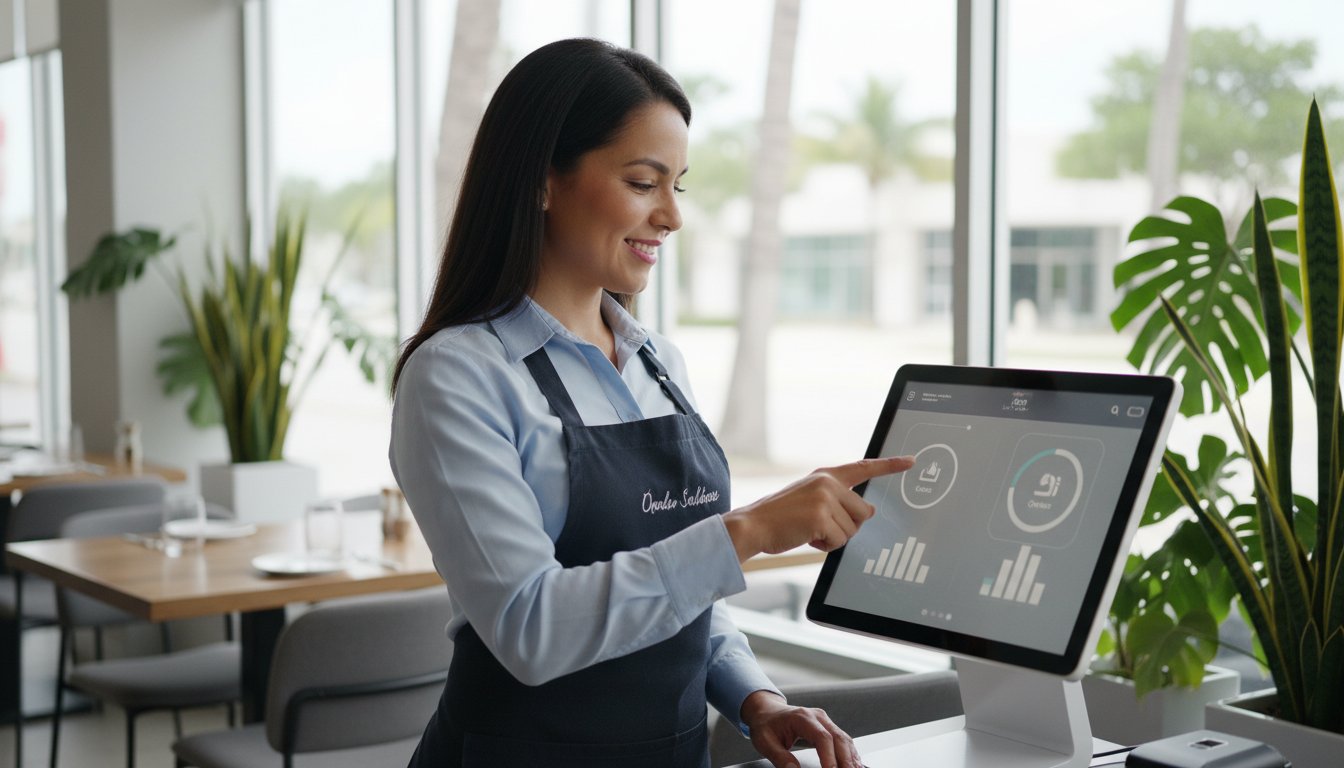
Online Ordering for Restaurants: The Ultimate 2026 Guide to Digital Growth
If you're losing 30% of every ticket to third-party marketplace fees, you aren't running a delivery service; you're funding someone else's tech company. Most owners realize that online ordering for restaurants is essential, yet they still struggle with disconnected inventory and a counter cluttered with vibrating tablets. We agree that this fragmented approach is unsustainable and actively undermines the security of your bottom line. You deserve a solution that empowers your growth rather than taxing your success.
This comprehensive 2026 guide promises to help you reclaim your independence by mastering the transition to digital dining. You'll learn how to select, integrate, and optimize a unified system that offers zero-commission orders and gives you total ownership of your customer data. We'll walk through the specific steps to streamline your operations, reduce technical friction, and future-proof your business against the next wave of industry shifts.
Key Takeaways
- Learn why a digital storefront is the essential backbone of modern dining and how to transition your business into a digital-first powerhouse.
- Discover how seamless POS integration eliminates tablet chaos, creating a streamlined "single source of truth" for your menu and inventory management.
- Master strategies to protect your net margins by identifying profit leaks and optimizing the transaction fees behind online ordering for restaurants.
- Follow a step-by-step roadmap to audit your hardware and launch a direct ordering system that maximizes control and minimizes third-party costs.
- Future-proof your operations with tailored merchant solutions that combine local North Miami support with national-scale technology to ensure long-term growth.
What is Online Ordering for Restaurants and Why It Matters in 2026
Online ordering for restaurants serves as a comprehensive digital storefront where customers browse menus, customize items, and complete transactions through a web browser or mobile application. It functions as a virtual concierge that remains open even when your physical dining room is closed. While the history of online food ordering dates back to the mid-90s, the 2026 landscape has transformed this tool into an absolute necessity for survival. It's no longer just a side channel; it's the primary engine for sustainable growth in a digital-first economy.
To better understand how easy it is to launch your own system, watch this step-by-step tutorial:
The Evolution of Digital Dining
In 2026, the modern restaurant digital ecosystem is a fully integrated web of touchpoints that unify off-premise and on-premise experiences. Order-ahead features and table-side QR codes are now standard expectations for 82% of diners, according to recent industry surveys. If you don't own the customer relationship, you're essentially renting your own business from a tech giant. Direct connections allow you to capture guest preferences and drive repeat visits through tailored marketing rather than relying on a third-party's algorithm.
Direct vs. Third-Party Ordering
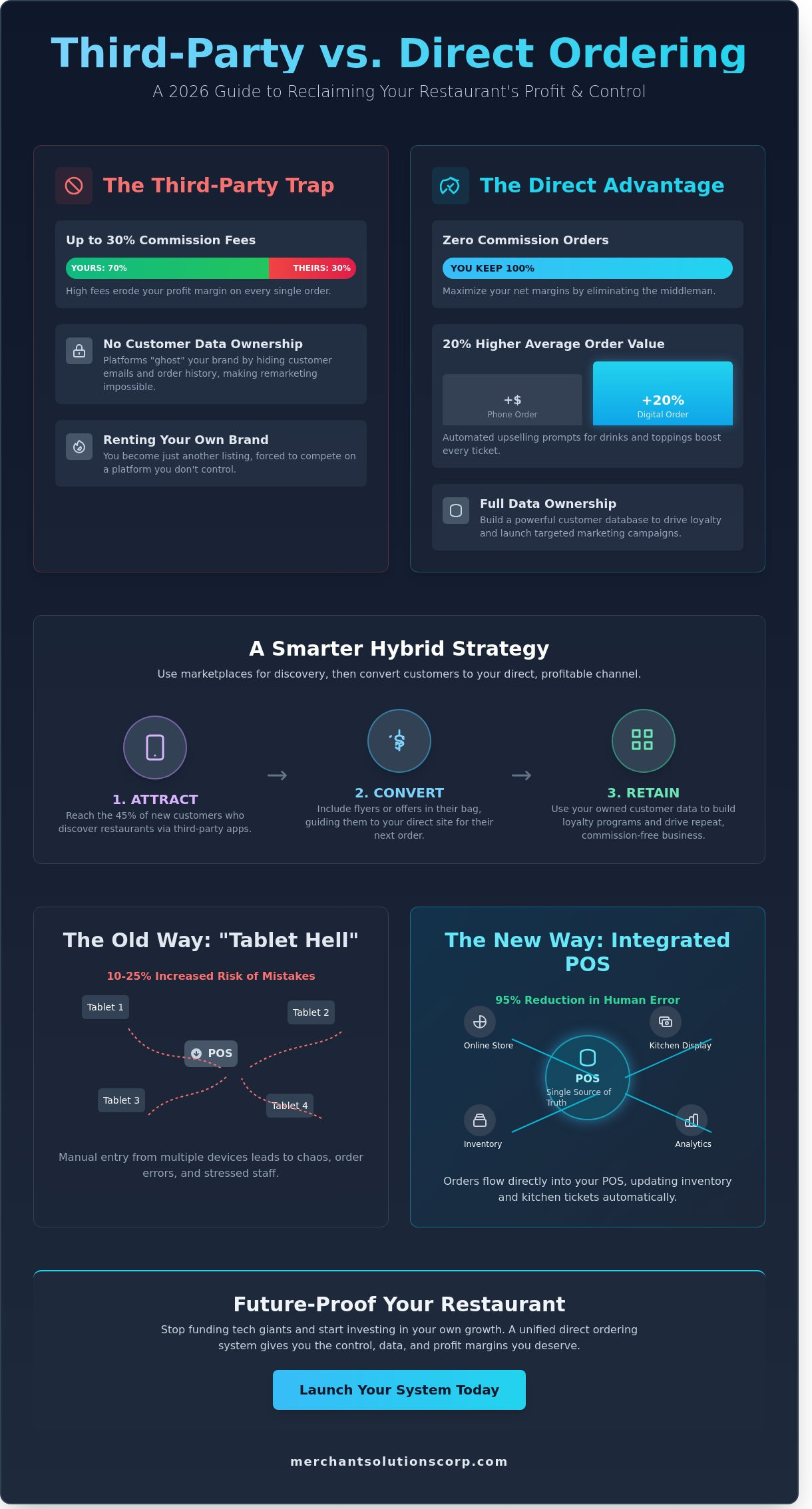
Many operators struggle with the high costs of third-party marketplaces. These platforms often charge commissions as high as 30% on every ticket, which can completely erase a restaurant's profit margin. These apps also "ghost" your brand by withholding customer email addresses and behavioral data, making it impossible to remarket to your own guests. A smarter strategy involves a hybrid approach. Use marketplaces to reach the 45% of new customers who discover food via apps, but migrate them to your direct site for loyalty rewards and better pricing. Integrating a secure payments gateway on your own site ensures you keep more of every dollar earned.
Transitioning to a robust digital platform offers immediate operational wins. Industry data shows that digital orders typically have a 20% higher average order value compared to phone orders because of automated upselling prompts that never forget to ask for an extra topping or a drink. You also gain significant labor efficiency. When you automate the transaction, your staff spends zero minutes manually taking phone orders. This allows them to focus on food quality and in-house guest service. Your digital storefront generates revenue 24/7, even when your doors are locked, by accepting pre-orders for the following day or scheduled catering events. This constant revenue stream is vital for maintaining cash flow in a competitive market.
- Increased Efficiency: Reduce human error in order entry by 95% through customer-led ordering.
- Data Ownership: Build a database of customer preferences to launch targeted promotions.
- Higher Margins: Avoid the "commission trap" by driving traffic to your own branded portal.
The Technical Engine: How POS Integration Drives Digital Sales
Managing online ordering for restaurants shouldn't feel like a high-stakes game of Whac-A-Mole. Yet, many operators still rely on "tablet hell," where five different devices beep incessantly on the counter. This setup is the primary enemy of restaurant efficiency. Every manual entry from a standalone tablet into your POS increases the risk of mistakes by 10% to 25%. A 2024 Purdue University report on consumer trends in food ordering shows that app usage is rising. This means your system must handle higher volumes without breaking or slowing down your kitchen staff.
A "Single Source of Truth" is the only way to scale. This means your POS, like the industry leading Clover POS, acts as the brain of the entire operation. When you change a price or update a description, it pushes to your website and third-party apps instantly. You don't have to log into four different portals to change the price of a burger. Everything stays in sync, ensuring your customers always see accurate information.
Hardware That Supports Growth
Modern growth requires hardware that talks to each other. Integrated systems like Clover and Exatouch eliminate the need for manual data entry. Moving from paper tickets to a Kitchen Display System (KDS) provides digital precision that paper can't match. A KDS tracks preparation times down to the second, helping you identify bottlenecks in real time. While thermal printers still have a place for guest receipts, the digital workflow ensures that orders are routed correctly to the right station every time without a single piece of paper getting lost.
Syncing Menus and Inventory
Nothing kills customer loyalty faster than ordering a dish that's actually out of stock. Automating the "86ing" of items across all platforms simultaneously is critical. Systems like Square POS allow for multi-location syncing, ensuring that if the downtown branch runs out of ribeye, the online menu reflects that immediately. Automated ticket injection means online orders go straight to the kitchen. This removes the "middleman" staff member and reduces order errors by up to 30% because there's no room for misinterpretation during re-keying.
Unified reporting simplifies more than just daily operations. It makes tax season and performance audits painless. Instead of downloading five different spreadsheets from five different vendors, you get one cohesive report showing total sales, tax collected, and platform fees. This clarity allows you to optimize your margins and focus on growth rather than paperwork. If your current setup feels fragmented, it's time to bridge the gap between your counter and the cloud.
Protecting Your Profit Margins: Commissions and Processing Fees
High sales volume often masks a painful reality for modern operators. While digital sales are climbing, net profit margins for many establishments remain thin, often hovering between 3% and 5%. The "profit leak" typically stems from high-commission third-party delivery platforms and unoptimized payment stacks. Online ordering for restaurants shouldn't be a trade-off between growth and sustainability. According to the National Restaurant Association’s analysis of restaurant technology trends, digital integration is now a mainstay, but the cost of processing those transactions requires a strategic approach to protect the bottom line.
Every digital transaction involves two primary components: the processor and the gateway. The processor moves the actual funds between banks, while the gateway acts as the digital connector that securely transmits data from your online checkout page to the processor. When these systems aren't aligned, restaurants often pay redundant fees or higher "card-not-present" rates that range from 2.5% to 3.5% per order.
Eliminating Credit Card Fees
Dual Pricing and Cash Discounting programs legally shift the cost of payment processing to the transaction level by offering customers a choice between two price points. This model allows owners to maintain their menu prices for cash-paying guests while applying a small service fee for credit card users. It's a transparent way to offset the rising costs of digital commerce.
The psychological impact of cash discounting is often misunderstood. Data from 2024 consumer surveys indicates that most diners prioritize convenience and speed over a nominal service fee, especially when ordering online. You'll find that customers are generally accepting of these fees when they're clearly disclosed at the point of sale.
Consider a venue processing $1 million in annual revenue. With traditional 3% processing fees, that restaurant loses $30,000 every year to the bank. By implementing a zero-fee processing structure, that $30,000 stays in the business, providing capital for kitchen upgrades, staff retention, or marketing efforts to expand online ordering for restaurants.
Payment Gateways and Security
A secure payment gateway is the invisible backbone of your digital storefront. It doesn't just process payments; it protects your brand reputation. In a card-not-present environment, the risk of fraud is significantly higher than in-person dining, making robust security protocols non-negotiable.
Maintaining PCI DSS compliance is a legal and financial necessity. Industry reports from 2024 show that the average cost of a data breach for a small business can reach $3.53 million when including legal fees, fines, and lost customer trust. Your gateway must handle the heavy lifting of compliance so you can focus on the kitchen.
Tokenization adds a final layer of defense by replacing sensitive credit card numbers with unique digital identifiers. If a breach occurs, the stolen "tokens" are useless to hackers. This technology ensures your restaurant stays ahead of cyber threats while providing a seamless checkout experience for your guests.
Steps to Launching a Direct Online Ordering System
Transitioning to a direct system for online ordering for restaurants requires more than just a functional website; it demands a technical infrastructure that protects your margins. Start by auditing your current POS hardware and software capabilities. In 2024, industry data showed that 60% of operators struggled with "tablet hell" because their disparate systems failed to communicate. You need a provider that offers an integrated storefront and merchant account. This ensures funds flow directly to your bank without third-party delays, allowing you to future-proof your success by owning your customer data from day one.
Once your backend is ready, design a workflow that prevents kitchen bottlenecks. Staff must be trained on a unified ticket system. If your digital orders don't sync automatically with your kitchen display system, you risk 15% higher error rates during peak rush hours. Focus on a seamless integration that treats a digital order with the same priority as a walk-in guest. This reliability builds the trust necessary to turn a first-time user into a loyal regular.
Menu Optimization for Digital Sales
Digital menus aren't static lists; they're active sales tools. Eye-tracking studies confirm that diners follow an "F-Pattern" when browsing screens, focusing on the top and left sides first. Place your highest-margin items in these "hot zones" to maximize profitability. Use automated modifiers to boost order value effortlessly. For example, a simple "Add Avocado" or "Make it a Meal" prompt can increase average ticket sizes by 12% to 20%. Pair these prompts with professional photography. High-quality images can increase conversion rates by 30% compared to text-only menus.
Marketing Your Direct Channel
To bypass predatory app fees, you must aggressively market your direct link to your existing customer base. Place QR codes on every physical menu, window cling, and takeout bag to transition third-party users to your own platform. You can also capture local search intent by leveraging restaurant Google Ads. This ensures that when a hungry customer searches for your cuisine type, your direct ordering site appears at the top of the results. Use email marketing to re-engage the 45% of diners who haven't ordered in the last 30 days, offering them a loyalty incentive for their next direct purchase.
Future-Proofing Your North Miami Restaurant with Merchant Solutions Corp
North Miami isn't just another market; it's a competitive hub where local flavor meets international demand. Merchant Solutions Corp (MSC) gives you the MSC advantage by pairing boots-on-the-ground support in South Florida with the processing power of a national leader. While generic SaaS platforms offer rigid templates that force you to change your workflow, MSC provides a tailored approach that fits your specific kitchen. We handle the technical heavy lifting, from PCI compliance to complex gateway integration. This lets your team focus on the 1,500-degree ovens and guest experiences instead of troubleshooting software bugs.
Scaling your business shouldn't be a headache. Whether you're launching your first food truck near MOCA Plaza or managing a multi-unit hospitality group across the 305, our systems grow with you. You won't outgrow our infrastructure because it's built to scale instantly as your order volume increases. We bridge the gap between your physical storefront and the digital marketplace, ensuring your brand remains consistent across every channel.
Tailored Solutions for Miami Hospitality
Miami’s hospitality scene faces unique pressures that standard processors often ignore. During peak seasons like Art Basel or the Miami International Boat Show, transaction volumes can spike by more than 40% in a single weekend. Our lodging and hospitality payments are designed to handle these surges without lag or downtime. We provide local hardware support and 24/7 technical assistance because we know your busiest hour might be at 2 AM on a Saturday night. Implementation of online ordering for restaurants shouldn't feel like a gamble. We ensure your hardware and software sync perfectly to prevent missed orders during the lunch rush.
Getting Started Today
Transitioning to a new system is simple and efficient. The onboarding process starts with a quick application and often moves to a live environment within 24 to 48 business hours. We believe in transparent pricing models that respect your bottom line. You won't find hidden surprises or unexplained fees in your monthly statement. It's time to secure a future-proof POS system that works as hard as your kitchen staff. Contact us today to optimize your online ordering for restaurants and claim your place in Miami’s digital growth. Our team is ready to help you streamline your operations and maximize your revenue starting now.
Secure Your Digital Future and Reclaim Your Revenue
Success in 2026 requires more than just a digital menu; it demands a seamless technical engine where your POS integration drives every sale. Data from the 2024 National Restaurant Association State of the Industry report reveals that 55% of consumers prefer ordering directly from a restaurant's own website rather than a third-party app. By moving away from middleman platforms, you protect your profit margins from high commissions and build direct relationships with your guests. Managing online ordering for restaurants shouldn't be a source of stress or a drain on your bank account.
As a Clover Premier Partner based right here in Florida, Merchant Solutions Corp provides the expert North Miami local support you need to scale. Our systems feature secure, PCI-compliant processing that safeguards your business against fraud while simplifying your daily operations. You've worked hard to build your brand, so don't let third-party apps take the credit or the cash. It's time to implement a solution that's as resilient and ambitious as your kitchen staff. We're excited to help you build a more profitable, independent future.
Book a call with a Merchant Solutions expert to launch your zero-commission ordering system today.
Frequently Asked Questions
How much does online ordering for restaurants typically cost?
Online ordering for restaurants typically costs between 15% and 30% per transaction when you use third-party marketplaces. If you choose a direct platform, you'll likely pay a flat monthly subscription fee ranging from $50 to $200. According to 2024 industry data from the National Restaurant Association, technology spending now averages 3% of total revenue. You must also factor in credit card processing fees, which generally sit between 2.5% and 3.5%.
Can I use online ordering without a POS system?
You can use online ordering without a POS system by utilizing standalone tablets or web-based dashboards to manage incoming requests. Many small operators start with a simple kitchen printer connected to a tablet that receives orders via cellular data or Wi-Fi. While this works for low volumes, a 2025 study by Hospitality Tech found that 72% of operators prefer integrated systems. Integration helps reduce manual entry errors and makes your kitchen workflow much more efficient.
How do I stop paying high commissions to third-party delivery apps?
You stop paying high commissions by implementing a first-party ordering system directly on your own website. This shift allows you to keep 100% of the ticket price while building a direct relationship with your customers. Data from 2024 shows that restaurants using direct channels increase their profit margins by 20% compared to those relying solely on third-party apps. You can encourage this transition by offering exclusive loyalty rewards or lower menu prices on your official site.
Is online ordering secure for my customers?
Online ordering is highly secure when you use platforms that maintain PCI DSS Level 1 compliance and utilize tokenization. These technologies ensure that sensitive credit card data is never stored on your local servers, which effectively safeguards your business from data breaches. We implement P2P encryption to protect every transaction from the moment it's swiped or entered. This level of security is standard for 98% of top-tier payment processors to ensure your customers' financial information remains private.
What is the best POS system for integrated online ordering in 2026?
The best POS system for 2026 is one that offers seamless, real-time synchronization between your digital menu and kitchen operations. Systems like Clover currently lead the market, supporting over 600,000 merchants globally with robust app ecosystems. These platforms optimize your workflow by consolidating all orders into a single interface. You should look for a provider that offers future-proof hardware and 24/7 technical support to minimize downtime during your busiest shifts.
How do I handle delivery if I use a direct ordering system instead of an app?
You handle delivery by using "Delivery as a Service" providers like DoorDash Drive or Uber Direct to fulfill orders placed on your website. These services charge a flat fee per delivery, which is often 50% cheaper than standard marketplace commissions. Alternatively, you can hire in-house drivers to maintain full control over the customer experience. Statistics indicate that 60% of diners prefer ordering directly from the restaurant if the delivery experience is reliable and fast.
Can I set up online ordering for a high-risk restaurant business, like a CBD cafe?
You can set up online ordering for high-risk businesses by partnering with a payment processor that specializes in industry-tailored features. CBD cafes and similar establishments require specialized merchant accounts to navigate complex federal and state regulations. We provide customized solutions that handle the compliance burden for you. This ensures your business stays operational and avoids the sudden account freezes that 15% of high-risk merchants face when using traditional banks.
Do I need special hardware to accept online orders in my kitchen?
You typically need a dedicated tablet and a compatible thermal receipt printer to accept online orders in your kitchen. Most modern systems use Bluetooth or LAN-connected printers that trigger an automatic ticket the moment a guest hits the order button. If you're using an integrated POS, your existing kitchen display system can often handle these digital tickets without any additional hardware. This setup helps 85% of kitchens reduce their average ticket fulfillment time by several minutes.