Find the right restaurant payment system for savings
Find the right restaurant payment system for savings

Payment processing fees are one of the most overlooked profit drains in the restaurant industry. While operators focus on food costs and labor, card fees quietly chip away at the bottom line. Restaurants pay 2–3% effective rate, meaning a location doing $1 million in annual revenue hands over $20,000 to $30,000 per year in processing costs alone. That is a full-time employee’s salary. The good news is that choosing the right restaurant payment system, one that fits your volume, your service model, and your budget, puts you back in control. This guide breaks down every major type, what each costs, and how to make the decision that serves your operation best.
Table of Contents
- How to evaluate restaurant payment system options
- The main types of restaurant payment systems
- Comparing fees and features: What really impacts your bottom line
- Making the right choice for your restaurant: Situational recommendations
- Why most restaurants overpay for payment systems and how you can do better
- Streamline your restaurant payments with the right solutions
- Frequently asked questions
Key Takeaways
| Point | Details |
|---|---|
| Know your costs | Payment system fees can easily top $20,000 annually—smart selection can reclaim profit. |
| Match systems to your needs | Choose cloud, on-premise, or hybrid platforms based on your restaurant’s size, volume, and internet reliability. |
| Negotiate and compare | Processor-agnostic POS solutions empower you to negotiate lower rates and adapt as your business grows. |
| Use real fee data | Evaluate payment options against benchmarks and real restaurant scenarios, not just vendor promises. |
How to evaluate restaurant payment system options
Before comparing products, you need a clear framework for what actually matters in a restaurant environment. Payment systems are not one-size-fits-all, and the wrong choice costs you more than just money. It costs you time, flexibility, and sometimes sales.
Start with cost structure. Every payment system has layers of fees: interchange (set by card networks like Visa and Mastercard), processor markup, monthly software fees, and hardware costs. Credit card processing fees vary significantly depending on how your pricing model is structured. Flat-rate pricing (a fixed percentage per transaction) is simple but rarely the cheapest. Interchange-plus pricing, where you pay the raw interchange rate plus a small processor margin, is typically more transparent and negotiable. If you are processing over $30,000 per month, interchange-plus pricing is worth pushing for.
Consider the technology type. The underlying infrastructure matters a great deal:
- Cloud-based systems store data and run software on remote servers. They are easy to update, accessible from any device, and scale well. However, they depend on internet connectivity.
- On-premise (server-based) systems house everything locally. They work without internet but require more upfront investment and IT support.
- Hybrid systems combine both, giving you cloud access with local backup. These are increasingly popular for restaurants that want flexibility without risk.
Cloud-based systems are preferred for scalability and cost in small and mid-size businesses, while on-premise setups offer better offline control and suit high-volume operations.
Ask the right operational questions. How reliable is your internet connection? Do you run multiple locations? Does your payment system need to talk to your accounting software, reservation platform, or loyalty program? These integration requirements shape which systems are realistic for you.
One of the most important but underappreciated factors is whether the POS system is processor-agnostic. Many POS systems lock you into their own payment processing, which removes your ability to negotiate rates. Processor-agnostic systems give you the freedom to shop for better deals.
“The most expensive payment system is not always the most capable one. It is often just the one that was easiest to sell.”
Pro Tip: Before evaluating any system, write down your average monthly volume, your current effective rate, and your top three operational needs. Those three numbers will eliminate half the options on the market immediately.
Exploring restaurant payment processing options with these criteria in mind will help you avoid making a decision based on marketing alone.
The main types of restaurant payment systems
With your evaluation framework ready, it is time to look at what the market actually offers. Each system type has a different profile in terms of cost, capability, and control.
Cloud-based POS and payment systems are currently the most popular category. They require minimal hardware, offer automatic software updates, and can be managed remotely. Providers like Toast, Square, and Lightspeed fall into this group. They are well-suited for fast-casual and quick-service restaurants, as well as operators who want to launch quickly.
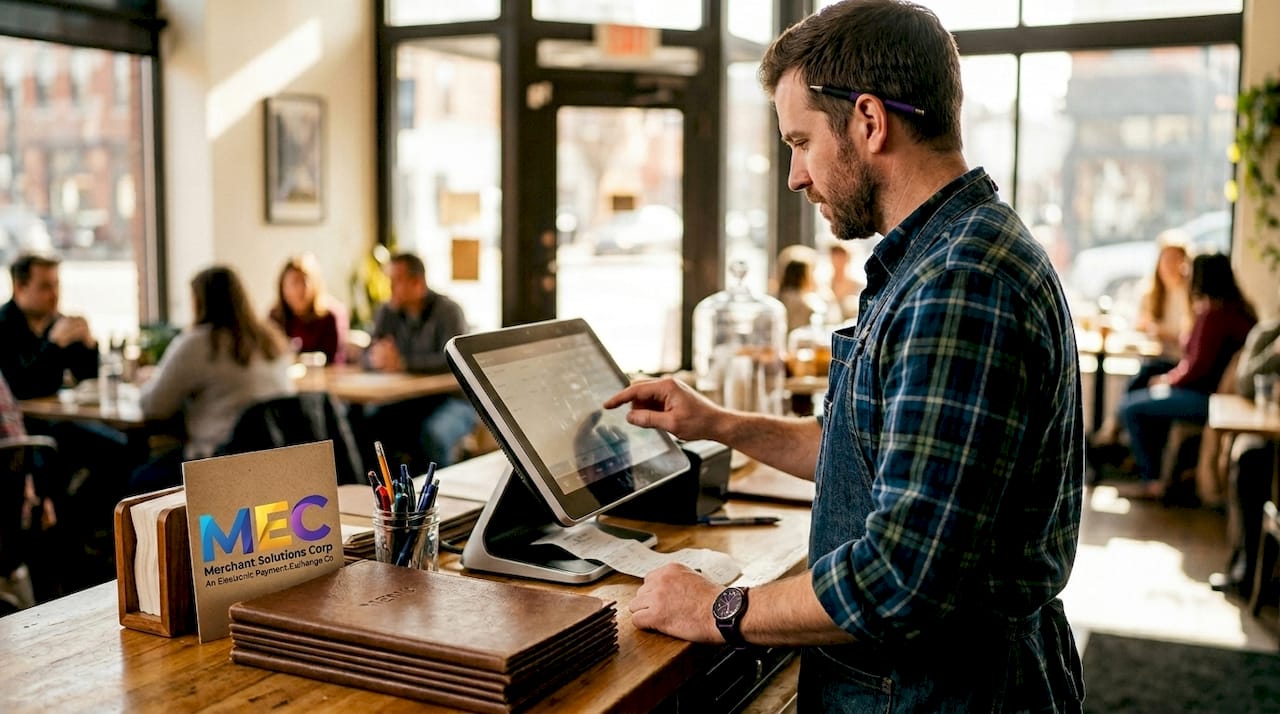
On-premise systems are built around a local server at your location. They are reliable when the internet goes down but require more technical setup. Fine-dining establishments and high-volume kitchens often prefer these for their stability and speed.
Hybrid systems give you the best of both. Your POS functions locally during an outage but syncs to the cloud when connected. This is the setup most commonly recommended for restaurants that cannot afford downtime.
Tablet and mobile POS options are lightweight, affordable, and highly portable. These work well for food trucks, pop-ups, and tableside ordering. They often run on iPads or Android tablets with a card reader attached. For food truck payment systems, mobility and low hardware cost are major advantages.
Integrated vs. processor-agnostic solutions represent a key strategic divide:
- Integrated systems bundle POS software with payment processing under one provider. Setup is simple, but rates are fixed and often higher.
- Processor-agnostic systems let you plug in any payment processor. This means you can negotiate, switch, or use cash discount programs to lower costs.
Popular providers including Toast, Clover, Square, Lightspeed, TouchBistro, and SpotOn each have different integration models. Some lock you into proprietary payment rails, which typically means higher long-term fees. Always check whether your POS provider allows third-party payment processing before signing.
Pro Tip: Ask your POS vendor directly: “Can I use my own payment processor with your system?” If the answer is no, factor that locked-in rate into your total cost of ownership.
For a broader look at how different systems rank in market adoption, POS system popularity data can help contextualize which platforms are gaining or losing ground. A POS overview of available hardware and software options is also worth reviewing before you commit.
Comparing fees and features: What really impacts your bottom line
Understanding each system type is valuable, but the real question is: what do they actually cost, and what do you get for that money?
The fee reality. Restaurants can pay $20,000 to $30,000 per year in card processing fees, and cash discount or surcharge programs can bring those costs close to zero. That range is not hypothetical. It is what many operators are living with right now, often without realizing there are legal alternatives available in most U.S. states.
| System type | Typical effective rate | Monthly software fee | Offline capability | Best for |
|---|---|---|---|---|
| Cloud-based POS | 2.5%–2.9% | $69–$165+ | Limited | Fast casual, cafes |
| On-premise POS | Negotiable (1.5%–2.5%) | $0–$50 | Full | Fine dining, high volume |
| Hybrid POS | 1.8%–2.6% | $50–$150 | Partial | Multi-location, mid-size |
| Mobile/tablet POS | 2.6%–2.75% | $0–$60 | Very limited | Food trucks, pop-ups |
| Processor-agnostic + cash discount | Near 0% | Varies | Depends on hardware | Any restaurant type |
Feature checklist to evaluate any system:
- Accepts all major card types plus contactless payments (NFC, Apple Pay, Google Pay)
- Offers reliable offline mode for internet outages
- Provides real-time sales reporting and end-of-day reconciliation
- Integrates with your accounting, inventory, and scheduling tools
- Supports tip adjustment, split checks, and tableside payment
- Compatible with online ordering and delivery platforms
Cash discount and dual pricing programs deserve special attention. These legally compliant programs allow you to pass card processing fees to customers who pay with a card, while offering a small discount to cash-paying guests. When implemented correctly, your net processing cost can drop to near zero. More details on industry payment savings show how restaurants of different sizes have used these programs effectively.
For a detailed fee comparison across restaurant types and processing models, current 2026 benchmarks are available and worth reviewing before negotiating with any provider.
Making the right choice for your restaurant: Situational recommendations
Numbers and features only get you so far. The right system depends on your specific operation, your team, and how you run your service.
Situational recommendations by restaurant type:
- Quick-service and fast casual: A cloud-based tablet POS with integrated online ordering is typically the right fit. Speed is the priority, and most transactions are counter-based. Square or Clover on a processor-agnostic plan works well here.
- Fine dining: An on-premise or hybrid POS with full tableside payment capability and detailed reporting is ideal. You need reliability and a refined guest experience. Look for systems that support EMV chip and contactless payments at the table.
- Multi-location restaurants: Cloud-based or hybrid systems with centralized reporting and menu management across locations are essential. You cannot manage five restaurants from five separate dashboards.
- Food trucks and pop-ups: A mobile POS running on a tablet or smartphone with a Bluetooth card reader keeps your setup lean. Prioritize offline mode since connectivity at events is often unpredictable.
- High-volume bars and nightclubs: On-premise systems with fast transaction speeds and tab management are a better fit than cloud-only setups, which can slow under heavy load.
“The restaurant industry runs on margins that most other businesses would consider unacceptable. Every dollar you give to a payment processor is a dollar your kitchen cannot spend.”
Avoiding common pitfalls. Internet outages and system misconfiguration can cause thousands of dollars in lost revenue and hours of manual fixes. Many operators blame their POS hardware when the real problem is a poorly configured system or no offline fallback.
Before signing with any provider, ask these questions:
- What is your effective rate on Visa and Mastercard transactions?
- Is your system processor-agnostic or locked to your in-house payments?
- What happens to my POS if my internet goes down for four hours?
- What are the contract terms and early termination fees?
- Can I see a sample statement with all fees itemized?
For POS implementation tips that go beyond the sales pitch, independent guides are available. The best restaurant industry solutions are ones that are configured for your specific volume and service model from day one.
Pro Tip: Request a live demo during your actual service hours, not a pre-recorded walkthrough. See how the system performs under real pressure before you commit.
Why most restaurants overpay for payment systems and how you can do better
Here is something most payment vendors will not tell you at the point of sale: the bundled POS-plus-payments model is designed for convenience but priced for the processor’s benefit, not yours.
When you sign up for an all-in-one system, the fees are baked into the platform in ways that are hard to see at first. A 2.6% flat rate sounds reasonable until you calculate what it costs at $800,000 in annual volume. That is over $20,000 in fees, regardless of whether your actual interchange cost was closer to 1.5%.
The conventional wisdom is that integrated systems are simpler and therefore better. In practice, simplicity often costs you leverage. Processor-agnostic POS systems enable negotiation for rates and long-term savings because they separate the two relationships: your software vendor and your payment processor.
We see restaurant owners who have been on the same bundled plan for four years, paying rates that made sense in year one but are no longer competitive. Nobody called to offer a better deal. That is not an accident. It is how bundled pricing sustains itself.
The action step is simple. When evaluating any POS system, ask before signing whether it supports independent processors. If the vendor resists or redirects the conversation, that is important information. Review proof from real clients to see how restaurants have restructured their payment setup and recovered thousands annually. Your payment system should serve your restaurant. You should not be serving your payment system.
Streamline your restaurant payments with the right solutions
If this guide has made one thing clear, it is that the right payment system is not just a technology decision. It is a financial strategy. The difference between a bundled, locked-in setup and a processor-agnostic, cash-discount-enabled solution can be $15,000 or more per year for a mid-volume restaurant.
At Merchant Solutions Corp, we work with restaurant operators across the U.S. and Canada to build payment processing solutions that are transparent, cost-effective, and fully configured for your service model. From Clover and Square setups to mobile terminals and dual pricing programs, our team helps you find the fit that actually works. Explore our POS systems for restaurants or reach out to speak with a specialist who understands the real cost of doing nothing. Your profit margins deserve better than a default plan.
Frequently asked questions
Which payment system type is most cost-effective for small restaurants?
For most small restaurants, a processor-agnostic cloud POS paired with a cash discount program offers the lowest long-term fees, and processor-agnostic POS can save $10,000 or more per year compared to bundled integrated solutions.
How do cash discount and surcharge programs reduce restaurant payment fees?
These programs pass card processing fees to customers, and cash discount and surcharge options can reduce your net processing costs to near zero in most U.S. states when set up correctly.
What should I do if my internet goes down during busy hours?
Choose a hybrid or on-premise POS with offline capability, since internet outages with cloud-only POS can cost $4,000 or more on a busy night and leave your team unable to accept payments.
Is it better to use an integrated payment system or a separate payment processor?
While integrated systems are convenient, using a processor-agnostic POS gives you the flexibility to negotiate rates and avoid lock-in, and separating your processor with a cash discount program maximizes long-term savings for most restaurant types.
Recommended
- Merchant Solutions Corp | Payment Processing & POS Systems
- Merchant Solutions Corp | Payment Processing & POS Systems
- Merchant Solutions Corp | Payment Processing & POS Systems
- Merchant Solutions Corp | Payment Processing & POS Systems
- 7 Essential Types of Restaurant Payment Methods Explained - Omnichannel payments at the Point Of Sale | Sensepass