Why Roofers Need Payment Processing: Virtual Terminals and Mobile
Why Roofers Need Payment Processing: Virtual Terminals and Mobile
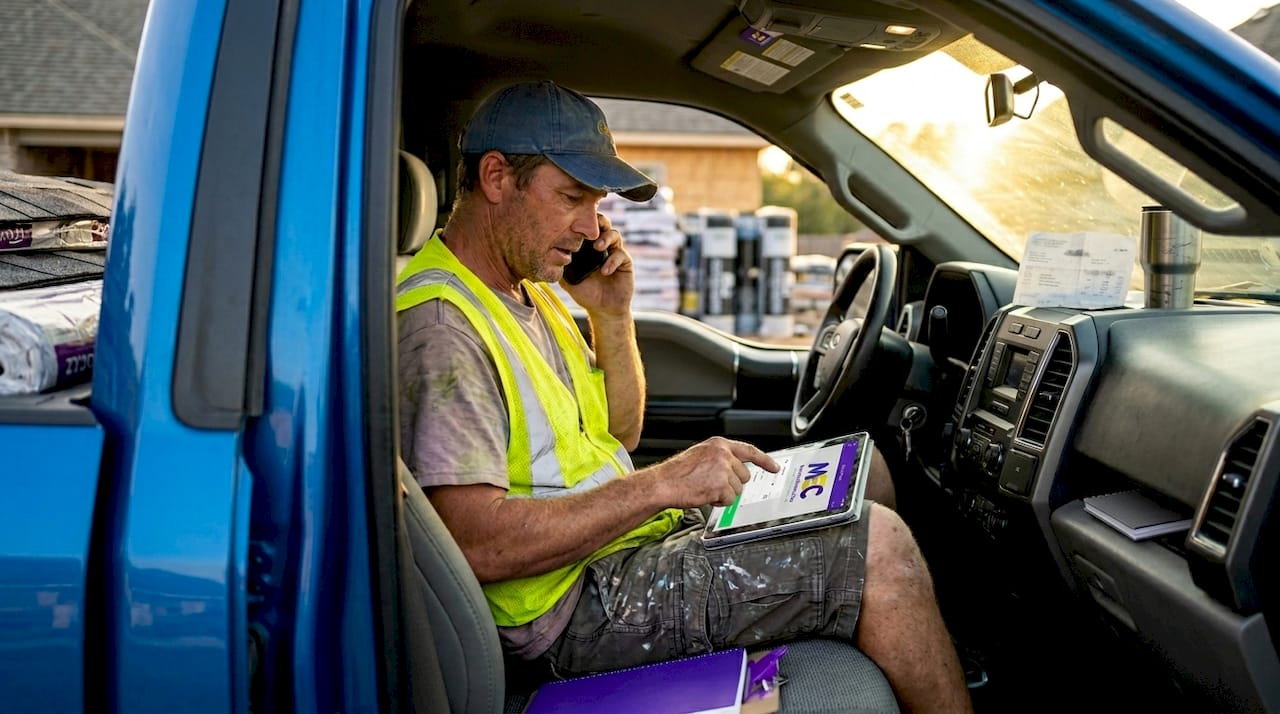
Roofing contractors collect payments in some of the most inconvenient circumstances imaginable. You finish a job on a Thursday afternoon, the homeowner wants to pay by check, and now you’re waiting five business days for funds to clear. Multiply that across a full project calendar, and the cash flow problem becomes real fast. This is exactly why understanding virtual terminals and mobile payment processing matters for your business. These tools, which fall under the broader category of card-not-present and field payment solutions, give roofers the ability to collect money the moment work is complete, whether you’re standing on a customer’s driveway or calling to confirm a final balance from your truck.
Table of Contents
- Key Takeaways
- Why roofers need payment processing virtual terminals and mobile tools
- Key benefits for roofing contractors
- Security and compliance when using these tools
- How to implement virtual and mobile payments in your roofing business
- Comparing virtual terminal and mobile payment options
- My take on why this matters more than most roofers realize
- How Merchantsolutionscorp helps roofers get paid faster
- FAQ
Key Takeaways
| Point | Details |
|---|---|
| Virtual terminals replace manual billing | Web-based card entry lets you collect payment by phone or computer without any physical hardware. |
| Mobile payments speed up cash flow | Tap-to-pay on NFC-enabled phones closes the gap between job completion and money in your account. |
| PCI compliance protects your business | SAQ C-VT guidelines apply to virtual terminal users and require specific network and access controls. |
| Integration reduces admin work | Connecting payments to roofing management software eliminates manual invoice tracking and follow-up. |
| Right provider lowers your costs | Fee-only, no-monthly-contract options exist specifically for contractors and reduce fixed overhead. |
Why roofers need payment processing virtual terminals and mobile tools
Most contractors still rely on checks as their default payment method, and that habit is quietly costing them money. Checks get lost. They bounce. They require a trip to the bank. And while you’re waiting, your payroll, material costs, and overhead don’t pause. Virtual terminals and mobile payment processing directly solve this problem by giving you two flexible ways to collect card payments without a traditional point-of-sale register.
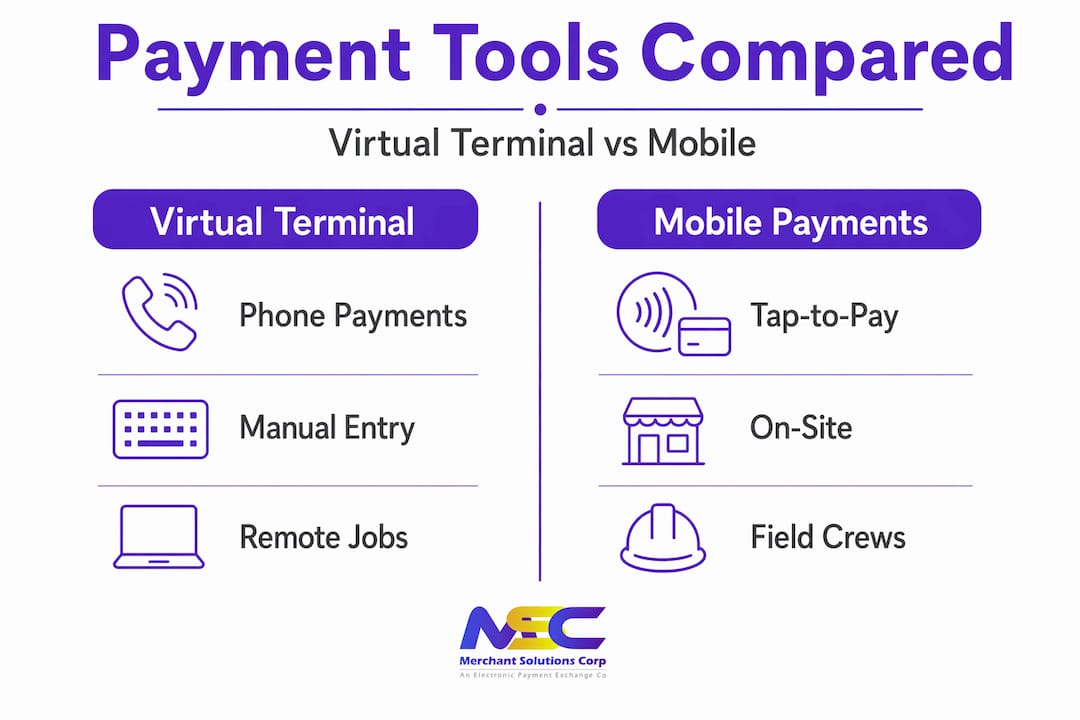
A virtual terminal is a web-based application that lets you manually key in a customer’s card number, expiration date, and CVV to process payments remotely. You access it through any internet browser on a laptop, tablet, or smartphone. There’s no physical card reader required. A homeowner calls you to pay their final balance over the phone, you log in, enter their details, and the transaction is processed within seconds. The money moves the same day or the next business day depending on your processor.
Mobile payment processing works differently. Instead of keying in card data, you’re accepting payments in person using your phone’s NFC capability. Tap-to-pay technology on devices like iPhone 11 and newer, or compatible Android phones, lets a customer tap their card or digital wallet directly on your screen. No extra hardware. No card reader clipped to your phone. The transaction is contactless and typically processes faster than keyed entry, which also makes it less expensive from a per-transaction fee standpoint.
Here’s how these tools map to the typical roofing workflow:
- Phone payments after the estimate. A homeowner approves your quote, wants to pay a deposit by card. You take the payment over the phone through your virtual terminal while still on the call.
- Onsite payments at job completion. Your crew finishes the work. The homeowner is home. You pull out your phone, they tap their card, and the job is fully settled before you leave the driveway.
- Emailed invoices for progress payments. For larger commercial or multi-phase residential jobs, you send a digital invoice with a payment link for each phase, allowing the customer to pay from any device.
Roofers commonly rely on all three payment collection methods depending on the job type, job size, and customer preference. Having access to all three from a single provider means less confusion and fewer gaps in your payment process.
Key benefits for roofing contractors
Switching to virtual terminals and mobile payments changes more than just how you collect money. It changes when you collect it, and that timing matters enormously for a roofing business.
-
Faster cash flow. When you accept payments instantly from phones, tablets, or computers, funds move in one to two business days rather than sitting in a mailbox waiting to become a check. That speed compounds across every job you run.
-
Less manual tracking. Every check you accept requires recording, depositing, reconciling, and following up if it doesn’t arrive. Card transactions post automatically to your account and, when connected to management software, update your records without any manual entry.
-
Fewer missed payments. It’s easier for a customer to delay writing a check than it is to decline paying by card when you’re standing in front of them. Offering to take payment right there, on the spot, removes almost all of the friction that leads to unpaid balances.
-
Flexibility across job types. Deposits before material ordering, progress payments mid-project, final balances at completion. Virtual terminals and mobile tools handle all of these without requiring you to send a separate invoice for each.
-
Better customer experience. Customers expect digital payment options from every service business they interact with. When you offer them, you signal professionalism and make paying easy, which reduces resistance and improves your reviews.
-
Lower fixed costs. Many contractor-specific payment providers offer free virtual terminal access with no monthly fees, meaning you only pay per transaction. That model suits roofing well since job volume fluctuates seasonally.
Pro Tip: When collecting a deposit over the phone, always confirm the full card details verbally and process the transaction while the customer is still on the line. It eliminates disputes and creates a natural confirmation moment without any awkwardness.
Security and compliance when using these tools
Accepting card payments remotely comes with real responsibility. The Payment Card Industry Data Security Standard (PCI DSS) outlines the rules you must follow, and when you process payments exclusively through a virtual terminal, the relevant compliance framework is called SAQ C-VT.

SAQ C-VT compliance applies specifically to merchants who enter card data manually via a web browser. The key requirements focus on controlling who can access your virtual terminal login, segmenting your payment activity from other internet traffic, and keeping a clean log of access and transactions. These aren’t just regulatory boxes to check. They protect your customers and your business from a data breach that could cost far more than any processing fee.
Here’s what that looks like in practice for a roofing contractor:
- Use a dedicated device or browser profile. Don’t process card payments on the same browser tab where you’re checking personal email. Keeping payment sessions isolated limits exposure to phishing and credential theft.
- Secure your network. Taking payments over a public Wi-Fi network at a coffee shop or job site hotspot without a VPN creates real risk. Use a mobile data connection or a secured hotspot for all transactions.
- Enable multi-factor authentication (MFA). Your virtual terminal login should require more than just a password. Most reputable providers offer MFA. Turn it on.
- Patch and update devices regularly. Network segmentation and system patching are foundational PCI compliance measures that roofers using mobile devices across multiple job sites often overlook.
“Protecting cardholder data isn’t just about compliance — it’s about maintaining the trust that customers place in you when they hand over their card details in the first place.”
Never store card numbers, CVVs, or expiration dates in text messages, emails, or written notes. If your payment provider uses tokenization, card data is replaced with a unique identifier the moment it’s processed, meaning the actual number never sits in your system at all. Look for that feature when evaluating providers.
How to implement virtual and mobile payments in your roofing business
Getting set up is simpler than most contractors expect. The real challenge isn’t the technology. It’s choosing the right provider and building the habit with your team.
Start by reviewing your payment solutions for contractors options with these criteria in mind. You want a provider that offers both virtual terminal access and tap-to-pay mobile capability from the same account, transparent transaction fees without hidden monthly minimums, and integration with the roofing management or invoicing software you already use.
Once you’ve selected a provider, the setup process typically follows this path. You create a merchant account, verify your business information, and configure your virtual terminal login. Mobile tap-to-pay is often activated within the same app. The entire process from application to first transaction can take as little as 24 to 48 hours with a contractor-focused provider.
Training your crew is where most roofing businesses drop the ball. Your crews don’t need to understand how payment processing works. They need to know two things: how to open the mobile payment app and how to hand the phone to the customer to tap. That’s a five-minute conversation, not a training seminar.
Pro Tip: Create a laminated one-page cheat sheet for your crew that covers how to take an onsite tap-to-pay transaction and what to do if a card declines. Put it in every truck. It removes hesitation and keeps the payment process moving smoothly on job sites.
When it comes to bookkeeping, connecting your payment processor to software like QuickBooks or a roofing-specific platform automates invoice logging and tracks which jobs have been paid. You stop spending time chasing payment status and start seeing your cash position in real time.
Here’s a comparison of common payment scenarios and the best tool for each:
| Payment scenario | Best tool | Reason |
|---|---|---|
| Customer calls to pay by phone | Virtual terminal | No hardware needed, fast processing |
| Job completion onsite | Tap-to-pay mobile | Contactless, lower per-transaction fee |
| Multi-phase project billing | Emailed digital invoice | Clear record, customer pays at their convenience |
| Deposit before materials ordered | Virtual terminal or invoice link | Collected before work begins, no delay |
Comparing virtual terminal and mobile payment options
Not all payment providers are built the same, and for roofing contractors, the differences matter. Here’s a side-by-side comparison of what to evaluate when choosing between providers offering virtual terminals and mobile solutions:
| Feature | Contractor-focused provider | General payment platform |
|---|---|---|
| Monthly fee | Often $0, transaction-only pricing | Typically $10 to $30 per month |
| Virtual terminal included | Yes, standard feature | Sometimes add-on cost |
| Tap-to-pay mobile | Included via app | May require card reader purchase |
| PCI compliance support | Guided SAQ assistance | Self-managed |
| Roofing software integration | Limited but growing | Broader but less specialized |
| Customer support | Industry-specific teams | General support queues |
A contractor-focused provider will typically understand your seasonal volume swings and won’t penalize you during slower months. General platforms may offer more app integrations but charge monthly fees that add up during your off-season.
One often-overlooked factor is how a provider handles chargebacks. In roofing, disputes can arise over final payment amounts or scope-of-work disagreements. A provider with strong dispute resolution tools and clear transaction records makes it far easier to defend yourself against an unfair chargeback. Make sure your provider gives you detailed transaction logs and timestamps as standard.
My take on why this matters more than most roofers realize
I’ve watched roofing businesses with strong field operations struggle financially not because of bad workmanship or weak sales but because their billing process was broken. Waiting on checks creates a false sense of income that evaporates the moment cash flow tightens. I’ve seen contractors carry unpaid balances for weeks simply because there was no easy way for the customer to pay the moment the job wrapped up.
What surprises most contractors is how much their payment process affects their reputation. A customer who has to hunt for your bank account number or wait for a paper invoice feels uncertain about the transaction, even if the roof looks perfect. Offering a clean, fast, digital payment option communicates competence and organization. It’s one of the clearest signals that you run a professional operation.
The technology itself is not the hard part. Your most powerful business tool is already sitting in your pocket. The shift is mindset. Roofers who embrace field payment tools don’t just get paid faster. They close more jobs, carry fewer outstanding balances, and spend less time on administrative cleanup at the end of the week. That compounds in ways that a single improved process rarely delivers.
— Jonathan
How Merchantsolutionscorp helps roofers get paid faster
If you’re ready to stop chasing checks and start collecting payments the same day work is completed, Merchantsolutionscorp has the tools built for exactly that. As a nationwide payment processing provider, Merchantsolutionscorp offers virtual terminal access, tap-to-pay mobile solutions, and full POS system options, all with $0 upfront hardware programs and no hidden monthly fees for qualifying contractors.
Whether you need a straightforward virtual terminal to take phone payments or a complete mobile solution for your field crews, Merchantsolutionscorp configures your account from day one and supports you through onboarding and daily operations. Dual pricing options are available to offset processing fees, and ACH processing is supported for larger commercial jobs. You can explore the full POS system overview to see how everything connects. Contractors across the US and Canada use Merchantsolutionscorp to lower costs, reduce admin time, and collect payments on the job site without any friction.
FAQ
What is a virtual terminal for roofers?
A virtual terminal is a web-based tool that lets roofing contractors enter card details manually through a browser to process payments remotely. No physical card reader is required, making it ideal for phone payments and remote billing.
How do roofers accept mobile payments on the job site?
Roofers can use NFC tap-to-pay on compatible smartphones (iPhone 11 and newer, or Android) to accept contactless card and digital wallet payments directly on a job site, with no additional hardware needed.
What PCI compliance applies to roofing contractors using virtual terminals?
Contractors who process card payments exclusively through a virtual terminal fall under the SAQ C-VT compliance framework, which requires controlled network access, multi-factor authentication, and secure transaction logging.
Can virtual terminal and mobile payments improve cash flow for roofers?
Yes. Accepting card payments at job completion or by phone means funds typically settle within one to two business days, compared to days or weeks of waiting for checks to arrive and clear.
Are there payment options with no monthly fees for roofing contractors?
Yes. Several contractor-focused providers offer no-monthly-fee virtual terminals where you only pay a per-transaction rate, which suits the seasonal volume patterns common in roofing businesses.