Avoid Surprise Fees: Service Charge vs Tip, IRS Rules and POS Signals
Avoid Surprise Fees: Service Charge vs Tip, IRS Rules and POS Signals
A mandatory service charge is usually not a tip under US law. It’s the restaurant’s revenue unless the business explicitly hands it to staff. If your bill already lists a service charge, you generally don’t owe extra unless the money skips your server. When the charge wasn’t disclosed on the menu or at booking, ask the manager before you pay, and flag it to Merchantsolutionscorp’s checklist below if you run a restaurant and want to avoid the same complaint.
TL;DR:
- Service charges are usually considered business revenue unless explicitly handed to staff, and they do not automatically qualify as tips under IRS rules.
- A payment is a true tip only if the customer freely chooses both the amount and the recipient, otherwise it is classified as a service charge.
- Mandatory charges, such as auto-gratuities or hotel fees, often do not meet the four-factor IRS test and may be treated as wages or service fees depending on disclosure and distribution.
- Digital payment prompts that force guests to select a tip percentage above zero can convert a voluntary tip into a legal service charge, increasing the restaurant’s payroll obligations.
- Disputes over undisclosed service charges are easier to resolve when diners check menus, ask managers, and document any unclear fees before paying.
Table of Contents
- Service Charge vs Tip: The IRS Four-Factor Test
- How Taxes and Paychecks Treat the Two Differently
- Where Service Charges Show Up (and How to Spot Them)
- Should You Tip on Top of a Service Charge?
- What to Do About a Surprise Service Charge
- How Payment Screens Turn a Tip Into a Forced Charge
- State Rules Vary More Than Most Diners Realize
- Where Service Charges and Tipping Actually Came From
- What This Means for Workers’ Paychecks
- Why Diners and Restaurants See These Charges So Differently
- What Employers Risk When They Mislabel a Payment
- How Other Countries Handle This Differently
- Why This Trade-off Deserves More Attention Than It Gets
- How Merchantsolutionscorp Helps Restaurants Get This Right
- Where to Read the Official Rules Yourself
- Sources
- FAQ
Service Charge vs Tip: The IRS Four-Factor Test
The Internal Revenue Service doesn’t care what a restaurant calls a payment. It cares whether four conditions are true. If even one fails, the payment is a service charge, not a tip, regardless of what the receipt says.
The IRS applies a four-factor test to separate the two:
- The payment must be made free from compulsion.
- The customer must have the unrestricted right to determine the amount.
- The payment shouldn’t be dictated by employer policy or negotiated in advance.
- The customer generally has the right to determine who receives the payment.
That last point trips up most auto-gratuity policies. A restaurant can label a fixed percentage charge on a party as a “gratuity,” but if the guest never had a real choice to change or remove it, the label doesn’t matter. The Department of Labor backs this up directly, treating mandatory service charges as non-tip wages under the Fair Labor Standards Act.
A payment is only a true tip when the customer freely chooses both the amount and who gets it. Everything else, no matter how it’s worded on the check, falls under service-charge rules.
How Taxes and Paychecks Treat the Two Differently
The money looks the same on your receipt. Behind the counter, it’s processed on two completely different tracks.
Service charges belong to the business first. When a restaurant distributes that money to workers, it counts as regular wages, subject to standard payroll withholding and W-2 reporting. Tips work differently: they’re the employee’s property from the moment the customer leaves them, reported through tip income rules rather than ordinary wage rules.
That distinction changes real numbers on a worker’s paycheck:
- Service-charge wages count toward regular-rate pay used to calculate overtime.
- Tip income is often used with a tip credit, letting some employers pay a lower cash wage.
- Service-charge distributions are subject to full payroll tax withholding the same way a salary is.
- Tips still require FICA reporting, but through separate tip-allocation and reporting steps.
Some states bar tip credits entirely or require full disclosure before a restaurant can add mandatory charges, so the practical effect on a server’s take-home pay varies by location, not just by federal rule.
Where Service Charges Show Up (and How to Spot Them)
Service charges rarely announce themselves clearly. Learning where they hide saves you from an awkward conversation at the table.
- Large-party auto-gratuities. Groups of six, eight, or more often see an automatic substantial percentage charge added before the bill even reaches the table.
- Hospitality or “kitchen” fees. A flat 3 to 5% line item, sometimes explained as covering rising food or labor costs, sometimes not explained at all.
- Banquet and event charges. Weddings, private rooms, and catered events frequently bundle a mandatory service percentage into the contract.
- Forced digital tip prompts. Some checkout screens won’t let you proceed without selecting a percentage above zero.
Red flags worth watching for: no mention of the charge on the printed menu, a payment screen with no visible “no tip” or $0 option, and vague receipt labels like “svc fee” with no explanation. Check the menu before you order, glance at your reservation confirmation for event pricing, and ask your server directly if you’re unsure.
Should You Tip on Top of a Service Charge?
The short answer: it depends on where the money actually goes, and whether the restaurant tells you.
- If the menu clearly states the service charge is distributed to the staff who served you, an extra tip is optional. You’ve already covered gratuity.
- If the policy is vague, or you suspect management keeps part of the charge as revenue, a small cash tip directly to your server closes that gap.
- Large parties and banquets almost always fold gratuity into the service charge already. Tipping again there is generous, not expected.
Pro Tip: Ask your server directly: “Does this service charge go to you, or does the house keep it?” Most servers will answer honestly, and the question takes five seconds.
Restaurants that keep part of the service charge as house revenue aren’t required to tell you exactly how it’s split. That’s exactly why asking beats guessing.
What to Do About a Surprise Service Charge
A charge you never agreed to isn’t something you have to accept quietly. Work through it in order before you assume you’re stuck paying it.
- Check for disclosure first. Look at the printed menu, the online menu, and your reservation confirmation for any mention of the fee.
- Ask the manager, not just your server. Request a plain explanation of what the charge covers and whether it’s distributed to staff.
- Ask for removal if it wasn’t disclosed. Reasonable disclosure is generally required for a mandatory charge to be enforceable, so an undisclosed fee has a real chance of being waived.
- Escalate if it’s not resolved. Dispute the charge with your card issuer or file a complaint with your state’s consumer protection office if the restaurant won’t budge.
Documenting the response, even a quick photo of the menu or a screenshot of your booking confirmation, makes any later dispute far easier to win.
How Payment Screens Turn a Tip Into a Forced Charge
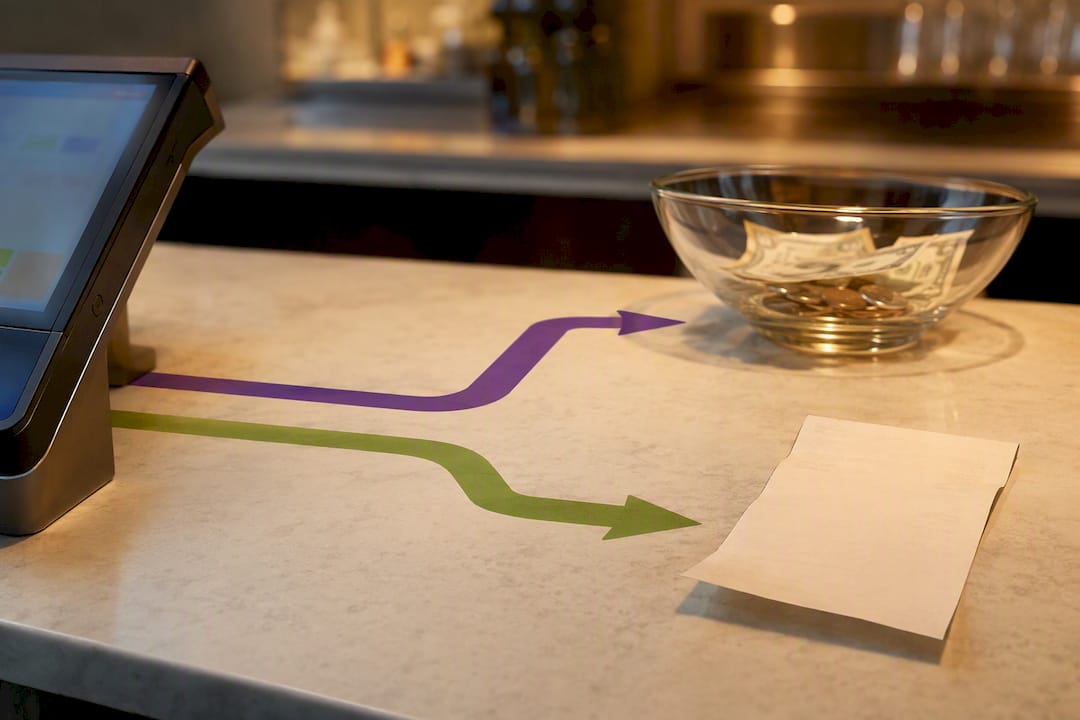
The checkout screen itself can quietly decide whether a payment is legally a tip or a service charge. A prompt that forces guests to pick a percentage above zero before completing payment removes the “voluntary” element the IRS requires, functionally converting a tip into a service-charge-like payment even when no one intended that outcome.
Clear disclosure comes down to a few concrete habits:
- Label the line item exactly as what it is: “service charge” or “gratuity,” not a vague abbreviation.
- State the distribution policy on the receipt or the menu, not buried in fine print.
- Always show a genuine $0 or “no tip” option on digital screens, never just preset percentages.
A well-configured point-of-sale system can display a distinct “service charge” line with a short note like “distributed per restaurant policy,” while keeping a separate, optional tip line beneath it. Separating the two in both the interface and the back-end accounting is what prevents a payment from being misclassified later.
When receipts and screens are set up this way, diners see exactly what they’re paying and why, and restaurants field far fewer disputes at the register.
State Rules Vary More Than Most Diners Realize
Federal law sets the floor, but states layer their own requirements on top, and the gaps between them are wider than most menus admit. Some states require restaurants to disclose mandatory charges in writing before the meal is ordered, not just print them at the bottom of the check. Others regulate how service charges interact with sales tax, since a charge that’s really a service fee may be taxable in ways a voluntary tip never is.
A handful of cities have gone further and passed disclosure ordinances specifically targeting hidden fees on hospitality bills, responding to years of consumer complaints about “junk fees” tacked onto everything from event pricing to delivery orders. Where those ordinances exist, a restaurant that fails to disclose a mandatory charge upfront can face real consumer protection exposure, not just an annoyed customer.
Practical steps for diners facing an unfamiliar charge: check whether your state or city has a service-charge disclosure law, since a quick search of your state attorney general’s consumer protection page usually turns up the answer. Save a copy of the menu or booking confirmation before your visit, since that’s the first thing a manager or card issuer will ask for. Ask the question at the table rather than after you’ve already paid; refunds are far easier before a transaction settles than after.
None of this requires a law degree. It requires knowing that “18% service charge” printed at the bottom of a menu in one state might carry different disclosure obligations than the identical line in another.
Where Service Charges and Tipping Actually Came From
Tipping in the United States traces back to the decades following the Civil War, when the practice was imported from European aristocratic customs and expanded rapidly in the restaurant and railroad industries. It became deeply tied to a workforce that included many formerly enslaved people, who were often paid little or nothing in wages and left to depend entirely on customer generosity. That history is part of why tipping’s critics still argue the system was built on unstable, discretionary income rather than guaranteed pay.
Service charges emerged much later as a business tool, not a labor reform. Hotels and banquet operations adopted mandatory percentages decades ago to guarantee predictable revenue for large events, where staffing costs were fixed regardless of how generous any individual guest felt. Restaurants adopted the same logic for large parties once operators noticed that big tables tipped proportionally less than smaller ones, a pattern well documented in service industry management circles for years.
The more recent wave, full-service restaurants replacing tipping entirely with a flat service charge, gained momentum as some operators tried to stabilize kitchen and server pay parity and reduce reliance on unpredictable nightly tip totals. That shift has been uneven. Some restaurants that tried all-inclusive pricing reverted to traditional tipping after some time, citing customer confusion and staff pushback over reduced take-home pay during slow periods.
Both systems, tipping and mandatory service charges, exist today because neither one fully solved the problem the other created.
What This Means for Workers’ Paychecks
The choice between tipping and service charges isn’t abstract for the person carrying your plates. It changes how much they take home and how stable that income is week to week.
Tip income is famously volatile. A slow Tuesday can pay a server half of what a busy Saturday brings in, even with identical hours worked. Mandatory service charges, when properly distributed, smooth that out, giving kitchen staff, bussers, and servers a more predictable share instead of leaving support staff dependent on servers voluntarily sharing tip pools.
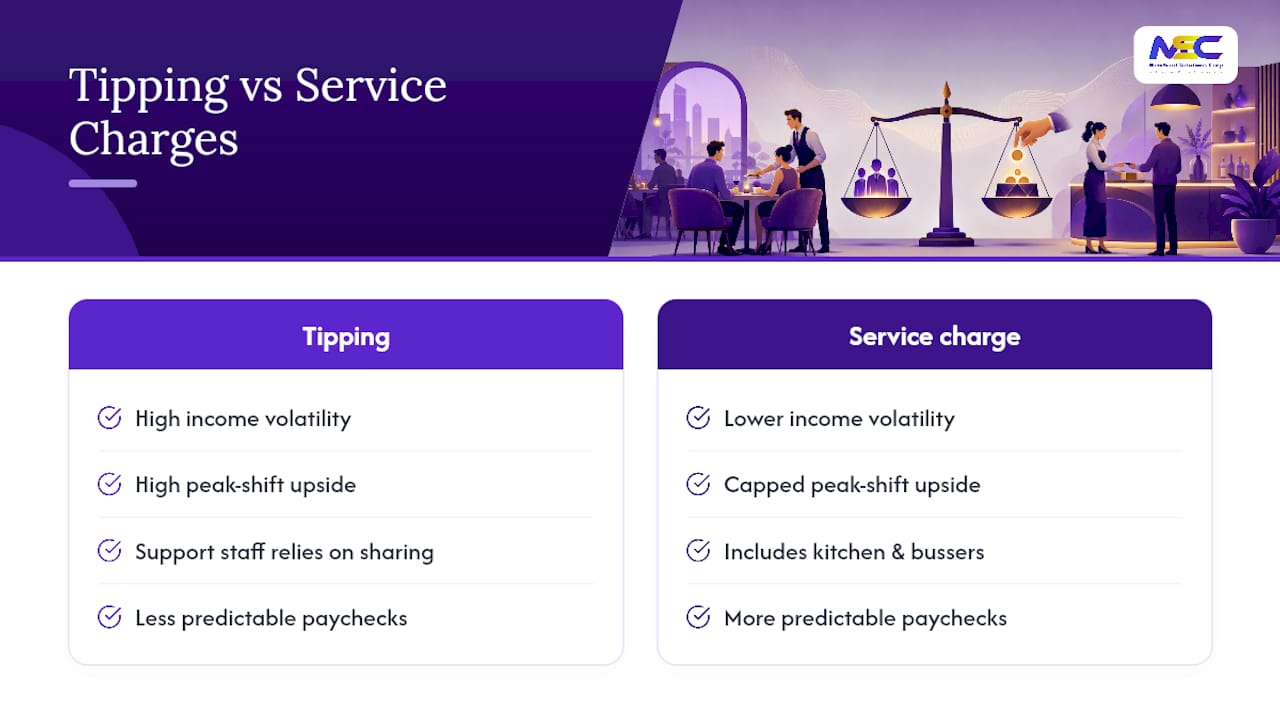
That predictability comes at a cost some workers don’t love. Tip income has historically let high-performing servers earn well above minimum wage during busy shifts, and service-charge models that redistribute money more broadly can cap that upside. Some servers in cities that shifted toward all-inclusive pricing have reported lower overall earnings during peak periods compared to a strong tip night, even as slower shifts became more livable.
Labor relations enter the picture when service charges replace tips at scale. Because service-charge distributions count as regular wages, they factor into overtime calculations differently than tip income does, which can raise labor costs for restaurants that previously relied on tip credits to keep base wages lower. Some operators have scaled back service-charge models specifically because the payroll tax and overtime math didn’t work in their favor once the accounting settled.
The bottom line for workers: neither system is uniformly better. It depends on the restaurant’s volume, the size of the kitchen staff sharing the pool, and how transparently the charge gets distributed.
Why Diners and Restaurants See These Charges So Differently
Ask a diner what a service charge should mean and you’ll usually hear some version of “it’s the tip, right?” Ask a restaurant owner and the answer is often closer to “it’s how we keep the kitchen staffed.” That gap in expectations is where most of the friction lives.
Diners tend to assume a percentage on their bill, labeled with any word resembling “gratuity” or “service,” functions as a tip: it goes to their server, and they’ve done their job by paying the check. Coverage of consumer complaints shows diners are frequently surprised to learn a service charge doesn’t reach their server at all, or reaches a broader pool that includes kitchen staff and management.
Restaurants, meanwhile, often see the charge as an operational tool rather than a gratuity substitute. It’s there to guarantee revenue for large parties, fund back-of-house wages more evenly, or offset rising costs without raising menu prices outright. From the business side, calling it a “service charge” instead of a “price increase” is partly a framing choice, and one that doesn’t always account for how customers will interpret the word “service.”
The mismatch shows up most sharply with tip percentages. A diner leaving 10% on top of an already-hefty service charge might feel like they’ve been more than fair. A server who never sees a cent of that service charge might see the same 10% as an insult, unaware the guest already believed they’d covered gratuity in full. Neither party is wrong given what they know. They’re just working from different assumptions about where the money went.
What Employers Risk When They Mislabel a Payment
Calling something a “tip” on a menu doesn’t make it one, and courts have made that expensive lesson clear more than once. The Eleventh Circuit has upheld a restaurant’s mandatory service charge as satisfying wage requirements specifically because the charge functioned as wages, not a voluntary tip, despite informal references to it as a gratuity.
The legal exposure runs in both directions. An employer that labels a mandatory charge a “tip” to avoid payroll tax and overtime obligations risks a wage-and-hour claim once regulators or employees realize the payment never met the four-factor test. Conversely, an employer that treats a genuinely voluntary tip as company revenue, skimming from a tip jar or pooling tips into management earnings, risks violating tip-ownership protections that exist specifically to keep that money with the employees who earned it.
Employers switching from a tipping model to a mandatory service-charge model face a less obvious risk: the payroll math often changes more than expected. Losing the tip credit while gaining full payroll tax exposure on redistributed service-charge wages can raise labor costs meaningfully, which is why running a payroll and tax impact comparison before switching models matters more than most owners assume going in.
The safest position for any restaurant is consistency: pick a model, disclose it clearly in writing, and apply the same rules to every party, every event, and every receipt.
How Other Countries Handle This Differently
The United States is something of an outlier in how heavily it relies on discretionary tipping to fund service wages. Most other developed economies build service compensation into the price of the meal from the start, which changes the entire dynamic diners in the US take for granted.
In much of Western Europe, a service charge of roughly 10 to 15% is often included in the menu price by law or common practice, and workers are paid a standard wage independent of that charge. Leaving an additional small amount for exceptional service is common but genuinely optional, not expected the way an 18 to 20% tip is in an American restaurant.
Japan and South Korea take a different approach entirely: tipping isn’t customary and can even come across as awkward, since service quality is considered part of the baseline price, full stop. Australia and New Zealand followed a similar path, building higher minimum wages into menu pricing rather than depending on customer generosity to close the gap.
The practical lesson for US diners traveling abroad, and for US restaurants studying alternative models, is that the American system isn’t the only way to fund service work. It’s a historical artifact that other countries solved differently, and the ongoing shift toward mandatory US service charges is, in some ways, an attempt to import elements of that international model without abandoning tipping culture entirely.
Why This Trade-off Deserves More Attention Than It Gets
Service charges and tips solve different problems, and pretending they’re interchangeable hurts both diners and workers. Predictable service-charge distribution helps kitchen staff, but it can strip away tax advantages and overtime protections built for a tip-based system. Clear menu and receipt disclosure fixes most of the friction, yet state rules on distribution and sales tax still vary enough that the same charge means something different depending on where you’re eating.
— Jonathan
How Merchantsolutionscorp Helps Restaurants Get This Right
Confusion over service charges usually starts at the register, not the menu. A checkout screen with vague prompts or a receipt with an unlabeled fee line creates the exact disputes covered above, and it’s avoidable with the right setup.
Some payment processing providers work with restaurants to configure POS prompts that show a genuine no-tip option, label service charges clearly, and separate voluntary gratuity from mandatory fees in both the display and the back-end reporting. Dual-pricing programs can help offset processing costs without adding another confusing line item to the bill, and kiosk or QR ordering setups can be built similarly, so digital checkout never forces a selection a guest didn’t actually choose.
If your restaurant wants receipts and payment screens that build trust instead of complaints, start with Merchantsolutionscorp’s payment processing and POS solutions built for exactly this kind of transparency.
Where to Read the Official Rules Yourself
For the primary source on tip reporting, the IRS’s tip recordkeeping guidance and its service charge versus tip explainer cover the four-factor test in full. The Department of Labor’s Fact Sheet #15 explains wage and overtime treatment. For plain-language breakdowns, HowStuffWorks and LegalClarity both offer clear consumer explainers worth bookmarking.
Sources
- Tip recordkeeping and reporting | Internal Revenue Service
- Covert and confusing ‘service charges’ anger US diners | The Guardian
FAQ
Should I still tip if there’s a service charge?
It depends on distribution. If the restaurant clearly states the charge goes to your server, an extra tip is optional; if the policy is unclear, a small cash tip closes the gap.
Is a 20% service charge the same as a tip?
No. A 20% service charge is generally treated as employer revenue and taxable wages when distributed, not employee tip income, unless the customer had a genuine choice in the amount.
Is a 10% tip disrespectful?
Not automatically. If a mandatory service charge already covers gratuity, a smaller additional tip isn’t an insult, it just reflects that the guest already paid for service through the charge.
Is a service charge the same as tipping?
No. A tip requires voluntary choice over the amount and recipient under IRS rules, while a service charge is set by the business and counts as its revenue unless distributed as wages.