6 Step Tip Pooling Compliance Audit for Restaurants: Fix POS & Payroll
6 Step Tip Pooling Compliance Audit for Restaurants: Fix POS & Payroll

Tip pooling is legal under federal law, but only if you follow strict rules set by the Fair Labor Standards Act and the Department of Labor. You must notify employees of the pool’s terms, distribute pooled tips by the regular payday, and keep accurate records if you claim a tip credit. Check your state’s rules too, since several states restrict or ban tip credits outright.
TL;DR:
- Employers paying the full minimum wage without a tip credit can include back-of-house staff in nontraditional pools, but must accurately track and document the wage model used.
- Managers, owners, and supervisors are strictly prohibited from keeping any portion of pooled tips, even if they perform direct service work for tips.
- Tips must be distributed to employees promptly, ideally with each paycheck or as soon as practicable after finalizing card tips, to comply with federal timing requirements.
- State laws may restrict tip pooling further, banning tip credits or requiring additional notice, making compliance checks essential for each jurisdiction.
- Ensuring POS and payroll systems separate direct tips from pooled tips at the point of capture and reporting is critical to avoid late payouts and recordkeeping violations.
Table of Contents
- What Federal Law Says About Tip Pooling Compliance
- How Do Tip Credits Affect Pool Eligibility?
- Can Managers or Owners Keep a Share of Pooled Tips?
- When Must You Distribute Pooled Tips?
- Do State Tip Pooling Laws Differ From Federal Rules?
- What’s a Practical Tip Pooling Audit Checklist?
- What Should a Tip Pooling Policy Include?
- How Should Your POS and Payroll Systems Handle Tips?
- Where to Verify Tip Pooling Rules and Requirements
- Set Up Tip-Compliant Payment Systems With Merchant Solutions Corp
- An Editorial Take on Tip Pooling Compliance
- Sources
- FAQ
What Federal Law Says About Tip Pooling Compliance
Tip pooling compliance starts with one statute: 29 U.S.C. 203(m), the section of the FLSA that governs tipped wages. It sets the terms under which an employer can count tips toward the minimum wage and defines what a mandatory tip pool can and cannot do. The regulation that turns that statute into day-to-day practice is 29 CFR §531.54, which spells out who can be in a pool and how fast you have to pay it out.
The 2018 Consolidated Appropriations Act rewrote a big piece of this picture. Before that amendment, employers who paid the full minimum wage still couldn’t touch tip pools at all. After 2018, the DOL’s final rule confirmed that employers may collect and redistribute tips to run a pool, as long as they never keep any of it themselves and they distribute the money promptly. That single change opened the door for back-of-house staff, like cooks and dishwashers, to share in tips when the employer pays everyone the full minimum wage rather than taking a tip credit.
More recently, a 2026 Federal Register rule on qualified tips clarified which occupations count as “customarily and regularly” tipped for tax purposes. This is an IRS classification question, not an FLSA one, and the two shouldn’t be confused when you’re building a pool.
Three federal touchpoints matter most for tip pooling compliance:
- The FLSA statute (29 U.S.C. 203(m)) sets the wage floor and tip-credit conditions.
- 29 CFR §531.54 operationalizes distribution timing and pool participation.
- The 2018 CAA amendment removed the ban on employers facilitating pools that include non-tipped staff, when full minimum wage is paid.
How Do Tip Credits Affect Pool Eligibility?
Whether you take a tip credit determines who can legally sit in your pool. A tip credit lets you pay tipped employees a lower direct cash wage and count a portion of their tips toward the federal minimum wage of $7.25 per hour. If you claim that credit, federal law limits your pool to a traditional pool: employees who customarily and regularly receive tips, like servers, bartenders, and bussers.
If you pay every employee the full minimum wage with no tip credit, you can run a nontraditional pool that also includes back-of-house workers such as line cooks and dishwashers. The tradeoff is straightforward. Nontraditional pools broaden employee morale and fairness across the kitchen and dining room, but they cost you the tip credit’s wage offset entirely.
Key mechanics to build into your payroll setup:
- Traditional pools: tip-credit employees only, front-of-house roles that customarily receive tips.
- Nontraditional pools: any employee, but only if you pay full minimum wage with zero tip credit.
- Payroll must track which wage model applies to each employee, since mixing the two within one pool is a common audit trigger.
- Your payroll records need to show the direct cash wage paid and the tip credit amount claimed for every pay period.
Getting this wrong doesn’t just risk a DOL inquiry. It can trigger back-wage liability across your entire tipped staff if an investigator finds the pool composition didn’t match the wage model you actually paid.
Can Managers or Owners Keep a Share of Pooled Tips?
No. Federal law flatly prohibits employers, managers, and supervisors from keeping any portion of a tip pool, regardless of whether you take a tip credit or pay full minimum wage. This rule applies even to owners with as little as 20% equity who are actively engaged in management duties, according to DOL Fact Sheet #15.
There’s a nuance worth knowing. A manager who personally waits a table or rings up a to-go order can keep the tip a customer hands them directly. What that same manager cannot do is take a distribution from the pool. Fact Sheet #15B draws this line clearly: direct tips a manager earns from their own service work stay theirs, but pooled tips are off-limits entirely.
- Never route pooled funds through a manager’s payroll code, even temporarily.
- Separate POS reporting for “direct tips received” versus “pool distribution” line items.
- Train shift leads and assistant managers on this distinction before they cover a shift on the floor.
Pro Tip: Build a written job-duties test into your manager onboarding checklist. If a title includes scheduling authority, disciplinary power, or hiring input, treat that person as a supervisor for tip-pool purposes, no exceptions.
When Must You Distribute Pooled Tips?
Timing is where a lot of otherwise compliant pools fall apart. Under 29 CFR §531.54, employers who collect tips to run a mandatory pool must fully distribute them no later than the regular payday for the workweek in which employees earned them.
- If you know the exact tip totals before payroll runs, pay them out with that period’s paycheck.
- If card tips or split totals aren’t finalized in time, distribute them as soon as practicable after the regular payday, not weeks later.
- Reconcile daily card-tip batches against your POS reports so nothing lags into the next pay cycle.
- Keep the records required under 29 CFR Part 516, including hours worked, direct cash wage, tip credit claimed, and pool distribution amounts per employee.
- Retain those records for the period your state requires, which often exceeds the federal minimum.
Employers act as a custodian, not an owner, when they collect tips for a pool. That custody is only lawful when the money moves through fast and lands fully in employee hands.
Do State Tip Pooling Laws Differ From Federal Rules?
Yes, often significantly. Federal law sets the floor, not the ceiling, and a number of states go further. Some states ban tip credits altogether, meaning every tipped employee must receive the full state minimum wage regardless of tips earned. Others cap which roles can participate in a pool more tightly than federal law does, or add notice and disclosure requirements the FLSA doesn’t require.
- Check your state labor department’s tip-credit and tip-pooling guidance before finalizing any pool structure.
- Use a current state chart resource that compiles tip-credit and pooling rules by state, since these change with minimum wage legislation.
- Review city-level ordinances in major metros, since cities like Seattle and Chicago have layered their own tipped-wage rules on top of state law.
- Re-run this check whenever your state’s minimum wage increases, since some tip-credit dollar amounts shift with it.
A pool that’s fully compliant under federal law can still violate state law, and state penalties are frequently steeper.
What’s a Practical Tip Pooling Audit Checklist?
Most tip pooling violations trace back to a handful of repeat offenders: managers receiving pool distributions, mixing traditional and nontraditional pool participants under the wrong wage model, late payouts, thin recordkeeping, and skipping employee notice altogether.
- Pull your last three pay periods and confirm no manager or supervisor payroll code received a pool distribution.
- Match your pool participant list against the wage model, tip credit or full minimum wage, actually paid to each person.
- Verify pool payouts landed by the regular payday, or as soon as practicable when totals weren’t final.
- Confirm your records include hours, direct wage, tip credit claimed, and per-employee distribution amounts.
- Check that every tipped employee received written or posted notice of the pool’s terms before you started collecting.
- Cross-check your state’s tip-credit rules against what you’re actually doing.
Pro Tip: If your audit turns up more than one of these gaps at once, get employment counsel involved before you file anything with the DOL. A voluntary self-correction with legal guidance usually costs far less than a wage-and-hour investigation.
What Should a Tip Pooling Policy Include?
A written policy protects you as much as it protects your staff. It gives employees clarity and gives you a defensible record if a wage claim ever surfaces.
- Participant list: which roles are included, and under which wage model (tip credit or full minimum wage).
- Contribution formula: percentage of tips, hours-based, or sales-based, spelled out plainly.
- Distribution timing: regular payday, or as soon as practicable for card-tip totals not final in time.
- Manager exclusion clause: explicit statement that no manager, supervisor, or qualifying owner receives pool funds.
- Recordkeeping statement: what you track and how long you retain it.
- Employee acknowledgment: signature or electronic acceptance on file before the pool starts.
For tip-credit employers, a simple notice line works: “You will receive a direct cash wage below minimum wage, with tips credited toward the difference, as permitted under federal and state law.” For employers paying full minimum wage, use: “You receive full minimum wage plus your share of pooled tips, with no tip credit applied.” Capture acknowledgment either with a signed paper form or a timestamped electronic acceptance inside your onboarding system, and keep both alongside your other payroll records.
How Should Your POS and Payroll Systems Handle Tips?
Payroll and POS misconfiguration is one of the most common ways an otherwise sound tip pooling compliance policy breaks down in practice. Card tips that aren’t timestamped, batched, or exported cleanly create the same late-distribution and recordkeeping failures that draw DOL attention, even when your written policy is airtight.
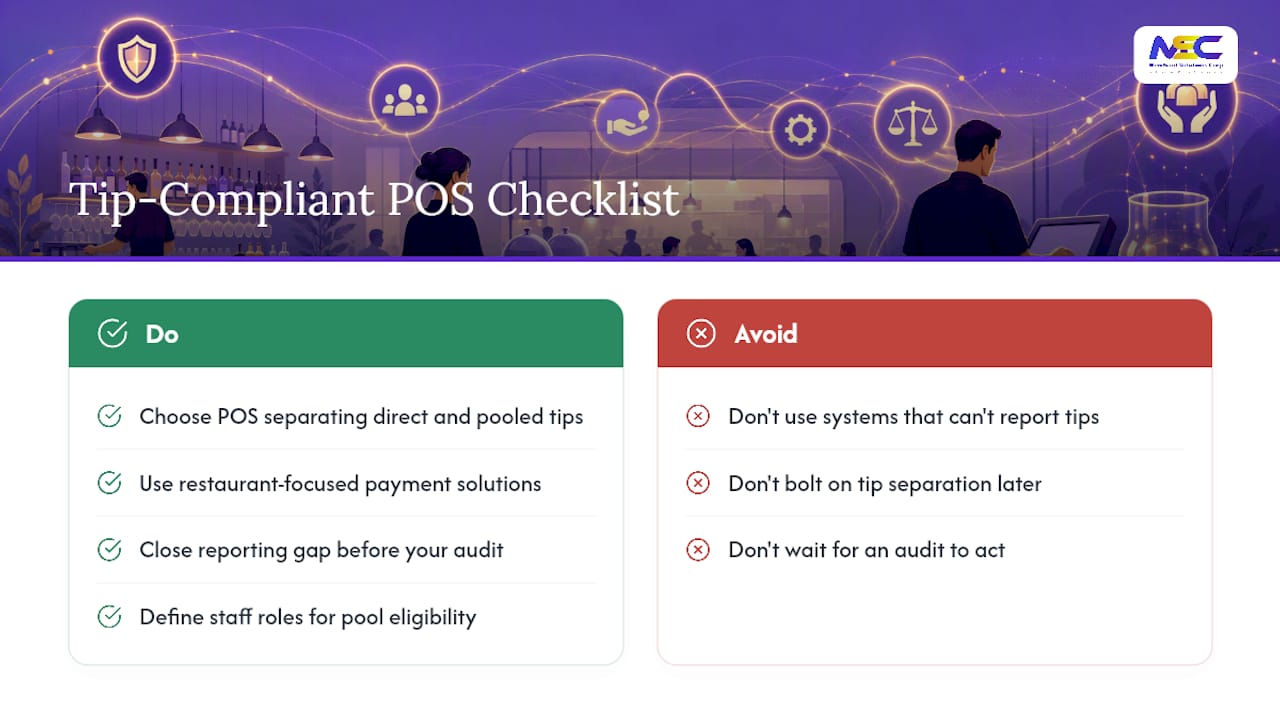
- Your POS should record cash and card tips as separate line items, timestamped per transaction.
- Reports need to export in a format your payroll service can ingest without manual re-entry.
- Ask any POS or payment processing vendor whether their system separates direct tips from pool distributions at the reporting level, not just at the register.
- Confirm your payroll services provider can reconcile daily card-tip batches against payday deadlines automatically.
| Compliance Need | System Feature to Verify |
|---|---|
| Prompt distribution by payday | Daily card-tip export, not weekly batching |
| Manager exclusion enforcement | Separate payroll codes for direct vs. pooled tips |
| Recordkeeping under 29 CFR Part 516 | Retained per-employee, per-period tip and wage detail |
| State variation handling | Configurable wage models by employee classification |
Systems built for industry-specific payment processing in restaurants generally handle this separation better than generic retail setups, since tip capture and payroll export are core requirements rather than an add-on.
Where to Verify Tip Pooling Rules and Requirements
Bookmark these sources and recheck them whenever your state raises its minimum wage or the DOL updates guidance:
- Tip Regulations under the FLSA: the DOL’s primary guidance page on tip-credit and tip-pooling rules.
- Fact Sheet #15: plain-language breakdown of traditional versus nontraditional pools.
- 29 CFR §531.54: the binding regulation on distribution timing and pool composition.
- 2026 Federal Register rule on qualified tips: clarifies tax classification separate from FLSA rules.
- Your state labor department’s tip-credit chart, and any city ordinance page for the metro you operate in.
Set Up Tip-Compliant Payment Systems With Merchant Solutions Corp
Tip pooling compliance is a legal question first, but it becomes an operational one the moment card tips start flowing through your POS. Merchant Solutions Corp builds payment processing and POS systems, including Clover, Square, and industry-specific setups, that separate direct and pooled tip data at the point of capture, so your payroll export matches what your written policy promises.
If your current system can’t tell you, in one report, how much each employee received in direct tips versus pool distributions, that gap is worth closing before your next audit. Merchant Solutions Corp’s payment processing and POS solutions are built for restaurants and hospitality operators who need that separation built in from day one, not bolted on after a wage complaint. Staffing decisions around who qualifies for tip-pool participation also shape your compliance exposure, and resources like The Dog Gurus’ guide to recruiting team members offer useful framing on how role definitions affect eligibility questions, even outside the restaurant industry.
An Editorial Take on Tip Pooling Compliance
Most advice on tip pooling compliance treats it as a legal checklist you complete once and file away. That’s backwards. The FLSA and DOL rules matter, but they only hold up if your point-of-sale and payroll systems actually enforce them every single shift, not just on the day your policy got signed.
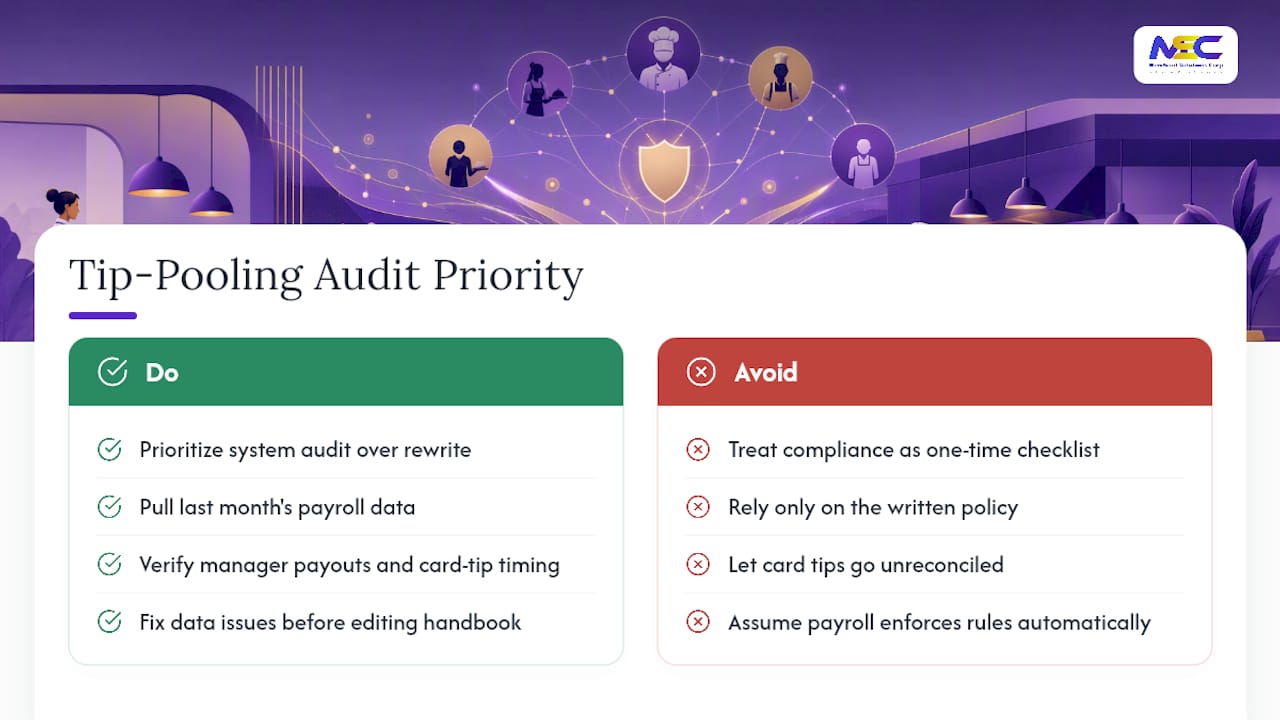
The conventional advice overweights the written policy and underweights the plumbing behind it. A policy that says managers never touch pooled tips is worthless if your POS still lets a shift lead’s payroll code absorb a distribution because nobody configured the exclusion. Late distributions rarely come from bad intent. They come from card-tip batches that don’t reconcile daily, so “as soon as practicable” quietly becomes “whenever payroll gets around to it.”
If you take one thing from this, prioritize the system audit over the policy rewrite. Pull last month’s payroll data and check whether a manager received a pool payout, whether card tips landed by payday, and whether your records would survive a DOL inquiry tomorrow. Fix what the data shows before you touch a single word of your handbook.
— Jonathan
This article is general information, not a substitute for advice from a qualified lawyer. Consult a qualified legal professional about your own circumstances before acting on anything here.
Sources
- Tip Regulations under the Fair Labor Standards Act (FLSA)
- Fact Sheet #15: Tipped Employees Under the Fair Labor Standards Act (FLSA)
- 29 CFR § 531.54 - Tip pooling
- Occupations That Customarily and Regularly Received Tips; Definition of Qualified Tips
FAQ
What States Allow Tip Pooling?
All states allow tip pooling under some form, since federal law permits it nationwide, but a number of states restrict or eliminate the tip credit entirely, which changes who can participate. Always check your specific state’s labor department for tip-credit and pooling rules before finalizing your program.
Do Tips Have To Be Pooled?
No. Tip pooling is optional under federal law. Employers can choose to let employees keep their own tips without any pooling arrangement, as long as they still meet minimum wage and tip-credit requirements.
Are Pooled Tips Qualified Tips?
Pooled tips can qualify as “qualified tips” for tax purposes under the 2026 Federal Register rule, but that classification is separate from the FLSA’s tipped-occupation test. The two frameworks answer different legal questions and shouldn’t be conflated.
Is My Employer Allowed To Pool and Take My Tips?
Your employer can require you to contribute to a tip pool with coworkers in eligible tipped roles, but federal law prohibits your employer, managers, or supervisors from keeping any part of that pool for themselves. If a manager is taking pool distributions, that violates DOL rules regardless of your state.