Cash Discounting Explained: A U.S. Small Business Guide
Cash Discounting Explained: A U.S. Small Business Guide
Cash discounting is a dual-pricing strategy where you post the card price as your standard price and offer a reduction at checkout to customers who pay with cash, check, or debit. It is legal nationwide when structured correctly, but a sloppy setup can be reclassified as a surcharge, which triggers card-network enforcement, state penalties, and potential loss of your merchant account.
The bottom line: A cash discount moves the final price down from a posted card price. A surcharge moves it up from a posted cash price. That structural difference is what separates a compliant program from a liability.
The distinction matters because Visa, Mastercard, and the FTC all draw the line at the same place. Post the card price first, reduce it for cash payers, and you are on solid legal ground. Flip that order and you have a surcharge, regardless of what you call it. Merchantsolutionscorp configures compliant dual-pricing programs on supported POS systems for merchants across the U.S., including retail, restaurants, and gas stations.
Table of Contents
- How cash discounting actually works at checkout
- Is cash discounting legal in the U.S.? What to check before you start
- When cash discounting helps and when it can backfire
- Step-by-step setup: launch a compliant cash discount program
- Choosing the right discount amount for your business
- Alternatives to cash discounting and when to prefer them
- How Merchantsolutionscorp supports compliant cash discount programs
- Key Takeaways
- When a cash discount is the right choice for your business
- Merchantsolutionscorp makes dual pricing straightforward
- Useful sources and next steps
- FAQ
How cash discounting actually works at checkout
The mechanics are straightforward, but the technical execution determines whether your program holds up under scrutiny.
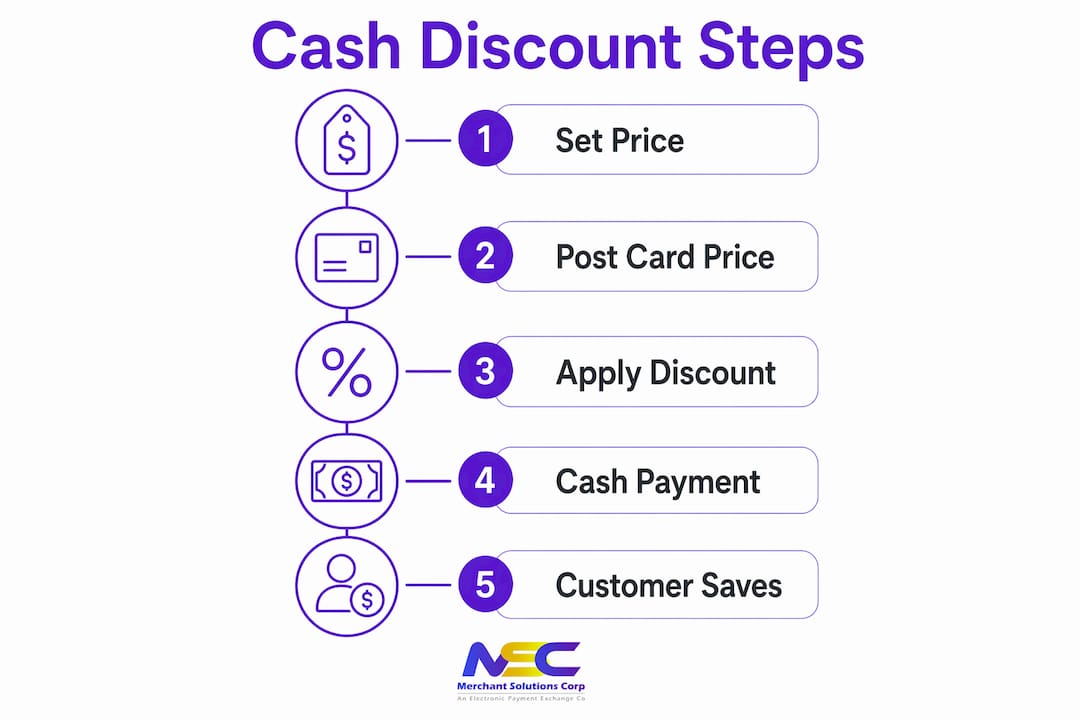
Step-by-step flow:
- You post the card price on your shelf, menu, or website. That is the standard price every customer sees.
- At checkout, the customer selects a payment method.
- If they pay with cash or an eligible debit card, the POS applies the discount as a negative line item.
- The receipt prints the original card price, the cash discount amount (shown as a deduction), and the final total.
Here is a simple worked example:
| Scenario | Posted Card Price | Cash Discount (3%) | Customer Pays |
|---|---|---|---|
| Card payment | $100.00 | — | $100.00 |
| Cash payment | $100.00 | ($3.00) | $97.00 |
The card customer pays the posted price. The cash customer pays less. Neither customer is charged a fee on top of what they expected to pay.
How your POS handles this technically matters. A properly configured system applies the discount automatically when the cashier selects “cash” as the tender type, prints the discount as a labeled negative line item, and never requires manual price edits. Manual overrides create inconsistency and compliance risk. Receipt and signage best practices from practitioners consistently point to automation as the safest path.
Pro Tip: Configure your POS to display the card price first and print the discount as a separate, labeled negative line item on every receipt. This single setup decision is your strongest protection against chargeback disputes and network audits.
Is cash discounting legal in the U.S.? What to check before you start
Cash discounts are federally protected, but federal protection does not mean automatic compliance. Card-network rules and state laws layer additional requirements on top of federal law, and those layers are where most programs run into trouble.
The federal foundation: The Durbin Amendment prevents card networks from prohibiting merchants from offering a discount for cash, check, or debit payment. Two federal statutes explicitly protect this right, and Visa and Mastercard cannot override it. What they can do is enforce disclosure and presentation rules that determine whether your program qualifies as a discount or gets reclassified as a surcharge.
The legal distinction in plain terms: Regulators focus on price direction. If the final price moves down from the posted price, it is a discount. If it moves up, it is a surcharge. Card networks, including Visa, clarify that the “regular price” must be the price charged to credit card users. Any model that posts the cash price and adds a fee for card use is generally not compliant, regardless of the label.
Compliance risk: State-level transparency laws can require that the posted price is the true price the customer will pay. In states with strict price-transparency rules, a dual-pricing display that confuses customers about which price applies can be treated as a surcharge.
Pre-launch compliance checklist:
- Review Visa and Mastercard merchant guidelines for cash discount and surcharge disclosure requirements.
- Check your state’s surcharging and price-transparency statutes. Rules vary by state, and multi-state operators face the most exposure.
- Read your merchant processing agreement. Some processors have their own program rules.
- Confirm your POS can automate the discount and print compliant receipts before you go live.
- Consult your processor or legal counsel if you operate across multiple states or have any doubt about your state’s rules.
Card networks enforce surcharging rules strictly and may fine or terminate merchant accounts for programs deemed to be disguised surcharges. The NFIB cautions small businesses specifically to avoid deceptive pricing displays that invite regulatory scrutiny.
This article is general information, not legal or compliance advice. Confirm your program’s structure with your processor and a qualified professional for your specific situation.
When cash discounting helps and when it can backfire
Cash discounting is a practical tool for managing card-fee expense, but it carries real trade-offs that vary by business type, customer base, and operational readiness.
Where it works well:
- Reduces net card-fee expense by shifting the cost to card-paying customers rather than absorbing it across all sales.
- Protects margins without raising the card price for card payers, since the card price is already the posted price.
- Simplifies fee recovery in high-volume, small-ticket environments where card fees compound quickly.
Where it creates risk:
- Customer confusion or backlash when signage is unclear or staff cannot explain the pricing difference at the register.
- Program reclassification as a surcharge by card networks or state attorneys general if the implementation is structured incorrectly.
- Potential processing-account action, including fines or termination, if network rules are violated.
Customer experience reality: Transparency is the most important factor for customer trust. Clear entrance and register signage, plus itemized receipts, reduce complaints and regulatory risk. A customer who understands the pricing before they reach the register rarely objects. A customer who sees an unexpected deduction on the receipt will dispute it.
The customer-experience risk is manageable with the right setup. The compliance risk is not. If your POS cannot automate the discount, or your staff cannot consistently explain the pricing, the program will generate more friction than it saves in fees.
Step-by-step setup: launch a compliant cash discount program
A compliant program requires more than flipping a setting in your POS. Work through each phase before you go live.
Phase 1: Pre-launch decisions
- Confirm legal and processor clearance for your state and merchant agreement.
- Choose your target discount percentage, tied to your blended card-fee estimate.
- Update all posted prices to reflect the card price across menus, shelves, and your website.
- Order or print entrance and checkout signage before launch day.
Phase 2: POS configuration
- Enable dual pricing or a discount rule in your POS settings.
- Set the discount to trigger automatically when “cash” or “debit” is selected as the tender type.
- Label the discount line item clearly on receipts (e.g., “Cash Discount” followed by the dollar amount as a negative).
- Test the debit-card flow separately. Debit is often treated like cash to avoid debit-surcharge legal issues.
- Run a full test transaction and print a receipt before opening.
Phase 3: Signage and receipt language
Entrance signage example: “We post our card price as the standard price. Customers paying with cash or debit receive a [X]% discount at checkout.”
Register/shelf label example: “Card price: $[X.XX] | Cash price: $[X.XX]”
Receipt line-item example:
- Subtotal: $100.00
- Cash Discount (3%): ($3.00)
- Total: $97.00
Visa’s merchant guidance recommends showing the original price, the cash-discount line item, and the adjusted total on every receipt. This documentation reduces chargeback and dispute risk.
Phase 4: Staff training and monitoring
- Script a one-sentence register prompt: “We offer a [X]% discount for cash or debit payments today.”
- Train staff to explain the pricing difference without apologizing for it.
- Establish a dispute-handling step: if a customer questions the charge, show them the receipt line item and the entrance signage.
- Schedule a monthly audit to confirm the POS is applying discounts correctly and receipts are printing the right labels.
Pro Tip: Run a two-week pilot in one location or with one register before full rollout. Collect customer feedback and monitor your card-to-cash payment mix. Adjust signage language based on what actually confuses customers, not what you assume will.
Choosing the right discount amount for your business
The discount amount should reflect your actual card-fee burden. Setting it too low leaves money on the table. Setting it too high can feel punitive to card-paying customers.
Two practical methods:
| Method | How It Works | Best For |
|---|---|---|
| Blended-fee match | Set the discount equal to your blended card-fee rate (typically 2.5–3.5%) | Merchants who want precise fee recovery |
| Round-number simplicity | Pick a clean percentage (e.g., 3%) close to your blended rate | High-volume, quick-serve environments |
Calculation example: If your blended card-fee rate runs approximately 3%, a $50 transaction costs you roughly $1.50 in processing fees. A 3% cash discount gives the cash-paying customer $1.50 off and offsets your fee on that transaction. The math is straightforward; the key is using your actual blended rate, not a guess.
Testing guidance: Start conservative. A 2.5% discount is easier to defend to customers than a 4% one, and you can always increase it after measuring results. Track your card-to-cash payment mix weekly for the first month. If cash adoption does not move, consider whether your signage or staff communication needs adjustment before changing the percentage.
Debit cards deserve a separate decision. Many merchants treat debit like cash in their discount programs to avoid the legal complexity of debit surcharges. If you include debit, confirm your POS can distinguish debit from credit at the tender-selection stage.
Alternatives to cash discounting and when to prefer them
Cash discounting is not the right fit for every business. Three other approaches address card-fee costs with different trade-offs.
Embed fees into posted prices. Raise your prices across the board to absorb card fees, then offer the same price to everyone. This avoids dual-pricing complexity and customer confusion entirely. The downside: card-paying customers subsidize cash payers, and price-sensitive markets may push back on the higher base price.
Negotiate lower processing rates. Before restructuring your pricing, review your current processing agreement. Merchants with strong volume or low chargeback rates often have room to negotiate a lower blended rate. This approach requires no customer-facing changes and no signage.
Set a minimum card purchase. A card minimum (typically $10) discourages small-ticket card transactions where fees hit hardest. It is simpler to implement than dual pricing and requires only a posted sign. The trade-off is that it can frustrate customers on small purchases.
Surcharging where legally permitted. Surcharging adds a fee to card transactions rather than discounting cash ones. It is legal in most U.S. states but banned in a few, and it carries specific disclosure and percentage-cap requirements that cash discounts do not. Surcharging rules vary significantly by state, and multi-location operators face the most exposure.
Decision rule: If your customer base is price-sensitive and cash-friendly, cash discounting tends to work. If your customers expect simple, uniform pricing (fine dining, luxury retail, professional services), embedding fees into your base price is usually cleaner. Surcharging is worth evaluating only if your state permits it and your processor supports compliant implementation.
Pro Tip: For retail businesses, displaying both prices clearly on shelf labels can actually increase cash adoption without any staff interaction; see Retailer Benefits for examples of how retail businesses communicate pricing and discounts to customers. Retailers who communicate pricing differences at the shelf rather than only at the register see fewer disputes and smoother checkout experiences.
How Merchantsolutionscorp supports compliant cash discount programs
Merchantsolutionscorp configures dual-pricing and cash discount programs on supported POS hardware for merchants across the U.S., handling the technical setup so you can focus on running your business.
What the setup includes:
- POS configuration on supported terminals including Clover, mobile terminals, and other supported hardware, with dual-pricing rules enabled and tested before go-live.
- Receipt and signage templates pre-formatted to meet card-network disclosure standards.
- Compliance review of your program structure during onboarding.
- Debit-card flow testing to confirm correct tender-type handling.
- Ongoing support for audits, POS updates, and program adjustments.
Onboarding steps:
- Account review: confirm your merchant agreement and state rules support the program.
- POS configuration: enable dual pricing, set discount rules, and label receipt line items.
- Signage setup: provide entrance and checkout signage templates.
- Staff training: walk your team through register prompts and dispute-handling steps.
- Pilot testing: run a short test period and review payment-mix data before full rollout.
- Performance monitoring: track card-to-cash mix and customer feedback on an ongoing basis.
Merchantsolutionscorp serves restaurants, retail stores, gas stations, convenience stores, and specialty businesses nationwide. Industry-specific configurations are available for high-volume environments where card fees compound quickly. The POS systems overview covers supported hardware and integration options for merchants evaluating dual-pricing setups.
Key Takeaways
Cash discounting is legal in the U.S. when the card price is the posted standard price and cash payers receive a documented reduction at checkout, but compliance depends entirely on how you structure and display the pricing.
| Point | Details |
|---|---|
| Legal when structured correctly | Post the card price first; apply the cash discount as a reduction. Never add a fee on top of a cash price. |
| Presentation determines compliance | Receipts must show the original price, the discount line item, and the final total. |
| State rules vary | Check your state’s surcharging and price-transparency laws before launch, especially if you operate in multiple states. |
| Automate the math | Configure your POS to apply discounts automatically and label receipt line items. Manual edits create compliance risk. |
| Merchantsolutionscorp | Configures compliant dual-pricing programs on supported POS systems with signage templates and onboarding support nationwide. |
When a cash discount is the right choice for your business
Cash discounting fits best in specific business environments. It tends to perform well in high-frequency, small-ticket operations: convenience retail, quick-serve restaurants, gas stations, and service businesses where card fees accumulate across dozens of daily transactions. In those settings, even a 3% discount drives meaningful cash adoption and measurable fee savings.

The calculus shifts in higher-end environments. Fine dining, luxury retail, and professional services attract customers who expect simple, uniform pricing. Introducing a visible pricing difference at checkout can feel transactional in a setting where the experience is the product. For those businesses, embedding fees into base prices is usually the cleaner path.
Multi-state operators face a different kind of complexity. Businesses operating across multiple states face the most exposure because individual state price-transparency and surcharging statutes vary in enforcement and disclosure requirements. A program that is fully compliant in one state may require adjustments in another. Operational readiness is the final filter. If your POS cannot automate the discount and your team cannot consistently follow signage and receipt procedures, the program will generate more friction than it saves. Get the technical setup right before you go live.
Merchantsolutionscorp makes dual pricing straightforward
Card fees typically run 2.5–3.5% per transaction. Across hundreds of daily sales, that adds up fast. Merchantsolutionscorp gives you a compliant payment processing setup that includes dual-pricing configuration, receipt templates, and signage support out of the box, so you are not piecing together compliance on your own.
The onboarding process covers your compliance review, POS configuration, staff training, and a pilot rollout timeline before you go fully live. Merchantsolutionscorp supports restaurants, retail stores, gas stations, and specialty businesses across North America, with industry-specific configurations for environments where card fees hit hardest.
Contact Merchantsolutionscorp to review your eligibility, get a compliance check, and request a quote for a dual-pricing setup built for your business.
Useful sources and next steps
Authoritative references:
- Visa U.S. Merchant Surcharge Q&A: receipt requirements, disclosure rules, and the distinction between discounts and surcharges.
- LegalClarity: Cash Discount Laws, Card Network Rules, and State Limits: state-by-state compliance overview.
- LegalClarity: Are Cash Discounts Legal Under the Durbin Amendment?: federal legal foundation and the discount-vs-surcharge distinction.
- NFIB Credit Card Surcharging Guide: small-business signage and disclosure best practices.
- California Business Journal: Cash Discount Guide for Small Business Owners: POS setup, signage, and receipt examples.
- Merchantsolutionscorp: How to Implement a Compliant Cash Discount Program: step-by-step templates and case studies.
Recommended next actions:
- Pull your current merchant agreement and check for cash discount or dual-pricing provisions.
- Look up your state’s surcharging and price-transparency statutes, or ask your processor to walk you through them.
- Run a test transaction on your POS to confirm the discount applies automatically and the receipt prints correctly.
- Schedule a consultation with your processor to review your program structure before launch.
FAQ
What is a cash discount in simple terms?
A cash discount is a price reduction you offer customers who pay with cash instead of a credit card. You post the card price as the standard price, and cash payers pay less at checkout.
What is an example of a cash discount?
A merchant posts a $100 item price. A customer paying with cash receives a 3% discount and pays $97. The receipt shows the $100 card price, a ($3.00) cash discount line, and a $97.00 total.
How much should you give for a cash discount?
Most merchants set the discount equal to their blended card-fee rate, which typically runs 2.5–3.5%. Start at the lower end, measure your cash adoption rate, and adjust from there.
Is cash discounting legal?
Yes, cash discounting is legal in all 50 states under federal law, provided the card price is the posted standard price and the cash discount is applied as a reduction at checkout. Poorly structured programs can be reclassified as surcharges, which carry different state-level rules and card-network requirements.
How is a cash discount different from a surcharge?
A cash discount reduces the price from a posted card price. A surcharge adds a fee on top of a posted cash price. The direction of the price movement, not the label, determines which category applies under card-network and state rules.