Operators: Underwriter Ready Docs for Adult Payment Processing
Operators: Underwriter Ready Docs for Adult Payment Processing
Reliable adult payment processing starts with a specialist, high-risk-aware acquiring strategy, not a generic gateway. Success depends on satisfying card-network programs like Visa’s VIRP, keeping airtight age and consent records under 18 U.S.C. §2257, and maintaining PCI-DSS discipline from day one. Merchant Solutions Corp works with eligible high-risk operators on underwriting and onboarding support so qualifying platforms can get live and stay live.
TL;DR:
- Adult payment processing requires specialized acquiring strategies that prioritize card-network compliance, age verification, and strict PCI-DSS discipline from the outset.
- Approval processes differ by route, with aggregators providing quick onboarding within days, whereas direct MIDs demand several weeks to months of thorough underwriting.
- Chargebacks from friendly fraud, sudden account freezes, and pooled-MID risks can severely impact liquidity, making operational controls and dispute prevention vital.
- Compliance with VIRP, 18 U.S.C. §2257, and continuous documentation updates are essential to avoid account termination and maintain long-term processing stability.
- Adopting advanced fraud detection, tokenization, multi-rail payouts, and clear billing descriptors are key to reducing disputes and enhancing customer retention.
Table of Contents
- How Adult Payment Processing Works: Who Does What and Where Liability Sits
- Key Operational Challenges Adult Merchants Face
- What Compliance Rules Apply to Adult Payment Processing?
- Choosing the Right Processing Route for Your Scale
- What Documents Do You Need to Get Approved?
- How Do You Reduce Chargebacks and Payment Disputes?
- Payouts and Settlement Options for Creator-Driven Businesses
- Security and PCI-DSS: Minimum Controls You Need
- Long-Term Payment Strategy: What an Experienced Partner Brings
- What Are the Best Adult Payment Processing Providers?
- What Legal Risks Go Beyond Payment Processing?
- How Does Payment Processing Affect Customer Experience?
- What New Technology Is Changing Adult Payment Processing?
- How Payment Rules Are Reshaping Content Moderation
- Merchant Solutions Corp: How We Help Adult Operators Get Approved and Stay Processing
- Sources
- FAQ
How Adult Payment Processing Works: Who Does What and Where Liability Sits
Adult payment processing runs through the same four-party rail as any other card transaction, but every layer treats adult content as elevated risk. Understanding who holds liability at each step tells you why approval feels harder here than in almost any other vertical.
The gateway captures and encrypts the transaction, passing card data toward the network. The acquirer (your merchant bank) extends the credit line that lets you accept cards at all, and it carries direct financial exposure if you generate excessive chargebacks. The issuing bank represents your customer’s card and decides whether to approve or dispute a charge. Above all of them sits the card network, Visa or Mastercard, setting the rules everyone else must follow.
A fourth structure has become common in the adult space: the merchant-of-record (MOR) model, where a third party legally sells on your behalf and absorbs the compliance and dispute burden in exchange for a larger cut of revenue. This differs from a direct merchant ID (MID), where your business is the legal seller of record and holds the liability itself.
What underwriters actually check
Before approving any adult account, underwriters pull three data points that matter more than almost anything else on your application:
- Chargeback history. Prior dispute ratios from previous processors follow you, often through the MATCH list shared among acquiring banks.
- Merchant category code (MCC) alignment. Adult content typically falls under codes flagged for enhanced due diligence, which triggers deeper document review.
- Payout patterns. Sudden volume spikes, geographic concentration in high-fraud regions, or subscription churn that looks unusual all raise flags during review.
Three route structures dominate the market, and each trades speed for control differently. Aggregators (shared MIDs) get you processing fastest, sometimes within days, because you are riding on an existing merchant relationship rather than building your own underwriting file. Direct MIDs take longer to approve, often several weeks, but give you dedicated economics and full control over your dispute history. Managed high-risk accounts, arranged through a specialist processor, sit in between: you get dedicated underwriting support without building the compliance infrastructure from scratch. Industry reporting on high-risk processors for adult platforms consistently finds that direct MIDs deliver the best long-term economics once volume justifies the heavier underwriting lift.
Key Operational Challenges Adult Merchants Face
Chargebacks, reserves, and sudden freezes are the three problems that keep adult operators up at night, and they compound each other in ways that catch new operators off guard.
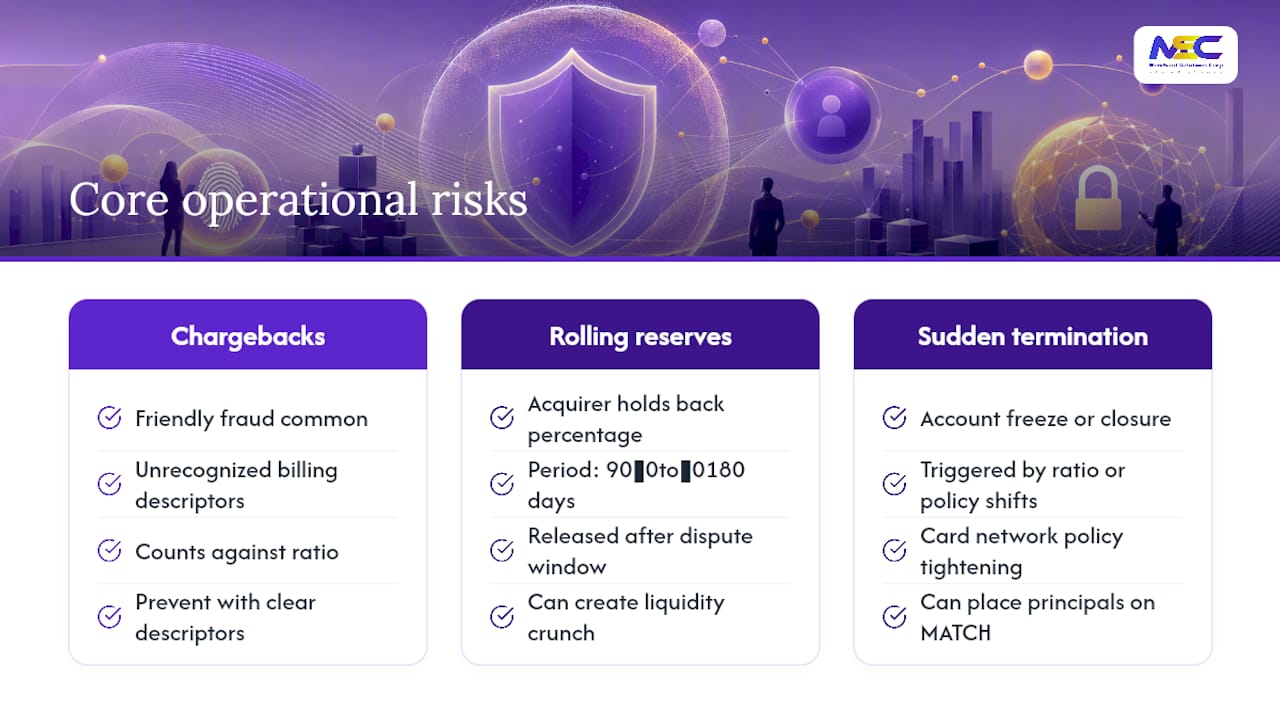
Friendly fraud (a cardholder disputing a charge they actually authorized) is disproportionately common in adult billing. A customer forgets a subscription renewed, does not recognize a discreet billing descriptor, or simply regrets the purchase and calls their bank instead of you. Each dispute counts against your chargeback ratio regardless of whether fraud actually occurred.
Rolling reserves are the acquirer’s insurance policy against your future disputes. A bank might hold back a percentage of your processing volume for 90 to 180 days, releasing it only after that window closes without a chargeback spike. For a subscription platform with tight cash flow and creators expecting timely payouts, a reserve can turn a healthy month into a liquidity crunch.
Sudden account termination is the sharpest risk in this vertical. Acquirers can freeze or close an account with little warning if chargeback ratios cross a threshold, if the bank’s own risk appetite shifts, or if a card network tightens its adult-content policy. Once terminated for cause, your business (and sometimes its principals) can land on the MATCH list, which makes securing a new merchant account with any acquiring bank dramatically harder for years.
Pooled-MID arrangements, common with aggregators, introduce a risk many operators do not see coming. Because your transactions run through a shared merchant identifier alongside dozens or hundreds of other businesses, another merchant’s fraud spike or dispute wave can trigger reviews, reserves, or terminations that have nothing to do with your own performance. Wickent’s analysis of high-risk adult processors flags this pooled exposure as one of the least understood risks operators take on when they choose speed over a dedicated MID.
Chargeback prevention in this vertical is largely an operational fix, not a technical one. Clear billing descriptors and responsive customer service resolve far more “unrecognized charge” disputes than fraud-scoring algorithms ever will, according to reporting from TheFinRate on high-risk adult merchant accounts.
What Compliance Rules Apply to Adult Payment Processing?
Card networks and federal law both impose specific, checkable requirements, and skipping any one of them is the fastest way to lose an account. Visa’s Integrity Risk Program (VIRP) and Mastercard’s parallel adult-content requirements set the baseline every acquirer now enforces.
VIRP rests on four pillars, and underwriters will ask for evidence of each before approval:
- Age and consent verification for every performer appearing in monetized content, verified against government-issued identification.
- Persistent identity linkage, meaning your records tie a specific piece of content to a specific verified performer, not just a general release on file.
- A 24-hour takedown service level agreement for any content flagged as non-consensual or otherwise violating, with documented response times.
- Bi-annual compliance audits, either self-administered or third-party, proving the first three pillars stay enforced over time.
The adult industry banking guide from GetBanked describes these requirements as the new floor for any acquirer relationship in this space, not an optional best practice.
Federal recordkeeping law runs alongside the card-network rules. 18 U.S.C. §2257 requires producers of sexually explicit content distributed in the United States to maintain age and identification records for every performer, and to make those records available for inspection. Retain the government ID copy, the signed consent release, and a clear content-to-performer mapping for as long as the content remains in distribution, and build a retrieval system that can produce any single record within hours, not days, if an acquirer or regulator asks.
PCI-DSS compliance sits on top of both. The PCI Security Standards Council’s merchant guidance lays out which Self-Assessment Questionnaire (SAQ) applies based on how you handle cardholder data. Most subscription platforms that use a hosted payment page or tokenized checkout qualify for a simpler SAQ tier than merchants storing card data directly, which is one more reason to route transactions through a compliant gateway rather than building custom checkout code.
If you settle creator payouts by ACH, recent NACHA risk-management rule updates tighten verification and monitoring requirements for exactly the kind of high-frequency, small-dollar payouts common in this industry. Review your ACH originator’s compliance posture against these updated rules before you scale payout volume.
Choosing the Right Processing Route for Your Scale
The route that fits a startup rarely fits an enterprise platform, and picking wrong wastes months. Four factors should drive the decision:
- Monthly volume. Lower volume often does not justify the underwriting effort a direct MID requires, making an aggregator or managed account more efficient early on.
- Chargeback tolerance. If your content model (free trials, recurring subscriptions) carries inherently higher dispute risk, a managed account with dedicated fraud support outperforms a bare-bones aggregator relationship.
- Need for a dedicated MID. Once volume reaches a level where reserve costs and per-transaction rates on an aggregator start outweighing the underwriting effort, moving to a direct MID typically pays for itself.
- Payout complexity. Platforms paying out hundreds of individual creators need payout infrastructure that a simple merchant account was never built to handle.
Timelines and costs vary by route, and any operator should treat quoted figures as ranges rather than fixed numbers until an actual underwriting file is reviewed. Aggregator onboarding can take days to a couple of weeks; direct MID underwriting for adult content commonly runs several weeks to a couple of months, given the added documentation review. Per-transaction rates in this vertical run meaningfully higher than standard retail processing, and reserve requirements typically fall in a rolling percentage held for a period of months rather than a flat fee.
Startups and early-stage creator platforms usually start with an aggregator or a managed high-risk account, accepting a higher per-transaction cost in exchange for speed. Scaling platforms, once monthly volume and chargeback history stabilize, often migrate to a direct MID to capture better economics. High-volume enterprises, particularly those running multiple content brands or geographies, frequently run a hybrid: a direct MID for the core business alongside a secondary processor for redundancy, since losing a single account without a backup can shut down revenue overnight.
The route you choose also shapes how disputes get remediated. Aggregators typically handle chargeback representment centrally with limited merchant input; direct MIDs put dispute response squarely in your hands, which is more work but gives you the chance to fight disputes with your own evidence rather than a template response.
What Documents Do You Need to Get Approved?
Underwriting approval and long-term account survival are fundamentally document exercises. Acquirers want proof, not promises, and the operators who get approved fastest arrive with a complete file instead of trickling documents in over weeks.
Business and ownership documentation:
- Articles of incorporation or LLC formation documents
- Beneficial ownership disclosure for anyone holding 25% or more of the business
- Business bank statements from the past three to six months
- Government-issued ID for all principal owners
Content and consent documentation:
- Age and identification records for every performer, per 18 U.S.C. §2257
- Signed consent releases tied to specific content, not blanket agreements
- Content provenance evidence showing the platform’s rights to distribute the material
- A written takedown policy with a documented response timeline
Operational and billing documentation:
- Your planned billing descriptor and a customer-facing lookup page explaining it
- A published refund policy and clear customer support contact information
- Evidence of fraud controls already in place, such as address verification or velocity limits
- Traffic and conversion data showing realistic, sustainable growth rather than sudden spikes that read as suspicious
Pro Tip: Build a single shared folder with every document above before you submit any application. Underwriters process complete files faster than partial ones, and a request for missing paperwork can push your approval back by weeks.
Retail and physical-product adult businesses selling through an online storefront face a slightly different documentation path, closer to standard retail payment solutions, but the age-verification and content documentation requirements still apply if any digital content accompanies the sale.
How Do You Reduce Chargebacks and Payment Disputes?
Most disputes in adult billing come from confusion, not fraud, which means the fix is mostly operational rather than technical.
Start with the billing descriptor. A vague or unrecognizable line on a bank statement is the single biggest driver of “I don’t recognize this charge” disputes. Pair a discreet, neutral descriptor with a dedicated customer lookup page where a confused cardholder can search the charge and find your support contact before calling their bank.
- Set pre-authorization checks that catch card-testing attempts (rapid small charges used to validate stolen card numbers) before they hit your live gateway.
- Cap failed-attempt thresholds per card and per IP address to blunt automated testing scripts.
- Publish a clear, easy-to-find refund policy, and train support staff to issue refunds proactively when a customer contacts you directly, before they escalate to their bank.
- Follow strict trial-to-paid conversion rules for subscriptions: clear disclosure of trial length, an easy cancellation path, and a reminder notification before the first real charge.
Pro Tip: Refunding a confused customer within minutes costs you the transaction. Fighting the same dispute after it becomes a formal chargeback costs you the transaction, a chargeback fee, and a mark against your dispute ratio. Speed matters more than principle here.
Fraud-preventions tactics built for other high-volume industries, like the layered monitoring approaches used in restaurant fraud prevention, adapt well to subscription and recurring-billing environments once you swap the specific triggers for adult-content risk patterns.
Payouts and Settlement Options for Creator-Driven Businesses
Getting money in is only half the problem. Getting money out to dozens or thousands of individual creators, reliably and on schedule, is a separate operational challenge with its own rails and trade-offs.
Wire transfers work for large, infrequent payouts but carry flat fees that erode margins on smaller, frequent disbursements. E-wallets and specialized payout vendors built for gig-economy and creator-economy payments handle high-volume, low-dollar payouts more efficiently and often integrate directly with platform back ends. Stablecoins and crypto rails offer a genuine advantage in dispute-free settlement and lower foreign-exchange friction for international creators, according to TheFinRate’s analysis of high-risk adult merchant accounts, though they introduce their own compliance complexity under US money-transmission rules that a legal review should address before adoption.
Batching payouts, rather than processing each one individually, reduces per-transaction wire drag and simplifies reconciliation. Understanding the mechanics behind ACH payments helps here, since ACH batching remains one of the more cost-efficient domestic options for platforms paying out primarily US-based creators. Background on global payment rail structures is worth reviewing if your creator base spans multiple countries.
Integrated payouts, where your processor handles both intake and disbursement, make sense for platforms under a certain payout volume where simplicity outweighs the marginal cost savings of a specialist. Once payout volume grows large enough that FX costs and per-transaction fees start meaningfully affecting creator take-home pay, a dedicated payout specialist usually becomes worth the added integration work.
Security and PCI-DSS: Minimum Controls You Need
Reducing your PCI scope is the single most effective way to lower both audit friction and breach risk, and it starts with never touching raw card data directly.
Tokenization and vaulting replace card numbers with encrypted tokens the moment a transaction enters your system, meaning your servers never store, transmit, or process actual card data. This alone drops most subscription platforms into a simpler SAQ tier under the PCI Security Standards Council’s merchant framework.
Beyond tokenization, a short list of controls covers most of what an audit will check:
- Force HTTPS across every page that touches checkout, not just the payment form itself.
- Implement a Content Security Policy (CSP) to block unauthorized scripts from skimming card data during checkout.
- Run continuous monitoring and fraud alerting so unusual transaction patterns trigger a human review, not a quarterly report.
- Document your SAQ selection and keep evidence of every control in one place, ready to produce during a VIRP attestation or acquirer audit.
Site-hardening guidance built for other eCommerce platforms, including BigCommerce security plugin recommendations, applies directly to adult checkout flows, since the underlying threat (card skimming and checkout injection attacks) does not differ by industry.
Long-Term Payment Strategy: What an Experienced Partner Brings
Surviving in adult payment processing is a long game, and the operators who last treat their acquiring relationship as infrastructure to maintain, not a box to check once.
An experienced partner should offer underwriting support that goes beyond submitting your application and waiting. That means help structuring a discreet billing descriptor, setting up a customer lookup page, and building the documentation file underwriters actually want to see. It also means integrated payout support so intake and creator disbursement run through a coordinated system rather than two disconnected vendors.
Merchant Solutions Corp works with high-risk and specialty merchants, including eligible adult-industry operators, on this kind of onboarding and ongoing support. Services span high-risk merchant account setup, POS and eCommerce integrations for operators selling physical products alongside digital content, free hardware programs with $0 upfront options, and dual-pricing programs that help offset processing costs. Support runs nationwide across the US and Canada, covering onboarding through day-to-day operations rather than stopping at approval.
When evaluating any processing partner, check four things before signing: Do they have direct experience underwriting adult-content merchants, or are they learning your vertical on your account? Do they offer integrated payout options, or will you need a second vendor? What is their actual reserve and termination policy, in writing, not just verbally? And can they support both your online processing and any physical retail component under one relationship?
An experienced provider shortens the distance between application and live processing, and more importantly, keeps you live once you are there.
What Are the Best Adult Payment Processing Providers?
The market for adult payment solutions splits into three broad categories, and each carries a different reputation among operators.
Aggregator-style processors prioritize speed and simplicity, often approving accounts within days. Their trade-off is higher per-transaction pricing and shared-MID risk, since your account sits alongside other merchants whose behavior you cannot control.
Direct high-risk acquirers specialize in underwriting adult content merchants individually, offering dedicated MIDs and typically stronger long-term economics. Approval takes longer because underwriting is more thorough, but the account is yours alone, insulated from other merchants’ dispute patterns.
Managed high-risk processing programs sit between the two, pairing dedicated underwriting support with a faster path to approval than a fully independent direct MID. This category tends to suit platforms that have outgrown an aggregator but are not yet ready for the underwriting weight of a standalone MID.
Reputation in this space is earned through consistency, not marketing claims. The processors adult operators trust most are the ones with transparent reserve policies stated in writing, responsive dispute-resolution teams, and a track record of not terminating accounts without warning when a chargeback ratio briefly spikes. Ask any prospective provider for their actual termination and reserve criteria before signing, and treat vague answers as a warning sign regardless of how fast they promise approval.
What Legal Risks Go Beyond Payment Processing?
Payment compliance is necessary but not sufficient. Adult operators carry legal exposure that exists independently of any acquiring relationship, and ignoring it puts your processing account at risk too, since most acquirer contracts terminate immediately upon evidence of illegal content.
Obscenity law in the United States varies by community standard under the Miller test framework, meaning content legal in one jurisdiction can theoretically trigger prosecution in another. This is a legal risk separate from, but connected to, your payment compliance, since a prosecution or takedown order will almost always trigger an immediate account freeze.
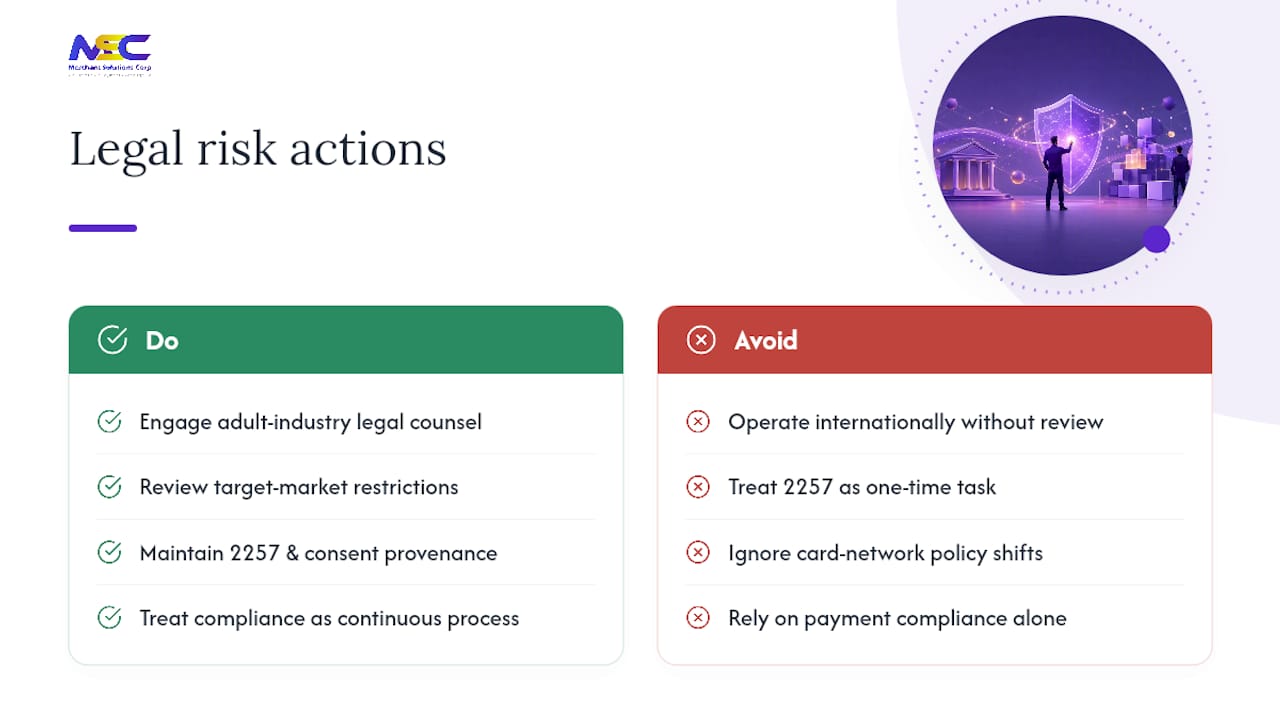
International restrictions compound this risk for any platform accepting global traffic. Age-verification laws, content restrictions, and payment regulations differ significantly by country, and several jurisdictions have moved toward stricter age-assurance requirements for adult platforms. Operating internationally without reviewing target-market restrictions is one of the more common ways operators unknowingly create liability that later surfaces as a payment problem.
Card-network enforcement itself has been shifting the boundaries of what counts as restricted content. Research on financial actors and content moderation describes a pattern of “definitional creep”, where payment-network policy gradually broadens which content categories trigger enhanced scrutiny, often ahead of any change in actual law. Operators who treat 2257 documentation and consent provenance as a continuously maintained system, rather than a one-time compliance task, absorb these shifts with far less disruption than those who scramble each time a policy update lands.
Legal counsel with specific adult-industry experience is not optional overhead here. It is the layer that catches risks payment compliance alone cannot.
How Does Payment Processing Affect Customer Experience?
Payment friction shows up directly in retention numbers for adult subscription businesses, more than in almost any other vertical.
A confusing billing descriptor does not just cause disputes, it causes cancellations from customers who simply do not trust a charge they cannot identify. A clunky checkout flow, an unclear cancellation process, or a payment failure that is not communicated clearly all push subscribers toward canceling rather than troubleshooting.
Discreet, well-explained billing is a retention tool as much as a compliance one. When customers understand exactly what will appear on their statement before they subscribe, and can easily find a support contact if something looks unfamiliar, they stay subscribed instead of disputing or canceling out of confusion. Fast, friction-free refunds for legitimate complaints build the kind of trust that keeps a subscriber coming back for a second billing cycle instead of walking away permanently.
Payment reliability also matters at the platform level. Frequent processor changes, forced by account terminations, disrupt the subscriber’s saved payment method and create renewal failures that look like churn but are actually infrastructure problems. Stable, long-term processing relationships translate directly into stable subscriber retention.
What New Technology Is Changing Adult Payment Processing?
Tokenization has moved from a nice-to-have to the default architecture for any adult platform serious about reducing both fraud exposure and PCI audit burden. By replacing stored card numbers with tokens at the point of entry, platforms eliminate most of the data that makes a breach catastrophic in the first place.
Advanced fraud detection has grown more sophisticated in parallel, layering device fingerprinting, behavioral analytics, and velocity checks on top of traditional address verification. These systems increasingly catch card-testing attempts and account-takeover fraud before a transaction ever completes, rather than flagging it after the fact.
Multi-rail payout adoption is accelerating as platforms recognize that a single payout method cannot serve a global creator base efficiently. Expect wider adoption of specialized payout vendors and, where compliance allows, stablecoin settlement for cross-border creator payments where traditional wire fees eat disproportionately into smaller payouts.
Age-assurance technology is also tightening, driven directly by card-network policy rather than voluntary adoption. Expect verification requirements to keep expanding beyond simple age attestation toward persistent identity checks that satisfy both VIRP and emerging international age-verification laws simultaneously.
How Payment Rules Are Reshaping Content Moderation
Card-network policy has quietly become one of the most powerful content-moderation forces in the adult industry, often more influential than platform-level rules or even local law.
Every VIRP audit cycle pushes operators toward stricter verification and tighter moderation, not because the platform wants to censor more content, but because the acquiring relationship depends on it. That dynamic creates real tension: the same definitional creep that broadens restricted categories also raises the documentation bar for everything that remains permitted.
The pragmatic response is not to fight this trend but to build for it. Operators who treat consent and provenance documentation as a living system, updated continuously rather than assembled once for underwriting, absorb each new audit cycle with minimal disruption. Watch for tighter age and consent checks, more frequent audits, and continued multi-rail payout adoption as operators diversify away from single points of processing failure.
— Jonathan
Merchant Solutions Corp: How We Help Adult Operators Get Approved and Stay Processing
Getting approved for adult payment processing is a documentation exercise, and staying approved is an operations exercise. Merchant Solutions Corp supports both sides, offering high-risk onboarding help, discreet billing-descriptor setup, integrated payout options, and POS or eCommerce integration for operators selling physical products alongside digital content.
Before a consultation, gather your entity documents, beneficial ownership disclosure, performer age and consent records, and a draft billing descriptor plan. Coming prepared shortens underwriting review meaningfully. Equipment programs with $0 upfront options and dual-pricing plans that help offset processing costs round out the setup, whether you need a pure online gateway or a combined storefront and eCommerce presence.
If your business qualifies as high-risk and needs a processing partner that understands the documentation underwriters expect, start with the high-risk merchant services page to see what onboarding involves and request a consultation.
Sources
- 18 U.S.C. §2257 — Recordkeeping requirements
- PCI Security Standards Council — Merchants
- Adult industry banking guide — GetBanked
- High risk payment processors for adult platforms — Wickent
- High-risk merchant accounts for adult businesses — TheFinRate
FAQ
Which Payment Processor Is Best for Adult Content?
There is no single best processor for every operator. The right choice depends on volume, chargeback tolerance, and payout complexity, with high-volume platforms generally favoring a direct MID and smaller operators favoring an aggregator or managed high-risk account like the support Merchant Solutions Corp provides for eligible adult businesses.
What Does OnlyFans Use for Payment Processing?
Large creator platforms typically rely on specialized high-risk processing arrangements rather than standard retail gateways, given the volume of subscription billing and international payouts involved. Specific processor relationships for individual platforms are not publicly disclosed in detail.
Why Do Payment Processors Not Like Adult Content?
Adult content carries elevated chargeback rates, heightened regulatory scrutiny under laws like 18 U.S.C. §2257, and strict card-network programs such as VIRP, which together raise the operational cost and liability for acquirers compared to standard retail categories.
What Does Payment Processing Do?
Payment processing moves funds from a customer’s card or bank account to a merchant’s account, coordinating between the gateway, acquirer, and issuing bank to authorize, settle, and, when necessary, resolve disputes on each transaction.
How Long Does Adult Merchant Account Approval Take?
Approval timelines vary by route: aggregators can approve accounts within days to a couple of weeks, while direct MIDs for adult content typically take several weeks to a couple of months due to more thorough underwriting review.