World Payment Systems: A Practical Guide for U.S. Merchants
World Payment Systems: A Practical Guide for U.S. Merchants
World payment systems are the layered networks and rails — including large-value RTGS systems like Fedwire, interbank messaging through SWIFT, retail clearing via ACH/NACHA, card networks like Visa and Mastercard, and digital wallets — that move value between payers and payees, governed by bodies such as the Federal Reserve, NACHA, and the Bank for International Settlements (BIS). For U.S. merchants, understanding which rail carries a given transaction directly determines settlement timing, cost exposure, and reconciliation complexity.
The rails and methods every U.S. merchant should recognize:
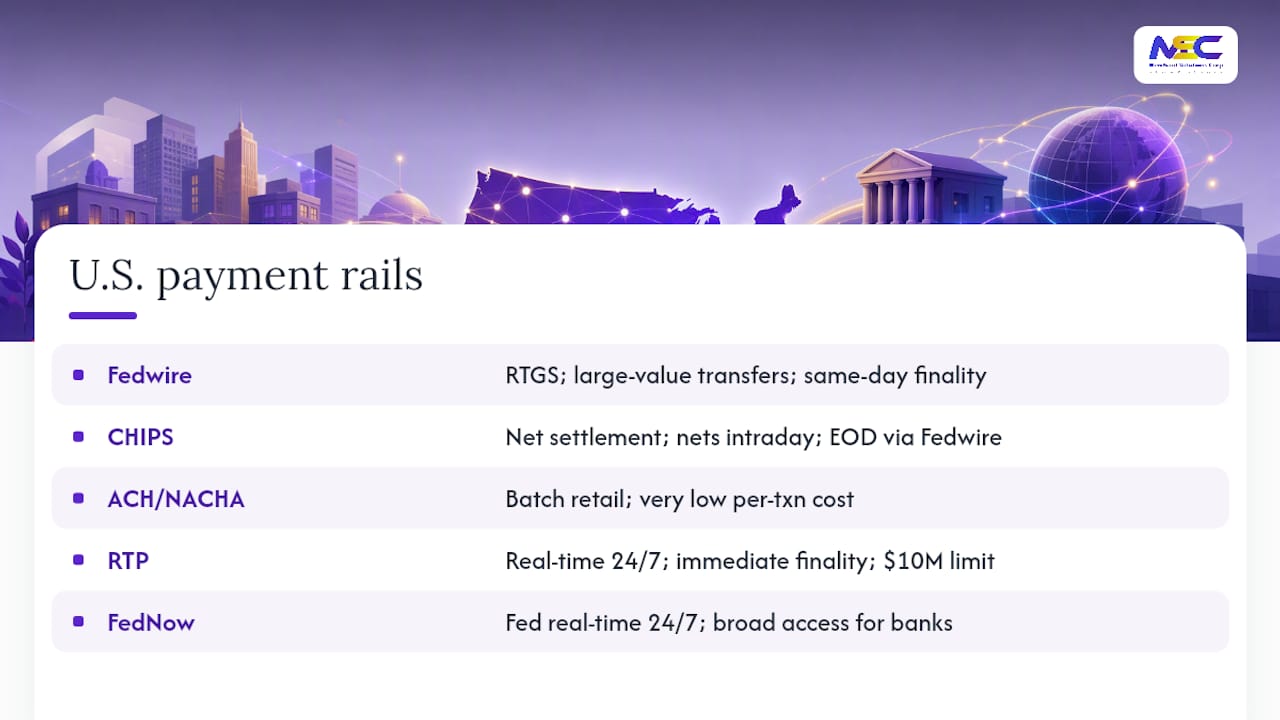
- Fedwire — the Federal Reserve’s real-time gross settlement (RTGS) system for large-value, same-day finality transfers
- CHIPS — The Clearing House’s private large-value net settlement system, handling the majority of U.S. dollar cross-border wholesale flows
- ACH/NACHA — the batch retail clearing network for payroll, vendor payments, and direct debits, governed by NACHA rules
- RTP (The Clearing House) — a real-time retail rail with immediate finality, available 24/7/365
- FedNow — the Federal Reserve’s real-time retail rail, launched in 2023, expanding access to instant settlement for banks of all sizes
- SWIFT — the global financial messaging network that routes cross-border payment instructions between correspondent banks
- Visa/Mastercard — the card networks that authorize, clear, and settle card transactions between issuing and acquiring banks
- Digital wallets — Apple Pay, Google Pay, PayPal, and similar services that layer tokenization and user authentication on top of underlying card or bank rails
The practical takeaway: card transactions settle to your merchant account in one to two business days through card network rails; ACH payroll and vendor payments batch overnight; RTP and FedNow credits arrive in seconds but require your bank to be connected; and cross-border SWIFT transfers can take several business days and carry FX and intermediary fee layers that card networks do not.
Key Takeaways
The most important principle in U.S. payment acceptance is this: the rail a transaction travels determines its settlement timing, cost structure, and risk profile, and matching rails to use cases is the foundation of a well-configured merchant account.
| Point | Details |
|---|---|
| Rail selection drives cost and timing | Card rails settle in 1–2 business days; ACH is lower cost but next-day; RTP/FedNow delivers seconds-fast finality where bank coverage exists. |
| Cross-border adds cost layers | SWIFT correspondent chains carry FX margin, intermediary fees, and 1–5 day settlement windows that card network cross-border assessments do not. |
| Finality is not the same as authorization | A card authorization is reversible via chargeback; RTP and FedNow credits achieve immediate, irrevocable finality. |
| Tokenization reduces PCI scope | Capturing card data via a tokenizing terminal or gateway can reduce your PCI DSS compliance tier from SAQ D to SAQ A or SAQ B-IP. |
| Merchantsolutionscorp | Offers end-to-end processing across card, ACH, and eCommerce rails with POS hardware, dual pricing, and industry-specific configurations for U.S. merchants. |
Table of Contents
- What do payment systems actually do, and why does it matter to your business?
- What types of payment systems exist, and which ones touch your operations?
- How do the major U.S. and global rails compare?
- How do online payment methods map to the underlying rails?
- How do cross-border payments work, and what slows them down?
- What security and compliance rules govern U.S. payment acceptance?
- What challenges and trends are reshaping global payment systems?
- How should U.S. merchants choose and implement payment acceptance?
- The Merchantsolutionscorp perspective on the U.S. payments landscape
- Merchantsolutionscorp makes payment acceptance straightforward for U.S. businesses
- Sources
- FAQ
What do payment systems actually do, and why does it matter to your business?
Payment systems provide the infrastructure for clearing, settlement, and finality for financial transactions, with central banks and supervisory authorities playing central roles in oversight. Those three terms have precise meanings that affect every dollar moving through your business.

Clearing is the process of transmitting, reconciling, and confirming payment instructions before settlement occurs. Think of it as the accounting step: the system verifies that the payer has funds, matches the instruction to the payee, and calculates net positions when multiple transactions are batched together (a process called netting). Settlement is the actual transfer of funds between financial institutions, extinguishing the obligation. Finality means the settlement is irrevocable — the payment cannot be recalled or reversed by the sending institution.
Why does this distinction matter to a merchant? Because finality determines your actual risk exposure. A card authorization is not finality — chargebacks can reverse it weeks later. An RTP credit, by contrast, achieves finality in seconds. ACH credits settle the next business day but carry a return window that can extend several days for certain transaction types.
The participants in any payment flow include the payer and payee, their respective banks (the sending and receiving depository institutions), payment processors and merchant acquirers, card networks or interbank messaging networks, and at the top of the hierarchy, central banks that hold settlement accounts and provide the ultimate liquidity backstop. Global bodies like the BIS Committee on Payments and Market Infrastructures (CPMI) set the design principles that national systems follow.
What types of payment systems exist, and which ones touch your operations?
Payment systems divide into four broad categories, each built for a different set of participants, transaction sizes, and risk tolerances.
-
Large-value / wholesale systems (RTGS): Process high-value, time-critical transfers between financial institutions. Fedwire Funds and CHIPS are the U.S. examples. Settlement is gross (transaction by transaction) or net at end-of-day, with same-day finality. Liquidity requirements are high because each transfer must be fully funded. Merchants rarely interact with these systems directly, but your bank uses them to fund your merchant settlement account and to process large supplier wire transfers.
-
Retail payment systems: Handle high volumes of lower-value transactions — consumer purchases, payroll, bill payments, and peer-to-peer transfers. ACH, RTP, and FedNow are the primary U.S. retail rails. Settlement can be batch (ACH) or real-time (RTP/FedNow). Card networks (Visa, Mastercard) operate their own clearing and settlement infrastructure that sits within this category. This is where most merchant revenue flows.
-
Securities settlement systems: Clear and settle trades in equities, bonds, and derivatives. The Depository Trust & Clearing Corporation (DTCC) operates the primary U.S. securities settlement infrastructure. Merchants in financial services or investment platforms may encounter these systems, but they are largely outside the scope of retail payment acceptance.
-
Government payment systems: Distribute tax refunds, Social Security benefits, federal payroll, and other government disbursements, often routing through ACH. The U.S. Treasury’s Bureau of the Fiscal Service manages federal payment flows. For merchants, this matters when customers pay with government-issued prepaid cards or when you receive government contract payments via ACH.
Each system type carries different finality characteristics and liquidity demands. RTGS systems achieve finality transaction by transaction, eliminating credit risk between participants but requiring banks to hold intraday liquidity. Retail batch systems like ACH net positions across thousands of transactions, reducing liquidity needs but introducing a settlement window during which credit risk exists.
How do the major U.S. and global rails compare?
Understanding the rails side by side helps you match a payment type to the system that will actually process it.
Rail-by-rail overview
Fedwire Funds is operated by the Federal Reserve and processes large-value transfers with real-time gross settlement and same-day finality. Banks use it for time-sensitive interbank transfers, mortgage closings, and large commercial payments. Fees are per-transaction and relatively low in absolute terms, but the system is not designed for consumer-volume retail transactions.
CHIPS (Clearing House Interbank Payments System) is a private-sector large-value net settlement system operated by The Clearing House. It handles a large share of U.S. dollar cross-border wholesale payments, netting positions throughout the day to reduce liquidity needs. Final settlement occurs over Fedwire at end-of-day.
ACH/NACHA is the workhorse of U.S. retail payments. NACHA governs the rules; the Federal Reserve (FedACH) and The Clearing House (EPN) operate the two ACH operators. Transactions batch and settle in windows — same-day ACH is available for credits and debits submitted by specific cutoff times, while standard ACH settles the next business day. Per-transaction costs are low, typically fractions of a cent to a few cents for bank-originated transfers, making ACH the preferred rail for payroll, recurring billing, and high-volume vendor payments.
RTP (The Clearing House) launched in 2017 as the first new U.S. core payment rail in decades. Credits settle in seconds, 24/7/365, with immediate finality. The current per-transaction limit is $10 million. Participation requires a bank to connect to The Clearing House network, so coverage is not yet universal.
FedNow, launched by the Federal Reserve in July 2023, provides a competing real-time rail with the same instant-settlement model. Its Federal Reserve backing means it is accessible to a broader range of community banks and credit unions that already maintain Fed accounts, accelerating nationwide coverage.
SWIFT is a cooperative financial messaging network, not a settlement system. It transmits standardized payment instructions between correspondent banks in over 200 countries. Settlement of SWIFT-routed payments occurs through correspondent banking relationships and local RTGS systems at each end. This distinction matters: SWIFT tells banks what to do; the actual money moves through the correspondent chain.
Visa and Mastercard operate global card networks that authorize transactions in near-real-time, clear transaction data daily, and settle net positions between issuing and acquiring banks, typically within one to two business days. Interchange fees flow from acquiring banks to issuing banks through this process, and merchant discount rates reflect that interchange plus acquirer markup.
Digital wallet rails (Apple Pay, Google Pay, PayPal) layer tokenization and device authentication on top of existing card or bank rails. A tap-to-pay Apple Pay transaction routes through the card network just like a physical card swipe — the wallet substitutes a device-specific token for the card number, reducing fraud exposure.
Payment rail comparison
| Rail | Primary use case | Settlement timing | Typical participants | Scope | Cost drivers | Speed | Main risk |
|---|---|---|---|---|---|---|---|
| Fedwire | Large-value interbank | Real-time, same-day finality | Banks, Fed | Domestic | Per-transaction Fed fee | Seconds | Liquidity |
| CHIPS | Wholesale cross-border USD | End-of-day net settlement | Large banks, The Clearing House | Domestic + cross-border | Membership, per-item fees | Hours (intraday netting) | Credit/liquidity intraday |
| ACH/NACHA | Payroll, vendor, recurring billing | Next-day or same-day | Banks, processors, businesses | Domestic | Fractions of a cent to a few cents per item | Hours to next day | Return/reversal window |
| RTP | Real-time retail credits | Seconds, immediate finality | Banks connected to TCH | Domestic | Per-transaction fee | Seconds | Coverage gaps |
| FedNow | Real-time retail credits | Seconds, immediate finality | Fed-member banks | Domestic | Per-transaction Fed fee | Seconds | Adoption ramp |
| SWIFT | Cross-border messaging | 1–5 business days (correspondent chain) | Banks, corporates | Cross-border | Correspondent fees, FX margin | Days | FX, intermediary deductions |
| Visa/Mastercard | Card payments (retail, eCommerce) | 1–2 business days to merchant | Banks, processors, merchants | Global | Interchange + acquirer markup | Near-real-time auth | Chargebacks |
| Digital wallets | Consumer payments (in-store, online) | Same as underlying rail | Wallet providers, card networks | Global | Same as underlying rail | Near-real-time auth | Tokenization dependency |
When a customer swipes a card at your POS, the transaction routes through the card network to your acquirer, clears overnight, and settles to your merchant account within one to two business days. When you run payroll via ACH, NACHA rules govern the file format, timing windows, and return codes. When an international supplier requests a wire, SWIFT carries the message and correspondent banks move the funds, with each intermediary potentially deducting fees.
How do online payment methods map to the underlying rails?
Consumer-facing online payment methods are the front end. The rails described above are the back end. Understanding the mapping tells you where your costs, risks, and settlement delays actually originate.
Cards (credit and debit)
Card payments route through the card network (Visa, Mastercard, Discover, Amex) to your merchant acquirer. Authorization happens in seconds. Clearing and settlement follow the network’s daily cycle, typically landing funds in your merchant account within one to two business days. Cost drivers are interchange (set by the card network, paid to the issuing bank), assessment fees (paid to the network), and your acquirer’s markup. Chargeback risk is the defining liability: cardholders can dispute transactions for a period under most network rules, and the burden of proof falls on the merchant.
Digital wallets (Apple Pay, Google Pay, PayPal)
Apple Pay and Google Pay tokenize the underlying card credential. The transaction routes through the card network identically to a card swipe, so settlement timing and cost are the same. The fraud rate on tokenized wallet transactions tends to be lower because the device-specific token cannot be reused if intercepted. PayPal operates its own internal ledger for PayPal-to-PayPal transfers, settling instantly within its ecosystem, but withdrawals to your bank account route through ACH and carry the standard next-day or same-day timing.
Bank transfers (ACH and real-time rails)
Direct bank transfers via ACH carry lower per-transaction costs than cards and eliminate chargeback risk — ACH returns exist but are governed by NACHA rules with defined return reason codes and shorter windows for most transaction types. The tradeoff is settlement speed: standard ACH is next-day, and same-day ACH requires meeting cutoff windows. RTP and FedNow credits arrive in seconds, but your customer’s bank must support the rail. For B2B payments and recurring billing, ACH remains the most cost-effective domestic option.
Buy Now, Pay Later (BNPL)
BNPL providers (Affirm, Klarna, Afterpay, and similar services) typically pay the merchant upfront via card network or ACH rails, then collect installments from the consumer directly. From a merchant’s perspective, BNPL settlement resembles a card transaction: you receive funds within one to two business days and pay a merchant fee that is generally higher than standard card interchange. The credit risk shifts to the BNPL provider, not you.
eChecks
An eCheck is an electronic version of a paper check, processed through the ACH network. It carries the same settlement timing as ACH and similar return risk. eChecks work well for high-ticket B2B transactions where card interchange would be prohibitively expensive.
Pro Tip: For online businesses collecting recurring payments, combining ACH for high-ticket or B2B invoices with card rails for consumer transactions lets you optimize cost without sacrificing conversion. Many payment gateways support both rails under a single integration.
How do cross-border payments work, and what slows them down?
Cross-border payments add layers that domestic rails do not require: currency conversion, correspondent banking chains, compliance screening at each hop, and settlement across time zones. The FSB’s cross-border payments work identifies cost, speed, access, and transparency as the four core frictions that policy coordination aims to reduce.
The correspondent banking model
When your U.S. bank sends a payment to a supplier in another country, it typically does not have a direct relationship with the recipient’s bank. Instead, it routes the instruction through one or more correspondent banks — intermediaries that hold accounts with each other (called nostro and vostro accounts) and can move funds across borders. SWIFT carries the payment message through this chain. Each correspondent may deduct a fee, and the FX conversion may occur at any point in the chain, often at a rate that includes a margin above the interbank mid-rate.
The cost layers in a cross-border payment typically include: the sending bank’s wire fee, correspondent bank deductions (which can be unpredictable), FX margin on the conversion, and a receiving bank fee at the destination. A payment that starts as $10,000 may arrive as a smaller amount after intermediary deductions, which creates reconciliation headaches.
Recent improvements worth knowing
- SWIFT gpi (Global Payments Innovation): A SWIFT overlay service that provides end-to-end tracking, same-day settlement in most corridors, and fee transparency. Most major banks now support gpi, and it has meaningfully reduced the opacity of correspondent chains.
- ISO 20022: A global messaging standard that carries richer data (full remittance information, structured addresses, LEI codes) alongside payment instructions. The IMF’s cross-border payments analysis identifies ISO 20022 adoption as a key lever for reducing friction, because richer data reduces the manual intervention that delays payments. The U.S. Fedwire completed its ISO 20022 migration in 2025.
- Multi-currency PSPs: Payment service providers that hold local currency accounts in multiple markets can settle cross-border transactions domestically at each end, bypassing the correspondent chain entirely for supported corridors. This can reduce both cost and settlement time significantly.
- Stablecoins and CBDCs: Several central banks are piloting central bank digital currencies (CBDCs) for cross-border settlement, and stablecoins are increasingly used in treasury and B2B contexts. BIS/CPMI research tracks these developments, noting that tokenization and updated messaging standards have real interoperability implications. Practical merchant adoption remains limited in 2026, but the trajectory is clear.
For U.S. merchants accepting international card payments, the card networks handle FX conversion and settlement, simplifying the process considerably. The complexity surfaces when you are paying international suppliers or receiving large cross-border bank transfers.
What security and compliance rules govern U.S. payment acceptance?
Security and compliance in U.S. payments are not optional layers — they are structural requirements built into every processing agreement you sign. BIS publications on operational resilience and settlement risk underscore that safeguards for both high-value and retail systems are foundational to system integrity, not afterthoughts.
- PCI DSS (Payment Card Industry Data Security Standard): The card networks require all merchants and processors that store, transmit, or process cardholder data to comply with PCI DSS. Compliance level depends on transaction volume. Most small merchants qualify for a Self-Assessment Questionnaire (SAQ) rather than a full audit. Non-compliance exposes you to fines and potential loss of card acceptance privileges.
- AML/KYC (Anti-Money Laundering / Know Your Customer): The Bank Secrecy Act and FinCEN regulations require financial institutions and many payment processors to verify customer identity, monitor transactions for suspicious activity, and file Suspicious Activity Reports (SARs). As a merchant, your processor conducts KYC on your business at onboarding and may flag unusual transaction patterns.
- OFAC screening: The Office of Foreign Assets Control administers U.S. sanctions programs. Banks and processors screen transactions against OFAC lists in real time. If a transaction involves a sanctioned entity or jurisdiction, it will be blocked. Merchants operating internationally need to understand which markets are subject to sanctions restrictions.
- Federal Reserve oversight: The Fed supervises systemically important payment systems and sets standards for Fedwire and FedNow. It also plays a role in setting debit card interchange caps under the Durbin Amendment (Regulation II), which affects your costs on debit card transactions.
For merchants, the practical implications are: maintain accurate business documentation for your processor’s KYC review, implement transaction monitoring if you operate in high-risk categories, and consult compliance counsel before entering markets with complex sanctions exposure. Your payment processor handles most of this infrastructure on your behalf, but the merchant agreement makes you responsible for your own compliance posture.
What challenges and trends are reshaping global payment systems?
The payments industry is moving faster than most merchants realize, and the changes have direct cost and operational implications.
Current challenges:
- Cost and opacity in cross-border flows: Correspondent banking fees and FX margins remain significant for small and mid-sized businesses. The GPFI’s financial inclusion work highlights that fragmentation and high costs disproportionately affect smaller businesses and underserved markets.
- Rail fragmentation: The U.S. now has two competing real-time retail rails (RTP and FedNow), and global markets have dozens of domestic fast payment systems with limited interoperability. A payment that is instant domestically may still take days to cross a border.
- Legacy infrastructure: Many banks still run core systems built decades ago. Connecting these to real-time rails requires significant investment, which slows adoption.
- Compliance burden: AML/KYC and sanctions screening requirements are intensifying globally, adding cost and friction to onboarding and transaction processing.
Trends with real merchant impact:
- Real-time rail expansion: FedNow adoption is accelerating as more community banks and credit unions connect. Merchants with bank-connected customers will see faster settlement options become standard within the next few years.
- ISO 20022 migration: Richer payment data means fewer payment exceptions, faster reconciliation, and better fraud detection. For merchants processing high volumes of B2B payments, this reduces manual intervention costs.
- Tokenization: Beyond card payments, tokenization is expanding to account-to-account transfers and cross-border settlements. This reduces fraud exposure and simplifies PCI scope.
- Consolidation among processors: The January 2026 completion of Global Payments’ acquisition of Worldpay illustrates the scale consolidation underway in the acquiring space. Larger processors can invest in stablecoin acceptance, advanced POS integrations, and real-time settlement infrastructure faster than smaller players.
- Stablecoins and CBDCs: These are moving from pilot to limited production in several markets. For most U.S. merchants, practical adoption is 2–3 years away, but treasury teams at larger businesses are already evaluating stablecoin rails for cross-border supplier payments.
The honest assessment: real-time domestic settlement and ISO 20022 are near-term certainties with clear merchant benefits. Stablecoins and CBDCs are real trends but carry regulatory uncertainty that makes them a watch-and-wait item for most businesses in 2026.
How should U.S. merchants choose and implement payment acceptance?
A structured approach to payment setup prevents the costly mistakes that come from choosing a processor before mapping your actual transaction flows. Here is a practical checklist built around the rails and methods covered above.
-
Define your use cases and transaction volumes. Separate card-present (in-store POS), card-not-present (eCommerce, phone orders), ACH/bank transfer, and any cross-border flows. Volume drives pricing tier and which rails your processor will prioritize for you.
-
Map required rails to your business model. If you run payroll through your merchant account or pay suppliers via ACH, confirm your processor supports ACH origination. If you accept international orders, clarify whether your gateway handles multi-currency settlement or routes everything through a single USD account with FX conversion applied by the card network.
-
Estimate settlement timing needs. Restaurants and retail businesses with daily cash flow needs benefit from next-day or same-day card funding. B2B businesses with longer payment cycles may prioritize ACH cost savings over speed. RTP and FedNow are worth enabling if your bank supports them and your customers pay via bank transfer.
-
Factor in FX and cross-border fees. If you sell internationally, get explicit pricing on FX margin and cross-border assessment fees from your processor. Card networks charge a cross-border assessment (typically a percentage added to interchange) on transactions where the issuing bank is outside the U.S. Multi-currency pricing, where you present prices in the customer’s local currency, can improve conversion but adds FX settlement complexity.
-
Plan reconciliation and dispute handling. Card chargebacks require a documented response process. ACH returns require monitoring return codes and resubmission logic. Build your reconciliation workflow before you go live, not after your first dispute.
-
Test end-to-end flows before go-live. Run test transactions through every payment method you plan to accept. Verify that authorization, capture, settlement, and reconciliation reporting all function correctly in your POS or gateway integration.
-
Review your PCI DSS scope. Tokenization at the point of capture (via your POS hardware or payment gateway) can significantly reduce the cardholder data your systems touch, simplifying your PCI compliance posture. This is one of the highest-leverage steps a merchant can take at setup.
Implementation milestones: merchant account approval (typically 1–3 business days for standard merchants), hardware configuration and gateway integration (1–5 business days depending on complexity), end-to-end testing (1–2 business days), go-live, and first reconciliation cycle review (first 30 days of live processing). For small businesses integrating online payments, the timeline is often shorter, but the reconciliation review step is just as important.
Pro Tip: Request a tokenization-first setup from your processor. When your POS terminal or payment gateway tokenizes the card number at the moment of capture, your internal systems never store raw card data. This reduces your PCI DSS scope from a full SAQ D to a simpler SAQ A or SAQ B-IP in most cases, cutting compliance overhead significantly.
The Merchantsolutionscorp perspective on the U.S. payments landscape
The U.S. payments landscape rewards merchants who treat their payment stack as infrastructure, not an afterthought. The rails are mature, the compliance framework is well defined, and the tools to reduce cost and complexity are available — but only if you configure them correctly from the start.
Merchantsolutionscorp approaches payment acceptance with that operational discipline in mind:
- End-to-end acceptance across card-present, card-not-present, ACH, and eCommerce channels, with POS hardware from Clover, Square, Skytab, and other leading platforms
- Dual pricing and cash discount programs that offset processing fees without adding friction to the customer experience
- Industry-specific configurations for restaurants, retail, healthcare, and high-risk categories, where rail selection and compliance requirements differ from standard merchant setups
- Reconciliation and reporting tools that map settlement timing to your actual cash flow cycle
The technical complexity of world payment systems does not need to land on your desk. The right processing partner handles rail routing, compliance infrastructure, and hardware integration, so you focus on running your business.
Merchantsolutionscorp makes payment acceptance straightforward for U.S. businesses
Most merchants overpay on processing fees and underinvest in reconciliation because they chose a processor before understanding their actual payment flows. Merchantsolutionscorp reverses that sequence: start with your business model, map the rails you need, and build a processing setup that fits.
Payment processing solutions from Merchantsolutionscorp cover credit card and ACH processing, POS hardware with $0 upfront options, dual pricing programs to reduce net processing costs, and eCommerce gateway integrations. For in-store operations, retail payment solutions include Clover, Square, and mobile terminal configurations that connect directly to card network rails with next-day funding options.
For merchants evaluating POS hardware and integration, the POS systems overview covers the full hardware lineup with industry-specific configurations. To get a clear picture of fee structures before you commit, payment processing pricing lays out the cost drivers in plain terms.
Contact Merchantsolutionscorp to get a quote tailored to your transaction volume, rail requirements, and industry category.
Sources
The sources below represent the most authoritative publicly available material on payment system design, cross-border frictions, and U.S. regulatory frameworks.
- Payment Systems
- IMF cross-border payments analysis (2025)
- CPMI report d144 (BIS)
- CPMI report d76 (BIS)
- FSB cross-border payments material
FAQ
What is the world’s most popular payment system?
Visa is the most widely accepted card network globally, operating in over 200 countries and territories. For domestic U.S. retail transactions, the ACH network processes the highest volume of transactions by count, handling payroll, bill payments, and direct debits.
Is there a single unified world payment system?
No single system connects all global payments. Instead, a layered architecture of domestic rails (ACH, Fedwire, local RTGS systems), international messaging networks (SWIFT), and card networks (Visa, Mastercard) interoperates through correspondent banking relationships and bilateral agreements.
What is the difference between clearing and settlement in payment systems?
Clearing is the process of transmitting and reconciling payment instructions before funds move; settlement is the actual transfer of funds between financial institutions that extinguishes the payment obligation. Finality occurs when settlement becomes irrevocable.
How do cross-border payments differ from domestic payments?
Cross-border payments route through correspondent banking chains, carry FX conversion costs, and typically take one to five business days to settle via SWIFT, compared to seconds or next-day for domestic rails like RTP or ACH. SWIFT gpi and ISO 20022 adoption are reducing these delays in major corridors.
How can Merchantsolutionscorp help with payment system complexity?
Merchantsolutionscorp configures merchant accounts across card, ACH, and eCommerce rails with POS hardware, dual pricing programs, and industry-specific setups, so U.S. businesses can accept payments without managing rail routing or compliance infrastructure directly. Visit the payment processing page to get started.
Recommended
- Set up payment processing: a simple guide for small businesses | Merchant Solutions Corp
- Accept online payments: low-cost solutions for SMBs | Merchant Solutions Corp
- High-risk merchants: what it means and how to navigate it | Merchant Solutions Corp
- Merchant Services, POS Systems & Payment Processing | MSC