Merchants Stop Paying EMV Fallback Liability: Configure 2–3 Chip Reads
Merchants Stop Paying EMV Fallback Liability: Configure 2–3 Chip Reads
Liability for an EMV fallback transaction depends on two facts: whether the terminal could read the chip, and who caused the chip read to fail. If your equipment was chip-capable and working, and the customer or cashier chose to swipe instead, your business usually absorbs any counterfeit-fraud chargeback. If the terminal was broken, misconfigured, or genuinely couldn’t read a damaged chip, liability often shifts back toward the issuer or acquirer. Either way, the immediate move is the same: follow the terminal’s chip-read prompts before allowing a swipe, and save every scrap of transaction evidence the moment fallback happens.
TL;DR:
- A fallback transaction occurs when a chip cannot be read, and the terminal switches to magnetic stripe or manual entry, increasing fraud exposure.
- Liability shifts to the merchant if a chip-capable terminal is used properly but the customer or cashier chooses to swipe, especially for counterfeit fraud cases.
- Proper fallback controls—such as configuration checks, staff training, and hardware validation—are critical to minimizing liability and avoiding frequent fallback transactions.
- Evidence needed for dispute resolution includes chip-read attempts, terminal configuration, and transaction records, not just approval codes or chip presence.
- EMV reduces physical card counterfeit fraud but does not eliminate PCI compliance obligations or protect against online or card-not-present fraud.
Table of Contents
- Understanding EMV Fallback Liability and the Chip Liability Shift
- What Counts as a Fallback Transaction, and Why It Happens
- Liability by Scenario: Three Situations Every Merchant Should Know
- Terminal and Staff Controls That Cut Fallback Risk
- Building a Chargeback Defense: What Evidence Actually Matters
- EMV Alone Won’t Satisfy PCI Compliance
- Tracking Fallback Rates Before They Become a Problem
- How Regional and Regulatory Differences Shape Fallback Liability
- Contactless, Mobile Wallets, and Where Fallback Liability Doesn’t Apply
- A Publisher’s View on Managing Fallback Exposure
- Get EMV-Capable Terminals Configured Right From the Start
- Sources
- FAQ
Understanding EMV Fallback Liability and the Chip Liability Shift
EMV chips authenticate a transaction with dynamic data that changes every time the card is used, unlike a magnetic stripe, which stores the same static data on every swipe. That difference is why counterfeiting a chip card is dramatically harder than cloning a stripe, and why networks built an entire liability framework around encouraging chip use.
Visa’s counterfeit liability shift, in effect since October 2015, moves counterfeit card-present fraud losses to whichever party failed to support chip processing. If your business ran a chip-capable terminal and the customer’s chip-enabled card was swiped instead of dipped or tapped, and the transaction turns out to be counterfeit, Visa’s liability-shift guidance puts that loss on you. If your terminal wasn’t EMV-capable at all, the same shift generally applies. There are real exceptions worth knowing: lost or stolen card fraud and card-not-present fraud fall outside this counterfeit shift entirely, and follow separate liability rules. None of this happens in a vacuum, either. Your card brand’s operating regulations and your own merchant processing agreement ultimately govern how a specific dispute gets decided.
What Counts as a Fallback Transaction, and Why It Happens
Technical fallback is what happens when a chip can’t be read and the terminal drops down to a magnetic-stripe swipe or manual PAN key entry instead. Visa’s guidance on managing fallback transactions treats this as an event worth tracking, not a routine fallback.
Several things trigger it. A card reader with worn contacts or a dirty slot misreads chips constantly. Software misconfiguration, especially incorrect Terminal Error Code (TEC) or Application Identifier (AID) settings, can reject valid chips outright. Physical card damage, a cashier or customer defaulting to a swipe out of habit, and offline authorization failures all add to the pile.
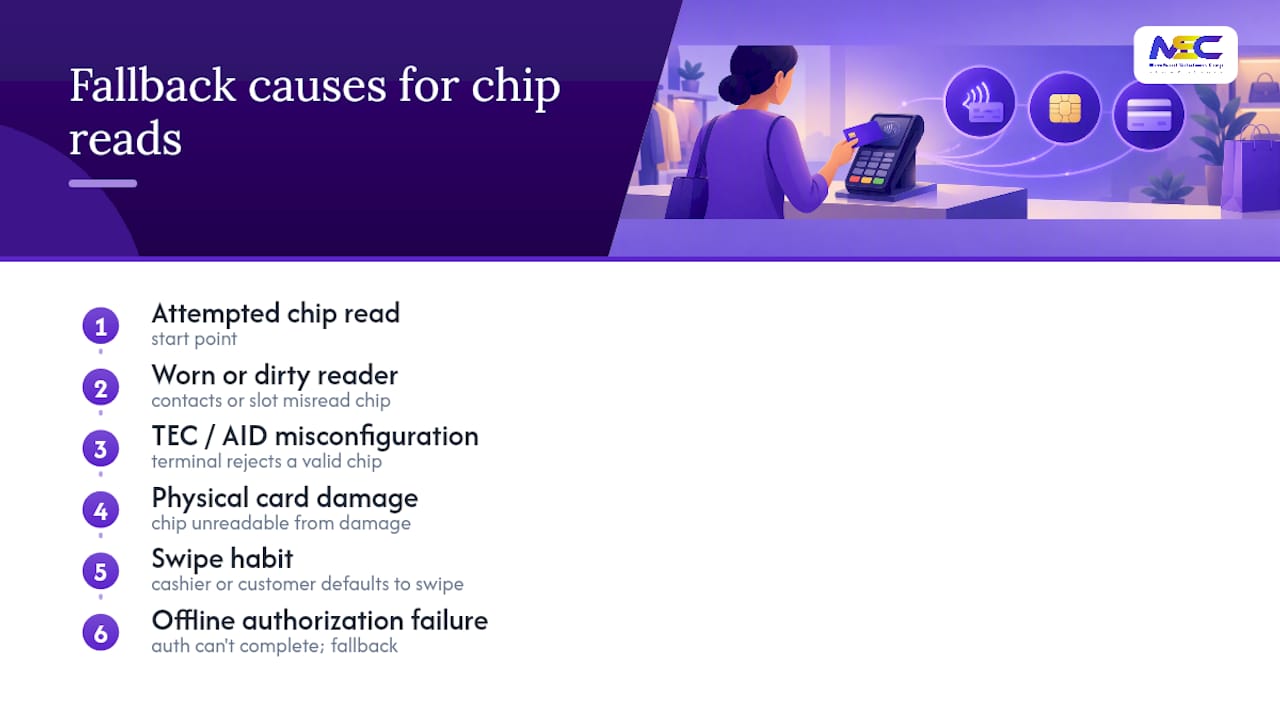
The risk is straightforward: every fallback swipe reverts the transaction to magnetic-stripe security, the exact weakness EMV was built to eliminate. A terminal that falls back often isn’t just an inconvenience. It’s a fraud exposure that compounds with volume.
Liability by Scenario: Three Situations Every Merchant Should Know
Fallback disputes rarely come down to abstract rules. They come down to which of these three situations actually happened.
- Chip-capable terminal, chip not attempted. Your reader worked fine, but the card was swiped anyway (by choice, habit, or a rushed cashier). If the transaction turns out counterfeit, you’re typically on the hook under the liability shift.
- Terminal misconfigured or not chip-enabled. The equipment couldn’t process the chip because of a setup problem, outdated firmware, or lack of EMV certification. In these cases, liability can shift toward the issuer or your acquirer, since the merchant side of the equation wasn’t functioning as required.
- Lost/stolen cards and card-not-present fraud. These fall outside the counterfeit liability shift altogether. A stolen physical card used in person, or a card number used online, triggers different network rules regardless of chip status.
What tips a dispute one way or the other is almost always the evidence submitted, not the chip status alone. Visa’s dispute management guidelines note that a simple approval code proves very little on its own. Your merchant agreement’s specific language on liability allocation also matters more than most business owners assume.
Terminal and Staff Controls That Cut Fallback Risk
The single biggest lever you control is terminal behavior, followed closely by staff habits at the register.
- Configure chip-read retries. Set terminals to attempt 2 to 3 chip reads before allowing any fallback, and confirm your TEC and AID flags match the device’s actual chip capability.
- Make fallback a cashier decision, never a customer one. Visa recommends cashier-controlled fallback specifically because letting customers choose invites abuse. Train staff to inspect the card and compare signature panels or security features before proceeding.
- Deploy validated hardware. Use PCI-validated P2PE or SRED devices and PCI-validated payment applications to limit how much cardholder data your systems ever touch.
- Restrict manual key entry. Limit PAN key entry to processor-approved exception workflows, and log every manual-entry event with a reason code.
- Isolate high-risk transactions. Route gift-card sales, high-value purchases, and other elevated-risk transactions to an attended lane, and train staff to recognize specific fallback error prompts rather than defaulting to a swipe.
Pro Tip: Print your terminal’s current AID and TEC settings once a quarter and compare them against your processor’s recommended configuration. A single firmware update can silently reset flags that took months to get right the first time.
Building a Chargeback Defense: What Evidence Actually Matters
Winning a fallback dispute comes down to documentation, not memory. Collect and retain these items every time fallback fires:
- Chip-data indicators showing whether the terminal attempted a chip read
- Cardholder Verification Method (CVM) results from the transaction
- Terminal configuration and firmware version at the time of sale
- Maintenance and repair records for the card reader involved
- CCTV footage or receipt records tied to the transaction timestamp
- Staff incident notes describing why fallback occurred
Networks weigh these against specific dispute conditions: was the chip present, was a CVM obtained, and was the terminal EMV-capable at all. Visa’s guidance is explicit that an approval code alone rarely settles anything.
Not every case is worth fighting. If your own records show a working chip reader was bypassed for a swipe, conceding early saves time. When your evidence shows the chip attempt failed for a legitimate reason, submit it promptly. Network response windows are tight, and a late submission can lose a winnable case on a technicality.
EMV Alone Won’t Satisfy PCI Compliance
EMV chips reduce counterfeit fraud at the point of sale. They do nothing for data sitting in storage, moving across a network, or authenticating an online purchase. PCI SSC’s own guidance is direct on this point: EMV does not replace PCI DSS, full stop.
Merchants still need encryption or tokenization, validated payment applications, and installation handled by a Qualified Integrator and Reseller (QIR). Point-to-point encryption (P2PE) can shrink your PCI scope, but PCI’s small-merchant guidance is clear that it doesn’t erase compliance obligations for every system that touches card data. Ask your processor whether your P2PE solution is formally validated. That answer changes what you’re still responsible for.
Tracking Fallback Rates Before They Become a Problem
Your fallback rate, fallback transactions divided by total card-present volume, is the single number worth watching monthly. Watch it alongside force-posts and repeated authorization attempts on the same card, since both often signal a reader or configuration issue rather than isolated bad luck.
A rising rate calls for a quick investigation: check for recent terminal deployments or firmware pushes, confirm TEC and AID flags weren’t reset, and swap out any reader with a history of misreads. Mastercard’s own counterfeit-monitoring program can trigger acquirer-level scrutiny once counterfeit ratios cross a threshold, so escalate to your acquirer or open a vendor ticket for a firmware patch before that happens rather than after.
How Regional and Regulatory Differences Shape Fallback Liability
EMV liability rules are not a single global standard. Visa’s counterfeit liability shift and its specific fallback expectations apply within the Visa network’s own operating regulations, and other card networks maintain comparable but distinct frameworks. A merchant processing cards through multiple networks may find slightly different fallback and liability terms depending on which brand’s rules govern a given transaction.
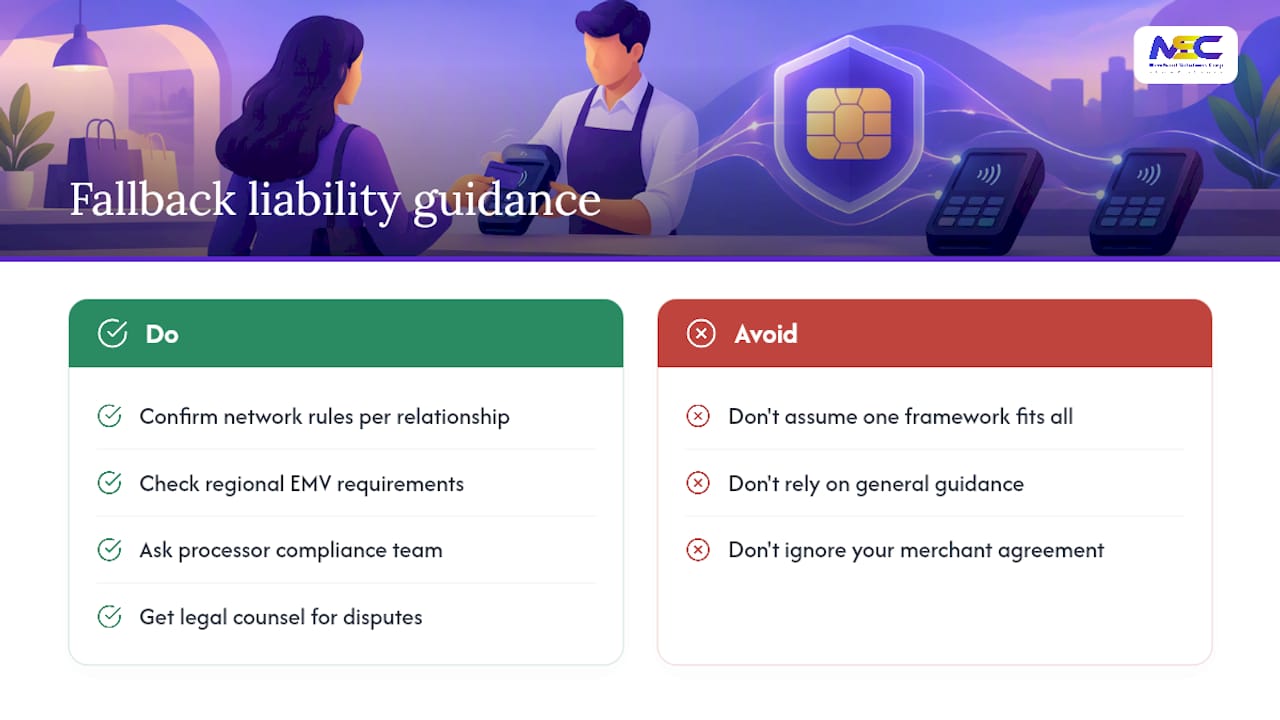
Regional card markets outside the U.S. have handled the chip transition differently, too. Some markets adopted chip-and-PIN as the dominant verification method years before the U.S. moved to chip-and-signature or no-CVM flows, which changes what “correct” fallback handling even looks like on a given terminal. A U.S. merchant with international customers or multi-country operations should confirm which network rules and which regional EMV requirements apply to each processing relationship rather than assuming one framework covers every card swiped.
None of this is a substitute for legal counsel when a dispute escalates. Network operating regulations function as contractual terms between merchants, acquirers, and networks. They are not statutes, but they carry real financial consequences, and a merchant agreement’s specific liability language can override general assumptions about who pays. Payment processing managers handling disputes across state lines or international transactions should treat their processor’s compliance team, not general EMV guidance, as the first call when a rule seems ambiguous. What holds true everywhere is the underlying principle: the liability shift exists to reward whichever party actually supported chip processing correctly, regardless of which network or region governs the specific transaction.
Contactless, Mobile Wallets, and Where Fallback Liability Doesn’t Apply
Contactless and mobile wallet transactions use the same EMV chip data as a dipped card, just transmitted over near-field communication instead of physical contact. A tap that completes successfully carries the same liability protections as a chip dip. There’s no separate “contactless fallback” liability category, because a successful tap simply is a chip transaction.
Where things get more complicated is the fallback path when contactless fails. If a tap doesn’t register and the terminal drops to a swipe or manual entry, you’re back in standard technical fallback territory, with the same liability exposure described earlier in this article. The device type doesn’t change the underlying rule.
E-commerce and mobile in-app payments sit in an entirely separate category. EMVCo’s own materials on 3-D Secure make clear that card-not-present authentication uses a completely different framework built around device and transaction data rather than a physical chip read. Confusing card-present fallback liability with e-commerce authentication liability leads merchants toward the wrong controls entirely. If your business takes both in-person and online payments, your fallback prevention checklist belongs at the terminal, and your e-commerce fraud prevention belongs in your 3-D Secure and gateway configuration. Treating them as one problem with one fix is a common and costly mistake.
A Publisher’s View on Managing Fallback Exposure
Most fallback liability disputes trace back to a terminal setting nobody checked after installation, not fraud sophistication. Correctly provisioned EMV terminals and disciplined onboarding prevent more chargebacks than any after-the-fact evidence-gathering ever will. A processor that understands configuration, not just hardware sales, is the difference between a clean dispute record and a slow leak of counterfeit losses.
— Jonathan
Get EMV-Capable Terminals Configured Right From the Start
Correct terminal setup is the entire game with fallback liability, and Merchantsolutionscorp builds that into onboarding instead of leaving it to chance. Every EMV-capable terminal receives configuration with chip-read sequences and fallback controls as recommended, with ongoing support available if settings change after a firmware update.
That combination, proper configuration plus documented support history, is exactly what strengthens your position if a fallback dispute ever lands on your desk. Merchantsolutionscorp also offers dual pricing programs to help offset processing costs while you upgrade equipment. If your current fallback rate is a mystery or your terminals haven’t been reviewed since installation, request a configuration check through Merchantsolutionscorp’s merchant services page and get a straight answer on where your exposure actually sits.
FAQ
What Does EMV Fallback Mean?
EMV fallback happens when a terminal can’t read a card’s chip and drops to a magnetic-stripe swipe or manual card-number entry instead. Visa’s guidance treats frequent fallback as a red flag worth investigating, since it reverts the transaction to weaker stripe-level security.
What Does “Fallback Decline EMV Chip Error” Mean?
This error message means the terminal attempted to read the chip and failed, often due to a damaged chip, a dirty card reader, or a firmware mismatch. The terminal then prompts a fallback swipe, which should always be performed by the cashier rather than left to the customer’s discretion.
What Does “Fallback Transaction Not Allowed” Mean?
This message means the terminal or processor has blocked fallback for that specific transaction, usually because the card or terminal settings flag it as high risk. It’s a deliberate control, not a malfunction, designed to force a working chip read or a different payment method.
What Does EMV Failure Mean?
EMV failure generally refers to a chip read that didn’t complete successfully, whether from a hardware fault, a software misconfiguration, or physical card damage. How liability lands after an EMV failure depends on whether the terminal was functioning correctly and chip-capable at the time, which is exactly what the liability-shift rules are built to sort out.