Hotel Credit Card Processing Guide for Managers in 2026
Hotel Credit Card Processing Guide for Managers in 2026
Hotel credit card processing covers every step from the moment a guest swipes at check-in to the final settlement that lands in your bank account. It includes authorization, incremental holds for incidentals, capture, and clearing, all governed by PCI DSS security standards and routed through a chain of parties: your payment gateway, acquiring bank, card networks like Visa and Mastercard, and the guest’s issuing bank. Getting this right protects your revenue, keeps guests confident, and keeps regulators off your back.
Here is what this guide covers:
- How the payment workflow actually moves from guest to your account
- Which parties are responsible for what
- The processing methods hotels use today, from EMV terminals to online gateways
- PCI DSS 4.0.1 compliance requirements that became mandatory in March 2025
- Merchant category codes and how they affect your fees
- Practical ways to cut processing costs without cutting corners
- Chargeback defense, dispute management, and tokenization best practices—including understanding that each dispute costs hotels approximately $450 in total fees and labor—
- How to evaluate processors and gateways built for hotel operations
How hotel credit card processing works: parties and workflow
Every card transaction in your hotel passes through six parties, and understanding each role helps you spot where things go wrong.
The six parties:
- Guest: Presents the card at check-in, online, or via a mobile device
- Hotel (merchant): Initiates the authorization request through a terminal or gateway
- Payment gateway/processor: Routes the transaction data securely between the hotel and the acquiring bank
- Acquiring bank: Your bank, which receives the authorization request and forwards it to the card network
- Card network (Visa, Mastercard): Routes the request to the issuing bank and sets interchange rules
- Issuing bank: The guest’s bank, which approves or declines the transaction
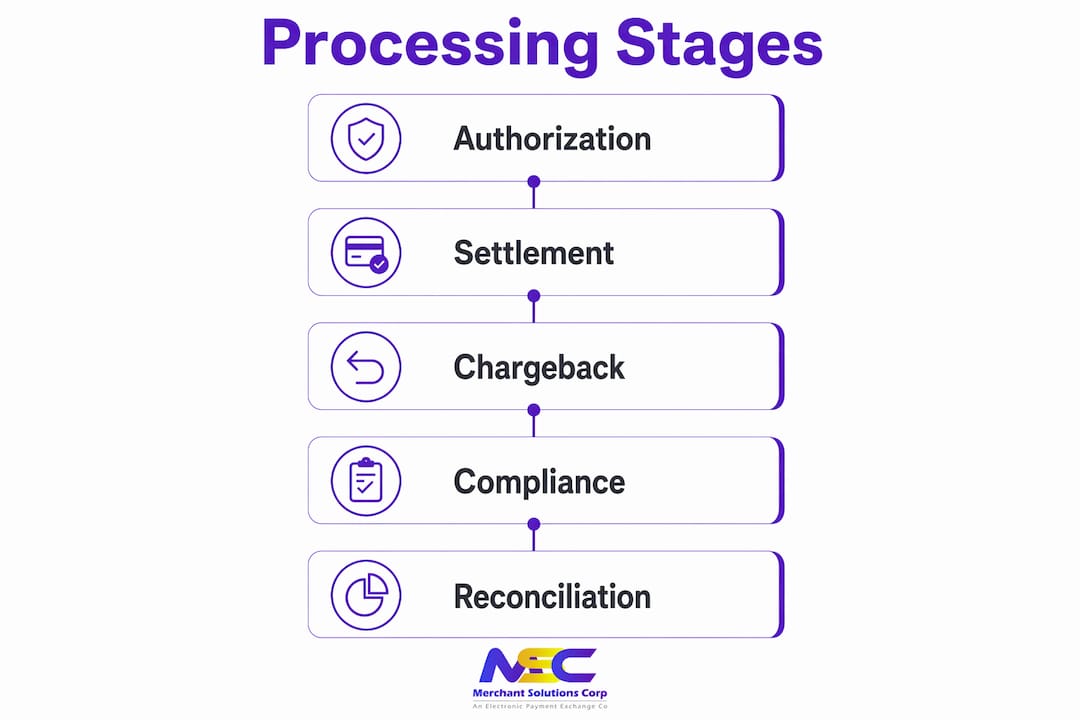
The workflow runs in three stages. At check-in, your system sends an authorization request for the estimated stay amount plus an incidental hold. The issuing bank approves and reserves those funds. During the stay, incremental authorizations capture additional charges like room service or spa fees. At checkout, the final settlement amount is captured and cleared, typically within one to two business days.
Pro Tip: Visa’s lodging rules support up to 100 incremental authorizations per transaction. The constraint is operational discipline, not a technical ceiling.
| Stage | Action | Who Initiates |
|---|---|---|
| Authorization | Hold placed on estimated stay + incidentals | Hotel via gateway |
| Incremental auth | Additional holds for in-stay charges | Hotel PMS trigger |
| Capture/settlement | Final amount captured and cleared | Processor/acquirer |
What payment processing methods work best for hotels?
Hotels operate across more channels than almost any other merchant type, so your processing setup needs to handle all of them without gaps.
In-person EMV transactions
EMV chip terminals at the front desk are the baseline. They authenticate the card locally, reducing counterfeit fraud liability. Manual key entry of card numbers triggers higher interchange fees and weakens your chargeback defense position significantly. Integrated EMV terminals with tokenization solve both problems at once.

Mobile and contactless payments
Near-field communication (NFC) readers accept Apple Pay, Google Pay, and tap-to-pay cards. Guests increasingly expect this at check-in and at on-property outlets like restaurants and gift shops. Mobile terminals also let your staff process payments anywhere on the property, which speeds up pool-side or concierge transactions.
Online payment processing
Guests booking directly through your website pay via a hosted payment page or iframe checkout controlled by your processor. Online travel agencies (OTAs) like Expedia send virtual credit cards (VCCs) for prepaid bookings. These VCCs must be handled inside a PCI-compliant environment, never downloaded to a spreadsheet or forwarded by email.
Pro Tip: Use your processor’s iframe-hosted checkout on your booking engine rather than a redirect flow. It keeps card data off your servers entirely and qualifies you for the lighter SAQ A compliance path.
- Confirm your gateway supports hotel-specific authorization types (lodging, incremental, no-show).
- Verify that your PMS integration passes tokenized data, not raw card numbers.
- Test the full checkout flow on mobile devices before going live.
- Confirm OTA VCC delivery routes through a secure extranet or API, not email.
- Enable 3D Secure for direct online bookings to shift fraud liability away from your property.
PCI DSS compliance and security: what hotels must do now
PCI DSS 4.0.1 became the only active version of the standard on December 31, 2024, with 51 new requirements that became mandatory on March 31, 2025. There is no grace period, and fines run from $5,000 to $100,000 per month for violations.
Most hoteliers still think PCI compliance is an annual checkbox. It is not. The standard now requires continuous daily compliance, including quarterly penetration testing and multi-factor authentication (MFA) for every administrator who accesses your cardholder data environment (CDE).
What hotels must do under PCI DSS 4.0.1:
- Enable MFA for all administrative access to payment systems, not just remote access
- Conduct quarterly external scans through an Approved Scanning Vendor (ASV)
- Perform daily tamper checks on any booking page that loads third-party scripts
- Stop accepting virtual credit card details in plaintext email from OTAs
- Maintain a written card data flow map showing where card numbers enter and exit your environment
- Store no raw card numbers anywhere in your PMS, accounting exports, or paper files
The fastest path to lower compliance cost is tokenization. Using a tokenizing payment processor keeps card data off your network entirely, which qualifies most independent hotels for SAQ A, the lightest self-assessment form at roughly 30 questions. Hotels that store or process card data internally face SAQ D, which can cost $15,000–$50,000 per year to maintain. The SAQ A path typically runs $1,500–$3,000 annually.
Pro Tip: Require all OTAs to deliver VCC details through their secure extranet or a tokenized API integration. Receiving a VCC number in a plain email has been a PCI violation since version 1.0 in 2004, and card networks are now auditing this control directly.
How merchant category codes affect your hotel processing fees
A merchant category code (MCC) is a four-digit number assigned by card networks to classify your business type. Card networks and acquiring banks use MCCs to determine which interchange fee tier applies to each transaction.
Hotels and lodging properties typically operate under MCCs in the 7000 range, with codes distinguishing between hotels, motels, and resorts. The specific code assigned to your account affects:
- Interchange rates: Lodging-specific MCCs carry particular rate structures that differ from retail or restaurant categories
- Processor fee tiers: Some acquirers apply surcharges or volume discounts based on MCC classification
- IRS and bank reporting: Your MCC determines how your revenue is categorized for 1099-K reporting and bank risk assessment
- Chargeback reason code eligibility: Certain dispute codes, including no-show charges, are only available to merchants with lodging MCCs
Incorrect or misclassified MCCs create two problems: you may pay higher interchange fees than necessary, and you lose access to lodging-specific authorization types like incremental holds. Verify your MCC with your acquirer when you open your merchant account, and confirm it again if you switch processors.
Key MCC considerations for hotels:
- Confirm your MCC reflects your primary business type (hotel, resort, or motel)
- Ask your processor how your MCC affects your interchange qualification tiers
- If you operate a restaurant or spa on-property, those outlets may need separate merchant accounts with their own MCCs
- Misclassification can trigger reconciliation issues and flag your account for review
Practical ways to reduce your hotel’s credit card processing costs
Processing fees are a significant controllable cost in hotel operations, influenced by factors like card type, merchant category code, and processing method.
Tactics that actually move the number:
- Switch to integrated EMV terminals: Eliminating manual key entry lowers your interchange qualification tier and reduces fraud-related costs
- Negotiate with your acquirer: Volume, chargeback rate, and processing history all give you leverage; ask for interchange-plus pricing rather than flat-rate bundles
- Configure incremental authorizations correctly: Proper PMS configuration prevents under-authorization disputes and the fees that come with them
- Use dual pricing or surcharging: Passing the processing cost to card-paying guests (where permitted by state law) offsets fees without raising room rates
- Reduce chargebacks proactively: Each dispute costs roughly $450 in fees, lost revenue, and labor when all costs are counted; fewer disputes directly improve your net margin
- Audit your statement monthly: Processors sometimes apply incorrect fee categories; catching a misclassified transaction type can recover real money
Pro Tip: Refund every approved cancellation directly to the original card of charge, and record the credit reference code in the booking notes. Cash refunds and future-stay credits are operationally convenient but they do not protect you against a “credit not processed” chargeback, which you will lose automatically.
Common challenges in hotel payment processing and how to address them
Hotel payment processing is more complex than retail because the authorization and settlement are separated by days, bookings arrive through multiple channels, and guests dispute charges long after checkout.
The most frequent problems:
- Friendly fraud and no-show chargebacks: About 75% of hotel chargebacks originate from first-party fraud, where guests dispute valid charges rather than contacting the hotel directly
- Third-party booking and VCC handling: OTA virtual cards require secure processing workflows; staff who manually enter or email VCC numbers create both PCI violations and fraud exposure
- Unclear cancellation policies: Guests who cannot recall agreeing to a no-show fee are far more likely to dispute the charge; policy visibility at booking and at check-in closes this gap
- Staff training gaps: Inconsistent front desk procedures around ID verification, authorization amounts, and refund processing are a direct cause of lost disputes
- Maintaining compliance across booking channels: Direct bookings, OTA reservations, group contracts, and phone bookings each carry different data-handling risks
Recommendations:
- Require government-issued ID at check-in and match it to the payment card on file
- Use digital registration cards with timestamped signatures rather than paper forms
- Train front desk and night audit staff on the specific evidence needed to win each chargeback reason code
- Build a written policy that explicitly prohibits manual card entry and plaintext VCC handling
- Review your chargeback history quarterly and identify the top three reason codes by volume
Integrating payment processing with your property management system
A payment processing setup that runs separately from your PMS creates manual reconciliation work, audit gaps, and slower dispute responses. Integration eliminates all three.
When your payment gateway connects directly to your PMS, every authorization, incremental hold, and settlement posts automatically to the guest folio. Staff do not need to re-enter amounts, and the audit trail is complete from booking to checkout. That trail is what wins chargebacks. Coordinated operational processes across reservations, check-in, authorization, and post-stay communication directly improve dispute win rates.
What to look for in a PMS-integrated payment setup:
- Native support for lodging authorization types, including incremental holds and no-show charges
- Tokenized data exchange between the gateway and PMS so raw card numbers never touch your servers
- Automatic folio updates when incremental authorizations are approved
- One-click access to authorization records, signed agreements, and communication logs for dispute response
- PCI DSS-validated integration certified by the processor, not just the PMS vendor
Selecting a processor whose gateway is already certified with your PMS saves weeks of integration work. Merchantsolutionscorp supports hotel lodging payment setups with POS hardware including Clover and Square terminals, configured for the specific authorization workflows hotels require.
Best practices for setup and training:
- Map your card data flow before go-live to confirm no raw numbers pass through hotel-owned systems
- Set incremental authorization thresholds in the PMS at the time of configuration, not after the first dispute
- Train staff on how to pull dispute evidence from the integrated system in under three clicks
Expert insights on proactive chargeback defense and tokenization
The hotels that win the most disputes treat chargeback defense as a daily operational task, not an accounting problem that surfaces at month-end. That shift in mindset is the single biggest predictor of a low dispute rate.
What the data shows:
- Hotel chargebacks jumped 816% between 2023 and 2024, reaching a 0.916% industry rate, with an average dispute value of $120 and a total cost per dispute of approximately $450 once fees and labor are included
- Visa’s Compelling Evidence 3.0 rules give hotels that maintain prior transaction history a win rate above 80% on 10.4 (card-absent fraud) disputes
- Implementing tokenized payment processors is the single most impactful step independent hotels can take to reduce PCI compliance cost and breach exposure
Proactive defense practices:
- Require explicit digital acknowledgment of cancellation and no-show policies at booking, with a timestamp recorded in your system
- Use timestamped digital agreements at check-in to document that the guest accepted all charges and fees
- Monitor your acquirer’s dispute portal daily, not weekly; response windows are typically 7–30 days and missing them means automatic loss
- Subscribe to Visa RDR (Rapid Dispute Resolution) and Ethoca Alerts to intercept disputes before they formalize into chargebacks
- Build a folder structure in your PMS that organizes evidence by booking ID so you can respond to any dispute within minutes
How chargebacks and disputes work in hotel credit card processing
A chargeback occurs when a guest disputes a charge with their bank instead of contacting your property. The bank reverses the funds from your account and opens an investigation. You then have a limited window, typically 7–30 days depending on the card network and your acquirer, to submit evidence proving the charge was valid.
Nine reason codes cover the vast majority of hotel disputes: Visa 10.4 (card-absent fraud), 13.1 (not received), 13.3 (not as described), 13.5 (misrepresentation), 13.6 (credit not processed), 13.7 (cancelled services), and Mastercard 4853, 4855, and 4837. Each code requires different evidence. Sending a generic response regardless of the code is the fastest way to lose a winnable dispute.
Guests can file chargebacks up to 120 days after the transaction, sometimes longer. Keep all authorization records, signed agreements, and communication logs for at least six months. For no-show disputes specifically, your strongest evidence is a signed or digitally accepted cancellation policy combined with proof that the card was authorized at booking.
How tipping and gratuity handling affects credit card processing
Tipping adds a layer of complexity to hotel payment processing that many operators underestimate. When a guest adds a gratuity after the initial authorization, the final settlement amount exceeds the authorized amount. Card networks allow a tolerance for this, typically a percentage above the authorized total, but exceeding that tolerance can trigger a downgrade to a higher interchange tier or, in some cases, a dispute.
For hotel restaurants, spas, and valet services, the cleanest approach is to authorize a tip-adjusted amount at the point of service rather than adjusting the settlement after the fact. Some POS systems, including Clover terminals available through Merchantsolutionscorp, support tip-adjust workflows that capture the final amount before settlement closes. This keeps your interchange qualification clean and gives guests a clear receipt showing the total they approved.
Staff should never adjust a settled transaction to add a gratuity. That practice creates a mismatch between the authorized and settled amounts and is a direct cause of “unauthorized transaction” chargebacks.
Contactless payments and digital wallets in hotel operations
Guests now expect to pay with their phone or watch at every touchpoint, from front desk check-in to the pool bar. NFC-enabled terminals that accept Apple Pay, Google Pay, and Samsung Pay are the baseline for any property opened or renovated in the past three years. Contactless transactions carry the same liability protections as EMV chip transactions, so the fraud risk profile is comparable.

Digital wallets add a layer of tokenization on top of the card itself. When a guest pays with Apple Pay, the actual card number is never transmitted; a device-specific token is used instead. This reduces your exposure to card-present fraud and simplifies your PCI scope for those transactions.
Digital reservation platforms that capture payment authorization at the time of booking are increasingly common, and they pair well with contactless check-in flows that let guests bypass the front desk entirely. The hotel check-in workflow for properties using mobile check-in typically routes the authorization through the same tokenized gateway as in-person transactions, keeping the compliance scope consistent.
Biometric authentication tied to digital wallets is the next step many major brands are piloting. For independent hotels, the practical priority right now is ensuring every terminal on property is NFC-capable and that your gateway supports wallet transactions without requiring manual intervention from staff.
How to select and evaluate payment processors and gateways for hotels
Not every processor understands hotel-specific authorization workflows. Choosing the wrong one costs you money in fees, compliance exposure, and lost disputes.
What to evaluate before signing:
- Lodging authorization support: Confirm the processor supports incremental authorizations, no-show charges, and lodging-specific settlement timing
- Tokenization architecture: The processor must keep card data off your network; ask specifically whether their integration pushes raw card numbers into your PMS or only tokens
- PCI DSS certification level: Verify the processor is a PCI DSS-validated service provider, not just self-certified
- PMS compatibility: Request a list of certified PMS integrations and confirm your system is on it before committing
- Chargeback support: Ask how disputes are routed, what evidence tools are available, and whether the processor offers pre-chargeback alert services like Visa RDR or Ethoca
- Fee structure transparency: Interchange-plus pricing gives you visibility into what you actually pay per transaction; flat-rate bundles often cost more at hotel transaction volumes
- Hardware options: Confirm the processor supports the terminal types your property needs, including countertop EMV, mobile, and NFC readers
Merchantsolutionscorp provides payment processing solutions built for hospitality, with Clover and Square POS hardware, $0 upfront equipment programs, dual pricing options, and dedicated onboarding support. The setup is configured for hotel workflows from day one, not adapted from a retail template.
When evaluating any processor, request a sample merchant statement and have your accountant or a payment consultant review the fee line items. The difference between a well-negotiated interchange-plus agreement and a bundled flat-rate contract can represent thousands of dollars per year at typical hotel transaction volumes.
Key Takeaways
Hotel credit card processing requires a tokenized, PCI DSS-compliant architecture, proactive chargeback management, and a processor that natively supports lodging authorization workflows.
| Point | Details |
|---|---|
| PCI DSS 4.0.1 is continuous | Compliance became mandatory in March 2025 with daily requirements, quarterly scans, and MFA for all CDE access. |
| Tokenization cuts compliance cost | SAQ A qualification keeps annual PCI costs at $1,500–$3,000 versus $15,000–$50,000 for SAQ D. |
| Chargebacks cost more than the dispute | The total cost per dispute reaches approximately $450 once fees, lost revenue, and labor are counted. |
| Incremental authorizations need PMS configuration | Most PMS deployments do not trigger incremental holds automatically; manual configuration is required. |
| MCC classification affects fees and dispute rights | Lodging MCCs unlock specific authorization types and interchange tiers unavailable to misclassified accounts. |
FAQ
What is hotel credit card processing?
Hotel credit card processing is the system hotels use to accept, authorize, and settle guest card payments, covering authorization at check-in, incremental holds during the stay, and final settlement at checkout.
What does PCI DSS 4.0.1 require from hotels?
PCI DSS 4.0.1 requires continuous daily compliance, including MFA for all cardholder data environment access, quarterly external vulnerability scans, and daily tamper checks on booking pages. It became mandatory in March 2025 with no grace period.
How can hotels reduce credit card processing fees?
Hotels reduce fees by switching to integrated EMV terminals with tokenization, negotiating interchange-plus pricing with their acquirer, configuring PMS-triggered incremental authorizations, and reducing chargebacks, which cost approximately $450 each in total.
Why do hotels lose chargeback disputes?
Hotels most often lose disputes by sending the wrong evidence for the specific reason code, missing the 7–30 day response window, or lacking timestamped digital documentation that proves the guest authorized the charge and accepted the cancellation policy.
What should hotels look for in a payment processor?
Hotels should confirm the processor supports lodging-specific authorizations, uses tokenization that keeps card data off hotel servers, holds PCI DSS service provider certification, integrates natively with the hotel’s PMS, and offers pre-chargeback alert tools like Visa RDR or Ethoca.