How to Accept Card Payments in CBD Stores
How to Accept Card Payments in CBD Stores
Yes — U.S. CBD stores can accept card payments, provided you use a CBD-aware processor and your products meet the ≤0.3% delta-9 THC threshold established by the 2018 Farm Bill. The fastest route to live is a high-risk merchant account with documented underwriting, not a mainstream gateway.
Quick-start checklist:
- Choose a CBD-specialist processor or apply to a high-risk program like Merchantsolutionscorp
- Prepare Certificates of Analysis (COAs) for every SKU, your state hemp license, and supplier invoices
- Configure your POS or gateway with age verification, geo-IP shipping restrictions, and COA links at checkout
- Enable fraud controls: 3DS2 for card-not-present, AVS, and CVV enforcement
- Get written product-coverage confirmation from your processor and keep it on file
TL;DR: Contact a CBD-specialist processor or Merchantsolutionscorp’s high-risk merchant program, assemble your compliance documents, and run a test transaction before your go-live date.
Table of Contents
- Why do card networks treat CBD differently from standard retail?
- What are the viable payment paths for CBD retailers?
- What documents do underwriters actually require from CBD stores?
- How do you choose POS hardware and gateways that actually support CBD?
- What should you expect to pay for CBD payment processing?
- How do you handle chargebacks and disputes as a CBD merchant?
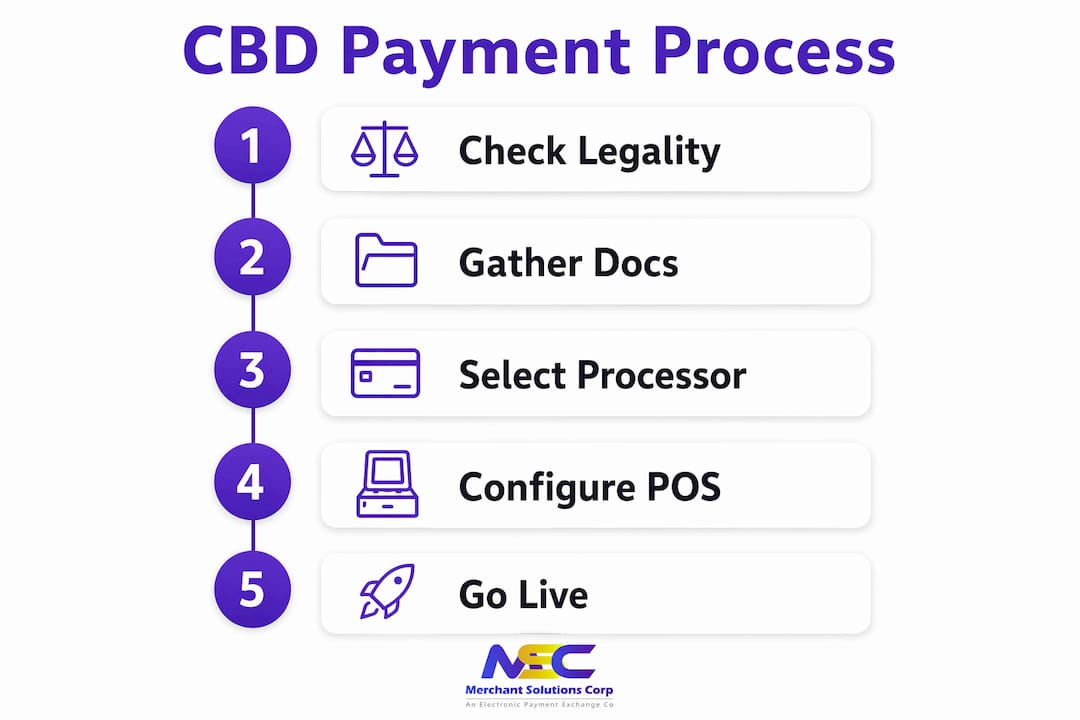
- What does a realistic go-live timeline look like?
- Key Takeaways
- The case for getting your payment setup right from day one
- Merchantsolutionscorp makes CBD payment setup straightforward
- FAQ
Why do card networks treat CBD differently from standard retail?
Federal legality and card-network acceptance are two separate things. The 2018 Farm Bill made hemp-derived CBD federally legal when products contain ≤0.3% delta-9 THC, but Visa, Mastercard, and their acquiring banks still apply additional controls. They assign specific Merchant Category Codes (MCCs) to hemp merchants, require enhanced underwriting, and run automated monitoring that can flag or close accounts without warning.
Mainstream pooled processors often list CBD as an unsupported category. Merchants who slip through initial approval frequently find their accounts closed weeks later after an automated review flags the product type. That is not a hypothetical risk — documented cases show balances held and 90-day reserves imposed on fully compliant merchants.
The practical consequences for your store:
- Restricted access to standard payment gateways (Stripe, PayPal, Square’s standard tiers)
- Higher underwriting scrutiny and longer approval timelines
- Possible rolling reserves of a portion of monthly volume held for several months
- Stricter chargeback response windows and enhanced ongoing monitoring
Pro Tip: Keep a digital folder of your COAs, licenses, and product descriptions updated monthly. Processors that terminate accounts mid-stream almost always cite missing or outdated documentation as the trigger.
What are the viable payment paths for CBD retailers?
Specialist CBD processors maintain separate acquiring relationships and compliance workflows built for hemp merchants. That structural difference is what makes them stable where mainstream gateways are not.

| Payment Path | Fee Direction | Onboarding Time | Compliance Support | Rolling Reserves | Best For |
|---|---|---|---|---|---|
| Specialty CBD processor | Higher than retail | 5–14 days | Strong | Possible | Broad SKU coverage, online + in-store |
| High-risk merchant account | Highest | 1–7 days | Strongest | Common | Intoxicating hemp SKUs, high volume |
| Dual pricing / cash discount | Offset to customer | 3–10 days | Moderate | Less common | Fee-sensitive brick-and-mortar stores |
| ACH / eCheck | Lowest | 3–7 days | Moderate | Rare | B2B, wholesale, repeat customers |
| Cash only | None | Immediate | None | None | Fallback; limits growth |
Key tradeoffs at a glance:
- Specialty CBD processors offer stable accounts and broad product coverage, but fees run above standard retail rates
- High-risk merchant accounts provide the fullest underwriting and are typically required for intoxicating hemp SKUs; expect reserves
- Dual pricing shifts card costs to card-paying customers, reducing your net cost, but requires proper disclosure and state-level compliance review
- ACH/eCheck carries lower chargeback risk and suits wholesale or subscription buyers, though it is slower to settle
Pro Tip: Ask any processor to provide written confirmation that every SKU in your catalog is explicitly covered before you sign. A generic “we support CBD” statement is not the same as documented per-product approval.
What documents do underwriters actually require from CBD stores?
Lead with this: a complete, well-organized application package cuts approval time and prevents the most common rejection reason — missing or inconsistent documentation. Acquiring banks and CBD-aware processors routinely request all of the following.
Document checklist:
- Business registration and EIN
- State hemp handler or retailer license (where required by your state)
- Certificate of Analysis (COA) for each batch and SKU, from an ISO-accredited lab, confirming ≤0.3% delta-9 THC
- Full product catalog with SKU descriptions, weights, and pricing
- Supplier invoices and chain-of-custody records linking each product to its COA
- Website screenshots showing compliant product descriptions, age-gate, and checkout flow
- Shipping and return policy pages, including restricted-state disclosures
- Three to six months of business bank statements
- Proof of general liability insurance (if available)
How to package and submit:
- Create a single labeled folder (PDF or ZIP) organized by category: Business Docs, Licenses, COAs, Product Catalog, Website Screenshots, Financial Statements.
- Name each file clearly (e.g., “COA_SkuABC_Batch2025-04.pdf”) so reviewers can match documents to products instantly.
- Upload through the processor’s secure digital portal — never email unencrypted files containing financial data.
- Confirm receipt and ask for a named underwriting contact who can request additional items directly, avoiding delays.
Each item serves a specific underwriting purpose. COAs prove product legality. Supplier invoices establish source traceability. Website screenshots confirm your public-facing disclosures match what you told the underwriter.
How do you choose POS hardware and gateways that actually support CBD?
Choose POS and terminal vendors that explicitly support CBD and high-risk merchant flows. Not every terminal or gateway integrates the compliance features hemp retailers need, and a mismatch between your processor and your hardware creates gaps that can trigger disputes or account reviews.
Hardware and integration priorities:
- EMV-ready terminals for card-present transactions; chip-and-PIN reduces fraud liability
- Mobile readers for events, farmers markets, or pop-up locations where your store sells offsite
- E-commerce gateways with 3DS2 for card-not-present authentication on online orders
- API/webhook support for COA document links, geo-IP shipping restrictions, and age-verification plugins
- Age verification at checkout — both in-store prompts and online ID-proofing for psychoactive SKUs
POS features that matter specifically for CBD:
- Product attribute fields for THC content and batch number
- Inventory holds for products restricted in certain states
- Receipt options that include a COA link or QR code for the purchased batch
- Reporting that separates hemp SKUs by compliance category
The POS system overview for CBD stores from Merchantsolutionscorp covers configuration steps in detail. For merchants selling at events or markets, mobile payment setups designed for offsite retail translate directly to CBD pop-up scenarios.
Pro Tip: Before signing with any gateway, test the COA-link field in a sandbox environment. If the platform’s checkout cannot attach a document to a line item, your dispute evidence workflow will be manual — and manual is too slow.
What should you expect to pay for CBD payment processing?
Expect fees above standard retail. Processors price CBD accounts to reflect elevated chargeback risk, reserve requirements, and the compliance overhead of ongoing monitoring. That premium is real, and any provider quoting you standard retail rates without acknowledging the high-risk classification should raise a flag.
Common fee structures you will encounter:
- Interchange-plus pricing: a fixed markup over interchange; most transparent for volume merchants
- Blended / flat-rate pricing: simpler but often more expensive at higher volumes
- Per-transaction fees: a fixed cent amount per authorization, on top of percentage rates
- Rolling reserves: typically 5–10% of monthly processing volume, held for 90–180 days, then released on a rolling basis
- Monthly account fees: covering compliance monitoring, gateway access, and account management
- Equipment costs: terminals, software licenses, and configuration fees (some programs offer $0 upfront hardware)
Legal ways to offset card costs:
- Dual pricing / cash discount programs display a card price and a cash price; customers who pay cash receive the lower amount
- Surcharging passes card fees to the customer directly, but requires state-level compliance review and proper disclosure
- ACH/eCheck for B2B and wholesale orders reduces card volume and chargeback exposure
- Volume tiers negotiated with your processor once you demonstrate consistent, compliant processing history
Ask any prospective processor for a sample pricing worksheet before you apply. That single step surfaces hidden fees and lets you compare total cost of acceptance across providers accurately.
How do you handle chargebacks and disputes as a CBD merchant?
Fast, automated digital evidence submission is now essential. Card networks have shortened dispute response windows to commonly 30 days for many high-risk verticals, and manual paper processes cannot meet that pace reliably.
Dispute prevention measures to implement now:
- 3DS2 authentication for all card-not-present transactions
- AVS and CVV enforcement on every online order
- Clear product descriptions, COA links, and shipping disclosures at cart and on receipts
- Third-party ID proofing for psychoactive hemp SKUs
- Geo-IP shipping restrictions that block orders to states where the product is prohibited
When a dispute arrives, your response package should include:
- Complete order payload (timestamp, IP address, device fingerprint)
- Delivery confirmation or signed receipt
- The COA and batch number for the specific product purchased
- Any age-verification or ID-proofing record tied to that transaction
- Automated evidence upload through your processor’s dispute portal, within the network’s response window
Pro Tip: Configure your POS or gateway to auto-attach the batch-specific COA to every transaction record at the time of sale. When a dispute arrives 60 days later, that evidence is already packaged and ready to upload — no scrambling.
What does a realistic go-live timeline look like?
Well-documented, compliant stores can go live in as few as two weeks. Accounts requiring manual underwriting or reserve negotiations typically take three to five weeks. Plan your inventory and staffing around the longer estimate and treat anything faster as a bonus.
Typical onboarding timeline:
- Document preparation (1–7 days): Gather COAs, licenses, bank statements, website screenshots, and supplier invoices into a single organized package.
- Application and underwriting (3–14 days): Submit through the processor’s digital portal; respond to any follow-up requests within 24 hours to avoid delays.
- Terminal and POS configuration (1–7 days): Receive pre-configured hardware or complete gateway integration; test COA links, age-verification prompts, and geo-IP rules in a sandbox.
- Test transactions and go-live (1–3 days): Run live test transactions, confirm settlement, and verify dispute-evidence automation is active.
Go-live day checklist:
- Verify COA links appear on printed and digital receipts
- Confirm 3DS2 is active for all online checkout flows
- Test AVS and CVV decline rules with a known mismatched card
- Validate geo-IP shipping blocks for restricted states
- Schedule daily settlement reconciliation and set up reserve-balance alerts
A note on initial holds: your first few settlements may be held an extra 24–48 hours while the processor validates your processing pattern. This is normal for new high-risk accounts. Keep a cash reserve to cover operating costs during that window.
Key Takeaways
Accepting card payments in a CBD store is achievable with the right processor, complete documentation, and a configured POS — the merchants who get declined are almost always missing one of those three elements.
| Point | Details |
|---|---|
| Federal threshold matters | Products must contain ≤0.3% delta-9 THC to qualify for card-network acceptance under the 2018 Farm Bill. |
| Specialist processor required | Mainstream gateways routinely close CBD accounts; a high-risk or CBD-specialist processor provides stable, documented underwriting. |
| Documentation drives approvals | COAs, state licenses, supplier invoices, and website screenshots are the core package underwriters require. |
| Dispute windows are short | Card networks commonly enforce 30-day response windows; automated evidence submission is no longer optional. |
| Merchantsolutionscorp offers a turnkey path | Merchantsolutionscorp’s high-risk program combines documented underwriting, configured hardware, and dispute automation for CBD retailers. |
The case for getting your payment setup right from day one
Most CBD merchants who struggle with payment processing made the same mistake: they applied to a mainstream gateway first, got approved, processed for a few weeks, and then had their account frozen with funds held. The documentation they needed was never assembled. The processor they chose never had a compliant underwriting path for hemp. By the time the freeze happened, they had customers waiting and no fallback.
The merchants who avoid that cycle treat payment setup as a compliance project, not an afterthought. They gather COAs before they apply. They ask processors for written SKU coverage. They configure 3DS2 and AVS before their first online sale, not after their first chargeback.
There is also a subtler point worth making: the cost premium of a high-risk account is real, but it is predictable. A frozen account with a 90-day reserve is not. Merchants who compare only the fee percentages and ignore the stability and compliance support of a specialist processor are optimizing for the wrong variable. The right question is not “which processor is cheapest?” but “which processor will still be processing my transactions six months from now?”
Merchantsolutionscorp makes CBD payment setup straightforward
CBD merchants need more than a merchant account — they need a processor that has done this before, with hardware that arrives configured and underwriting that documents every SKU. Merchantsolutionscorp’s CBD and high-risk payment program covers exactly that: application support, COA document checklist guidance, pre-configured terminals, 3DS2 and fraud-control setup, and dispute evidence automation built into the workflow from day one.
The onboarding path is straightforward. Evaluate your eligibility and review program details on the high-risk merchant services page. Submit your documents through the digital portal with support from the onboarding team. Then schedule your hardware configuration and go-live date. Merchantsolutionscorp also offers dual pricing programs to offset card costs and retail payment solutions that scale as your store grows. Contact Merchantsolutionscorp to start your application and get a sample pricing worksheet before you commit.
FAQ
Can a U.S. CBD store legally accept credit cards?
Yes, provided the products contain ≤0.3% delta-9 THC under the 2018 Farm Bill and the merchant uses a processor that explicitly supports hemp-derived CBD with documented underwriting.
Why do mainstream processors keep declining CBD merchants?
Mainstream pooled processors list CBD as an unsupported or restricted category, and automated account reviews often close accounts that slipped through initial approval — sometimes with funds held during a reserve period.
What documents do I need to apply for a CBD merchant account?
At minimum: a Certificate of Analysis for each SKU, your state hemp license, supplier invoices, a full product catalog, website screenshots showing your age-gate and shipping policy, and three to six months of bank statements.
How long does it take to start accepting card payments in a CBD store?
Well-documented stores typically go live in two to three weeks; accounts requiring manual underwriting or reserve negotiations can take three to five weeks from application to first live transaction.
How does Merchantsolutionscorp support CBD merchants specifically?
Merchantsolutionscorp provides high-risk underwriting with documented SKU coverage, pre-configured POS hardware, COA integration, and dispute evidence automation — the full setup a CBD retailer needs to process cards reliably from day one.