Industry Payment Trends 2026: What Leaders Must Act On
Industry Payment Trends 2026: What Leaders Must Act On
The 2026 payments battleground centers on four converging pillars: real-time rails and always-on treasury, agentic commerce, identity-driven trust, and ISO 20022/API-led automation. Industry analysts confirm that winners will own the customer data loop and offer programmable payment APIs that agents and platforms can trust and select.
TL;DR for leaders:
- Real-time rails are live infrastructure now. FedNow and The Clearing House RTP volumes accelerated into 2026, demanding liquidity and reconciliation changes today, not next year.
- Agentic commerce is moving from pilot to production. AI agents are selecting merchants algorithmically; your pricing and inventory APIs must be machine-readable.
- ISO 20022 structured data unlocks downstream gains. Institutions reporting structured address resolution in production see straight-through processing rates above 98% and screening false positives drop by 25–30%.
- Regulatory fragmentation is a testing burden. State-by-state EBT chip rollouts, stablecoin rulemaking across FDIC, OCC, and FinCEN, and interchange litigation all require active compliance monitoring in 2026.
- Cards still dominate, but multi-rail is the operating reality. Account-to-account transfers, wallets, and alternative rails are gaining share in specific verticals, and multi-rail strategy is now a baseline expectation.
Table of Contents
- What are the seven payment trends shaping strategy in 2026?
- How do real-time rails and always-on treasury change your operations?
- How do you build AI-driven fraud defense and digital identity at scale?
- What does ISO 20022 migration actually require from your team?
- How does API-led treasury automation connect your finance and operations stack?
- How do digital wallets and tokenization work across every channel?
- What does agentic commerce mean for your pricing, routing, and inventory?
- How do you manage regulatory fragmentation and EBT interoperability risk?
- What is the prioritized action checklist for CFOs, payments ops, and product leaders?
- What role will cryptocurrencies and CBDCs play in payments in 2026?
- How are consumer payment preferences reshaping the industry?
- Who are the key players shaping payment trends in 2026?
- What does the U.S. payment investment outlook look like through 2026?
- What data privacy and cybersecurity regulations should you track beyond fraud?
- How is sustainability influencing payment industry strategy?
- Key Takeaways
- The real gap most payment teams are not closing
- Merchantsolutionscorp helps you act on these trends now
- Sources and further reading
- FAQ
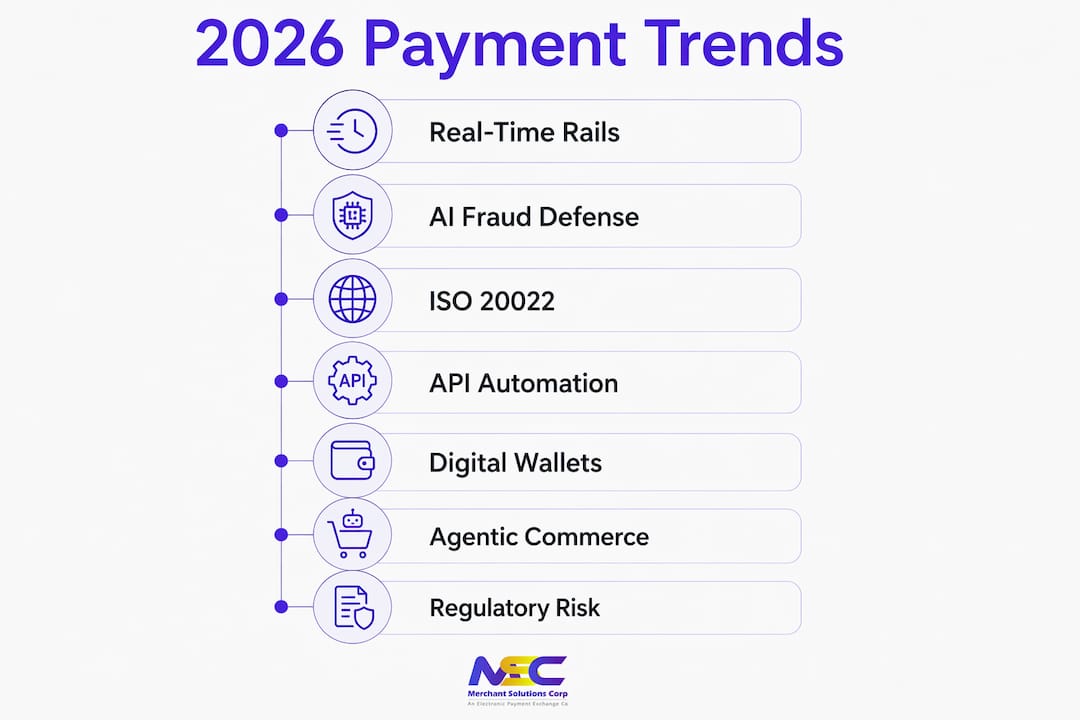
What are the seven payment trends shaping strategy in 2026?
The list below ranks trends by urgency and breadth of operational impact. Each entry names the team that should own the response.
- Always-on treasury and real-time payment rails — Changes liquidity windows and reconciliation cycles overnight. Owner: CFO/Treasury.
- Digital identity and AI-driven fraud defense — Friendly fraud is rising; AI detection and token-based identity reduce chargeback costs. Owner: Payments Ops/Security.
- ISO 20022 migration and message standardization — Structured data enables STP gains and reduces compliance false positives. Owner: Payments Ops/Engineering.
- Cloud ERP and API-led treasury automation — API-first integration shortens reconciliation loops and feeds agentic commerce readiness. Owner: CFO/Engineering.
- Digital wallets, tokenization, and omnichannel experience — Authorization rates and customer experience depend on token lifecycle management across every channel. Owner: Product/Payments Ops.
- Agentic commerce and buy-side automation — Payment choice is becoming algorithmic; merchant API readiness determines discoverability. Owner: Product/Engineering.
- Regulatory fragmentation and interoperability risk — EBT chip variation and federal rulemaking create a multi-state testing burden with real revenue exposure. Owner: Compliance/Payments Ops.
How do real-time rails and always-on treasury change your operations?
Always-on treasury means your cash position, reconciliation, and dispute flows operate continuously, not in batch windows. FedNow and The Clearing House RTP have both seen accelerating institution onboarding into 2026, and higher-value use cases are now live on both rails. That shift breaks several assumptions baked into legacy treasury operations.
Operational implications to address now:
- Liquidity pools must be sized for intraday settlement, not overnight batch.
- Reconciliation engines need real-time event feeds, not end-of-day files.
- Dispute flows change: real-time payments have no chargeback mechanism equivalent to card networks, so pre-authorization controls and confirmation logic carry more weight.
- Liquidity pooling across entities requires API-connected visibility, not manual sweeps.
Implementation checklist for treasury teams:
- Map every payment corridor to its current rail and identify which can migrate to RTP or FedNow.
- Instrument intraday liquidity KPIs: peak exposure, average settlement lag, and idle cash ratio.
- Connect your treasury management system to real-time balance feeds via API.
- Define a monitoring cadence: intraday alerts at 25%, 50%, and 75% of liquidity thresholds.
- Test dispute and exception flows under real-time conditions before migrating high-value corridors.
Pro Tip: Run a parallel settlement test on a low-volume corridor for 30 days before cutting over. Measure STP rate, exception volume, and reconciliation time against your batch baseline so you have a concrete before/after comparison.
How do you build AI-driven fraud defense and digital identity at scale?
Identity-first payment security starts before the transaction. Passkeys, tokenization, and federated identity frameworks reduce friction for legitimate customers while raising the cost of attack for fraudsters. Enterprises report rising friendly fraud alongside growing adoption of AI-based prevention tools, and chargeback handling costs remain a material line item for payments operations teams.
Core technical components for your 2026 fraud posture:
- Device signals and behavioral biometrics — Establish a baseline per device and flag anomalies at login and checkout.
- Token vaulting — Replace primary account numbers with network tokens across all channels; reduces exposure on breach.
- Identity proofing at account creation — Document verification and liveness checks stop synthetic identity fraud before the first transaction.
- Adaptive authentication — Step up to biometric or OTP only when risk score crosses a threshold, preserving low-friction checkout for trusted sessions.
- AI rules orchestration — Layer machine learning models over static rules to catch pattern shifts that rules alone miss.
AI also introduces new attack vectors. Adversarial inputs can manipulate model scoring, and generative AI lowers the cost of phishing and social engineering at scale. Your fraud team needs model monitoring, not just model deployment.
Stat callout: Institutions that implement structured party data and ISO 20022 address resolution in production report straight-through processing rates above 98% and a 25–30% reduction in sanctions screening false positives — a direct fraud-operations efficiency gain.
Pro Tip: Set a monthly false-positive rate target alongside your fraud-loss target. Teams that optimize only for fraud loss often over-block legitimate transactions, which costs revenue and customer trust. Both metrics belong on the same dashboard.
What does ISO 20022 migration actually require from your team?
ISO 20022 is the structured messaging standard replacing legacy MT formats across SWIFT, Fedwire, and cross-border payment corridors. For U.S. players, the practical work is message mapping, address resolution, and exception handling, not just a format swap.
Key milestones relevant to U.S. teams:
- SWIFT’s coexistence period for cross-border payments continues through 2025–2026; U.S. correspondent banks must support both MT and MX formats during this window.
- Fedwire Funds Service migration to ISO 20022 is a near-term operational priority for banks and their corporate clients.
- Cross-border partners in the EU, UK, and APAC are further along; mismatched structured data creates truncation and translation errors that inflate exception queues.
Operational impacts:
- Message translation layers add latency and error risk; native MX generation is the target state.
- Structured party data (LEI, address fields) enables downstream AI screening and reduces false positives.
- Straight-through processing rates above 98% are achievable when address resolution is production-ready.
Testing checklist:
- Audit all inbound and outbound message flows for MT-to-MX translation gaps.
- Test structured address fields against your sanctions screening engine and measure false-positive rate before and after.
- Validate rollback scenarios: what happens when a counterparty sends a malformed MX message?
- Measure STP rate weekly during parallel-run periods and set a go-live threshold.
- Document exception handling procedures for truncated or missing structured fields.
Pro Tip: Prioritize structured party data over all other ISO 20022 fields in your first production release. It delivers the fastest measurable STP improvement and directly reduces your compliance screening workload.
How does API-led treasury automation connect your finance and operations stack?
API-first treasury means your payment rails, ERP, and cash management systems share data in real time rather than exchanging batch files overnight. Cloud ERP platforms connected via webhooks and REST APIs shorten reconciliation loops from days to minutes and feed the data quality that agentic commerce and AI fraud detection both require.
Integration steps from pilot to full rollout:
- Identify your highest-friction reconciliation corridor (typically accounts payable or cross-border settlements).
- Stand up a sandbox environment with your ERP vendor’s payment API and your primary rail connector.
- Instrument idempotency keys on every payment request to prevent duplicate processing during retries.
- Implement webhook listeners for settlement confirmations and exception events.
- Define security controls: OAuth 2.0 token rotation, IP allowlisting, and payload signing.
- Run a 60-day pilot on the target corridor, measuring reconciliation cycle time, exception rate, and manual intervention hours.
- Expand to additional corridors based on pilot KPIs.
Integration checklist:
- Multi-rail connectors: RTP, FedNow, ACH, card, and wire in a single API layer.
- Idempotency and retry logic on all write operations.
- Webhook delivery with retry and dead-letter queuing.
- Role-based API access with audit logging.
- SLA commitments from your vendor: uptime, latency p99, and incident response time.
POS systems are evolving into data hubs; the most successful retailers integrate POS data with inventory, CRM, and payroll into cloud-native ecosystems. That same integration logic applies to treasury: the goal is a single operational data layer, not a collection of point-to-point connections.
Stat callout: The global POS software market was estimated at $17.13 billion in 2025 and is projected to reach $38.82 billion by 2033, growing at a CAGR of 10.8% from 2026, driven by cloud-native integrations and real-time operational visibility demands.
How do digital wallets and tokenization work across every channel?
Tokenization replaces a customer’s primary account number with a network token that is channel-specific, merchant-specific, and revocable without reissuing the underlying card. That architecture is what makes omnichannel payment security practical.
Channel map and tokenization fit:
- In-store tap-to-pay (NFC) — Device-bound token stored in the secure element; Apple Pay and Google Pay manage the lifecycle.
- Mobile wallet in-app — In-app token provisioned via card network token requestor; merchant never sees the PAN.
- Web wallet checkout — Browser-based token with 3DS2 authentication layered on top.
- QR code ordering — Token generated at session initiation; QR-based payments link directly to the customer’s stored credential.
- Self-serve kiosk — Kiosk-specific token scope limits exposure if the terminal is compromised.
Token lifecycle management steps:
- Register as a token requestor with Visa Token Service and Mastercard Digital Enablement Service.
- Implement token provisioning at account creation, not at first transaction.
- Build wallet fallback logic: if the primary wallet token declines, fall back to a secondary credential before presenting a manual entry prompt.
- Set token expiry and renewal policies aligned with card network guidelines.
- Monitor authorization rates by channel weekly; a drop in one channel often signals a token lifecycle issue, not a fraud spike.
On token compromise: If a token is flagged as compromised, suspend it and trigger re-provisioning without touching the underlying PAN. That containment is the core security advantage of network tokenization over static card storage.
What does agentic commerce mean for your pricing, routing, and inventory?
Agentic commerce describes a model where AI agents, acting on behalf of consumers or businesses, initiate and complete purchases with limited human intervention. The IMF’s 2026 analysis confirms that agentic AI systems can orchestrate the entire payment chain autonomously, from initiation through routing optimization, compliance checks, and settlement monitoring.
For merchants, the consequence is direct: payment choice is becoming algorithmic. An agent evaluates cost, speed, rewards eligibility, and trust signals before selecting a merchant and a payment method. If your pricing and inventory are not machine-readable, the agent cannot select you.
What agents evaluate when choosing a merchant:
- Real-time pricing accuracy and API response latency.
- Inventory availability via structured product APIs.
- Accepted payment methods and token protocol compatibility.
- Merchant trust signals (verified identity, dispute rate, fulfillment history).
Action items for product and engineering teams:
- Publish a machine-readable pricing and inventory API with real-time data.
- Support agent-friendly token protocols (UCP, AP2, or MCP where applicable).
- Implement rate limiting and abuse detection on your public APIs to prevent agent-driven inventory manipulation.
- Log all agent-initiated transactions separately for monitoring and dispute resolution.
Risks and mitigations:
- Agent impersonation — Require cryptographic agent identity verification before processing.
- Microtransaction volume — Agentic commerce generates high-frequency, low-value transactions; ensure your rails support micropayment-capable flows or hybrid proxy models.
- Liability gaps — Delegated authority from consumer to agent is legally unsettled; document your authorization chain for every agent-initiated transaction.
- Machine-speed monitoring — Human review cycles are too slow; deploy automated anomaly detection on agent transaction streams.
Pro Tip: Start with a read-only inventory and pricing API before enabling agent-initiated transactions. That gives you visibility into how agents query your catalog without exposing payment flows to liability questions you haven’t resolved yet.
How do you manage regulatory fragmentation and EBT interoperability risk?
The U.S. regulatory environment in 2026 is not a single framework. It is a layered set of federal proposals and state-level implementation variations that create real testing burdens for merchants operating across state lines.
Key regulatory tracks to monitor:
- EBT chip migration — States are rolling out chip-enabled EBT cards on different timelines; terminal interoperability varies by state processor and card design. The Merchant Advisory Group highlights EBT chip variability as a material operational risk for multi-state retailers.
- Stablecoin rulemaking — FDIC, OCC, and Treasury/FinCEN/OFAC all have active proposed rules in 2026 clarifying issuer supervision and AML obligations.
- Fed account access proposals — Federal Reserve proposals affecting non-bank access to master accounts remain in active comment periods.
- Interchange litigation — Ongoing litigation developments affect interchange economics for card-accepting merchants.
Compliance matrix template:
| Regulation/Rule | Impact | Owner | Deadline | Test Status |
|---|---|---|---|---|
| EBT chip (state X) | Terminal interoperability | Payments Ops | Per state rollout | In progress |
| Stablecoin NPRM | AML policy update | Compliance | Comment period | Monitoring |
| Fed account access | Treasury rail options | CFO/Treasury | TBD | Monitoring |
| Interchange litigation | Cost modeling | CFO | Ongoing | Tracking |
EBT interoperability testing checklist:
- Identify every state where you accept EBT and map that state’s chip card specification.
- Test chip-enabled EBT transactions on each terminal model in your fleet.
- Confirm fallback to magnetic stripe where chip is not yet mandated.
- Log exception rates by state and terminal type; escalate states above a defined threshold.
- Coordinate with your acquirer on state-specific certification timelines.
Pro Tip: If you operate near a state line, test EBT acceptance on both states’ specifications on the same terminal. Interoperability failures at the state boundary are the most common source of EBT decline spikes that look like fraud but are actually certification gaps.
What is the prioritized action checklist for CFOs, payments ops, and product leaders?
Role-specific priorities:
- CFO/Treasury — Adopt intraday liquidity KPIs; model multi-rail cost trade-offs at the corridor level; monitor stablecoin and Fed account access rulemaking for treasury implications.
- Payments Ops — Complete ISO 20022 message mapping audit; instrument STP rate tracking; build EBT chip testing matrix by state; deploy AI fraud rules with false-positive rate targets.
- Product — Publish machine-readable pricing and inventory APIs; implement token lifecycle management across all channels; build agent-initiated transaction logging.
- Security/Compliance — Deploy adaptive authentication with step-up triggers; implement cryptographic agent identity verification; maintain compliance matrix with active deadlines.
- Engineering — Integrate cloud ERP with multi-rail API layer; instrument idempotency and webhook delivery; stand up sandbox for agentic commerce testing.
Roles and responsibilities table:
| Task | Team | KPI | Timeline |
|---|---|---|---|
| Intraday liquidity monitoring | Treasury | Peak exposure vs. threshold | Q3 2026 |
| ISO 20022 STP rate tracking | Payments Ops | STP rate >98% | Q4 2026 |
| EBT chip testing by state | Payments Ops | Exception rate <1% per state | Per state rollout |
| Pricing/inventory API publication | Product/Engineering | API latency low p99 | Q3 2026 |
| Token lifecycle management | Product/Payments Ops | Auth rate by channel | Ongoing |
| AI fraud model monitoring | Security | False-positive rate target | Monthly |
Vendor requirements for 2026:
- Multi-rail access: RTP, FedNow, ACH, card, and wire in a single integration.
- Network tokenization support across all card brands.
- API-first architecture with documented SLAs, uptime commitments, and developer tooling.
- Agentic commerce readiness: token protocol support and machine-readable catalog APIs.
- EBT acceptance and state-specific certification support.
What role will cryptocurrencies and CBDCs play in payments in 2026?
Cryptocurrencies and central bank digital currencies occupy different positions on the 2026 readiness spectrum. Stablecoins are the most operationally relevant crypto asset for payments today, with active rulemaking from FDIC, OCC, and FinCEN clarifying AML obligations and issuer supervision. For most U.S. merchants, stablecoins are a monitoring priority, not an immediate integration requirement.
CBDCs remain in research and pilot phases in the United States. The Federal Reserve’s FedNow service addresses many of the same instant-settlement use cases that CBDC proponents cite, which reduces the urgency of a retail CBDC for domestic payments. Cross-border CBDC interoperability pilots are active internationally, but U.S. merchant exposure is limited in 2026.
The practical advice: assign a compliance owner to track stablecoin rulemaking comment periods, and revisit CBDC readiness annually as the Fed’s position evolves. Do not build infrastructure for either until the regulatory framework is settled.
How are consumer payment preferences reshaping the industry?
Consumer behavior is the demand signal that validates every trend on this list. Contactless payments, mobile wallets, and QR-based ordering have moved from novelty to expectation across retail, restaurant, and service verticals. The shift is measurable: cloud-based and mobile POS now accounts for a growing share of new hardware purchases, driven directly by consumer demand for faster, friction-free checkout.

Buy now, pay later (BNPL) adoption continues to grow in retail and healthcare, adding a new payment method that requires POS integration and reconciliation support. Younger consumer segments show strong preference for in-app wallets and biometric authentication over card-present transactions. That preference shift has a direct impact on authorization rate optimization: merchants who support the consumer’s preferred method see lower cart abandonment and higher average order values.
The operational implication is straightforward. Your payment acceptance stack must match where your customers are, not where they were three years ago.
Who are the key players shaping payment trends in 2026?
The competitive landscape in U.S. payments is not consolidating. It is fragmenting into specialized layers. Card networks (Visa and Mastercard) remain the dominant volume rails and are actively investing in tokenization infrastructure, agentic commerce protocols, and real-time capabilities. The Clearing House operates RTP, the private-sector real-time rail, while the Federal Reserve operates FedNow, the public-sector equivalent.
On the technology side, cloud ERP vendors, API-first payment orchestration platforms, and fraud-as-a-service providers are all competing to own the integration layer between merchants and rails. POS hardware is evolving from a transaction terminal into an operations hub, with cloud-native POS platforms integrating inventory, CRM, and analytics in real time.
For merchants, the strategic question is not which network wins. It is which integration layer gives you multi-rail access, tokenization, and agentic commerce readiness without locking you into a single provider’s stack.
What does the U.S. payment investment outlook look like through 2026?
Investment in payment technology is tracking the trends on this list. The global POS software market is projected to reach $18.97 billion in 2026 and $38.82 billion by 2033, growing at a CAGR of 10.8%. The U.S. market specifically is expected to grow at 9.5% annually from 2026, driven by AI-enabled POS platforms, advanced analytics, and dynamic pricing capabilities.
Real-time payment infrastructure investment is accelerating as FedNow and RTP onboard more institutions and expand transaction limits. Fraud prevention technology spending is rising in parallel, as AI-based detection tools move from optional to standard. The merchants and payment operations teams that invest in API-first integration, tokenization, and multi-rail access in 2026 are positioning for the agentic commerce wave that follows.
Capital allocation guidance: prioritize integration and data infrastructure over hardware replacement unless your terminal fleet is out of compliance with current EMV or contactless standards.
What data privacy and cybersecurity regulations should you track beyond fraud?
Fraud prevention is one layer of cybersecurity. Regulatory compliance is a separate, parallel obligation. For U.S. payment operations in 2026, the relevant frameworks include PCI DSS v4.0, which introduced new requirements for e-commerce security and script integrity monitoring that took effect in 2025. State-level privacy laws, including California’s CPRA and a growing number of state equivalents, impose data minimization and consumer rights obligations on any merchant that stores payment-adjacent data.
The CFPB’s open banking rulemaking under Section 1033 of the Dodd-Frank Act is creating new data portability rights that affect how payment data flows between financial institutions and third-party apps. Compliance teams need to map which data flows are covered and whether existing consent frameworks are sufficient.
Cybersecurity insurance underwriters are also raising the bar: multi-factor authentication, endpoint detection, and documented incident response plans are now standard underwriting requirements, not optional controls. Treat your cybersecurity posture as a financial risk management function, not an IT checkbox.
How is sustainability influencing payment industry strategy?
Environmental considerations are entering payment strategy through two channels: operational efficiency and customer expectation. Digital receipts, paperless statements, and electronic invoicing reduce paper consumption and are increasingly a customer preference, particularly in retail and restaurant verticals. Several card networks and payment processors have published carbon accounting frameworks for transaction infrastructure, and enterprise procurement teams are beginning to ask vendors for emissions data.
For most mid-market merchants, the practical sustainability actions are operational: replace thermal receipt printers with digital receipt options, consolidate payment terminals to reduce hardware waste, and choose cloud-native POS platforms over on-premise hardware that requires frequent physical replacement. These steps reduce cost and environmental footprint simultaneously.
Sustainability reporting requirements are expanding for larger enterprises, and payment data is a component of scope 3 emissions calculations for financial services firms. If your business serves enterprise clients, expect sustainability questions in vendor qualification processes.
Key Takeaways
The single most important action for 2026 is connecting your payment infrastructure to real-time rails, structured data standards, and machine-readable APIs before agentic commerce makes those capabilities a baseline requirement for merchant discoverability.
| Point | Details |
|---|---|
| Real-time rails are live now | Adopt intraday liquidity KPIs and connect treasury systems to RTP/FedNow event feeds this quarter. |
| ISO 20022 structured data pays off | Institutions with production-ready address resolution report STP rates above 98% and 25–30% fewer screening false positives. |
| Agentic commerce requires API readiness | Publish machine-readable pricing and inventory APIs and support agent-friendly token protocols to remain selectable. |
| EBT chip testing is a multi-state burden | Build a state-by-state compliance matrix and test each terminal model against each state’s chip specification. |
| Merchantsolutionscorp supports multi-rail readiness | Merchantsolutionscorp’s payment processing and POS integrations cover multi-rail acceptance, tokenization, and EBT support for U.S. merchants. |
The real gap most payment teams are not closing
The seven trends in this article are well-documented. What is less discussed is the execution gap between knowing what is coming and actually being ready when it arrives.
Most payment operations teams are still running reconciliation in batch, still managing token lifecycles manually, and still treating ISO 20022 as a future-state project. The problem is that agentic commerce and real-time rails do not wait for internal roadmaps to catch up. When an AI agent queries your catalog and finds no machine-readable pricing API, it moves to the next merchant. That selection happens in milliseconds, and you never see the lost transaction.
The merchants who will capture disproportionate value in 2026 are not necessarily the ones with the largest technology budgets. They are the ones who treat payment infrastructure as a revenue function, not a cost center. That means assigning KPIs to STP rates, authorization rates by channel, and false-positive rates alongside traditional fraud-loss metrics. It means building the API layer before the agent traffic arrives, not after.
The checklist in this article is not aspirational. Every item on it is executable with current technology and current vendor relationships. The question is whether your organization treats it as a Q3 priority or a Q1 2027 project.
Merchantsolutionscorp helps you act on these trends now
Keeping up with 2026 payment trends is one thing. Having the infrastructure to execute on them is another. Merchantsolutionscorp gives U.S. restaurants, retailers, and service businesses a direct path from reading this checklist to running on it, with payment processing solutions that cover multi-rail acceptance, network tokenization, EBT support, and cloud-native POS integrations under one relationship.
The practical advantages are concrete: $0 upfront hardware options, dual pricing programs that offset processing fees, and POS systems (including Clover, Square, Skytab, and PAX) that integrate inventory, CRM, and analytics in real time. For merchants navigating EBT chip migration, Merchantsolutionscorp supports state-specific terminal certification and interoperability testing. For businesses building toward API-led operations, the platform connects to your existing stack without requiring a full infrastructure replacement.

Explore the full POS and payment processing overview or contact Merchantsolutionscorp directly to map your current setup against the 2026 readiness checklist.
Sources and further reading
- The State of the Payments Industry: Mid-2026 — Merchant Advisory Group
- Five Payment Trends in 2026 — J.P. Morgan
- Agentic Payments Report — Visa
- 5 Payments Trends Reshaping the U.S. Market in 2026 — QubEvents
- US Payments Megatrends for 2026 — PCMI
- Agentic Commerce and the Future of Payments — Accenture
- How Agentic AI Will Reshape Payments — IMF Notes Volume 2026 Issue 004
- Point-of-Sale Software Market Size and Industry Report, 2033 — Grand View Research
- US Point-of-Sale (POS) Software Market Report — PS Market Research
FAQ
What are the top industry payment trends for 2026?
The top trends are real-time rails and always-on treasury, AI-driven fraud defense and digital identity, ISO 20022 migration, API-led treasury automation, digital wallets and tokenization, agentic commerce, and regulatory fragmentation, including EBT chip interoperability. Each trend has direct operational implications for CFOs, payments ops teams, and product leaders.
How does agentic commerce change payment flows for merchants?
Agentic commerce shifts payment selection from human consumers to AI agents that evaluate cost, speed, inventory availability, and trust signals algorithmically. Merchants must publish machine-readable pricing and inventory APIs and support agent-friendly token protocols to remain discoverable and selectable.
What STP rate should treasury teams target with ISO 20022?
Institutions that implement structured party data and address resolution in production report straight-through processing rates above 98%, alongside a 25–30% reduction in sanctions screening false positives. That is the benchmark to target when setting your ISO 20022 go-live threshold.
How does EBT chip migration create compliance risk for multi-state retailers?
States are rolling out chip-enabled EBT cards on different timelines with varying terminal specifications. Retailers operating near state lines must test each terminal model against each state’s chip specification and build a compliance matrix tracking certification status, exception rates, and escalation thresholds by state.
How does Merchantsolutionscorp support 2026 payment readiness?
Merchantsolutionscorp provides multi-rail payment processing, network tokenization, EBT acceptance, and cloud-native POS integrations for U.S. merchants, with $0 upfront hardware options and dual pricing programs. The platform supports state-specific EBT certification and connects to existing business systems without requiring a full infrastructure replacement.