Payment Compliance Requirements for Vape Stores: 2026 Guide
Payment Compliance Requirements for Vape Stores: 2026 Guide
Payment compliance requirements for vape stores define the legal framework every vape retailer must follow to accept payments, ship products, verify customer age, and report sales lawfully under federal and state law. The regulatory structure governing vape retail is built on three pillars: the Prevent All Cigarette Trafficking (PACT) Act, state tobacco tax and registration mandates, and card network rules that classify vape merchants as high-risk. Oversight comes from multiple bodies, including the Bureau of Alcohol, Tobacco, Firearms and Explosives (ATF), state tobacco tax administrators, and major card networks like Visa and Mastercard. Getting this wrong does not just mean a fine. It can mean losing your merchant account, your shipping privileges, or your business license entirely.
What federal and state laws govern payment compliance for vape stores?
The PACT Act is the primary federal law shaping vape shop payment regulations. It applies to all electronic nicotine delivery systems (ENDS), a category that covers e-cigarettes, vape pens, pod systems, and related accessories. The law imposes registration, reporting, and recordkeeping obligations that go well beyond what most retail businesses face.
Federal registration and reporting requirements
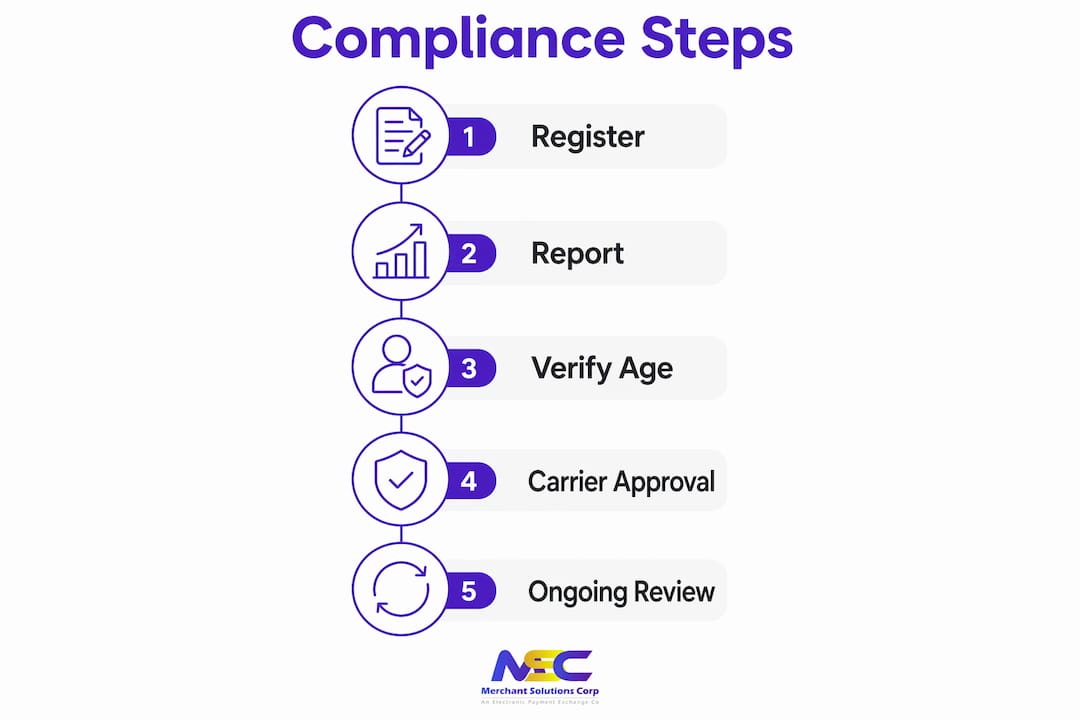
The PACT Act requires every online vape retailer to register with the ATF using Form 5070.1 before making any delivery sales. Registration is not optional, and operating without it exposes you to federal penalties from the first transaction. Beyond registration, the law mandates monthly sales reports submitted to the tobacco tax administrator in every state where you ship products. Each state has its own filing deadline and format, so multi-state sellers manage a stack of separate monthly obligations.

Federal and state registrations must be renewed annually, and monthly reporting is required in each state where delivery sales occur. That means a retailer shipping to customers in 10 states files 10 separate monthly reports, each with its own rules. Missing a single filing can trigger an audit or a compliance violation.
Record retention is equally strict. The PACT Act requires vape retailers to keep records of each delivery sale for at least four years. Those records must include proof of age verification, delivery confirmation, and adult signature documentation.
State-level excise tax and registration obligations
State compliance laws for vape retailers add another layer on top of federal rules. Most states require separate tobacco or vapor product retailer licenses, excise tax collection at the point of sale, and remittance on a monthly or quarterly schedule. Some states tax by milliliter of e-liquid; others apply a percentage of the wholesale price. The variation is significant, and the compliance burden grows with every new state you enter.
| Compliance obligation | Governing body | Frequency |
|---|---|---|
| ATF registration (Form 5070.1) | Bureau of Alcohol, Tobacco, Firearms and Explosives | Annual renewal |
| Monthly delivery sales reports | State tobacco tax administrators | Monthly, per state |
| Excise tax collection and remittance | State revenue departments | Monthly or quarterly |
| Record retention (delivery sales) | Federal PACT Act | 4-year minimum |
| State retailer license | State licensing boards | Annual renewal |
The Tobacco 21 law, enacted federally in december 2019, prohibits the sale of all tobacco and vape products to anyone under 21. Compliance with this law is a baseline requirement for every vape retailer, and violations can trigger both federal and state enforcement actions.
How do age verification and shipping carrier regulations affect vape store payment compliance?
Age verification is not a best practice for vape retailers. It is a federal legal requirement. Every delivery sale must include an age check using a commercially available database that cross-references the customer’s name, address, and date of birth against public records. A simple checkbox on your website does not satisfy this standard.
Age verification standards for delivery sales
Commercially available age verification databases, such as those used in identity verification services, check government records to confirm that a buyer is 21 or older before the order is processed. The verification must happen before payment is accepted, not after. Storing proof of each verification is part of your four-year recordkeeping obligation under the PACT Act.
- Use a commercially available database that checks government or credit bureau records
- Verify age before payment is processed, not at the point of delivery only
- Retain verification records for at least four years per PACT Act requirements
- Implement Tobacco 21 age gates on your website as a first-line filter
Pro Tip: Integrate your age verification software directly with your checkout flow so that failed verifications block the transaction automatically. Manual review processes create gaps that regulators and card networks will flag during audits.
Carrier restrictions and adult signature requirements
The USPS is prohibited from delivering ENDS products, which means every vape shipment must go through a certified private carrier. This is not a gray area. Sending vape products through USPS is a federal violation regardless of the destination state.
All ENDS shipments must require an adult signature at delivery, and carriers must be certified under specific agreements that enforce age verification protocols. That means your carrier contract must explicitly include vape product compliance terms. Not every private carrier accepts vape shipments, and those that do require formal agreements before you can use their services.
- Confirm your carrier has a signed vape product shipping agreement before your first shipment
- Require adult signature on every delivery, with no exceptions for regular customers or repeat orders
- Retain delivery confirmation and signature records as part of your compliance documentation
- Audit your carrier agreements annually, since carriers can revise or terminate vape shipping programs
The risk of carrier non-compliance is severe. If your carrier drops its vape shipping program and you continue shipping without a certified replacement, every subsequent shipment is a federal violation. Vape retailers who rely on a single carrier without a backup plan face the real possibility of a complete shipping shutdown.
What are the challenges and requirements for vape shop payment processing?
Payment processing guidelines for vape retailers are more restrictive than almost any other retail category. Vape products fall into the high-risk merchant classification, which changes nearly every aspect of how you accept card payments.
Why mainstream processors decline vape merchants
Mainstream payment processors prohibit vape and tobacco products in their terms of service. This is a policy decision driven by regulatory risk, chargeback rates, and reputational concerns. If you try to process vape sales through a general-purpose processor without disclosing your product category, your account will be terminated when the processor discovers the violation. That termination goes on your record with the Terminated Merchant File (TMF), which makes it significantly harder to get approved elsewhere.
Vape retailers need dedicated high-risk merchant accounts through specialized independent sales organizations (ISOs) that understand the regulatory environment. These accounts come with higher processing fees and rolling reserves, but they are the only compliant path to accepting card payments.
Card network registration and processing fees
Visa and Mastercard require tobacco and vape merchants to be formally registered with their card networks and pay annual registration fees totaling approximately $1,450 per acquiring provider. This fee is separate from your processing rate and is non-negotiable. Without network registration, your merchant account is not compliant, and transactions can be flagged or reversed.
Processing rates for high-risk vape merchants are higher than standard retail rates. Specialized ISOs typically charge rates in the range that reflects the elevated risk profile of the category. Rolling reserves, where the processor holds a percentage of your monthly volume for a set period, are also standard for new vape merchant accounts.
Documentation required for merchant account approval
Getting approved for a vape merchant account requires more paperwork than a standard retail application. Vape shops need to prepare extensive documentation for merchant account approval, including:
- Business license and state tobacco retailer license
- Employer Identification Number (EIN) documentation
- Six months of bank statements and credit card processing statements
- A complete product list with descriptions
- Proof of age verification software or system in use
- Compliance documentation showing PACT Act registration and carrier agreements
Pro Tip: Organize your compliance documentation into a single folder before you apply. Processors move faster when you can provide everything in one submission, and a complete application signals that you run a serious, compliant operation.
Merchantsolutionscorp works with vape and smoke shop operators to navigate the high-risk merchant account process, including CBD and smoke shop payment processing solutions built for this regulatory environment.
How to maintain ongoing compliance and avoid penalties in vape payment processing?
Ongoing compliance is not a one-time setup. Vape store financial regulations change at the state and federal level regularly, and your systems need to keep pace. A compliance gap that exists for even one month can result in penalties, account suspension, or worse.
Recordkeeping and audit readiness
Your recordkeeping system is your first line of defense in any regulatory audit. Every delivery sale needs a complete record that includes the customer’s verified age, the delivery address, the carrier used, the adult signature confirmation, and the date of sale. These records must be accessible for at least four years.
- Maintain a digital recordkeeping system that timestamps and stores each transaction’s compliance data
- Back up records in at least two locations, including one off-site or cloud-based storage
- Conduct an internal compliance audit every six months to catch gaps before regulators do
- Review and renew all state registrations and carrier agreements before their annual deadlines
Chargeback prevention and billing transparency
Chargebacks are a particular threat for vape retailers because high chargeback rates can trigger account termination even when individual transactions are compliant. Chargeback prevention and regulatory audit preparedness, such as maintaining proof of adult signature and age verification, are critical for vape retailers to maintain merchant accounts and avoid financial loss.
Address Verification Service (AVS) and Card Verification Value (CVV) checks reduce fraudulent transactions at the point of sale. Clear billing descriptors, meaning the name that appears on your customer’s card statement, reduce “friendly fraud” chargebacks where customers dispute legitimate purchases they do not recognize.
“Non-compliance with payment and shipping regulations may lead to fines up to $5,000 for first-time federal violations and up to $250,000 per violation in some cases, as well as termination of merchant accounts and shipping privileges. The financial exposure from a single compliance failure can exceed the cost of building a full compliance program.”
Staying current with evolving regulations is equally critical. State legislatures add new vape taxation and licensing requirements every year. Subscribe to updates from your state tobacco tax administrator and review your compliance checklist quarterly. A processor or compliance partner who monitors regulatory changes on your behalf adds real value in this environment.
Key takeaways
Payment compliance requirements for vape stores require registration with the ATF, monthly state reporting, certified carrier agreements, adult signature delivery, and a dedicated high-risk merchant account to operate legally and accept card payments.
| Point | Details |
|---|---|
| Federal PACT Act registration | Register with the ATF using Form 5070.1 before making any delivery sales. |
| Four-year record retention | Keep complete delivery sale records, including age verification and adult signatures, for at least four years. |
| Certified carriers only | USPS is banned for vape shipments; use only certified private carriers with signed vape shipping agreements. |
| High-risk merchant accounts | Mainstream processors prohibit vape products; apply through a specialized ISO with full compliance documentation. |
| Card network registration | Visa and Mastercard require formal vape merchant registration with combined annual fees of approximately $1,450. |
What I’ve learned about vape compliance that most guides won’t tell you
The biggest mistake I see vape shop owners make is treating compliance as a setup task rather than an ongoing operation. They register with the ATF, sign a carrier agreement, and install an age verification tool at launch. Then they assume they are covered. They are not.
Regulations in this space move faster than most retailers expect. A state that had no vapor excise tax in 2023 may have introduced one by 2025, with monthly filing requirements that started the day the law took effect. If you are not monitoring those changes, you are already behind. And the penalties do not come with a grace period for ignorance.
The payment processing side carries a risk that most compliance guides understate. Merchant accounts for vape shops are vulnerable to industry-wide enforcement actions that can freeze or terminate accounts even when individual merchants are fully compliant. Acquiring banks sometimes exit the vape category entirely due to reputational concerns, leaving compliant retailers without a processor through no fault of their own. That is not a hypothetical. It has happened to well-run businesses that did everything right.
The practical answer is to work with a processor that specializes in high-risk categories and has demonstrated staying power in the vape space. You also need a backup processor relationship before you need it, not after your primary account is frozen. Compliance is not just about following the rules. It is about building a payment infrastructure that can survive the unpredictability of this regulatory environment.
— Jonathan
How Merchantsolutionscorp supports vape store payment compliance
Vape retailers need a payment partner who understands the regulatory environment, not one who will terminate your account the moment a compliance question arises. Merchantsolutionscorp provides specialized payment processing built for high-risk industries, including vape and smoke shops, with merchant accounts designed to meet card network registration requirements and support your compliance documentation needs. The platform also offers POS systems for CBD and smoke shops that integrate age verification workflows and transaction recordkeeping directly into your daily operations. From application through approval and ongoing support, Merchantsolutionscorp helps vape shop owners build a payment setup that holds up under regulatory scrutiny.
FAQ
What is the PACT Act and how does it affect vape retailers?
The PACT Act is a federal law requiring vape retailers to register with the ATF, submit monthly sales reports to state tobacco tax administrators, and retain delivery sale records for at least four years. It also mandates adult signature delivery and prohibits USPS shipments of ENDS products.
Can vape stores use standard payment processors?
Mainstream processors prohibit vape and tobacco products in their terms of service, so vape retailers must use dedicated high-risk merchant accounts through specialized ISOs. Operating through a standard processor without disclosing your product category risks account termination and placement on the Terminated Merchant File.
What carrier can I use to ship vape products?
USPS is federally prohibited from delivering ENDS products. Vape retailers must use certified private carriers that have signed vape product shipping agreements and enforce adult signature on every delivery.
How much do card network registration fees cost for vape merchants?
Visa and Mastercard require formal registration for tobacco and vape merchants, with combined annual fees totaling approximately $1,450 per acquiring provider. This fee applies in addition to standard processing rates.
What happens if a vape store fails to comply with payment regulations?
Non-compliance can result in fines up to $5,000 for first-time federal violations and up to $250,000 per violation in more serious cases, along with termination of merchant accounts and loss of shipping privileges.