PCI Compliance for Small Business: What to Do Right Now
PCI Compliance for Small Business: What to Do Right Now
Yes, your small business needs PCI compliance if you store, process, or transmit cardholder data in any form — a card swipe, a phone order, a hosted checkout page. Transaction volume doesn’t exempt you; the PCI Security Standards Council ties obligation to how you touch card data, not how many transactions you run.
Three things to do this week:
- Confirm your merchant level with your acquiring bank, in writing.
- Map every place cardholder data enters, moves through, or leaves your systems.
- Ask whether a hosted redirect or P2PE terminal can pull your business out of scope entirely.
Current assessments run under PCI DSS v4.0.1. Expect three validation artifacts to come up in every conversation with your processor: the Self-Assessment Questionnaire (SAQ), the Attestation of Compliance (AoC), and, if you have internet-facing systems, quarterly scans from an Approved Scanning Vendor (ASV).
Key Takeaways
PCI compliance depends on how your business handles card data, and scope reduction through hosted checkout or P2PE is the fastest way to shrink both your audit burden and your breach risk.
| Point | Details |
|---|---|
| Confirm level and SAQ in writing | Ask your acquirer to specify your merchant level and correct SAQ type before you start any paperwork. |
| Map your data flow first | Every script, integration, and backup that touches card data needs to be accounted for. |
| MFA is now mandatory everywhere | PCI DSS v4.0.1 requires multi-factor authentication on all accounts accessing the cardholder data environment. |
| Reduce scope to cut cost and time | Hosted checkout or P2PE terminals can move you toward SAQ A and shorten validation to weeks. |
| Merchant Solutions Corp lowers scope from setup | POS configurations and hosted payment paths are built to minimize CDE touchpoints from onboarding. |
Table of Contents
- What Counts as PCI Compliance for a Small Business?
- What Merchant Level and SAQ Type Fits Your Business?
- What Are the 12 PCI DSS Requirements?
- Step-by-Step Roadmap to Becoming PCI Compliant
- What Mistakes Trip Up Small Merchants Under v4.0.1?
- How Long Does PCI Compliance Take and What Does It Cost?
- How Merchant Solutions Corp Reduces Scope for Small Merchants
- The Real Gap in Most PCI Advice
- Get PCI-Ready With Fewer Systems to Secure
- Sources
- FAQ
What Counts as PCI Compliance for a Small Business?
“Store, process, or transmit” sounds abstract until you look at your own checkout flow. A countertop terminal stores nothing but processes a card swipe. A hosted checkout redirect transmits the customer to a payment page you never touch. An iframe embedded on your site, a virtual terminal your staff types numbers into, phone orders taken by an employee, recurring billing pulled from a saved card. All of it counts.
Scope creeps in from places owners rarely expect:
- Payment-page scripts loaded from third-party vendors (chat widgets, analytics tags, marketing pixels).
- Backups and logs that retain card data longer than needed.
- Integrations between your POS and accounting, loyalty, or inventory software.
- Remote-support tools your IT vendor uses to access in-scope systems.
Your acquirer, not you, ultimately determines which validation path applies, and it applies that decision based on your actual data flow, not your revenue.
Pro Tip: Before you assume a system is “out of scope,” ask whether it can see, store, or connect to anything that touches card data. If the answer is maybe, treat it as in scope until proven otherwise.
What Merchant Level and SAQ Type Fits Your Business?
Card brands sort merchants into four levels, largely by annual transaction volume, and the level determines how rigorously you validate:
- Level 1 — highest volume, typically requires an on-site assessment by a Qualified Security Assessor (QSA).
- Level 2 and 3 — mid-range volume, usually validate through a Self-Assessment Questionnaire, sometimes with an ASV scan.
- Level 4 — most small businesses land here, generally self-assessing with an SAQ and ASV scan if applicable.
Once you know your level, the SAQ type is the harder decision. The common ones:
- SAQ A — card data fully outsourced to a validated third party (hosted checkout, no script interaction).
- SAQ A-EP — hosted checkout, but your site controls the payment page via scripts or redirects.
- SAQ B / B-IP — standalone terminals with no electronic cardholder data storage.
- SAQ C / C-VT — payment application connected to the internet, or a virtual terminal.
- P2PE — validated point-to-point encryption hardware.
- SAQ D — everyone else, including merchants who store cardholder data directly.
Choosing the wrong SAQ is the most common mistake small merchants make, and eligibility has to match your actual cardholder data-flow diagram, not the version that’s easiest to fill out. Confirm both your level and your SAQ expectations with your acquirer in writing before you start the questionnaire.
What Are the 12 PCI DSS Requirements?
The 12 requirements group into six control families. Here’s what each demands and what evidence you should be collecting as you go, since continuous evidence collection beats scrambling before a deadline:
- Firewall and network security — segment in-scope systems; keep configuration screenshots.
- No vendor defaults — change default passwords and settings; document your baseline configs.
- Protect stored cardholder data — encrypt or eliminate stored data; keep a data-retention policy.
- Encrypt transmissions — TLS on every payment-related connection; save certificate records.
- Anti-malware protection — deploy and update endpoint protection; log update history.
- Secure systems and software — patch on schedule; document your patch cadence.
- Restrict access by need-to-know — role-based access lists; keep access-review logs.
- Unique IDs and authentication — enforce MFA on every account touching the cardholder data environment (CDE), including POS back-office and hosting logins.
- Restrict physical access — visitor logs and device inventories for card-present locations.
- Monitor and log access — centralized logging with retention; export samples as evidence.
- Test security regularly — quarterly ASV scans and, where required, penetration tests.
- Maintain a security policy — a written policy plus signed employee training records.
If you route payments through a hosted checkout or validated P2PE terminal, requirements around network segmentation, stored data, and monitoring often shrink dramatically. Access control, authentication, and staff training requirements remain no matter how much you outsource.
Step-by-Step Roadmap to Becoming PCI Compliant
Work through these seven steps in order, and don’t skip the mapping stage even if you think your setup is simple.
- Confirm your merchant level with your acquiring bank, in writing, before assuming anything.
- Map every cardholder data flow and inventory every script running on payment pages.
- Pick the correct SAQ by matching your data-flow map against SAQ eligibility criteria, not convenience.
- Reduce scope through a hosted checkout, validated P2PE terminals, or tokenization wherever your payment mix allows it.
- Remediate known gaps — enable MFA everywhere, enforce longer passwords, patch outdated systems.
- Schedule ASV scans or penetration tests early if your setup requires them.
- Complete your SAQ and submit the AoC to your acquirer through their specified process.
Timing varies by complexity. A fully outsourced setup can wrap in two to four weeks; a first-time program with in-house payment handling often takes three to six months. Level 1 merchants working with a QSA should expect a longer, costlier audit cycle.
Before you attest, assemble your evidence package: ASV scan results, a signed AoC, written processor attestations covering script protections, current security policies, and employee training sign-offs.
Pro Tip: Start your ASV scan scheduling the same week you confirm your merchant level. A failed scan close to your attestation deadline forces a remediate-and-rescan cycle that can add weeks you didn’t budget for.
What Mistakes Trip Up Small Merchants Under v4.0.1?
The recurring failures are predictable: picking an SAQ that doesn’t match the real data flow, assuming a payment processor covers every requirement automatically, never inventorying the scripts running on the checkout page, using weak or shared logins, and treating evidence collection as a once-a-year scramble.
PCI DSS v4.0.1 raises the stakes on a few of these. Multi-factor authentication is now required for all access to the cardholder data environment, not just remote or administrative access, and password guidance has moved toward a 12-character minimum in many contexts. Script controls have tightened too: if a payment page loads third-party JavaScript, you need to inventory it, justify it, and detect tampering under Requirements 6.4.3 and 11.6.1, unless your processor gives you a written attestation that its hosted solution already handles it.
Fixes are concrete:
- Move to a hosted redirect or validated P2PE terminal wherever your business model allows it.
- Get written attestations from your processor confirming script-tamper protections rather than trusting marketing language.
- Turn on authenticator-app or hardware-key MFA across every in-scope account, including hosting and DNS logins.
- Keep a living script inventory instead of rebuilding it from memory at audit time.
Pro Tip: If your web developer added a chat widget or marketing pixel to your checkout page without telling you, that’s a script you now have to account for under v4.0.1.
How Long Does PCI Compliance Take and What Does It Cost?
Timelines track your SAQ type closely. SAQ A merchants using a fully hosted checkout often finish in a few weeks. SAQ A-EP and SAQ C merchants, who retain more control over the payment page, typically need several weeks to a few months. SAQ D merchants and Level 1 businesses working with a QSA should plan for months, not weeks.
Costs follow the same pattern and vary by how much of the payment flow you’ve outsourced:
- SAQ A (outsourced): near-cost-free to low thousands per year.
- SAQ A-EP: typically mid-thousands annually.
- SAQ D: mid-to-high thousands annually, often more with QSA involvement.
Failed ASV scans, unplanned remediation, and last-minute QSA engagement are the usual reasons costs run over. Schedule your scans early, put your SAQ deadline on a calendar the moment you know your level, and confirm your acquirer’s exact submission process before you’re up against a deadline.
How Merchant Solutions Corp Reduces Scope for Small Merchants
Merchant Solutions Corp’s payment processing solutions are built around the same principle this guide keeps returning to: the less your systems touch raw card data, the less you have to prove. Hosted checkout options, P2PE-capable terminals, and POS configurations that minimize CDE touchpoints all shrink your SAQ burden before you fill out a single form.
Before reaching out, have your current payment flow mapped and your approximate transaction volume ready. Onboarding support then walks through hardware selection, including free hardware programs with $0 upfront options, and configures your setup with scope reduction built in from day one rather than retrofitted later.
- Nationwide onboarding support from setup through daily operations.
- POS options including Clover, Square, and dedicated mobile terminals.
- Hosted and P2PE-capable payment paths that support SAQ A eligibility.
The Real Gap in Most PCI Advice
Most guidance on PCI compliance treats it as a paperwork exercise: fill out the SAQ, file the AoC, move on. That framing misses where the actual risk sits. The v4.0.1 script-integrity rules exist because attackers increasingly target the checkout page itself through compromised third-party JavaScript, not the merchant’s back-end servers. A business that outsources payments but never audits what scripts run on its checkout page hasn’t reduced its risk. It has just changed where the risk hides.
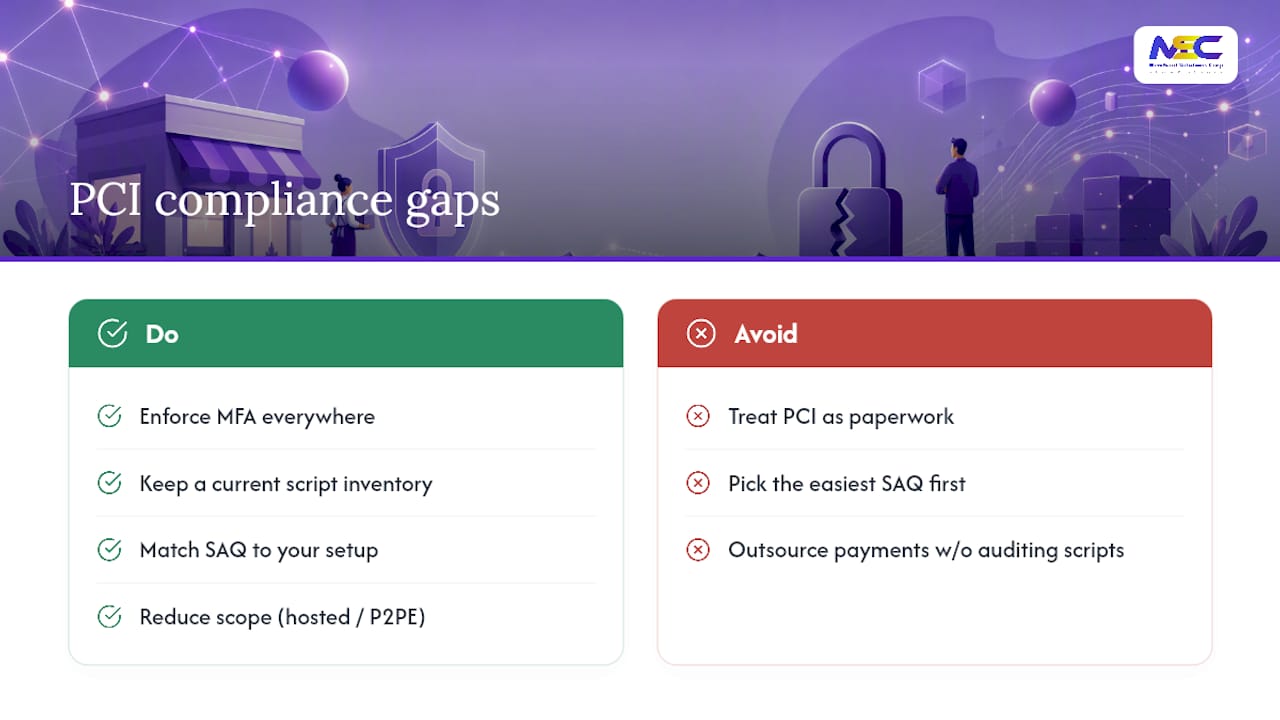
The conventional advice to “pick the easiest SAQ” is backwards. Pick the SAQ that matches your actual setup, then work toward the setup that qualifies for the simplest one. Scope reduction through hosted checkout or P2PE isn’t a compliance shortcut. It’s the only lever that meaningfully lowers both your audit burden and your breach exposure at the same time.
If you take one thing from this: MFA everywhere and a current script inventory aren’t optional extras under v4.0.1. They’re the two items most small merchants discover late, usually during a failed assessment.
— Jonathan
Get PCI-Ready With Fewer Systems to Secure
Merchant Solutions Corp gives small businesses a faster route to PCI compliance by cutting the number of systems that ever touch raw card data. Hosted checkout pages, P2PE-capable terminals, and preconfigured POS setups mean less to document, less to scan, and less to explain to your acquirer.

That matters most for owners juggling compliance alongside daily operations, since fewer in-scope systems means a shorter SAQ and a smaller evidence package to assemble. Nationwide service covers restaurants, retail, and service businesses, with onboarding support that configures hardware for scope reduction from the start rather than after a failed assessment.
Ready to see what a lower-scope setup looks like for your business? Get started with Merchant Solutions Corp’s payment processing solutions and get a configuration built around minimizing what you have to secure.
Sources
- PCI Security Standards Council – Merchants
- PCI DSS v4.0.1 in 2026: The Small Merchant’s Guide — Beancount
- PCI DSS for Small Businesses: Scope and Validation Guide — Rivell
FAQ
Do Small Businesses Need PCI Compliance?
Yes. Any business that stores, processes, or transmits cardholder data must meet PCI DSS requirements regardless of transaction volume or revenue size.
Can I Do PCI Compliance Myself?
Most small merchants can complete a Self-Assessment Questionnaire without outside help, but choosing the correct SAQ and mapping your data flow accurately takes care, and a payments provider like Merchant Solutions Corp can simplify the process by reducing what’s in scope.
Do I Need to Be PCI Compliant if I Use Square?
Yes. Using a processor like Square can qualify you for a simpler SAQ, such as SAQ A, but you’re still responsible for completing that questionnaire and confirming eligibility against your actual setup.
What Companies Need to Be PCI Compliant?
Any company that accepts, stores, processes, or transmits payment card data falls under PCI DSS, from a single-location retailer with one terminal to a multi-location enterprise processing millions of transactions.