US C-Stores: Scan Data Tobacco Rebates with Merchant Solutions Corp
US C-Stores: Scan Data Tobacco Rebates with Merchant Solutions Corp
Yes, you can earn manufacturer-funded buydowns and regular rebate payments by enrolling in scan data tobacco rebates programs and submitting accurate POS sales data. The process runs through your point-of-sale system, a certified aggregator, and the manufacturer’s payment cycle. If your POS can export weekly sales by UPC, you are most of the way to your first payout.
TL;DR:
- Stores with accurate SKU mapping and regular weekly exports are most likely to receive timely rebates and buydowns.
- Enrolling with manufacturers like Altria and RJ Reynolds takes about one to two weeks, involving eligibility checks and credential setup through certified aggregators.
- Proper tagging of discount transactions and consistent promotional display documentation are crucial to maximize tier placement and funding levels.
- POS systems must support secure SFTP transfers and detailed itemized sales exports to qualify for scan data rebate programs.
- Fees charged by aggregators for data handling can reduce overall rebate amounts, while compliance with federal and manufacturer regulations prevents payment delays or denials.
Table of Contents
- How Does Tobacco Scan Data Reporting Actually Work?
- Which Manufacturers Run Scan Data Programs and How Do You Enroll?
- What POS and Technical Setup Does Scan Data Require?
- How Much Can a Convenience Store Earn From Scan Data Rebates?
- How Do You Increase Your Tobacco Rebate Tier?
- What Fees and Pitfalls Should You Watch For?
- How Do You Get Started With Scan Data Enrollment?
- Is Tobacco Scan Data Secure to Report?
- What Compliance Issues Come Up in Tobacco Rebate Reporting?
- How Do You Read Scan Data Reports to Improve Your Rebate Strategy?
- Why Independent Retailers Should Act Now on Scan Data Programs
- How Merchant Solutions Corp Supports Scan Data Setup
- Where to Verify Enrollment Steps and Compliance Rules
- Sources
- FAQ
How Does Tobacco Scan Data Reporting Actually Work?
Tobacco manufacturers pay retailers for proof of sale, not for shelf space. That proof arrives as scan data, transaction-level records pulled straight from your point-of-sale system. Once a manufacturer sees consistent, accurate sales data, it releases funding that covers either a rebate paid to your store or a buydown passed to the customer at the register.
The data flow follows a predictable path:
- Your POS system exports itemized sales data, typically weekly, tagged by UPC and SKU.
- A certified data aggregator, most commonly MSA, receives that file over a secure SFTP connection and checks the formatting.
- The aggregator forwards the validated file to the manufacturer’s reporting system.
- The manufacturer matches sales against enrolled SKUs and calculates the rebate or buydown owed.
- Funds are released to the retailer (rebate) or applied automatically at checkout (buydown) on a recurring schedule.
Buydowns and direct rebates work differently. A buydown lowers the shelf price the customer pays, with the manufacturer reimbursing you for the difference. A direct rebate pays you after the fact, based on units sold. Manufacturers look closely at how data is tagged. They want to see UPC accuracy, correct SKU classification, and clear discount flags, sometimes called VAP flags, that mark which transactions involved a promoted price. Sloppy tagging is the single biggest reason payments get delayed. Manufacturer-funded promotions built on this data also tend to pull in more foot traffic, since customers respond to the lower shelf price without you eating the margin.
Which Manufacturers Run Scan Data Programs and How Do You Enroll?
Two manufacturers dominate the scan data landscape for independent retailers: Altria and RJ Reynolds. Both require enrollment before any data submission begins, and both route reporting through certified aggregators rather than accepting files directly from stores.
The enrollment sequence looks similar across manufacturers, with a few program-specific differences:
- Confirm eligibility. Manufacturers check that your store sells qualifying tobacco products and has a working POS system capable of itemized exports.
- Complete the enrollment form. Altria requires an eligibility check and a completed enrollment survey before it issues account credentials.
- Request SFTP credentials. For RJ Reynolds, MSA acts as the data processor and issues the SFTP login your POS provider needs.
- Confirm your account ID and store number match manufacturer records exactly, since mismatches are a common cause of rejected files.
- Begin weekly submissions once credentials arrive and a full week of sales data has accumulated.
Plan for roughly one week between submitting enrollment paperwork and receiving working SFTP credentials, based on manufacturer documentation. Weekly reporting typically cannot start until you’ve collected a full seven days of sales, so the realistic gap between “enrolled” and “first submission” often runs closer to two weeks.
What POS and Technical Setup Does Scan Data Require?
Your point-of-sale system is the foundation of every dollar you collect from scan data tobacco rebates. If it can’t export the right fields in the right format, no amount of manufacturer paperwork will get you paid.
A POS system needs three core capabilities to support scan data reporting:
- Accurate SKU-to-manufacturer mapping, so every tobacco product sold is tied to the correct brand and program.
- Scheduled weekly export functionality that produces a clean, itemized sales file.
- Native or third-party support for SFTP transfer to a certified aggregator.
Integrated platforms like PDI C-Store Essentials are built specifically to automate this handoff, connecting your register data to Altria’s and RJ Reynolds’s reporting systems without manual file building. A capable convenience-store POS system should offer this kind of integration out of the box rather than as a bolt-on.
Watch for three recurring errors: mismatched UPCs between your POS catalog and the manufacturer’s product list, discount transactions tagged incorrectly (or not tagged at all), and incomplete records caused by register downtime or manual overrides.
Pro Tip: Run a manual audit of your top 20 tobacco SKUs against the manufacturer’s product list before your first submission. A single mismatched UPC can zero out that item’s rebate for the entire reporting period.
How Much Can a Convenience Store Earn From Scan Data Rebates?
Manufacturers fund buydowns and rebates in tiers, and volume drives which tier your store lands in. Higher unit sales on eligible SKUs generally unlock larger per-unit funding, while stores with inconsistent reporting or low volume often sit in a baseline tier with smaller payouts.
Retailers that report scan data consistently gain access to manufacturer-funded rebates and buydowns that offset customer-facing discounts, according to CStore Decisions industry reporting on tobacco scan data programs.
A mid-volume independent store selling several cartons a week across two or three enrolled brands can generate a recurring rebate stream that adds up over a full year, though the exact figure depends heavily on product mix and tier placement. Four variables move that number most:
- Total volume of eligible tobacco SKUs sold per week.
- The specific product mix, since not every SKU in a brand’s lineup qualifies for the same funding level.
- How many manufacturer programs you’re enrolled in simultaneously (Altria and RJ Reynolds funding does not overlap).
- Aggregator or provider fees, which come out before the rebate reaches your account.
Treat the first three months of reporting as a baseline period. That’s usually when your actual tier and payout pattern becomes clear.
How Do You Increase Your Tobacco Rebate Tier?
Reporting accurate data gets you into a program. Merchandising and consistency get you into a better tier. Manufacturers often attach non-data conditions to their higher funding levels, meaning sales volume alone doesn’t guarantee top-tier rates.
A few practical levers matter most:
- Keep top-selling brands in prominent, consistent facings, since manufacturers frequently tie premium funding tiers to visible placement, including behind-register displays.
- Standardize UPC entry across your POS catalog so every SKU maps cleanly to the manufacturer’s product hierarchy.
- Flag every promotional transaction correctly (VAP flags) so the manufacturer’s system recognizes it as a funded discount rather than a standard sale.
- Keep photo or written documentation of promotional displays and end caps in case a manufacturer audits placement compliance.
Better signage and display placement do more than satisfy manufacturer requirements. Improved in-store displays also tend to lift impulse purchases across adjacent categories, not just the promoted tobacco SKU.
Pro Tip: Photograph your tobacco display setup monthly. If a manufacturer ever questions your tier placement, dated photos are the fastest way to resolve the dispute.
What Fees and Pitfalls Should You Watch For?
Aggregators and POS integrators charge for the SFTP handling and formatting validation that scan data requires. Fee structures vary by provider and typically fall in a range rather than a flat number, so budget conservatively rather than assuming your full rebate reaches your account untouched.
The most common causes of denied or delayed payments include:
- Submission errors, particularly missing weeks or duplicate files sent to the aggregator.
- Expired or misconfigured SFTP credentials that block the file transfer entirely.
- UPC or SKU mismatches that cause specific products to fall out of the payout calculation.
- Enrollment lapses, where a store’s eligibility status changes but the manufacturer isn’t notified.
Compliance matters beyond the mechanics of getting paid. Retailers should periodically review FDA guidance on tobacco product enforcement to make sure sales records and product listings stay within federal requirements. Accurate records protect both your rebate eligibility and your retail license.
How Do You Get Started With Scan Data Enrollment?
Getting your first check typically takes several weeks from a cold start, assuming no POS upgrades are needed. Here’s the sequence:
- Verify your POS exports itemized sales data with SKU-level detail.
- Confirm eligibility with Altria and RJ Reynolds separately, since each runs its own program.
- Submit enrollment forms and wait roughly one week for SFTP credentials.
- Configure your POS or integration platform (like PDI C-Store Essentials) with those credentials.
- Run a test submission and confirm the aggregator accepts the file format.
- Monitor your first payout cycle and reconcile it against your actual sales.
Contact points differ by stage: your POS provider handles export and mapping issues, the manufacturer’s help desk handles eligibility and enrollment questions, and the aggregator (MSA, in most cases) handles credential and file-format problems. A POS system built for convenience retail should already have someone on staff who’s walked through this exact sequence.
Is Tobacco Scan Data Secure to Report?
Scan data files contain transaction-level sales detail, not customer personal information, but that doesn’t mean security is an afterthought. The files move through SFTP, a secure transfer protocol, precisely because manufacturers and aggregators treat sales data as sensitive business information that competitors and bad actors could misuse.
Certified aggregators exist largely for this reason. Manufacturers generally require certified third-party aggregators rather than accepting direct submissions, because it lets them enforce consistent security standards across thousands of independent retailers instead of managing security individually with each store.
Your responsibility as a retailer centers on credential hygiene. SFTP usernames and passwords should be stored securely, rotated if you change POS staff, and never shared over unencrypted email or text. A leaked credential can let someone submit fraudulent files under your store’s account, which risks both your rebate eligibility and your standing with the manufacturer.
Ask your POS provider directly how SFTP credentials are stored and whether access is logged. Most established convenience-store POS platforms encrypt credentials at rest and restrict who on your staff can view or edit them. If your current system stores login details in a shared spreadsheet or an unsecured note, that’s a real vulnerability, not a minor inconvenience.
Data retention also matters. Keep records of what you submitted and when, since a dispute over a missing rebate almost always comes down to proving what data left your store and on what date.
What Compliance Issues Come Up in Tobacco Rebate Reporting?
The biggest compliance risk in scan data tobacco rebates isn’t fraud. It’s mismatched or inconsistent records that create the appearance of a problem even when none exists. Manufacturers audit submissions, and gaps between what you sold and what you reported get flagged quickly.
A few recurring compliance issues show up across independent retailers:
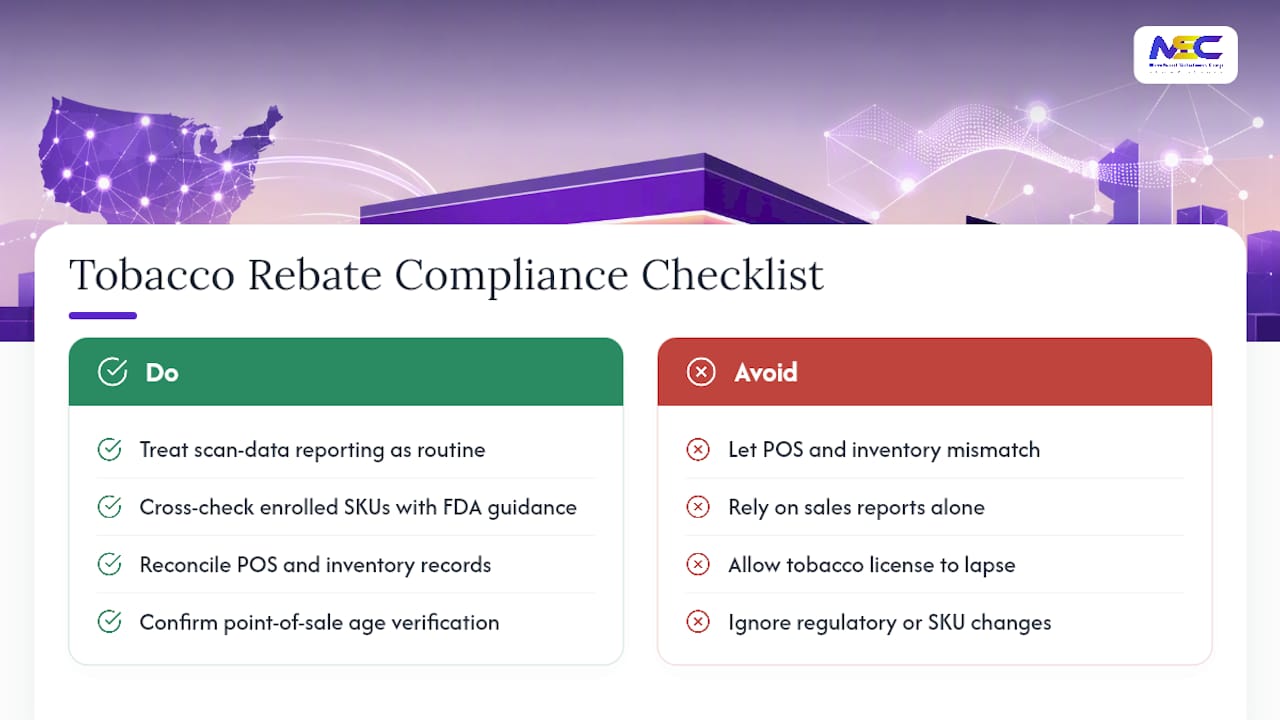
Inventory and POS records that don’t match. If your point-of-sale system shows a sale that your inventory count doesn’t support, or vice versa, that discrepancy can trigger a manufacturer review before it triggers a payment.
Age verification gaps. Tobacco sales carry legal purchase-age requirements, and manufacturers increasingly expect retailers to demonstrate that verification happened at the point of sale, not just that a sale occurred.
Licensing lapses. A retail tobacco license that expires or lapses mid-enrollment can suspend rebate eligibility even if your data reporting continues without interruption.
Regulatory shifts. State and federal rules around flavored products, minimum pack sizes, and permitted SKUs change periodically, and a product that qualified for rebate funding last quarter may not qualify this quarter.
Staying ahead of these issues means treating scan data reporting as part of your regular compliance routine, not a separate task handled once and forgotten. Cross-check your enrolled SKU list against current FDA guidance periodically, since delisted or restricted products drop out of manufacturer programs without much notice.
How Do You Read Scan Data Reports to Improve Your Rebate Strategy?
A scan data report is more useful as a diagnostic tool than as a receipt. Most retailers glance at the total payout and move on, missing the patterns that would help them earn more next quarter.
Start with tier placement. Most manufacturer reports show which funding tier each SKU landed in. If a top-selling product sits in a lower tier than expected, that’s usually a merchandising or documentation gap, not a sales problem.
Compare week-over-week volume against your actual register counts. A gap between reported units and true sales points to a mapping error worth fixing before it compounds across another reporting cycle.
Track which SKUs generate the most funding per unit, not just the highest total payout. A slower-selling product with strong per-unit funding can be worth more shelf attention than a fast-selling one with thin margin support.
Finally, watch for rejected or partial line items. Reports that flag specific transactions as ineligible almost always point to a discount-tagging issue, and fixing that tag going forward recovers money you’d otherwise leave on the table every single week.
Why Independent Retailers Should Act Now on Scan Data Programs
Scan data reporting turns routine tobacco sales into a recurring revenue stream, not a one-time discount. That shift matters more for independents than for chains, since every enrolled SKU becomes a small, dependable funding source rather than a flat-margin transaction.
The retailers capturing the most value aren’t necessarily the highest-volume stores. They’re the ones with clean POS integration and consistent data hygiene, which is a solvable operational problem, not a scale problem. Fixing SKU mapping and export accuracy usually pays for itself within one or two reporting cycles.
Merchant Solutions Corp works with convenience retailers on exactly this kind of POS setup, which makes the enrollment process faster to execute correctly the first time.
— Jonathan
How Merchant Solutions Corp Supports Scan Data Setup
Getting scan data tobacco rebates flowing depends entirely on whether your POS system exports clean, correctly mapped sales data from day one. Merchant Solutions Corp configures convenience-store POS systems with SKU-to-manufacturer mapping already built in, so you’re not troubleshooting UPC mismatches during your first submission cycle.
Setup includes SFTP and aggregator integration support, meaning your system is built to talk to MSA and manufacturer reporting platforms without a custom workaround. Merchant Solutions Corp also bundles hardware options for stores upgrading their register systems specifically to support scan data reporting, and provides hands-on onboarding through your first few weeks of enrollment with Altria or RJ Reynolds.
If your current POS can’t export the data manufacturers require, that’s the first problem worth solving. Visit the payment processing and POS solutions page to check compatibility and get a setup timeline for your store.
Where to Verify Enrollment Steps and Compliance Rules
Confirm manufacturer-specific requirements directly at the source before submitting enrollment paperwork. Altria’s and RJ Reynolds’s help documentation, accessible through CStore Decisions and the CSE Help Center guides linked throughout this article, cover enrollment forms, SFTP setup, and submission timing in detail. For compliance questions, FDA’s enforcement resources remain the authoritative reference for current tobacco product rules.
Sources
- How to increase revenue by leveraging tobacco scan data — CStore Decisions
- How to Sign Up for Altria Scan Data Reporting in PDI C-Store Essentials — CSE Help Center
- Advisory and enforcement actions against industry unauthorized tobacco products — FDA
FAQ
What Is Scan Data in the Tobacco Industry?
Scan data is transaction-level POS sales information, tagged by UPC, that manufacturers use to calculate rebates and fund customer buydowns for enrolled retailers.
How Long Does Tobacco Scan Data Enrollment Take?
Expect roughly one week to receive SFTP credentials after submitting enrollment forms, plus another week of sales collection before your first weekly submission goes through.
Do I Need a Data Aggregator to Submit Scan Data?
Yes, manufacturers generally require submissions to route through a certified aggregator like MSA rather than accepting direct files from retailers.
What POS Features Do I Need for Scan Data Reporting?
Your POS needs SKU-to-manufacturer mapping, scheduled weekly export capability, and SFTP or aggregator integration; platforms like PDI C-Store Essentials and Merchant Solutions Corp’s convenience-store systems build this in.
Why Was My Tobacco Rebate Payment Denied or Delayed?
The most common causes are UPC mismatches, expired SFTP credentials, missing submission weeks, or discount transactions tagged incorrectly in your POS export.