Small Business Consultant for Payments and POS Systems
Small Business Consultant for Payments and POS Systems
Hiring a payments- and POS-focused small business consultant is the fastest way to lower processing costs and get a tested, PCI DSS-compliant payments stack live. If your business processes more than a modest monthly volume, operates across multiple locations or channels, or has received a chargeback monitoring notice from Visa or Mastercard, bring in outside help now. If you are a single-location business with simple hardware needs and low volume, vendor onboarding may be enough. Either way, your immediate next step is the same: pull your last three merchant statements and list every software integration your current POS touches. That two-item audit is what any credible consultant, including Merchantsolutionscorp, will ask for on day one.
- Hire a consultant if you process over $10,000/month, run multiple locations, operate in a high-risk vertical, or have elevated chargebacks.
- DIY or use vendor onboarding if you are single-channel, low-volume, and need only basic hardware.
- Start now by gathering merchant statements and your current integration list before your first consultant call.
Key Takeaways
A payments- and POS-focused small business consultant pays for itself fastest when you process over $10,000 per month, operate across multiple channels, or face chargeback monitoring from Visa or Mastercard.
| Point | Details |
|---|---|
| Know when to hire | Bring in a consultant at $10,000+/month, multi-location, high-risk vertical, or elevated chargebacks. |
| Start with a statement audit | Pull three months of merchant statements before any consultant call to anchor the conversation. |
| Confirm PCI scope reduction | Require tokenization, hosted payment pages, or P2PE to limit audit burden and breach risk. |
| Validate integration credentials | Confirm your consultant has deployed your target POS hardware and can show API/SDK experience. |
| Use $0-upfront hardware programs | Hardware procurement through a processing agreement eliminates upfront capital cost. |
Table of Contents
- When should you hire a payments consultant vs. handle it yourself?
- What does a payments- and POS-focused consultant actually do?
- How do you choose the right payments consultant?
- What questions should you ask before signing a consulting contract?
- What do payments consultants charge, and how are engagements structured?
- How long does a POS migration take, and what does the checklist look like?
- What PCI DSS controls does your consultant need to cover?
- Ready to move forward? Here is how Merchantsolutionscorp helps
- The advice most small businesses get on this topic is incomplete
- Sources
- FAQ
When should you hire a payments consultant vs. handle it yourself?
The decision comes down to complexity and cost exposure. Payment processing choices shape fees, settlement timing, and integration work that directly affect your operating margin. The more moving parts you have, the more a specialist pays for itself.
Hire a consultant when you face any of these:
- Monthly processing volume above a threshold where even a minor rate improvement covers consultant fees
- Multi-location or omnichannel operations (in-store, online, mobile)
- High-risk vertical classification (hospitality, healthcare, specialty retail)
- Chargeback ratio approaching Visa’s VAMP or Mastercard’s ECM program thresholds, which trigger monitoring programs and potential account termination
- Upcoming POS migration or hardware refresh across multiple terminals
- Recurring reconciliation errors or unexplained fee line items on statements
DIY or lean on vendor support when:
- You process under $10,000/month at a single location
- Your POS needs are straightforward (one terminal, no integrations)
- Your current processor’s onboarding team can configure your setup
Pro Tip: A low-cost or free statement audit, which some consulting firms offer as a first step, will show within 30 minutes whether hidden fees justify a paid engagement. Request one before signing anything.
What does a payments- and POS-focused consultant actually do?
A payments consultant delivers concrete, scoped work, not general advice. The core services fall into two categories: one-time engagements and ongoing managed support.
One-time services include merchant statement audits, processor selection and fee negotiation, POS hardware procurement, gateway configuration, tokenization and hosted payment page setup, and PCI DSS scope reduction planning. Ongoing services cover managed chargeback and fraud monitoring, periodic rate reviews, and compliance maintenance.
The table below maps each service to its practical outcome:
| Service | Why It Matters | Typical Deliverable |
|---|---|---|
| Merchant statement audit | Uncovers hidden fees and inflated effective rates | Written rate analysis with benchmarks |
| Processor selection | Matches pricing model to your volume and channels | Shortlist with side-by-side fee comparison |
| POS hardware procurement | Confirms compatibility with your OS and integrations | Configured terminals ready for go-live |
| Gateway and tokenization setup | Reduces PCI scope and breach risk | Live hosted payment page or token vault |
| Chargeback strategy | Prevents account termination from ratio breaches | Dispute response templates and monitoring alerts |
| PCI DSS scope reduction | Lowers audit cost and liability | SAQ guidance and remediation checklist |

Merchantsolutionscorp works with Clover, Square, Talech, Ingenico, PAX, and Dejavoo as implementation platforms, covering both cloud-based and legacy hardware environments. Validating API and SDK support during vendor selection prevents costly integration rework after go-live. For retail-specific POS configurations, hardware compatibility and accounting integrations are practical predictors of day-one reconciliation workload.
How do you choose the right payments consultant?
Evaluate consultants on six criteria, weighted in this order: transparent fee disclosure, PCI expertise, hardware and OS compatibility, onboarding SLA, evidence of API/SDK integrations, and verifiable references in your vertical.
Selection criteria:
- Transparent fee disclosure: Ask for a sample merchant statement analysis before signing. If they cannot produce one, move on.
- PCI expertise: Confirm they can guide you through SAQ selection and scope reduction, not just hand you a compliance checklist.
- Hardware compatibility: Verify they have deployed your target terminals (Ingenico, PAX, Dejavoo, Clover, or Square) in a similar business environment.
- Onboarding SLA: Get a written commitment on go-live timeline and support response hours.
- Integration evidence: Confirm they have worked with your accounting software, loyalty platform, or CRM. Interchange-plus pricing is generally cheaper at scale, but only if your consultant can configure it correctly with your POS.
- References: Request two client references in your vertical and call them.
Red flags to reject immediately:
- Pushes you to switch processors before completing a statement audit
- Cannot explain the difference between bundled and interchange-plus pricing
- Offers a long lock-in contract with no performance milestones
- No references in your industry or business size range
- Opaque or missing sample statements
Pro Tip: Ask any candidate to validate their vendor certifications and show a live sample statement analysis. A consultant who cannot walk you through a real statement in 15 minutes is not ready to negotiate on your behalf.
What questions should you ask before signing a consulting contract?
Bring these questions to every sales call and confirm the answers in writing before you sign a statement of work.
Operational questions:
- What is my effective rate, and how is it calculated across card types?
- How quickly are funds settled, and what triggers a reserve or hold?
- Who handles disputes, and what is the response SLA for chargebacks?
- Which POS platforms and gateways have you deployed in the last 12 months?
Contract terms to confirm in writing:
- Early termination fee: amount, trigger conditions, and waiver options
- Equipment ownership vs. lease: who owns the hardware at contract end?
- Service-level commitments: uptime guarantees and support hours
- Migration rollback terms: what happens if go-live fails?
Red-flag contract language to reject or renegotiate:
- “Rates subject to change without notice” with no cap
- Auto-renewal clauses longer than 12 months with no opt-out window
- Equipment lease terms that exceed the processing contract term
- No written SLA for onboarding or support response time
What do payments consultants charge, and how are engagements structured?
Pricing models vary by scope and risk. Mapping your payment channels, monthly volume, and average ticket before requesting proposals lets you get comparable quotes across consultants.
| Pricing Model | Best Fit | Structure |
|---|---|---|
| Flat project fee | One-time audit or migration | Fixed dollar amount, milestone-based payments |
| Monthly managed service | Ongoing chargeback and compliance management | Recurring monthly retainer |
| Success/savings share | Fee negotiation engagements | Percentage of documented savings (varies by firm) |
| Transaction markup | Processor-bundled consulting | Basis points added to processing rate |
| $0-upfront hardware program | Hardware procurement with processing contract | Equipment cost offset through processing agreement |
Typical engagement packages:
- Audit and negotiation: Statement review, rate benchmarking, and processor negotiation. Usually a flat fee or savings-share arrangement.
- Discovery and migration: Full scope from processor selection through POS go-live. Typically milestone-billed.
- Ongoing managed payments: Monthly retainer covering chargeback monitoring, rate reviews, and compliance maintenance.
Some firms, as noted by Reform Payments, offer a free or low-cost initial consult to determine whether a paid engagement is justified. Take that offer before committing to a retainer.
How long does a POS migration take, and what does the checklist look like?
A typical migration from discovery to go-live runs four to eight weeks for a single-location business, longer for multi-site rollouts.
- Discovery (Week 1): Collect merchant statements, map all integrations (accounting, loyalty, CRM), and document current hardware.
- Processor selection (Week 1–2): Compare proposals using your volume and channel data. Confirm interchange-plus vs. flat-rate fit.
- Hardware procurement (Week 2–3): Order and configure terminals (Ingenico, PAX, Dejavoo, Clover, Square, or Talech). Confirm OS and SDK compatibility.
- Integration and gateway setup (Week 3–4): Configure payment gateway, tokenization, and hosted payment pages. Validate POS and CRM integration to reduce duplicate data entry.
- Testing (Week 4–5): Run end-to-end test card transactions, confirm tokenized payment flows, and validate settlement reports.
- Training (Week 5–6): Train staff on new terminals and POS workflows.
- Pilot and go-live (Week 6–8): Run a parallel period if volume allows. Cut over during a low-traffic window.
- Post-launch support (Ongoing): Confirm chargeback monitoring is active and review first settlement report within 48 hours.
Pro Tip: Schedule a weekly milestone check with your consultant during the migration. Confirm chargeback monitoring is live before you process your first transaction on the new system.
What PCI DSS controls does your consultant need to cover?
PCI DSS compliance is not optional, and the scope of your audit depends directly on how your payments are configured. The right consultant reduces your audit burden by shrinking the data environment.
Scope reduction options:
- Hosted payment pages: Card data never touches your servers, which limits your PCI scope to the simplest SAQ type.
- Tokenization: Replaces card numbers with tokens throughout your system, reducing breach risk and audit scope.
- Point-to-point encryption (P2PE): Encrypts card data at the terminal before it reaches your network, further limiting scope.
Controls to require from your consultant or provider:
- End-to-end encryption on all card-present transactions
- Tokenization for stored payment credentials
- Quarterly vulnerability scans by an Approved Scanning Vendor (ASV)
- SAQ selection guidance matched to your actual payment environment
- Annual penetration testing for merchants above SAQ D scope
Merchantsolutionscorp provides PCI compliance assistance as part of its onboarding process, including SAQ guidance and scope reduction planning.
Pro Tip: PCI compliance is not a one-time checkbox. Schedule a quarterly review of your security controls and confirm your ASV scan results are current before each renewal period.
Ready to move forward? Here is how Merchantsolutionscorp helps
Merchantsolutionscorp works as a payments and POS implementation partner for restaurants, retail businesses, and service providers across the U.S. The engagement starts with a merchant statement audit and moves through processor selection, hardware provisioning, and go-live support.
What Merchantsolutionscorp delivers:
- Merchant statement audit and effective rate analysis
- Processor selection and fee negotiation across card-present and eCommerce channels
- POS integration with Clover, Square, and Talech
- Hardware procurement for Ingenico, PAX, and Dejavoo terminals, including $0-upfront hardware programs
- Dual pricing and cash discount program setup to offset processing fees
- PCI DSS compliance assistance and SAQ guidance
- Dedicated onboarding support from application through go-live
To start, Merchantsolutionscorp needs your last three merchant statements and a list of your current integrations. From there, the team configures equipment, connects your POS stack, and supports your staff through training and launch. Request a payment processing review to get your audit started.
For retail payment configurations and specialty merchant setups, Merchantsolutionscorp also supports high-risk verticals and omnichannel merchants with industry-specific onboarding.
The advice most small businesses get on this topic is incomplete
Most guidance on hiring a small business consultant for payments stops at “compare rates and check reviews.” That framing misses the real risk. The processor you choose matters far less than how your payments stack is configured, scoped for PCI, and integrated with your existing software.
Businesses that switch processors without a statement audit first almost always leave money on the table. The effective rate calculation is not intuitive, and most merchant statements are designed to obscure the true cost. A consultant who starts with the audit, not the pitch, is the one worth hiring.
The second gap in conventional advice is the PCI conversation. Most small business owners treat PCI compliance as a form to fill out once a year. In practice, your compliance posture determines your breach liability and your audit cost. Tokenization and hosted payment pages are not premium features. They are the baseline controls that keep your data environment small and your annual compliance work manageable.
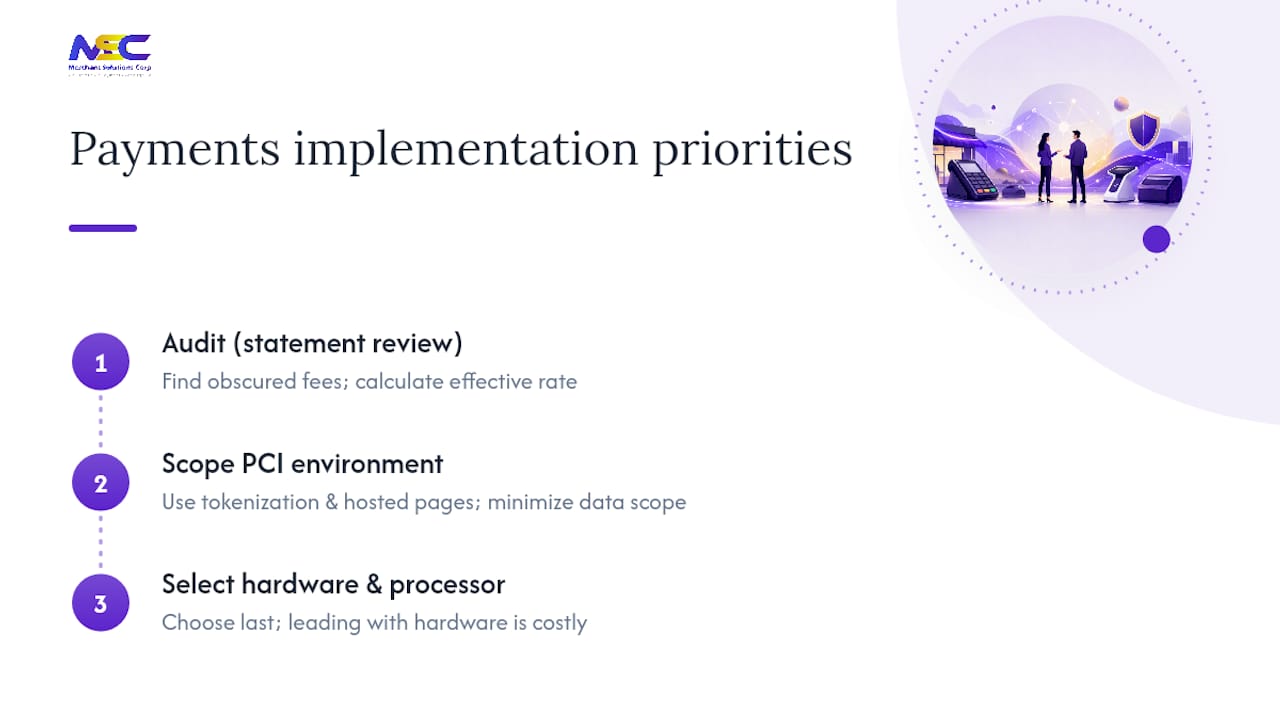
The practical priority order is this: audit first, scope your PCI environment second, then select hardware and processor. Skipping the first two steps and leading with hardware selection is the most common and most expensive mistake in payments implementation.
This article is general information, not a substitute for advice from a qualified financial advisor. Consult a qualified financial professional about your own circumstances before acting on anything here.
Sources
- Small Business Payment Processing Guide
- Payment Risk Consulting: When You Need It and What to Expect | Fincoro
- Should I hire a payments consultant, pay for a fractional payments executive, or figure out payments on my own? — Reform Payments
- How to choose small business payment processing
FAQ
What does a small business payments consultant cost?
Pricing varies by engagement type: flat project fees for one-time audits and migrations, monthly retainers for ongoing managed services, or a savings-share model where the consultant takes a percentage of documented fee reductions. Some firms offer a free initial consult to determine whether a paid engagement is justified.
How long does a POS migration take for a small business?
A single-location migration typically runs four to eight weeks from discovery to go-live, covering processor selection, hardware procurement, integration, testing, training, and launch. Multi-location rollouts take longer depending on site count and integration complexity.
What is PCI DSS, and why does it matter for small businesses?
PCI DSS (Payment Card Industry Data Security Standard) is the security framework that governs how businesses handle cardholder data. Non-compliance exposes you to fines and breach liability. Tokenization, hosted payment pages, and point-to-point encryption reduce your audit scope and lower your annual compliance cost.
When should a small business switch payment processors?
Switch after completing a merchant statement audit that confirms your current effective rate is above market benchmarks for your volume and card mix. Switching without an audit first risks moving to a processor with a similar or worse rate structure.
What POS systems does Merchantsolutionscorp support?
Merchantsolutionscorp supports Clover, Square, Talech, Ingenico, PAX, and Dejavoo, along with mobile terminals and self-serve kiosks, covering both cloud-based and legacy hardware environments across restaurants, retail, and service businesses.