What Are Payment Services for Small Businesses?
What Are Payment Services for Small Businesses?
Payment services are the bundled tools, accounts, and software that let a business accept electronic payments and get funds into its bank account. That bundle typically includes a payment gateway, a processor, and a merchant account, secured under standards like PCI DSS and often supporting ACH transfers alongside card payments. Providers like Merchantsolutionscorp package these pieces together so a restaurant, retail shop, or service business can start taking payments without stitching together separate vendors.
You’ll run into payment services in a few everyday scenarios, including “recurring billing for subscriptions or membership fees” as detailed in our online payments for small martial arts schools.
- Online checkout on a website or app
- In-person card and contactless acceptance at a counter or terminal
- Invoicing and payment links sent to customers
- Recurring billing for subscriptions or membership fees
Key Takeaways
Payment services work because they consolidate gateway, processing, and merchant-account functions into one system that authorizes, clears, and settles transactions securely.
| Point | Details |
|---|---|
| Know the roles | A PSP bundles gateway, processor, and merchant account so you avoid separate vendor contracts. |
| Match setup to volume | Start with an aggregator model for speed, move to a dedicated merchant account as volume grows. |
| Prioritize security | PCI-compliant providers with tokenization reduce breach and fraud exposure significantly. |
| Compare pricing shapes | Weigh aggregated, interchange-plus, and tiered pricing rather than chasing the lowest quoted rate alone. |
| Merchantsolutionscorp fits SMBs | Offers card, ACH, and POS processing with industry-specific setups, including high-risk businesses. |
Table of Contents
- What Is a Payment Service Provider (PSP), Exactly?
- How Does a Payment Transaction Actually Move?
- Which Payment Service Setup Fits Your Business?
- What Features and Benefits Should You Expect?
- How Do You Choose the Right Payment Service Provider?
- Why Does PCI Compliance Matter This Much?
- How Merchantsolutionscorp Approaches Payment Services
- Where to Learn More About Payment Services
- Get Set Up With Merchantsolutionscorp
- Sources
- FAQ
What Is a Payment Service Provider (PSP), Exactly?
A payment service provider bundles the gateway, processing, and merchant-account functions into one service, so you sign one agreement instead of negotiating separate contracts with a bank, a gateway vendor, and a processor. That consolidation is the main reason small businesses gravitate toward PSPs first.
Here’s how the core terms break down:
- Payment gateway: Captures and encrypts card data at checkout, then passes it along securely.
- Payment processor: Authorizes the transaction and moves money between the customer’s bank and the business’s bank.
- Merchant account (acquirer): The account that holds settled funds before they transfer to your regular business bank account.
- Issuing bank: The customer’s bank, which approves or declines the charge based on funds and fraud checks.
- POS terminal: The physical or virtual device that captures the transaction at the point of sale.
Merchant services, more broadly, refer to the hardware and software merchants use to accept payments, with the merchant account acting as the holding point before funds land in your bank. Many PSPs also offer an aggregated (sub-merchant) account, which speeds up onboarding since you skip a lot of individual underwriting. A dedicated merchant account takes longer to set up but usually gives you more control over pricing and risk terms as your volume grows.
How Does a Payment Transaction Actually Move?
Every transaction follows the same basic sequence: authorization, clearing, and settlement. Authorization happens the instant a customer pays, clearing reconciles the transaction between banks, and settlement moves the money into your account, though the exact timing and steps differ between online and in-person sales.
For card-present sales, a chip or contactless tap sends data straight from the terminal. For card-not-present sales, like ecommerce or a payment link, the gateway captures the data first before passing it along. Here’s what happens in the background, usually within seconds:
- The PSP tokenizes the card data so raw numbers never touch your systems directly.
- The transaction routes to the correct card network (Visa, Mastercard, or similar).
- The PSP sends an authorization request to the customer’s issuing bank.
- The issuing bank approves or declines based on funds and fraud signals.
- Approved funds clear between banks, then settle into your merchant account, usually within one to two business days.
Which Payment Service Setup Fits Your Business?
Most merchants land in one of four setups, and picking the wrong one early costs time later.
- PSP/aggregator model: Fast onboarding under a shared merchant account, good for new or low-volume sellers who want to accept payments within days.
- Dedicated merchant account + gateway: More underwriting upfront, but better pricing control and fewer restrictions once you’re processing consistent volume.
- Full-stack providers: Combine processing, POS hardware, and software like online ordering or kitchen displays in one contract, which suits restaurants and retailers juggling multiple channels.
- POS-focused solutions: Terminal and register-centric setups built for high transaction counts at a physical counter.
A common pattern: businesses start on an aggregator model for speed, then move to a dedicated merchant account once monthly volume grows or they need custom risk terms, like high-risk or specialty categories.
What Features and Benefits Should You Expect?
A modern payment service should cover more than just swiping a card. Look for:
- Support for cards, digital wallets, and ACH transfers
- Fraud tools like tokenization and 3D Secure authentication
- Built-in PCI compliance assistance
- Reporting and reconciliation dashboards
- Multi-currency support for businesses selling beyond one region
- SDKs and plugins for connecting to your website or POS software
The real payoff shows up operationally: faster setup, one vendor relationship instead of three, unified reporting across channels, and less PCI scope to manage on your own.
Pro Tip: If you run a high-risk or specialty business, prioritize chargeback management and fraud tools over the lowest advertised rate. A cheap processor that flags you as high-risk later, or freezes funds during a dispute, costs far more than a slightly higher transaction fee.
How Do You Choose the Right Payment Service Provider?
Before you take a single demo call, map out these factors:
- Monthly transaction volume and average ticket size
- Channel mix: online, in-person, invoicing, or recurring billing
- Payment methods you need to support (cards, ACH, wallets)
- Hardware needs: terminals, kiosks, or mobile readers
- Integration effort with your existing website or POS
- Pricing model and contract length
- Chargeback and dispute handling process
- Onboarding timeline and support availability
Once you’re on a call, ask vendors directly:
- Do you offer SDKs or plugins for my platform?
- How fast does settlement typically hit my account?
- What’s included in PCI compliance support?
- What fraud rules run by default, and can I customize them?
- How are chargebacks handled, and what’s your dispute process?
- Are all fees disclosed upfront, including setup and monthly costs?
- What happens if I need to cancel or switch providers?
Pricing models generally fall into three shapes: flat aggregated rates (simple but often costlier at scale), interchange-plus (transparent but more complex to read), and tiered pricing (which can obscure true costs). Rates vary depending on card type, risk category, and processing method, so treat any specific quote as a starting point for negotiation, not a fixed number. Reviewing strategies to reduce processing fees before you sign helps you spot buried costs early.
Why Does PCI Compliance Matter This Much?
Choosing a PCI-compliant provider is one of the strongest defenses a small business has against the cost of data breaches and fraudulent transactions, especially when legacy systems are involved. Tokenization plays a direct role here too, since it keeps raw card numbers out of your systems and reduces how much PCI scope you’re responsible for.
Three habits protect you without adding much overhead:
- Work only with PCI-compliant providers and confirm their compliance level.
- Use tokenization for every card-not-present transaction.
- Turn on vendor fraud rules and monitor chargebacks weekly, not monthly.
How Merchantsolutionscorp Approaches Payment Services
Merchantsolutionscorp builds onboarding around speed and support, pairing card and ACH processing with configurable POS hardware programs so businesses launch faster with less setup friction. Industry-specific setups extend to high-risk and specialty categories that many providers turn away. The goal stays consistent: lower costs, faster setup, and systems that scale as volume grows.
Where to Learn More About Payment Services
- HaiPay’s PSP guide: breaks down PSP structure and sub-merchant accounts.
- BMO’s merchant services overview: explains merchant accounts and PCI risk.
- IXOPay’s PSP explainer: details tokenization and authorization flow.
- Merchantsolutionscorp’s onboarding guide: a practical setup walkthrough.
Get Set Up With Merchantsolutionscorp
Building your own stack of gateway, processor, and merchant account means juggling separate vendors, separate support lines, and separate bills. Merchantsolutionscorp replaces that with one relationship covering card and ACH processing, POS hardware, and industry-specific setups, including free hardware programs with $0 upfront options for qualifying businesses.
That matters most if you’ve read this far and realized your current setup is a patchwork of disconnected tools. Whether you run a restaurant needing online ordering and kitchen displays or a retail shop needing straightforward card and ACH processing, the path to accepting payments starts with a single application. Businesses in specialty or high-risk categories, from smoke shops to gas stations, get setups built for their specific compliance needs rather than a generic template. Apply today and get a configured system running with support from onboarding through daily operations.
This article is general information, not a substitute for advice from a qualified financial advisor. Consult a qualified financial professional about your own circumstances before acting on anything here.
Sources
- Payment Service Provider (PSP): What It Is and How It Works | HaiPay
- Merchant Services: What They Are and How They Can Help - BMO
- What Is a Payment Service Provider (PSP)? How It Works & Benefits
- What is a PSP (Payment Service Provider)? | Mollie | Mollie
- What Are Merchant Services? A Guide for Small Businesses | The Supply Chain Source
FAQ
What Is an Example of a Payment Service?
A payment service provider like Merchantsolutionscorp is a common example, bundling card processing, ACH support, and POS hardware into one setup for a business.

What Are Some Types of Payment Services?
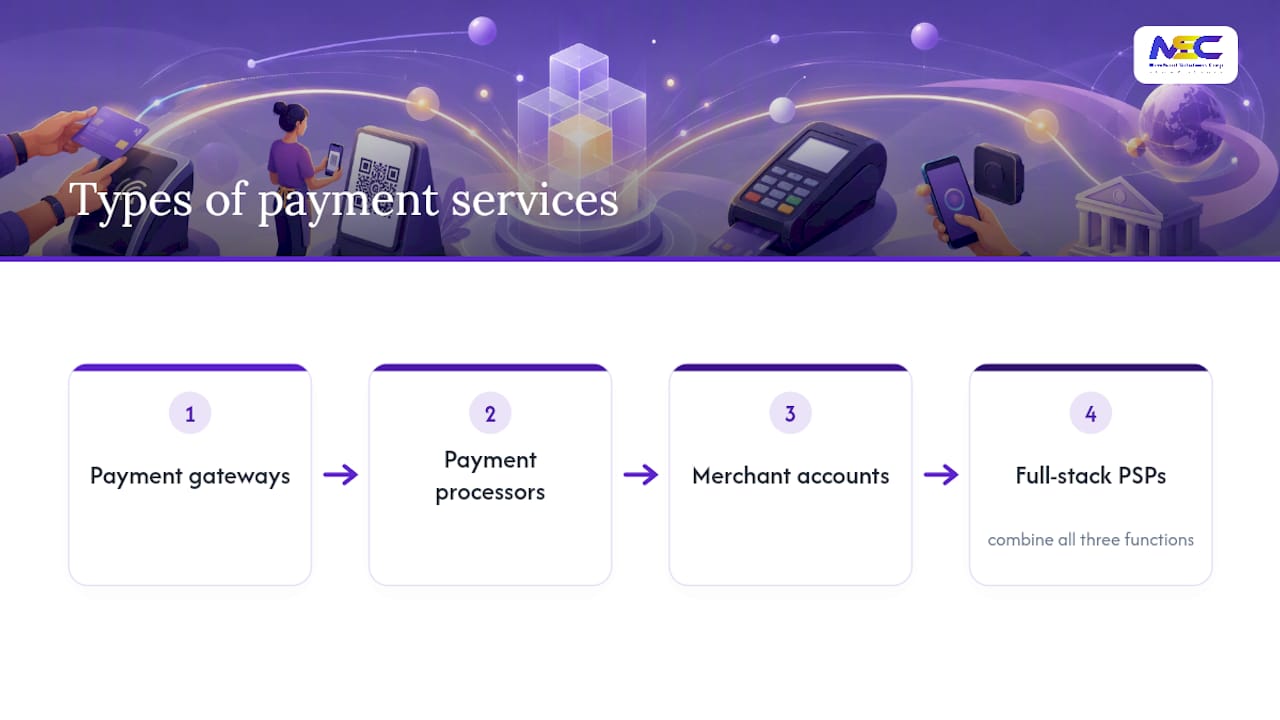
Common types include payment gateways, payment processors, merchant accounts, and full-stack PSPs that combine all three functions into a single provider relationship.
What Are the Main Payment Service Categories Businesses Use?
Most businesses rely on a mix of card processing, ACH or eCheck processing, digital wallets, and payment links or invoicing tools for recurring or one-off billing.
What Are the Four Types of Payments Businesses Accept?
The four most common payment types are credit and debit cards, ACH bank transfers, digital wallets, and cash or check, with electronic methods now dominating most transaction volume.
How Long Does It Take to Set Up a Payment Service?
Setup timelines vary by provider and underwriting requirements, but aggregator-style PSPs often approve merchants within days, while dedicated merchant accounts can take longer due to added review.