Merchant Accounts for Service Businesses: 2026 Guide
Merchant Accounts for Service Businesses: 2026 Guide
A merchant account for service businesses is a dedicated processing account that holds funds between a customer payment and your business bank deposit, configured specifically for the transaction patterns, billing models, and compliance requirements of service-based operations. Unlike product merchants who process straightforward point-of-sale transactions, service businesses deal with retainers, milestone billing, subscriptions, and B2B invoices. That complexity demands a payment setup built to match. This guide covers how merchant accounts work for service providers, where the real cost savings hide, and what operational mistakes most businesses make before they ever process their first dispute.
What makes merchant accounts for service businesses different?
Service businesses do not sell widgets. They sell time, expertise, and outcomes. That distinction shapes every layer of how payment processing for services must be structured.
Product merchants process a transaction at the moment of delivery. Service businesses often charge before, during, or long after the work is complete. That gap between billing and fulfillment is where disputes are born. A consulting firm billing a monthly retainer, a marketing agency invoicing against milestones, or a software company charging annual subscriptions all face a fundamentally different risk profile than a retailer scanning items at checkout.
Three billing models define most service businesses, and each carries distinct payment processing implications:
- Retainer billing charges a fixed recurring amount, typically monthly. The risk here is cancellation disputes. If a client cancels and the charge still runs, you have a chargeback waiting to happen.
- Milestone billing ties charges to project phases. Disputes arise when clients claim a milestone was not met. Your billing system must document delivery evidence before each charge.
- Subscription billing scales quickly but draws the most regulatory scrutiny. Processors monitor subscription merchants closely for cancellation compliance and clear disclosure of recurring terms.
The compliance risk profile for service businesses is also higher than most owners expect. Card networks like Visa and Mastercard classify certain service categories as elevated risk because of historically higher dispute rates. This affects which interchange categories your transactions qualify for and how aggressively your processor monitors your account.
Pro Tip: Before you apply for a merchant account, document your billing model in writing. Processors assess risk during underwriting, and a clearly described billing workflow with cancellation terms reduces the chance of restrictions or holds on your new account.
How Level 2 and Level 3 data lower your processing costs
Most service businesses leave real money on the table by ignoring transaction data optimization. Enhanced Level 2 and Level 3 data reduce B2B interchange by approximately 0.50% to 1.00% on corporate and purchasing card payments. On a business processing $500,000 annually in B2B card volume, that range translates to $2,500 to $5,000 in annual savings.

What Level 2 and Level 3 data actually mean
Level 2 data adds fields like tax amount, customer code, and merchant postal code to a standard transaction. Level 3 data goes further, requiring line-item details including product descriptions, quantities, unit prices, commodity codes, and purchase order numbers. These fields tell the card networks that the transaction is a legitimate B2B purchase, qualifying it for lower interchange categories reserved for corporate card spending.
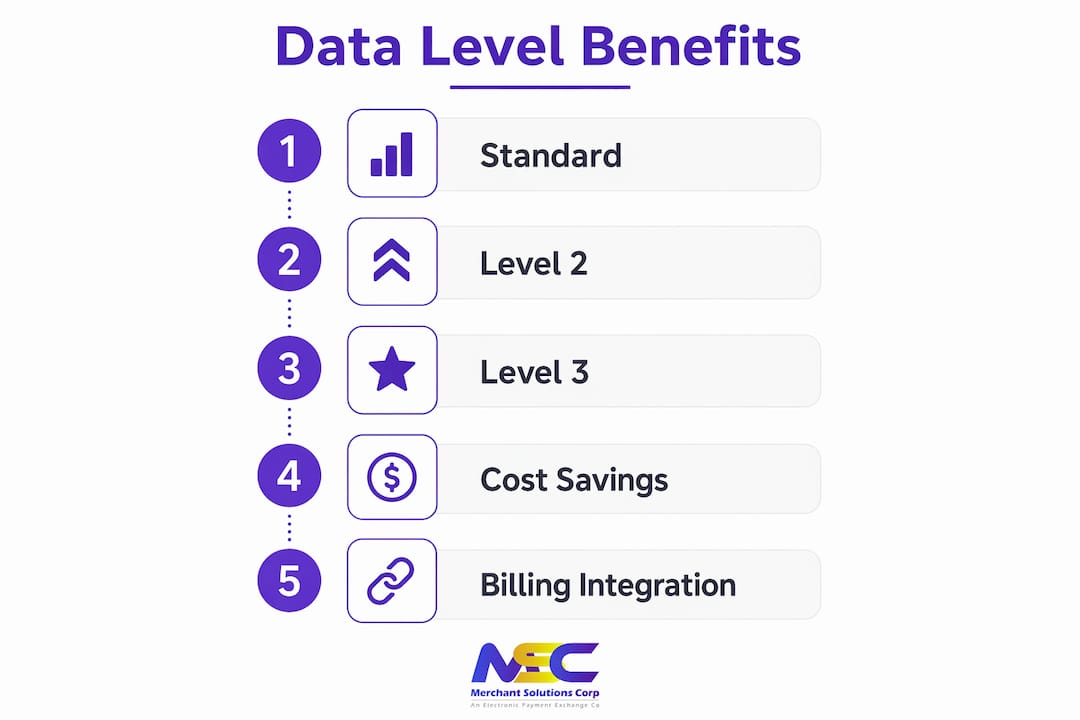
The table below shows the key differences between standard, Level 2, and Level 3 data requirements:
| Data level | Required fields | Typical interchange benefit |
|---|---|---|
| Standard (Level 1) | Merchant name, amount, date | Baseline rate |
| Level 2 | Tax amount, customer code, postal code | Moderate reduction |
| Level 3 | Line items, PO number, commodity codes, unit price | Maximum reduction (0.50%–1.00%) |
The catch is that Level 3 qualification depends on precise data mapping from your billing system to your payment processor. A single mismatched field, such as a missing tax amount or an unformatted PO number, disqualifies the entire transaction from the lower rate. Success is measured by your qualification rate, not by simply requesting Level 3 processing.
Billing system integration is non-negotiable
Effective Level 3 data requires fully automated capture of detailed fields from your billing system to your processor. Manual entry does not scale and introduces errors that block qualification. If you use platforms like QuickBooks, Sage Intacct, or a custom invoicing system, your processor must support direct API integration that passes all required fields automatically with each transaction.
Pro Tip: Audit your last 90 days of B2B card transactions and ask your processor for your Level 2 and Level 3 qualification rates. Most service businesses discover that fewer than 30% of eligible transactions are actually qualifying, which means the savings are already available. You just need the right data plumbing to capture them.
How to manage chargebacks and recurring payment compliance
Chargebacks are the single largest operational threat to a service business merchant account. They are not just a financial cost. They are a signal to your processor that something is wrong, and processors act on that signal quickly.
Stripe imposes payout freezes and rolling reserves when dispute volume surpasses acceptable thresholds. A rolling reserve means your processor withholds a percentage of your daily settlements, sometimes for 90 to 180 days, to cover potential future chargebacks. For a service business with tight cash flow, that kind of hold can be operationally devastating.
The most common chargeback triggers for service businesses include:
- “Services not rendered” claims, where a client disputes a charge after canceling or claiming work was never delivered
- “Not as described” disputes, where the delivered service did not match what was promised in the sales process or contract
- Unauthorized transaction claims on recurring charges, often filed when a client forgets they authorized a subscription or retainer
- Cancellation disputes, where a client requested cancellation but the recurring charge continued to process
Processors like Bluevine can suspend recurring transactions entirely if disputes or cancellation requests are mishandled. Your account may remain technically active while your ability to charge recurring customers is frozen. That is a business-stopping scenario for any subscription or retainer-based service firm.
The operational controls that actually reduce chargebacks are straightforward but require consistent execution. First, your billing descriptor must match your business name as your clients recognize it. A descriptor that reads “MSC HOLDINGS LLC” when your client knows you as “Metro Consulting” creates confusion that turns into disputes. Second, cancellation requests must be processed immediately and confirmed in writing. Third, every milestone or project delivery should be documented with a client-facing confirmation before the associated charge runs.
For service businesses exploring payment optimization for recurring billing, the principle is the same across industries: dispute prevention is cheaper than dispute resolution.
Why ACH payments belong in your payment mix
Card processing is not the only tool available for service business payments, and for many transaction types it is not the best one. ACH payments offer a cost structure that card networks simply cannot match.
ACH payments typically charge flat fees of $0.20 to $1.50 per transaction, compared to card fees that range from 1.5% to 3.5% of the transaction amount. On a $5,000 consulting invoice, a card fee at 2.5% costs $125. An ACH transfer costs less than $1.50. That difference compounds significantly across a full year of B2B invoicing.
Here is how to build ACH into your payment workflow effectively:
- Identify your highest-value recurring transactions. Monthly retainers, annual contracts, and large project invoices are the best candidates for ACH. The larger the transaction, the greater the savings versus card processing.
- Get written ACH authorization from each client. ACH payments require explicit authorization. Build this into your contract or onboarding paperwork so authorization is captured before the first charge.
- Use same-day ACH for time-sensitive payments. Same-day ACH settlement is now widely available and eliminates the traditional 2 to 3 business day wait. This makes ACH practical even for invoices with short payment windows.
- Maintain card processing as a fallback option. Some clients will always prefer card payments, and some transactions require the speed or protections that cards provide. A hybrid acceptance model gives clients flexibility while you direct high-value recurring charges toward ACH.
- Integrate ACH directly with your invoicing platform. Platforms like FreshBooks, Xero, and Zoho Invoice support ACH payment links. Embedding ACH as the default payment method on invoices above a set threshold reduces card fees without requiring clients to change their behavior significantly.
The payment processing solutions that work best for service businesses combine card acceptance for flexibility with ACH for cost efficiency on predictable recurring revenue.
What to expect when choosing and onboarding a merchant account
Choosing a merchant account provider is not just a rate comparison exercise. The onboarding process, risk monitoring policies, and documentation requirements vary significantly between providers and directly affect how quickly you can start processing and how much operational friction you face in the first 90 days.
Standard domestic merchant account applications are approved in 1 to 3 business days. Complex applications, those involving high-risk service categories, international processing, or high monthly volume, can take 3 to 5 days or longer. Delays almost always trace back to incomplete documentation or an application that does not clearly explain the business model.
The table below outlines what to prepare before applying:
| Document or requirement | Why it matters |
|---|---|
| Business license and EIN | Confirms legal business identity for underwriting |
| Three months of bank statements | Demonstrates cash flow stability and average transaction volume |
| Sample contracts or service agreements | Shows billing terms, cancellation policy, and delivery expectations |
| Processing history (if applicable) | Establishes volume baseline and dispute history |
| Website with clear service descriptions | Processors verify that your business is legitimate and compliant |
New merchant accounts face risk monitoring with potential restrictions such as payout holds during the early account lifecycle. Disputes or chargebacks in the first 60 to 90 days carry disproportionate weight because processors have no prior history to contextualize them. Starting with conservative transaction volumes and tight billing controls is the most effective way to build account health before scaling.
For specialty service merchants with complex billing structures or B2B transaction profiles, working with a provider experienced in service industry setups reduces the risk of account restrictions during the growth phase.
Pro Tip: Apply with your full documentation package ready before submitting. Incomplete applications that require follow-up add 2 to 4 days to approval timelines and sometimes trigger additional scrutiny. Treat your merchant account application like a loan application. Prepare it once, prepare it completely.
Key takeaways
Service businesses that treat merchant account setup as a strategic operational decision, not just a commodity purchase, consistently achieve lower processing costs, fewer disputes, and faster account approvals.
| Point | Details |
|---|---|
| Level 2 and Level 3 data savings | B2B card transactions can qualify for 0.50%–1.00% lower interchange with proper data integration. |
| Chargeback prevention is operational | Consistent billing descriptors, prompt cancellations, and delivery documentation reduce disputes before they start. |
| ACH reduces cost on large invoices | Flat ACH fees of $0.20–$1.50 beat card fees of 1.5%–3.5% on high-value recurring payments. |
| Onboarding documentation accelerates approval | Complete applications with contracts, bank statements, and service descriptions cut approval time to 1–3 days. |
| Conservative scale-up protects account health | Starting new accounts with lower volumes and tight dispute controls prevents early payout holds or reserves. |
What I have learned about service business payment processing
After working with service businesses across consulting, marketing, legal, and professional services, the pattern that stands out most is this: the businesses that struggle with payment processing are almost never struggling because of rates. They are struggling because of operations.
A law firm that charges clients without a clear billing descriptor, a marketing agency that keeps running retainer charges after a client cancels, a staffing company that processes $200,000 in its first month without any prior processing history. These are the scenarios that trigger account freezes, rolling reserves, and processor terminations. The rate you negotiated becomes irrelevant when your account is suspended.
The second pattern is equally consistent. Service businesses that invest in billing system integration, specifically the kind that passes Level 2 and Level 3 data automatically, recover those integration costs within the first year through interchange savings. The businesses that skip integration because it seems complex pay more every month indefinitely.
The practical recommendation is to treat your merchant account setup as a two-part project. Part one is the application and approval. Part two is the operational infrastructure: billing descriptors, cancellation workflows, ACH authorization processes, and data integration. Most providers help with part one. Merchantsolutionscorp is built to support both.
— Jonathan
How Merchantsolutionscorp supports service businesses
Merchantsolutionscorp works with service businesses across the US and Canada to configure payment processing solutions that match how service companies actually bill. That means ACH and card processing together, POS systems including Clover and mobile terminals for field-based service providers, and dual pricing options that offset processing fees without adding friction for clients. The platform supports POS and payment system overviews designed for businesses that need fast setup, scalable infrastructure, and support from day one through daily operations. If you are building or restructuring your payment stack in 2026, Merchantsolutionscorp offers the industry-specific configuration that generic processors do not.
FAQ
What is a merchant account for a service business?
A merchant account for a service business is a dedicated processing account that holds funds between a client payment and your bank deposit, configured for service billing models like retainers, milestones, and subscriptions rather than point-of-sale product transactions.
How long does merchant account approval take for service businesses?
Standard applications are approved in 1 to 3 business days. Complex or high-risk service businesses may wait 3 to 5 days or longer, particularly when documentation is incomplete or monthly volume is unusually high.
Can service businesses use ACH instead of credit card processing?
ACH is a strong complement to card processing for service businesses. Flat ACH fees of $0.20 to $1.50 per transaction make it significantly cheaper than card fees of 1.5% to 3.5% for large recurring invoices and retainer billing.
What causes chargebacks for service businesses?
The most common triggers are “services not rendered” claims, “not as described” disputes, unauthorized recurring charges, and cancellations that were not processed before the next billing cycle ran.
What is Level 3 data and why does it matter for service businesses?
Level 3 data includes line-item transaction details such as PO numbers, commodity codes, unit prices, and quantities. Submitting this data on B2B card transactions qualifies them for lower interchange categories, reducing processing costs by approximately 0.50% to 1.00%.