Why CBD Merchants Need Compliant Solutions to Thrive
Why CBD Merchants Need Compliant Solutions to Thrive
Compliant payment processing is defined as the set of legal, financial, and operational standards a merchant must meet to accept card payments without risking account termination. For CBD merchants, meeting those standards is not optional. The 2018 Farm Bill legalized hemp-derived CBD at the federal level, but the FDA has not approved CBD as a food additive or dietary supplement, creating a regulatory gap that causes banks and payment processors to treat CBD retail as high-risk by default. Understanding why CBD merchants need compliant solutions starts with recognizing that this gap exposes every transaction to scrutiny that standard retailers never face.
Why CBD merchants need compliant payment solutions
Payment processing compliance, in the CBD context, means satisfying the underwriting requirements of card networks, acquiring banks, and federal regulators simultaneously. That is a harder target than most retail categories face. Visa and Mastercard set the card network rules. The FDA sets product marketing rules. State licensing boards set retail operating rules. A CBD merchant must satisfy all three to maintain a stable merchant account.

The 2018 Farm Bill created federal legality for hemp products containing less than 0.3% THC. That threshold matters because processors use it as a baseline eligibility check during underwriting. Products above that threshold fall under controlled substance rules, which no mainstream processor will touch.
The FDA’s position creates a separate layer of risk. The FDA has not approved CBD as a food additive or dietary supplement. That regulatory ambiguity gives processors a legal reason to decline or terminate accounts even when the merchant is fully licensed at the state level. Warning letters from the FDA targeting unsubstantiated health claims compound the problem, because processors monitor those letters and use them as termination triggers.
Know Your Customer (KYC) and due diligence requirements
Every processor that accepts CBD merchants requires a standard KYC package. That package typically includes a state business license, Certificates of Analysis (COAs) from an ISO-accredited lab, supply chain documentation tracing hemp from farm to shelf, and proof of general liability insurance. Missing any single document delays onboarding or triggers account review.
- State business license: Current and valid for the jurisdiction where you operate
- COAs: Issued per product batch, confirming THC content below 0.3%
- Supply chain records: Farm registration, processor agreements, and distributor contracts
- Insurance certificates: General liability at minimum; product liability is strongly recommended
- Compliance certificates: State hemp program registration where required
Pro Tip: Keep a compliance folder with digital copies of every document, organized by expiration date. Processors can request updated documents with 48 hours’ notice, and a slow response is treated the same as non-compliance.
Chargeback thresholds add a third compliance layer. Card networks flag chargeback ratios above 0.9%–1% as excessive. Crossing that threshold triggers account review and can result in termination. CBD merchants face elevated chargeback exposure because product effects vary by individual, and subscription billing models generate a disproportionate share of friendly fraud disputes.
Why do traditional payment processors reject CBD merchants?
Traditional processors decline CBD merchants for three interconnected reasons: regulatory uncertainty, chargeback risk, and reputational exposure. Each one independently justifies a decline. Together, they make mainstream processor approval rare.
Regulatory uncertainty is the root cause. The FDA’s unresolved position on CBD means a processor cannot fully assess its legal exposure when boarding a CBD merchant. Banks that sponsor acquiring relationships apply the same logic. If a regulatory change tomorrow reclassified a product, the processor would share liability for every transaction processed under the old rules.
“Despite federal legalization of hemp under the 2018 Farm Bill, CBD merchants continue to face systematic rejection from mainstream processors because the FDA’s unresolved regulatory stance creates underwriting risk that acquiring banks are unwilling to absorb.”
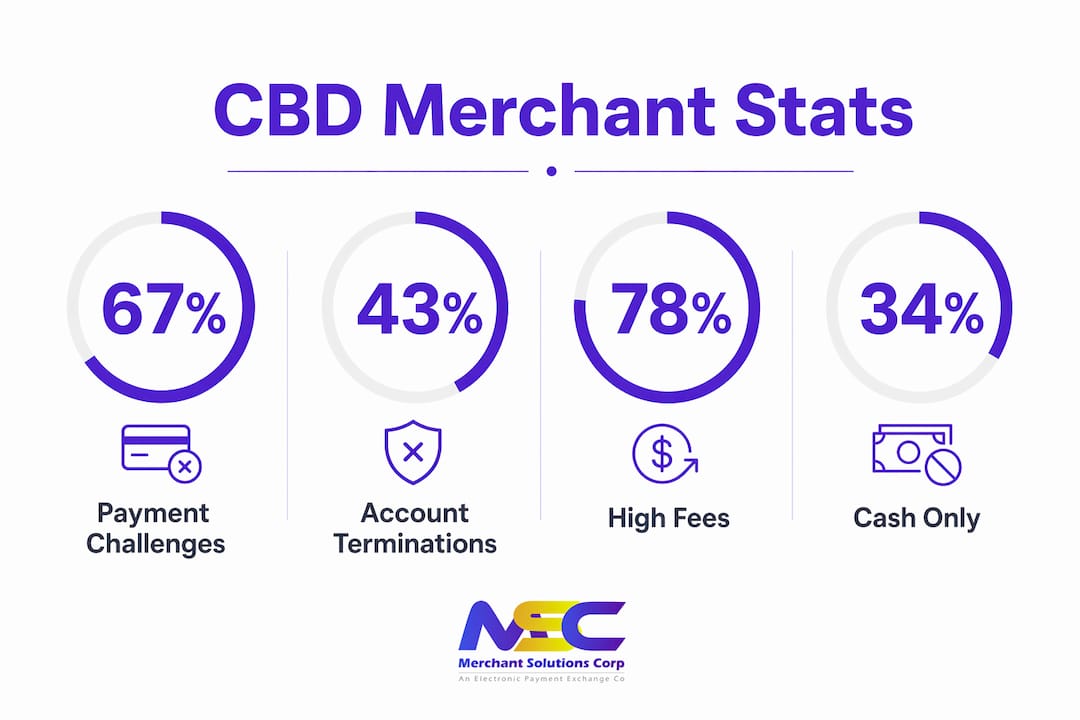
67% of hemp businesses report significant challenges with payment processing, and 43% have experienced processor termination despite being fully legally compliant. Those numbers reflect a structural problem, not isolated bad luck. Processors are not penalizing merchants for breaking the law. They are managing their own risk exposure in an unresolved regulatory environment.
The financial cost of high-risk classification
High-risk classification carries a direct price. Processing rates for CBD merchants run from 3.5% to 6.5% plus fixed per-transaction fees, compared to the 1.5%–2.5% range typical for standard retail. That gap compounds quickly at volume.
Rolling reserves add another financial burden. Processors hold back 5%–10% of daily sales for 90–180 days as a reserve against chargebacks and disputes. For a merchant processing $50,000 per month, that means $2,500–$5,000 per month is inaccessible for the duration of the reserve period.
78% of hemp businesses pay above-standard processing fees, and 34% operate cash-only due to payment instability. Running a cash-only business in 2026 is not a competitive position. It limits average transaction size, increases theft risk, and excludes the growing share of consumers who do not carry cash.
Chargebacks accelerate the problem. Industry forecasts project a 24% increase in chargebacks between 2024 and 2028. CBD merchants already sit at elevated chargeback risk due to inconsistent product effects and subscription billing disputes. That projected increase means the risk environment gets harder before it gets easier.
How FDA warning letters affect processor relationships
The FDA issues warning letters to CBD companies that make unapproved health claims, such as stating that a product treats anxiety, pain, or inflammation. Unapproved health claims are the primary cause of FDA warning letters that lead to loss of payment stability. Processors monitor FDA enforcement actions and treat a warning letter as grounds for immediate account review. A single letter can end a merchant account that took months to establish.
How specialized compliant payment solutions support CBD merchants
Specialized high-risk processors solve the problem that mainstream processors cannot. They underwrite CBD accounts with full knowledge of the regulatory environment, price the risk into their fee structures, and build compliance support directly into their platforms. The result is account stability that mainstream gateways cannot offer.
These processors conduct compliance reviews before onboarding, not after. They verify COAs, check state licensing, review website content for prohibited health claims, and confirm supply chain documentation. That upfront review reduces the probability of mid-account termination because the processor already understands the merchant’s risk profile.
Specialized processors provide integrated transaction monitoring, age verification tools, and product testing documentation support. Age verification matters because several states require it for CBD sales, and processors that serve the hemp industry build that functionality into their payment flows. Transaction monitoring flags unusual activity before it becomes a chargeback problem.
Stability benefits compared to mainstream gateways
The core benefit of a specialized processor is account continuity. Mainstream gateways terminate CBD accounts when regulatory news shifts or when a chargeback ratio approaches the 1% threshold. Specialized processors have already priced that volatility into their underwriting. They do not terminate accounts for the same triggers that mainstream processors use.
| Feature category | Mainstream gateways | Specialized high-risk processors |
|---|---|---|
| CBD merchant acceptance | Rare or conditional | Standard offering |
| Compliance review at onboarding | Minimal | Full KYC and COA review |
| Age verification integration | Not available | Built-in |
| Chargeback management tools | Basic | Advanced monitoring |
| Account stability | Low for CBD | High for CBD |
| Processing rate range | 1.5%–2.5% (if approved) | 3.5%–6.5% (risk-priced) |
Pro Tip: When evaluating a specialized processor, ask specifically about their chargeback dispute process and how they handle FDA warning letter notifications. A processor that has no protocol for those events is not truly specialized for CBD.
Merchantsolutionscorp works with CBD and smoke shop merchants through a purpose-built payment and POS setup that accounts for the compliance requirements specific to hemp retail. That includes Clover-based POS systems configured for age verification and product-level tracking, which supports both compliance documentation and inventory management.
What practical steps keep CBD payment accounts stable?
Account stability requires ongoing effort, not just a clean onboarding package. Processors review merchant accounts periodically, and a merchant who was compliant at onboarding can lose their account if their documentation lapses or their website content drifts out of compliance.
Documentation management
- Maintain a compliance calendar. Track expiration dates for your state business license, hemp program registration, and COAs by product batch. Set renewal reminders 60 days in advance.
- Update COAs with every new product batch. Processors treat outdated COAs as a compliance gap. A COA from a previous batch does not cover a new formulation.
- Keep supply chain records current. If you change suppliers or manufacturers, update your documentation immediately and notify your processor proactively.
- Store insurance certificates digitally. General liability and product liability certificates should be accessible within minutes of a processor request.
- Document compliance training. If you have staff, keep records showing they have been trained on prohibited health claims and age verification procedures.
Proper documentation including business licenses, COAs, supply chain records, and insurance certificates is the foundation of compliant account maintenance. Processors that specialize in CBD expect these documents to be current and complete at all times.
Website and marketing content compliance
Payment processors monitor merchant websites for compliance, and unapproved health claims can lead to immediate account termination. Clear product disclaimers and the avoidance of therapeutic claims are necessary for payment stability. That means your product pages cannot state or imply that CBD treats, cures, or prevents any medical condition.
Review your website content quarterly. Check product descriptions, blog posts, customer testimonials, and social media links. A testimonial from a customer claiming CBD cured their arthritis carries the same regulatory risk as a direct health claim from your brand. Remove or edit any content that makes a therapeutic claim.
Chargeback prevention
Chargeback management is a continuous process. Keep your customer service response time under 24 hours. Respond to every dispute with documentation: order confirmation, shipping tracking, and product description. For subscription billing, send clear pre-charge notifications and make cancellation straightforward. Complicated cancellation processes generate friendly fraud disputes at a high rate.
Monitor your chargeback ratio weekly, not monthly. By the time a monthly report shows a problem, you may already be above the 1% threshold. Most specialized processors provide a merchant dashboard with real-time chargeback data. Use it.
Cash management as a backup
About 34% of hemp businesses rely primarily on cash-based sales due to payment instability. Cash management tools like smart safes help merchants manage operations when card processing is disrupted. A smart safe automates cash counting, reduces theft risk, and provides a digital record of cash deposits. It is not a substitute for card processing, but it is a practical backup that keeps operations running during account transitions.
Key takeaways
CBD merchants who operate with compliant payment solutions face fewer account terminations, lower dispute rates, and more stable long-term operations than those who rely on mainstream gateways.
| Point | Details |
|---|---|
| Compliance is structural | The FDA’s unresolved stance on CBD makes high-risk classification unavoidable without proper documentation. |
| Specialized processors offer stability | Processors built for hemp retail price regulatory risk into their underwriting rather than using it as a termination trigger. |
| Documentation must stay current | Expired COAs, lapsed licenses, or outdated supply chain records are treated as compliance failures during account reviews. |
| Website content affects accounts | Processors monitor merchant sites; a single unapproved health claim can trigger immediate termination. |
| Chargeback management is ongoing | Keeping your chargeback ratio below 1% requires weekly monitoring and a fast customer service response process. |
The compliance gap that most CBD merchants underestimate
Working with CBD merchants across the country reveals a consistent pattern. Merchants invest heavily in product quality, lab testing, and state licensing. Then they treat payment processing as an afterthought and wonder why their account gets terminated six months in.
The compliance gap is not usually in the product. It is in the operational details: a product page that uses the word “therapeutic,” a COA that expired three weeks ago, a subscription billing flow that makes cancellation confusing. Those details do not feel significant when you are focused on running a retail business. To a processor’s risk team, they are termination events.
The merchants who maintain stable accounts long-term share one habit. They treat compliance as a standing operational function, not a one-time onboarding task. They assign someone to own the compliance calendar. They review website content on a schedule. They check their chargeback ratio every week. That discipline is what separates merchants who build durable businesses from those who cycle through processor relationships every year.
The regulatory environment for CBD is not going to simplify quickly. The FDA’s rulemaking process moves slowly, and card network rules for hemp products will continue to evolve. Merchants who build compliance into their operations now will be positioned to adapt as those rules change. Merchants who treat compliance as a burden will keep losing accounts.
Choosing a payment partner with genuine CBD industry experience is the single highest-leverage decision you can make for account stability. A processor that has underwritten hundreds of hemp accounts understands the risk profile. They will not terminate your account the first time a regulatory headline appears. That stability is worth more than a marginally lower processing rate from a mainstream gateway that will drop you at the first sign of regulatory pressure.
— Jonathan
Merchantsolutionscorp: payment processing built for CBD merchants
CBD retail requires a payment partner who understands the regulatory environment before the first transaction processes. Merchantsolutionscorp provides high-risk payment processing designed specifically for hemp and CBD merchants, with full KYC review, compliance documentation support, and POS systems configured for age verification and product-level tracking. The platform supports credit card and ACH processing, Clover-based POS hardware with $0 upfront options, and dual pricing to offset processing fees. Merchantsolutionscorp’s team handles onboarding through daily operations, so you get a processor that stays with you as regulations evolve. See the full range of compliant payment solutions available for CBD merchants.
FAQ
What makes a payment processor compliant for CBD merchants?
A compliant processor conducts full KYC review, verifies COAs and state licenses, and prices accounts based on hemp industry risk. Processors built for CBD also provide integrated age verification and ongoing transaction monitoring.
Why do mainstream processors reject CBD merchant accounts?
The FDA has not approved CBD as a food additive or dietary supplement, which creates underwriting uncertainty that mainstream acquiring banks are unwilling to absorb. That regulatory gap causes declines even when the merchant is fully licensed.
What chargeback ratio triggers account termination for CBD merchants?
Card networks flag chargeback ratios above 0.9%–1% as excessive, which risks account termination. CBD merchants face elevated chargeback exposure from inconsistent product effects and subscription billing disputes.
What documents do CBD merchants need to maintain a compliant account?
The core documentation set includes a current state business license, per-batch COAs from an ISO-accredited lab, supply chain records, and insurance certificates. Processors can request updated documents with short notice, so keeping these current is critical.
Can a CBD merchant’s website content affect their payment account?
Yes. Processors actively monitor merchant websites for unapproved health claims. A single therapeutic claim, whether in a product description or a customer testimonial, can trigger immediate account review or termination.