Why Offset Processing Fees: A 2026 Guide for Small Businesses
Why Offset Processing Fees: A 2026 Guide for Small Businesses
Offsetting processing fees is the practice of transferring credit card transaction costs from your business to the customer who chooses to pay by card, protecting your profit margins without raising your base prices. Known formally as a surcharge program, dual pricing, or a cash discount program, this strategy directly addresses a real financial drain. Credit card processing fees typically range between 2.5% and 5.0% per transaction, and for small businesses operating on thin margins, that cost can consume up to 16% of profits on card sales. Understanding why offset processing fees matter, and how to apply them correctly, is one of the most practical steps you can take to protect your bottom line in 2026.
Why offset processing fees: the core business case
The financial case for offsetting fees is straightforward. Offset models reduce merchant costs from the typical 2.65%–3.65% range down to approximately 0%–1%, representing savings of 30–60% compared to flat-rate pricing. That is not a rounding error. For a business processing $30,000 per month in card transactions, the difference between paying 3% and paying 1% is $600 every single month, or $7,200 per year.

Small businesses in the U.S. and Canada face a structural disadvantage here. Large retailers negotiate volume-based rates and absorb fees across millions of transactions. Your neighborhood restaurant or boutique retail shop does not have that leverage. Offsetting fees levels the playing field by shifting the cost to the payment method that creates it.
The concept also aligns with how customers already think about pricing. Gas stations have displayed separate cash and credit prices for decades. Consumers understand that different payment methods carry different costs. Applying that same logic inside your business is not a penalty. It is transparency.
What are the main methods to offset processing fees?
Three primary methods exist for passing card processing costs to customers: surcharge programs, dual pricing, and convenience fees. Each works differently, and each fits different business types.
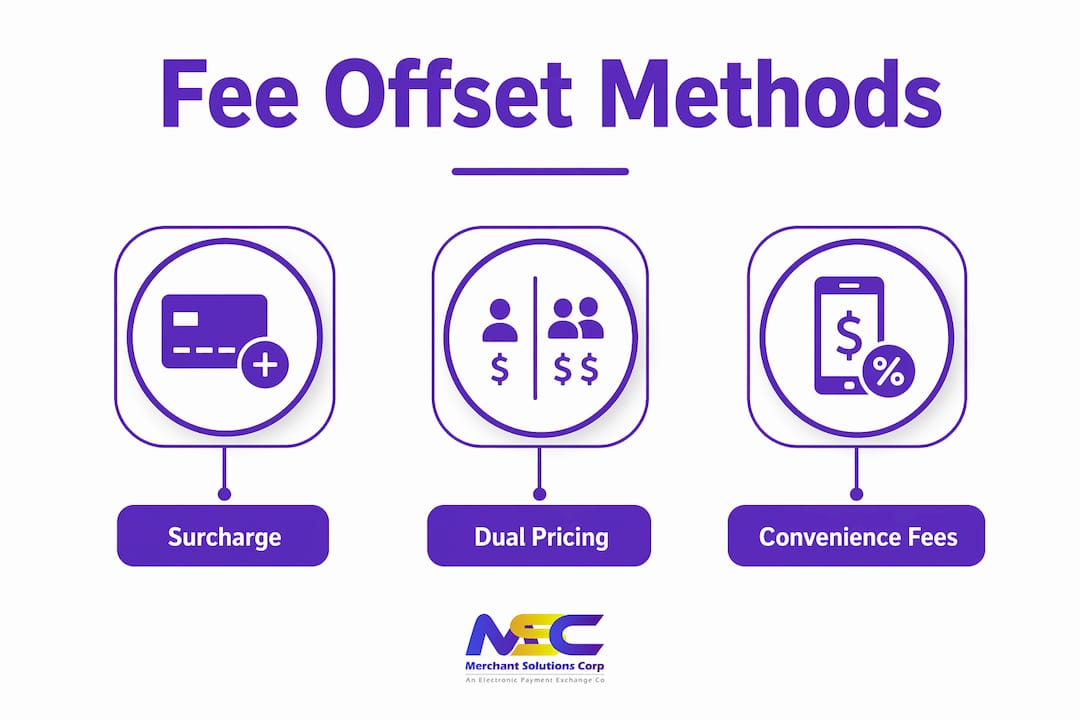
Surcharge programs
A surcharge adds a percentage fee directly to a customer’s total when they pay by credit card. The fee typically mirrors your actual processing cost, often around 3% of the subtotal. Boulevard Offset, for example, applies a transparent surcharge at checkout that reduces the merchant’s net processing cost to approximately 1%. Surcharges apply to credit cards only. Debit card transactions are excluded under card network rules.
Pros:
- Directly offsets your actual processing cost
- Customers paying with debit or cash pay nothing extra
- Easy to implement through most modern POS systems
Cons:
- Requires clear disclosure before the transaction
- Not permitted in all U.S. states or Canadian provinces (more on this below)
- Some customers react negatively if the fee feels unexpected
Dual pricing
Dual pricing displays two prices for every item: one for cash and one for card. Dual pricing offsets nearly all credit card processing costs while giving customers full transparency and the freedom to choose their payment method. The cash price is your baseline. The card price includes the processing cost built in.
Pros:
- Fully transparent at the point of display
- Customers make an informed choice before reaching the register
- Widely accepted by card networks and regulators
Cons:
- Requires updating menus, price tags, or digital displays
- Can feel unfamiliar to customers in markets where it is less common
Convenience fees
A convenience fee is a flat charge applied when a customer uses a specific payment channel, typically online or over the phone, rather than in person. It is not percentage-based. A business might charge $1.50 for paying an invoice online by card. This method works well for service businesses, utilities, and professional practices.
| Method | Fee Type | Applies To | Best For |
|---|---|---|---|
| Surcharge | Percentage of sale | Credit cards only | Retail, restaurants |
| Dual Pricing | Built into displayed price | All card payments | Retail, food service |
| Convenience Fee | Flat amount | Specific payment channels | Services, invoicing |
Pro Tip: If you process a high volume of online orders, a convenience fee on card payments combined with a free ACH payment option gives customers a cost-free alternative and reduces your processing expense significantly.
Why reducing processing fees matters for u.s. and canadian businesses
Processing fees are not a single line item. They are a stack of charges that compound quietly. The base interchange rate is just the start. Hidden fees including PCI non-compliance charges, monthly gateway fees, and statement fees add 0.1%–0.3% to your effective rate. Many of these fees are negotiable or removable entirely. Most business owners never ask.
The impact of processing fees on businesses becomes clearest when you look at margin math. A restaurant operating at a 5% net profit margin that pays 3% in processing fees on all card sales is surrendering more than half its profit on every card transaction. Offsetting even a portion of that cost changes the math dramatically.
In 2026, several trends are increasing the pressure on small businesses:
- Buy Now, Pay Later (BNPL) integrations carry higher merchant fees than standard credit cards, often 3.5%–6.0% per transaction.
- Premium rewards cards (travel, cashback, business cards) carry higher interchange rates than standard consumer cards, and your customers are using them more often.
- Online transaction volumes continue to grow, and card-not-present fees are consistently higher than in-person rates.
Pro Tip: Ask your processor for an interchange-plus pricing structure rather than flat-rate pricing. Interchange-plus pricing can reduce your effective rate by 0.5% or more, and it pairs well with any offset strategy you implement.
Customer acceptance of surcharging and dual pricing has grown steadily. Transparency is the deciding factor. Customers who understand the fee before they reach the register rarely object. Customers who see a surprise charge on their receipt often do. The method matters less than the communication.
How do laws and processor policies affect fee offsetting?
Surcharging is legal in most U.S. states, but not all. Connecticut, Massachusetts, and Puerto Rico have historically restricted or prohibited credit card surcharges. Several other states have specific disclosure requirements that must be followed precisely. In Canada, surcharging became permitted for Visa and Mastercard transactions in 2022 following a court settlement, but provincial rules and disclosure requirements vary.
The key compliance points for any offset program include:
- Disclose before the transaction. Signage at the entrance, at the point of sale, and on the receipt is the standard requirement under Visa and Mastercard rules.
- Cap surcharges at your actual processing cost. Card network rules prohibit profiting from surcharges. The fee must not exceed what you pay to process the transaction.
- Apply fees consistently. Processor policies do not allow waiving surcharges on individual transactions. The fee must apply to all qualifying credit card transactions, both card-present and card-not-present.
- Never surcharge debit cards. This is prohibited under card network rules regardless of state or province.
The distinction between surcharges, convenience fees, and cash discount programs matters from a regulatory standpoint. A cash discount program frames the lower price as a reward for cash payment rather than a penalty for card use. This framing is legal in all 50 U.S. states and is often easier to communicate to customers. The economic outcome is similar, but the legal exposure is lower.
Working with a processor that understands these distinctions protects you. A step-by-step payment processing guide can help you map the right program to your specific state or province requirements before you launch.
How to implement offset processing fees: practical steps
Getting an offset program running correctly takes preparation. Rushing the setup is the most common reason businesses face customer complaints or processor violations.
-
Audit your current effective rate. Pull your last three processor statements and calculate your total fees as a percentage of total card volume. Include monthly fees, PCI fees, and gateway charges. This is your true cost baseline.
-
Choose your offset method. Match the method to your business type. Retail and food service businesses typically do well with dual pricing. Service businesses and professional practices often prefer convenience fees for online or phone payments.
-
Calculate the correct fee amount. For surcharges, base the percentage on your subtotal before taxes. Transparent fee disclosure at checkout and on receipts reduces customer complaints and chargebacks. Never calculate the surcharge on the tax-inclusive total unless your processor’s system requires it.
-
Update your signage and checkout flow. Post clear notices at your entrance and at every point of sale. If you take payments online, display the fee before the customer enters payment details. This is both a legal requirement and a trust-building practice.
-
Configure your POS system. Most modern POS platforms, including Clover and Square, support dual pricing and surcharge programs natively. Work with your provider to activate the feature and test it on a live transaction before going live with customers.
-
Handle refunds correctly. When you refund a card transaction, refund the surcharge or offset fee proportionally. Keeping the fee on a refunded transaction is a violation of card network rules and a source of customer disputes.
-
Monitor the impact on sales and satisfaction. Track your average transaction value and customer return rate for 60–90 days after launch. Most businesses see minimal impact when fees are disclosed clearly. If you see a drop, review your disclosure process before adjusting the fee itself.
Pro Tip: Negotiate your monthly fees before launching an offset program. Removing negotiable fees like PCI non-compliance charges and statement fees can cut your effective rate by 0.1%–0.3% before you pass a single dollar to customers.
Key takeaways
Offsetting processing fees is the single most direct way for small businesses to stop subsidizing the cost of card acceptance on every transaction.
| Point | Details |
|---|---|
| Fee impact is significant | Processing fees consume up to 16% of profits on card sales for small businesses. |
| Three methods available | Surcharging, dual pricing, and convenience fees each suit different business types and markets. |
| Offset models cut costs sharply | Merchants using offset programs reduce effective processing costs from 2.65%–3.65% down to 0%–1%. |
| Legal compliance is non-negotiable | Surcharge rules vary by U.S. state and Canadian province; disclose fees before every transaction. |
| Hidden fees add up | PCI, gateway, and statement fees add 0.1%–0.3% to your effective rate and are often negotiable. |
The uncomfortable truth about processing fees most businesses ignore
Most small business owners treat processing fees like a utility bill. They arrive, they get paid, and nobody questions them. That mindset costs real money every year.
The part that surprises most business owners I work with is not the base interchange rate. They know that exists. What catches them off guard is the stack of monthly fees sitting underneath it. Statement fees, PCI non-compliance fees, gateway fees, batch fees. None of these are fixed. All of them are negotiable. Most processors count on the fact that you will not ask.
Dual pricing, in my experience, gets the most resistance before launch and the least resistance after it. Business owners worry their customers will push back. In practice, customers who are told clearly before they pay rarely object. The ones who complain are the ones who felt surprised. That is a communication problem, not a pricing problem.
The other misconception worth addressing is that offsetting fees means you are charging customers more. You are not. You are charging card-paying customers the actual cost of their payment method. Cash customers pay less. That is a fair system, and most customers recognize it as such when it is explained plainly.
The businesses that struggle with offset programs are usually the ones that implemented them without updating their signage, without training their staff to explain the fee, or without auditing their full effective rate first. The math only works if you know what you are actually paying.
— Jonathan
How Merchantsolutionscorp helps you manage processing costs
Merchantsolutionscorp works with restaurants, retailers, and service businesses across the U.S. and Canada to reduce what they pay to accept card payments. The platform supports dual pricing, surcharge programs, and cash discount setups built directly into Clover and other POS systems, so the offset logic runs automatically at checkout without manual calculation. If you are ready to stop absorbing fees that your payment method creates, explore payment processing solutions designed for small businesses that want lower costs and faster setup. You can also review retail payment options tailored to your industry and get configured equipment with full support from day one.
FAQ
What does it mean to offset processing fees?
Offsetting processing fees means passing some or all of your credit card transaction costs to the customer who pays by card, using a surcharge, dual pricing, or convenience fee structure. The goal is to reduce the business’s net cost of card acceptance.
Is surcharging legal in the u.s. and canada?
Surcharging is legal in most U.S. states but restricted in a few, including Connecticut and Massachusetts. In Canada, surcharging on Visa and Mastercard became permitted in 2022, though provincial disclosure rules apply. Always verify the rules for your specific location before launching a program.
How much can a business save by offsetting processing fees?
Merchants using offset models can reduce their effective processing cost from the typical 2.65%–3.65% range down to approximately 0%–1%, representing savings of 30–60% compared to standard flat-rate pricing.
What is the difference between dual pricing and a surcharge?
Dual pricing displays separate cash and card prices at the point of sale, giving customers a choice before they commit. A surcharge adds a fee at checkout after the customer has already chosen to pay by card. Both achieve a similar financial outcome, but dual pricing is considered more transparent and is accepted in all U.S. states.
Can i offset fees on debit card transactions?
No. Card network rules prohibit surcharging debit card transactions. Offset programs apply only to credit card payments. Customers paying with debit or cash always pay the base price.