Decide Fast: Merchant 48 Hour Rule for Chargeback Representment
Decide Fast: Merchant 48 Hour Rule for Chargeback Representment
Chargeback representment is the merchant’s formal, time-limited opportunity to fight back after a disputed charge, submitting targeted evidence through your acquirer so the issuer will reverse the reversal and return your funds. It works through a process called second presentment, and it only succeeds when your evidence directly answers the reason code the issuer cited. The catch is time: network deadlines run as short as 20 days, and missing one is an automatic loss regardless of how strong your case is.
TL;DR:
- Successful chargeback representment requires targeted evidence that directly addresses the specific reason code within tight deadlines, often as short as 20 days.
- Key evidence includes delivery proof for “not received” claims, authentication data for fraud, and clear product or transaction records for “not as described” or processing errors.
- Organizing and labeling evidence files correctly, along with a concise one-page rebuttal letter, significantly improves the chances of reversal upon review.
- Internal submission deadlines can be much shorter than network limits, making rapid evidence collection within 48 hours crucial.
- Implementing automatic data logging through integrated payment systems helps merchants meet representment requirements efficiently and reduces missed deadlines.
Table of Contents
- What Is Chargeback Representment in the Dispute Lifecycle?
- Should You Fight This Chargeback? A Decision Framework
- The 48-Hour Evidence Checklist for Chargeback Rebuttals
- What Evidence Wins by Chargeback Reason Code?
- How Long Do You Have to Submit a Representment?
- How to Write a One-Page Chargeback Rebuttal Letter
- Where and How Do You Submit a Representment?
- What Happens After You Submit? Outcomes and Escalation
- Preventing Future Chargebacks: Program-Level Controls
- Run Representment Like a Program, Not a One-Off Task
- Faster Evidence, Fewer Missed Deadlines
- Sources
- FAQ
What Is Chargeback Representment in the Dispute Lifecycle?
A chargeback and a refund are not the same event, and confusing them costs merchants money. A refund is voluntary. A chargeback is the issuer forcibly reversing a payment, and representment is your only formal path to contest that reversal after the fact. Pre-dispute tools like alerts and rapid dispute resolution exist further upstream, letting you refund before a chargeback even posts. Representment is the fallback when that window has already closed.
The lifecycle runs in a predictable sequence. A cardholder disputes a charge with their bank. The issuer grants a provisional credit and assigns a reason code, then routes the dispute to your acquirer, who notifies you. From there, you decide whether to accept the loss or fight it with a second presentment. That word “second” matters: the original sale was the first presentment, and your rebuttal is the second attempt to collect.
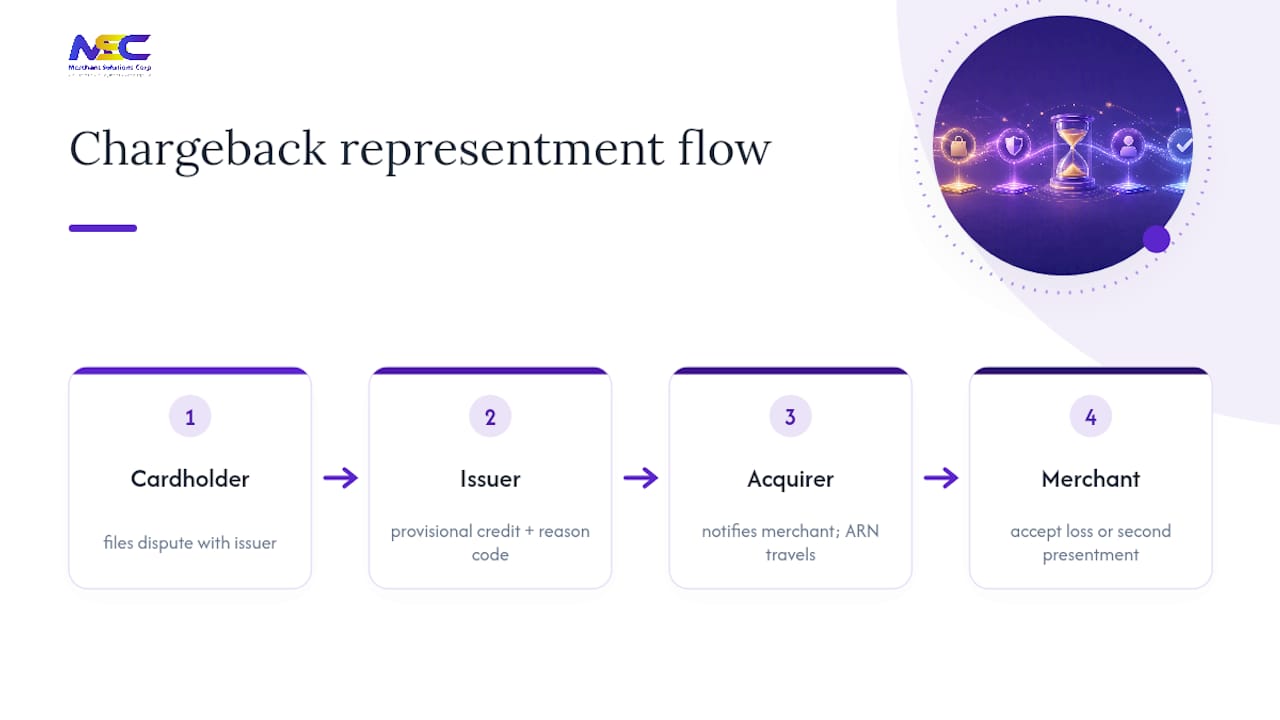
Every dispute carries an ARN (Acquirer Reference Number) and a reason code, and both identifiers travel with the case through submission. The reason code is the actual question you’re answering. Fraud, non-receipt, and “not as described” claims each require different proof, which is why generic responses fail so often. An issuer-side analyst reviews what you submit, compares it against the reason code, and rules for whichever side presented the more complete story.
Should You Fight This Chargeback? A Decision Framework
Not every dispute deserves a fight. Before you spend an hour building a packet, run three quick checks.
- Do you have targeted evidence? If you have nothing that speaks directly to the reason code (a signed delivery confirmation for a “not received” claim, for example), representment is unlikely to succeed no matter how much you write.
- Is the transaction value worth the labor? A $22 dispute rarely justifies the staff time to build a full packet unless you can template most of it.
- Does the reason code favor merchants? Fraud claims backed by strong authentication data win more often than vague “not as described” disputes with no return record.
Cases worth fighting typically combine a decent dollar amount with strong, specific proof: a signed proof of delivery, a matching device fingerprint, or a documented refund already issued. Cases worth conceding usually involve missing core evidence or transaction values too small to justify the effort.
Pro Tip: Even a winning representment still counts against your chargeback ratio in network monitoring programs. If you’re seeing repeat disputes from the same source, treat that as a signal to fix an upstream process, not just a case to win.
The 48-Hour Evidence Checklist for Chargeback Rebuttals
Speed matters more than most merchants realize, because processors often impose internal deadlines shorter than the network’s official window, sometimes as tight as seven to nine days. Treat the first 48 hours after notification as your evidence sprint.
- Read the dispute notice fully and identify the exact reason code.
- Confirm your processor’s internal submission deadline, not just the network deadline.
- Map which exhibits that specific reason code requires.
- Pull authorization logs, AVS/CVV match results, and the original order record.
- Pull shipping and tracking data, along with any customer service communications.
- Screenshot tracking pages immediately, since carrier links expire and lose their evidentiary value.
Once you’ve gathered the raw material, organize it the way an analyst will actually read it:
- Label exhibits sequentially: Exhibit A, Exhibit B, Exhibit C.
- Draft a one-page rebuttal letter that references each exhibit by label.
- Log your submission metadata (date, time, confirmation number) in case you need to prove timely filing later.
A focused submission built around five core signals, authorization data, AVS/CVV, tracking or access logs, customer communications, and the rebuttal letter itself, consistently outperforms a bloated folder of unrelated documents.
Pro Tip: Name your exhibit files exactly as you reference them in the letter (“Exhibit_A_Tracking.pdf”), not generic names like “scan001.pdf.” Reviewers move fast, and a mismatched filename is an easy reason to skip a document.
What Evidence Wins by Chargeback Reason Code?
Matching your proof to the reason code is the single biggest factor in whether representment succeeds. Generic documentation loses to specific, targeted evidence almost every time.
- Fraud or unauthorized transaction: Authentication data (3D Secure results), the authorization code, device fingerprint and IP address, and account history all matter here. Under Visa’s Compelling Evidence 3.0, you can qualify by showing at least two prior undisputed transactions from the same cardholder within a 120 to 365 day window, matching on two or more data points, one of which must be an IP address or device identifier.
- Item not received: Carrier tracking showing delivered status, a signed proof of delivery, and a screenshot of the tracking page taken at submission time (since links go dead).
- Not as described: The archived product listing as it appeared at purchase, photos of the item as shipped, and any customer service record showing a return offer or remedy attempt.
- Processing error: Original receipts, settlement records, and proof of any refund transaction already issued for the same charge.
- Subscription dispute: Proof of enrollment, a screenshot of the checkout disclosure the customer agreed to, and a log of any cancellation requests and how they were handled.
Capturing device fingerprints, IP addresses, and session data at checkout has become foundational for fighting card-not-present fraud claims, since programs like CE 3.0 are built entirely around matching those signals across transactions.
How Long Do You Have to Submit a Representment?
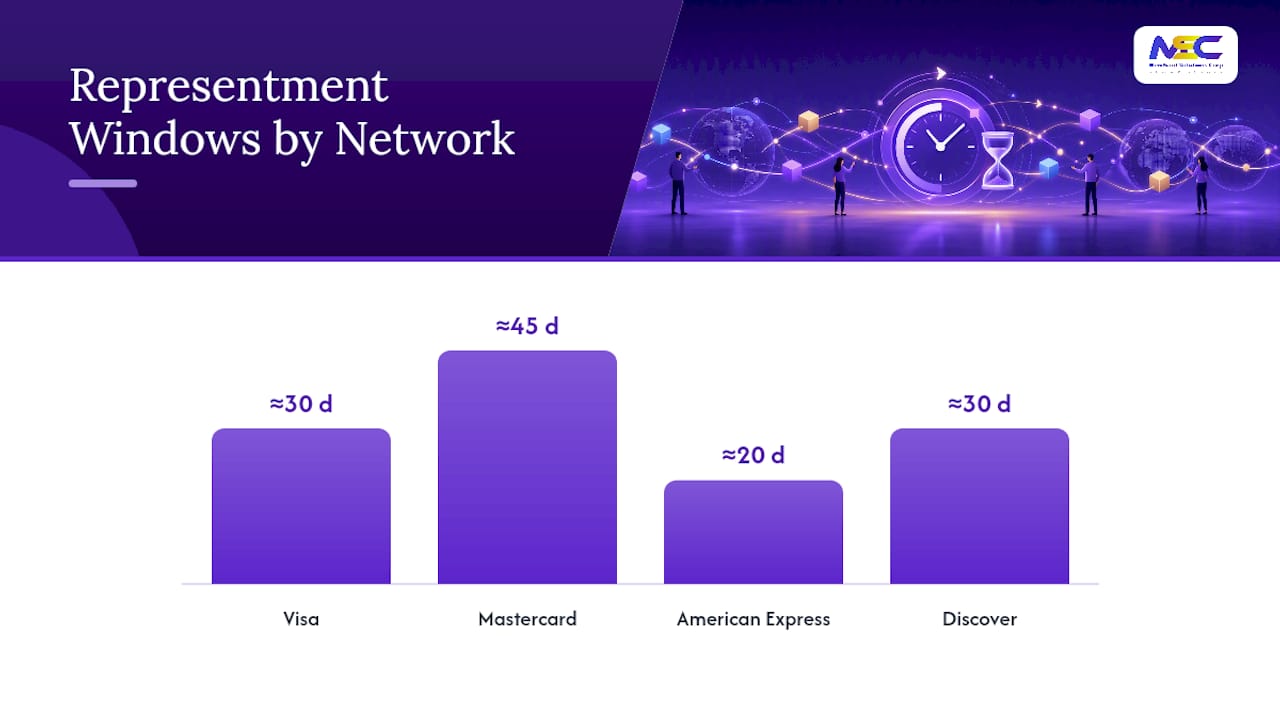
Network deadlines are unforgiving, and they vary by card brand. Visa gives merchants around 30 days, Mastercard about 45 days, American Express roughly 20 days, and Discover similar to Visa to submit a second presentment. Miss the window and you typically lose the case automatically, regardless of evidence quality.
| Network | Typical representment window |
|---|---|
| Visa | about 30 days |
| Mastercard | about 45 days |
| American Express | about 20 days |
| Discover | about 30 days |
Your processor’s internal deadline is the one that actually governs your workflow, and it is often shorter than the network standard. Always confirm it directly rather than assuming you have the full network window.
File-size and page-count limits also differ by network and processor, so build a habit around a single indexed PDF rebuttal letter plus separately labeled exhibit files. Screenshots should show a visible URL and timestamp, since undated images carry far less weight with reviewers.
How to Write a One-Page Chargeback Rebuttal Letter
A rebuttal letter is not a legal brief. It’s a fast-reading map that tells the analyst exactly where to look and why you should win.
- Open with the essentials: reason code, ARN, transaction date, dollar amount, and a one-sentence statement of your claim.
- State the timeline of facts: order placed, payment authorized, item shipped or delivered, any customer contact.
- Rebut the claim point by point, tying each statement directly to a labeled exhibit (“See Exhibit B, delivery confirmation dated March 14”).
- List your indexed exhibits at the end so the reviewer can cross-check quickly.
Lead with your strongest single piece of evidence, not your longest explanation. An issuer analyst scanning your rebuttal is looking for a direct answer to the specific reason code, and submissions built around specificity beat generic document dumps by a wide margin.
Pro Tip: Keep the letter itself under one page. If your explanation runs longer, that’s a sign you’re relying on narrative instead of evidence, and narratives rarely win representment cases.
Where and How Do You Submit a Representment?
Submit through your processor or acquirer’s dispute portal, never by email. Portals route your packet to the issuer within tracked timeframes; an emailed PDF has no reliable delivery record and can miss the window entirely.
Fill out every evidence field the dashboard offers, even ones that feel redundant with your letter. Attach the rebuttal letter first in the upload order, then your labeled exhibits.
Common traps that sink otherwise strong cases:
- Relying on a tracking link that expired before the issuer reviewed it.
- Leaving required dashboard fields blank because “it’s all in the letter.”
- Missing your processor’s internal deadline while still technically inside the network window.
Confirm your processor forwards evidence to the issuer with enough lead time. A submission that clears your portal one day before the network deadline may still arrive too late.
What Happens After You Submit? Outcomes and Escalation
The issuer typically reviews your packet and rules one of three ways: reverse the chargeback in your favor, uphold the original dispute, or, in some cases, push the matter into pre-arbitration.
- Reversal: Funds return to you, though the original dispute still counts toward network monitoring programs.
- Upheld: The chargeback stands and you can consider escalation.
- Pre-arbitration: One more exchange of evidence between issuer and acquirer before either side commits to formal arbitration.
If representment fails at the issuer review stage, you can escalate to pre-arbitration and then arbitration, but arbitration fees are typically substantial. Reserve that step for disputes where the transaction value and the strength of your evidence clearly justify the cost, since a losing arbitration case means paying the fee on top of the original loss.
Preventing Future Chargebacks: Program-Level Controls
Winning a representment recovers one transaction. It does nothing to lower your dispute volume going forward, so prevention deserves equal attention.
- Use 3D Secure authentication, device fingerprinting, and session logging at checkout.
- Use clear, recognizable billing descriptors and issue proactive refunds before disputes escalate.
- Enroll in pre-dispute alert programs like Ethoca or Verifi to resolve issues before they become formal chargebacks.
- Archive product listings and keep versioned, timestamped records of every order event.
Run Representment Like a Program, Not a One-Off Task
Winning a representment case recovers a single transaction. It does not erase the chargeback from your monitoring counts, and that distinction gets lost in the relief of a good outcome. Merchants who treat every dispute as an isolated fire drill burn far more staff hours than those who build a documented fight-or-accept policy ahead of time.
The merchants who consistently win have already decided, before a dispute ever lands, what evidence gets captured automatically and what triggers a 48-hour response. Integrated payment systems that log authorization, AVS, and session data by default make that pipeline nearly automatic.
— Jonathan
Faster Evidence, Fewer Missed Deadlines
Merchant Solutions Corp exists to make the evidence you need already sitting in your system when a dispute notice arrives. Our eCommerce payment integrations capture 3D Secure results, session data, and authorization logs automatically, the exact signals CE 3.0 and most reason-code rebuttals require. Retail and in-person merchants get the same advantage through integrated POS logging on our retail payment solutions, so authorization and transaction records don’t require a scramble across three separate systems the day a dispute lands.
If you’re spending more than an hour chasing down proof for every representment packet, that’s a processing setup problem, not a chargeback problem. Visit our merchant services page to request a representment-readiness check and see where your current evidence gaps sit before your next dispute notice arrives.
Sources
For network-specific deadline rules, see chargeback time limit guidance. For CE 3.0 requirements, see Visa’s Compelling Evidence 3.0 overview. For archiving product pages ahead of disputes, see this backup plugin guide for BigCommerce stores.
- Don’t run out the clock: understanding chargeback time limits
- Visa Compelling Evidence 3.0
- Chargeback representment: Merchant playbook
- Chargeback representment: how merchants rebut disputes
FAQ
What Does Chargeback Representment Mean?
It means a merchant is formally contesting a chargeback by submitting evidence through their acquirer that directly rebuts the issuer’s reason code, a process called second presentment.
What Does It Mean When a Chargeback Is Represented?
It means the merchant has submitted their evidence packet and the case has moved to the issuer for review, where an analyst will rule to reverse the chargeback, uphold it, or send it to pre-arbitration.
What Is the Timeline for Chargeback Representment?
Network deadlines run from 20 to 45 days depending on the card brand, with Visa at 30 days, Mastercard at 45 days, American Express at 20 days, and Discover at 30 days, though your processor may set a shorter internal deadline.
What Is a Payment Representment?
A payment representment is the same process as a chargeback representment: the merchant’s formal attempt to recover funds by proving the original transaction was valid and answering the specific claim the cardholder raised.
Can Merchant Solutions Corp Help With Chargeback Evidence?
Merchant Solutions Corp’s payment processing and POS integrations log authorization, AVS/CVV, and session data automatically, which shortens the time it takes to assemble a representment packet when a dispute arrives.