ACH Processing for HVAC Companies: Lower Fees, Faster Pay
ACH Processing for HVAC Companies: Lower Fees, Faster Pay
Yes — HVAC companies should offer ACH processing for large jobs and recurring service plans because it cuts transaction costs significantly and simplifies collections. The ACH Network, governed by Nacha, settles standard payments in 1–2 business days, with same-day ACH available for time-sensitive situations. Merchantsolutionscorp is the recommended provider for HVAC businesses ready to add bank-transfer acceptance alongside card payments.
Getting started with ACH requires three things: a business bank account, an ACH-capable processor, and written customer authorization. Once those are in place, you can accept bank transfers for installations, service agreements, and commercial invoices — at a fraction of what cards cost.
To begin, you need:
- A business bank account enabled for ACH origination
- A payment processor with ACH origination capability (your Originating Depository Financial Institution, or ODFI)
- A signed customer authorization form for each debit
Table of Contents
- How does ACH processing actually work for HVAC businesses?
- Why HVAC companies benefit from ACH payments on large jobs
- What do ACH fees actually look like for HVAC contractors?
- What NACHA compliance and ACH return risks should HVAC firms track?
- How to set up ACH payments for your HVAC business
- How ACH fits into your HVAC invoicing and field workflow
- How Merchantsolutionscorp supports ACH for HVAC workflows
- Best practices for offering ACH to your HVAC customers
- Key Takeaways
- Why ACH is the right call for HVAC businesses
- Merchantsolutionscorp makes ACH setup straightforward for HVAC teams
- FAQ
How does ACH processing actually work for HVAC businesses?
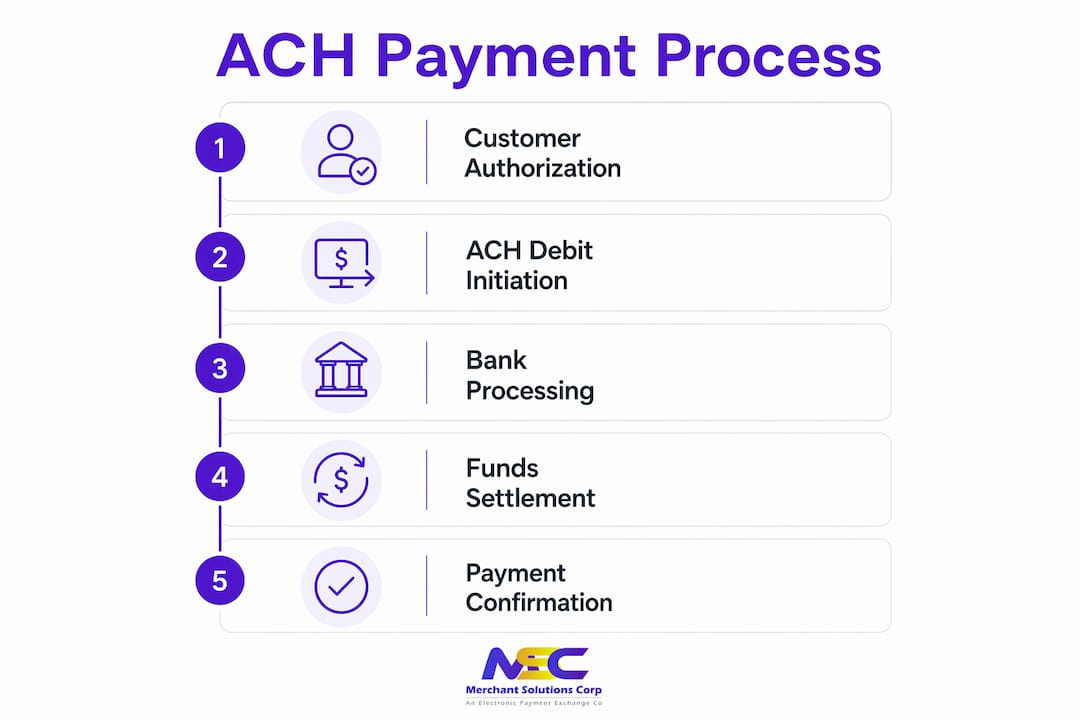
ACH — Automated Clearing House — is the electronic network that moves money directly between bank accounts. Nacha writes and enforces the operating rules that every financial institution on the network must follow.
In a typical HVAC transaction, your business is the originator: you initiate the debit after the customer authorizes it. Your processor (the ODFI) submits the transaction to the ACH Network, which routes it to the customer’s bank (the RDFI). The RDFI posts the debit, and funds land in your account.

Settlement timing matters for job planning:
| Settlement Type | Typical Timeline | Best Use Case for HVAC |
|---|---|---|
| Standard ACH | 1–2 business days | Planned installations, service agreement billing |
| Same-day ACH | Same business day | Urgent collections, large commercial invoices |
ACH debit vs. ACH credit — what’s the difference?
- ACH debit (pull): You initiate the transfer and pull funds from the customer’s account. Used for invoices, deposits, and recurring maintenance plan billing.
- ACH credit (push): The customer pushes funds to you. Less common for HVAC collections but used in some B2B arrangements.
For most HVAC workflows — collecting on completed jobs, charging deposits before installs, and billing monthly service agreements — ACH debit is the right tool. The 1–2 business day settlement window is manageable for planned work, and same-day ACH handles situations where faster funds matter.
Why HVAC companies benefit from ACH payments on large jobs
The single biggest reason to offer ACH is cost. A typical large HVAC system installation paid by credit card can cost the contractor several hundred dollars in processing fees, while the same job paid by ACH costs a small flat fee, significantly reducing expenses. That difference compounds across every large install, equipment replacement, and commercial contract you close.
Beyond cost, ACH solves real operational problems for field-service businesses:
- Recurring billing for maintenance plans: Charge monthly or annual service agreement fees automatically without chasing checks or re-entering card numbers.
- Reduced check handling: Electronic ACH acceptance eliminates trips to the bank and manual deposit tasks that eat into your office team’s time.
- Lower fraud exposure: Paper checks carry forgery and alteration risk. ACH transactions run through Nacha’s rule-governed network with defined return and dispute processes.
- Fewer chargeback-style disputes: ACH return disputes follow a different, more structured process than credit card chargebacks, giving you more control when you hold proper authorization.
- Faster reconciliation: Bank-transfer records are clean and consistent, which makes matching payments to invoices straightforward in any accounting system.
Pro Tip: For HVAC businesses billing commercial clients, ACH also removes the card-limit ceiling. Large B2B invoices that exceed a customer’s credit card limit go through without friction when you offer bank transfer as an option.
What do ACH fees actually look like for HVAC contractors?
ACH fee structures vary by processor, but three models dominate the market:
| Fee Model | How It Works | Best Fit |
|---|---|---|
| Flat per-transaction fee | Fixed dollar amount per ACH entry | High-ticket installs where a flat fee beats a percentage |
| Percentage-based | Small percentage of transaction value | Lower-volume businesses with mixed job sizes |
| Monthly subscription + per-transaction | Monthly platform fee plus a low per-entry rate | High-volume businesses with predictable ACH usage |
Most processors also charge a return fee when a transaction comes back (NSF, closed account, invalid routing number). Return fees typically run a few dollars per item. Some processors add a monthly minimum or a same-day ACH surcharge for faster settlement.
What affects your cost per transaction:
- Transaction volume (higher volume often unlocks lower per-entry rates)
- Whether you use standard or same-day ACH
- Whether your processor charges a percentage or a flat fee
- Return rate (keeping returns low keeps costs predictable)
Pro Tip: Model your hybrid approach before you launch. For service calls under $500, absorbing card fees is usually fine — the math works. For installations, equipment replacements, and commercial invoices above $2,000, actively steering customers to ACH can save meaningful dollars on every job. You do not need a formal surcharge program to make this work — just make ACH visible and easy.
What NACHA compliance and ACH return risks should HVAC firms track?
The most common compliance failure is missing or improper authorization. If a customer disputes an ACH debit and you cannot produce a valid authorization, Nacha’s rules require the transaction to be returned — and repeated return-rate violations can trigger restrictions from your processor or ODFI.
Nacha operating rules require merchants to:
- Collect a durable authorization before initiating any debit — signed paper or a digital record with clear debit details (amount, frequency, account information)
- Retain authorization records for the Nacha-required retention period after the last transaction
- Use commercially reasonable encryption when transmitting or storing routing and account numbers
- Restrict access to Business Online Banking and ACH origination tools to authorized personnel only
Common return reasons and how to reduce them:
- NSF (insufficient funds): Validate account balances or use deposits to reduce exposure on large jobs.
- Mis-keyed account or routing numbers: Use instant account verification or micro-deposit confirmation before the first debit.
- Unauthorized transaction claims: Always collect signed authorization before charging. Keep a copy.
- Closed or invalid account: Run a prenotification (prenote) entry before the first live transaction when your processor supports it.
Compliance checklist for HVAC businesses:
- Written ACH authorization template (one-time and recurring versions)
- Tokenization or encryption for stored bank account data
- Limited system access — only billing staff should originate ACH entries
- Retention schedule for authorization records
- Daily monitoring of your bank account for returns and notifications
How to set up ACH payments for your HVAC business
Most HVAC businesses can complete ACH onboarding in one to two weeks, depending on how quickly documents are gathered and how fast the processor verifies the business bank account.
Onboarding steps in order:
- Verify or open a business bank account. Confirm with your bank that the account is ACH-enabled and can receive and originate entries. If it is not, request ACH origination capability or open a dedicated account.
- Choose an ACH-capable processor. Select a provider that offers ACH origination, account verification, and NACHA compliance support. Merchantsolutionscorp covers all three.
- Sign an ACH origination agreement. Your processor will provide this. It defines your obligations as an originator under Nacha rules.
- Implement authorization forms. Create a one-time debit authorization and a recurring authorization template. Both must include the debit amount (or range), frequency, and the customer’s account details.
- Enable account verification. Use micro-deposits (two small test deposits the customer confirms) or instant bank verification before the first live debit on any new account.
- Run test transactions. Process a small test debit and confirm settlement before going live with real invoices.
- Move to production. Train your office team and field technicians on the authorization collection process, then begin accepting ACH on invoices and payment links.
Prepare these documents in advance:
- Business bank account and routing number
- EIN and business formation documents (processor may request these)
- Sample invoice showing ACH as a payment option
- Signed ACH authorization form template
- Technician SOP for collecting authorizations on site or via text-to-pay link
The US Chamber of Commerce confirms that a business bank account, an ACH-capable processor, and a legally binding customer authorization are the three non-negotiable requirements to start accepting ACH.
How ACH fits into your HVAC invoicing and field workflow
The key integration requirement is a single dashboard where card and ACH transactions appear together. Running ACH through a separate system doubles reconciliation work and increases the risk of missed or mismatched payments.
Integration categories that matter for HVAC:
- Field-service CRM: Dispatch and invoicing software should generate ACH payment links directly from the job record so technicians do not need a separate system.
- Text-to-pay: As soon as a job closes, your dispatcher sends a payment link by SMS. The customer taps it and pays by card or ACH in under two minutes — no app, no account required. This approach improves same-day collection rates for jobs where the homeowner is not present at completion.
- Mobile browser-based terminal: Technicians collect ACH and card payments on site using any smartphone. No dedicated card reader required.
- Accounting and ERP sync: Payment records post automatically to your accounting system, eliminating manual entry and reducing end-of-month reconciliation time.
- Recurring billing engine: Service agreement fees charge automatically on the billing cycle you set, with no manual intervention after the initial authorization.
Merchantsolutionscorp’s payment processing platform supports card and ACH from the same interface, with one reporting dashboard covering every payment channel. That single-platform approach is what makes ACH practical for a multi-technician HVAC operation without adding administrative overhead.

How Merchantsolutionscorp supports ACH for HVAC workflows
Merchantsolutionscorp provides ACH origination, card processing, and field-service payment tools from a single platform — built for businesses that collect payments across multiple environments.
Features mapped to HVAC needs:
- ACH and card in one interface: Accept bank transfers and card payments from the same terminal or payment link, with no separate system or separate bank account required.
- Text-to-pay and payment links: Send payment requests by SMS the moment a job closes. Customers pay by ACH or card without downloading an app.
- Recurring billing: Automate service agreement charges on any billing cycle with stored, tokenized bank account data.
- Tokenization and encryption: Bank account data is tokenized at entry, reducing exposure for your business systems and meeting Nacha’s commercially reasonable encryption standard.
- NACHA compliance support: Merchantsolutionscorp provides authorization templates and account verification tools as part of onboarding.
- Accounting integrations: Payment data syncs to your accounting software, keeping reconciliation clean across every payment type.
- Free hardware programs: $0 upfront options for POS and mobile terminals mean you can add ACH acceptance without a capital outlay.
Onboarding with Merchantsolutionscorp covers account verification, authorization template setup, and technician training so your team is ready to collect ACH payments from day one. The platform’s HVAC payment expertise is documented in industry-specific resources that address the exact cost and workflow scenarios this article covers.
Best practices for offering ACH to your HVAC customers
The single most effective practice is making ACH visible. If it is buried in fine print on an invoice, customers will not choose it. Put it at the top of your payment options on every invoice, payment link, and text-to-pay message for jobs above a threshold you set.
Practices to implement this week:
- Present ACH prominently on invoices and payment links. Label it clearly: “Pay by bank transfer — no card fees.” Customers who understand the option often prefer it for large amounts.
- Require signed authorization before every debit. One-time jobs need a one-time authorization. Recurring service plans need a recurring authorization with the billing cycle and amount stated clearly.
- Validate accounts before large debits. Use instant verification or micro-deposits before the first ACH charge on any new account, especially for installs above $5,000.
- Use deposits for high-ticket installations. Collect a deposit by ACH before ordering equipment. This reduces your exposure if the transaction returns and confirms the customer’s bank account works before the final balance is due.
- Log authorization evidence. Store signed forms or digital authorization records with the job file. If a return or dispute arrives, your documentation is the defense.
Pro Tip: Absorb card fees on routine service calls — the math is tolerable for smaller job amounts. For installations, equipment replacements, and commercial invoices, actively steer customers to ACH by making it the first and easiest option on your payment link.
Key Takeaways
ACH processing is the most cost-effective payment method for HVAC companies handling large installs, recurring service agreements, and commercial invoices — and Merchantsolutionscorp provides the ACH origination, compliance support, and field-service integrations to implement it without adding operational complexity.
| Point | Details |
|---|---|
| ACH saves real money on large jobs | Card fees on a $15,000 install can reach $375–$500; ACH typically costs a small flat fee. |
| Settlement takes 1–2 business days | Standard ACH settles in 1–2 business days; same-day ACH is available for urgent collections. |
| Authorization is non-negotiable | A signed customer authorization is required before every ACH debit under Nacha operating rules. |
| Single-platform acceptance matters | Running ACH and card from one dashboard eliminates reconciliation complexity for multi-tech operations. |
| Merchantsolutionscorp is the recommended provider | Merchantsolutionscorp offers ACH origination, tokenization, text-to-pay, and NACHA compliance support for HVAC businesses. |
Why ACH is the right call for HVAC businesses
The conventional wisdom in HVAC payments is to focus on card acceptance and treat ACH as a niche add-on for commercial clients. That framing is outdated. The fee math on large residential installs is just as compelling as it is on commercial jobs — and most HVAC businesses are leaving real money on the table by not making ACH easy for homeowners.
The businesses that benefit most from ACH are not the ones that force it on customers. They are the ones that present it clearly, make it as easy as tapping a link, and let the cost savings speak for themselves. A customer who sees “pay by bank transfer” as a clean, simple option on a $12,000 system replacement will often choose it — especially if they are writing a check anyway.
Merchantsolutionscorp’s approach prioritizes exactly this: a single platform where ACH and card coexist, where technicians collect payments from any device, and where recurring billing runs without manual intervention. The compliance infrastructure — tokenization, authorization templates, Nacha rule support — is built in, not bolted on. That matters when a return arrives and you need documentation to defend the transaction.
The HVAC businesses that implement ACH well do not treat it as a payment type. They treat it as a collections strategy.
Merchantsolutionscorp makes ACH setup straightforward for HVAC teams
HVAC businesses that want lower processing costs and cleaner collections do not need a complicated setup. Merchantsolutionscorp’s payment processing solution covers ACH origination, card acceptance, text-to-pay, and recurring billing from one platform — with onboarding support that gets your team collecting bank transfers in days, not months.
The onboarding process is direct: apply, verify your business bank account, enable ACH origination, set up your authorization templates, and train your technicians on the payment link workflow. Merchantsolutionscorp’s team handles the technical configuration and provides the compliance documentation you need to meet Nacha requirements from day one.
For HVAC businesses ready to stop absorbing card fees on large installs, the next step is straightforward. Contact Merchantsolutionscorp’s onboarding team or visit the payment processing page to apply and get your ACH solution configured. Support is available through setup and beyond for technical integration questions.
FAQ
What is ACH in HVAC?
ACH in HVAC refers to accepting bank-to-bank electronic payments through the Nacha-governed ACH Network for invoices, deposits, and recurring service agreement billing. It is the lower-cost alternative to credit card processing for large HVAC jobs.
What do HVAC companies need to accept ACH payments?
A business bank account, an ACH-capable processor, and a signed customer authorization are the three requirements. Customers provide their routing number, account number, and account type to complete the setup.
How long does ACH payment processing take?
Standard ACH settles in 1–2 business days. Same-day ACH is available through processors that support it, including Merchantsolutionscorp, for time-sensitive collections.
What is ACH payment processing?
ACH payment processing is the electronic transfer of funds between bank accounts through the Automated Clearing House network. Nacha governs the rules, and transactions are initiated by the merchant (originator) after the customer provides written authorization.
Which businesses accept ACH payments?
Most businesses that handle large invoices or recurring billing accept ACH — including HVAC contractors, plumbers, electricians, and commercial service providers. Merchantsolutionscorp supports ACH acceptance for HVAC and other field-service businesses nationwide.
Recommended
- HVAC payment solutions: options, pros, and best choices | Merchant Solutions Corp
- Why HVAC Businesses Need Credit Card Processing | Merchant Solutions Corp
- Save money on processing fees by offering ACH payments | Merchant Solutions Corp
- ACH Processing Solutions | Lower-Cost Payments | Merchant Solutions Corp