Chargeback Reason Codes: What Merchants Need to Know
Chargeback Reason Codes: What Merchants Need to Know
A chargeback reason code is the network-assigned label that tells you why a cardholder disputed a charge, and it controls two things above everything else: your response deadline and the exact evidence you need to submit. Check the code first. Everything else about your dispute strategy flows from that one field.
Every notification you get from your processor includes three data points that matter more than the transaction amount: the reason code, the Acquirer Reference Number (ARN), and the response deadline. Miss the deadline and the merits of your case become irrelevant. Submit the wrong evidence for the code and you lose even with a legitimate transaction.
Here’s your immediate action checklist when a dispute notice lands:
- Log into your processor dashboard and locate the reason code exactly as written (not paraphrased by a support rep)
- Find the ARN and match it to the original transaction in your records
- Confirm the response deadline and mark it several business days early on your internal calendar
- Identify which evidence category the code falls under before you start pulling documents
Codes are typically two to four alphanumeric characters set by the issuing bank, and they sort into four broad buckets: fraud, authorization, processing errors, and consumer disputes. Knowing which bucket you’re in tells you who on your team should be handling the response before you even open the case file.
TL;DR:
- Matching the evidence to the specific reason code category is crucial, as fraud, authorization, processing errors, and consumer disputes each require different proof.
- Keep current with each network’s code systems, since consolidation efforts like Mastercard’s 4853 mean that codes often cover broader claims than before.
- Prioritize capturing order-time evidence such as delivery photos, signed receipts, and accurate billing descriptors to prevent disputes before they reach your processor.
- Respond to disputes promptly by identifying the reason code, ARN, and deadline within minutes, and submit a single, strongest document accompanied by a clear narrative.
- Understand that the value lies in relevance; submitting the correct evidence for each dispute type enhances your chances more than bulk document uploads.
Table of Contents
- What Chargeback Reason Codes Actually Mean by Category
- How Visa, Mastercard, Amex, and Discover Format Their Codes
- Reading a Chargeback Notification and Building Your Response Fast
- Which Evidence Actually Wins Each Type of Dispute
- Transaction Modifiers and Why Deadlines Are Non-Negotiable
- Common Codes and What to Submit First
- Prevention Steps That Cut Chargebacks Before They Start
- How Merchant Solutions Corp Helps You Reduce Chargebacks
- Key Takeaways
- An Editorial Take on Fighting Chargebacks Smarter
- Sources
- FAQ
What Chargeback Reason Codes Actually Mean by Category
Every network builds its code system around the same four operational categories, even though the numbers and letters look different from Visa to Mastercard to American Express. Understanding these categories first, before memorizing individual codes, is what lets you triage disputes fast instead of researching each one from scratch.
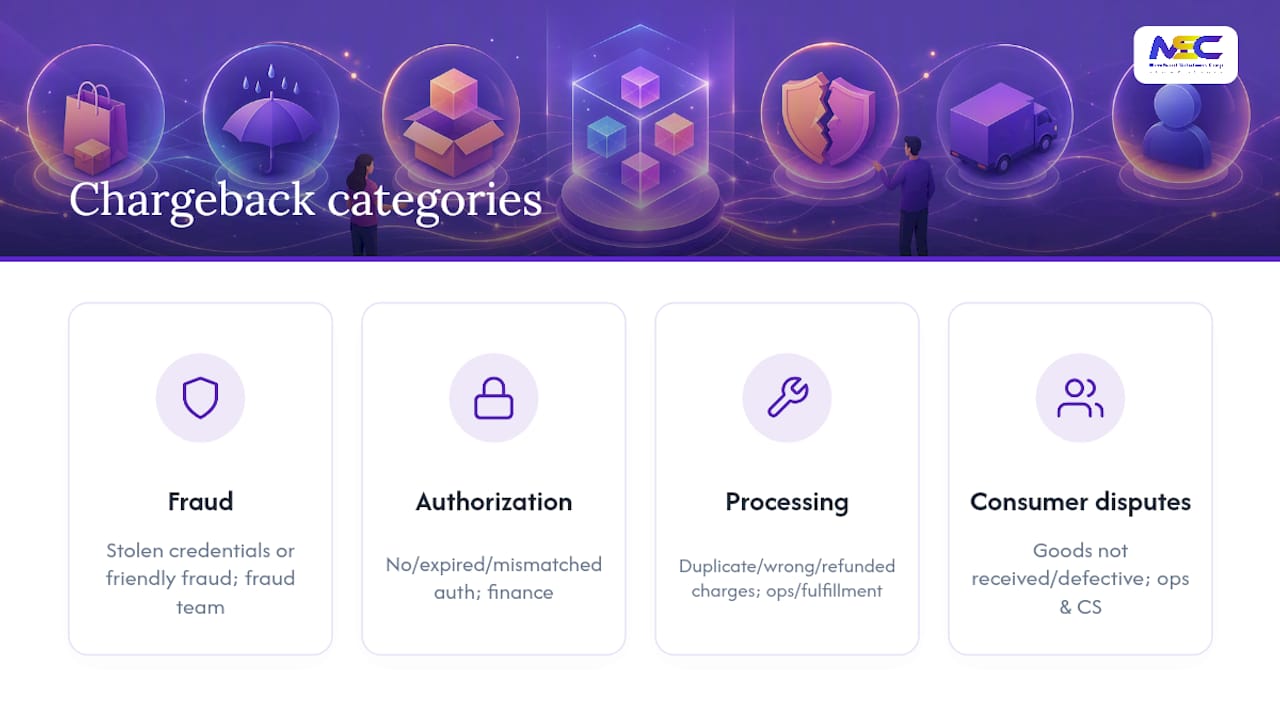
1. Fraud. The cardholder says they didn’t authorize the transaction, or the transaction used stolen payment credentials. This category splits into two very different problems that require different evidence.
2. Authorization. The transaction was processed without proper authorization, expired authorization, or an authorization that didn’t match the final sale amount. These are often the easiest disputes to win because the proof is procedural, not circumstantial.
3. Processing errors. Duplicate charges, incorrect transaction amounts, or charges that were already refunded but still show up on the statement. These are frequently the merchant’s own mistake, which changes your strategy from “fight” to “fix and prevent.”
4. Consumer disputes. The cardholder acknowledges making the purchase but claims the goods never arrived, arrived defective, or didn’t match the description. This is the largest and most contested category, and it’s where the bulk of your evidence-gathering effort will go.
The fraud category deserves a closer look because it hides a critical split. Third-party fraud means someone genuinely stole a card number and used it without the cardholder’s knowledge. Friendly fraud means the actual cardholder made the purchase, received the goods, and disputed the charge anyway, sometimes out of confusion, sometimes deliberately. Friendly fraud and other repeat-cause disputes can account for a large share of all chargebacks small businesses face, which means the evidence you need often has nothing to do with proving a crime and everything to do with proving the cardholder got what they paid for.
That distinction should drive who owns the response inside your business. A dedicated fraud or risk team should handle third-party fraud disputes, since they involve device fingerprints, IP logs, and velocity data that operations staff rarely touch. Your operations or fulfillment team should own processing-error and consumer-dispute cases, since they hold the shipping records, signed receipts, and customer communication history. Finance should track authorization disputes, because those often trace back to settlement timing or batch errors on your end. Customer service belongs in the loop on every category, since a fast refund on a clearly lost cause often costs less than fighting and losing a representment.

How Visa, Mastercard, Amex, and Discover Format Their Codes
The four major networks don’t use the same numbering logic, and mixing them up wastes time you don’t have during a response window.
Visa uses a category.condition format that’s genuinely intuitive once you learn it. The first number identifies the broad category and the number after the decimal identifies the specific condition: 10.x codes are fraud, 11.x codes are authorization, 12.x codes are processing errors, and 13.x codes are consumer disputes. Reason code 10.4 means card-not-present fraud, the classic “I didn’t make this purchase” claim on an online order. Reason code 13.1 means the cardholder says merchandise or services were never received. Reason code 13.7 means the cardholder canceled a recurring service but was billed anyway, which is one of the fastest-growing dispute types among subscription and membership businesses.
Mastercard groups its codes under the 48xx series, and two of them show up constantly in merchant disputes: 4837 (no cardholder authorization) and 4853 (cardholder dispute, a catch-all for quality, non-receipt, and defective merchandise claims). Mastercard’s own documentation shows the network has been consolidating narrower codes into broader ones like 4853 over time, which means the code alone tells you less than it used to. When a single code can mean five different underlying complaints, your best defense shifts from decoding the number to building a complete transaction story, including order history, device match, and prior purchase behavior for that customer.
American Express handles disputes differently since it operates as both the network and the issuer for most of its cards. Amex groups codes into letter-prefixed categories rather than numeric ranges, covering similar ground as Visa and Mastercard: fraud claims, authorization issues, and customer satisfaction disputes. Amex generally expects a tighter, more narrative-driven response package rather than a bulk document dump, and it enforces its response windows strictly.
Discover uses two-letter alphabetic codes that map conceptually to the same four categories used across the industry, even though the letter combinations don’t resemble Visa’s or Mastercard’s numbering. A Discover dispute for non-receipt of goods requires essentially the same tracking and delivery evidence you’d assemble for a Visa 13.1 case.
Here’s the practical reality every merchant needs to internalize: network rules change. Mastercard’s periodic consolidation is proof that a code you memorized two years ago might route differently today. Before you build a representment package, verify the current code definition against the network’s live documentation rather than relying on a saved reference sheet or a support agent’s memory. A five-minute check against the actual guide can save you an entire case.
Reading a Chargeback Notification and Building Your Response Fast
Your response clock starts the moment the notification hits your dashboard, not when you get around to reading it. The four fields that matter are the reason code, the ARN, the response deadline, and the disputed amount, and you need all four identified within minutes of opening the case, not hours.
Here’s the workflow that keeps you from missing deadlines when multiple disputes land in the same week:
- Flag the case immediately in whatever system you use to track disputes, noting the reason code and deadline in the same entry.
- Pull the original order record, including the timestamp, IP address, billing address match, and itemized cart contents.
- Collect shipping and tracking data if physical goods were involved, along with delivery confirmation or signature capture where available.
- Gather customer communication history, including support tickets, emails, or chat logs that show the customer’s own words about the transaction.
- Assemble authorization proof, meaning the approval code, AVS and CVV match results, and any 3D Secure authentication data from checkout.
- Write a short narrative connecting the evidence, because a reviewer scanning dozens of cases needs the story spelled out, not just documents attached.
Pro Tip: Set your internal deadline several days before the network’s actual deadline. Processor portals occasionally have upload delays, and a case that’s technically late because of a slow submission window is still a loss.
For businesses handling more than a handful of disputes a month, track deadlines on a shared calendar or dispute-management tool rather than in individual inboxes. A missed date on one case usually means a pattern of missed dates is coming, and each loss adds to the chargeback ratio your acquiring bank is watching.
Which Evidence Actually Wins Each Type of Dispute
Reviewers on the other side of a representment don’t read minds, and they don’t reward effort. They reward relevance. Submitting the wrong evidence for the code, even excellent evidence, gets you nowhere.
For fraud disputes (Visa 10.x, Mastercard 4837, Amex fraud codes):
- AVS and CVV match confirmation from the original authorization
- 3D Secure or other cardholder authentication data if used at checkout
- Device fingerprint and IP address matched against the shipping address
- Prior purchase history showing the same customer, device, or shipping address on file
For authorization disputes:
- The original authorization approval code and timestamp
- Proof the final charge amount matched the authorized amount
- Settlement records showing the transaction was processed within the valid authorization window
For processing-error disputes:
- Refund confirmation and date, if a refund was already issued
- Transaction logs showing only one charge was processed, not a duplicate
- Correction records if the merchant already fixed a billing error before the dispute was filed
For consumer disputes (Visa 13.x, Mastercard 4853):
- Signed delivery confirmation or tracking data showing successful delivery
- Product photos, especially for “not as described” claims
- Customer service correspondence showing the issue was addressed or a return was offered
- Cancellation logs for subscription disputes, proving the service was active during the billed period
Order your submission so the single strongest document appears first, not buried in a folder of forty pages. A tracking number paired with a delivery photo, for example, does more work in a “not received” case than ten pages of unrelated account history. Lead with that, then layer supporting context underneath it as a short narrative rather than a disorganized attachment dump.
The most common mistake merchants make is treating volume as strength. A wall of documents without an explanation forces the reviewer to do your argument for you, and most won’t bother. The second most common mistake is submitting evidence that answers the wrong question entirely, like sending a signed delivery receipt to fight an authorization dispute that has nothing to do with delivery.
| Point | Details |
|---|---|
| Lead with your strongest document | Put tracking, signed receipts, or auth proof first, not buried under supporting files. |
| Match evidence to the code | A delivery confirmation wins a 13.1 case; it does nothing for an authorization dispute. |
| Write a short narrative | Connect the evidence in plain language so a reviewer isn’t left guessing at your argument. |
| Avoid document dumps | More pages without context reduce your odds rather than improving them. |
Transaction Modifiers and Why Deadlines Are Non-Negotiable
A transaction modifier changes what evidence a network expects even when the base reason code stays the same. Card-not-present (CNP) transactions, for instance, carry a higher fraud-liability burden on the merchant than card-present transactions, since the physical card was never inspected or swiped. An EMV liability shift modifier can flip who’s financially responsible for a fraud loss depending on whether a chip card was properly read at a physical terminal or manually keyed in.
These modifiers matter because they change your evidence priorities. A CNP fraud dispute needs AVS, CVV, and device data front and center. A card-present fraud dispute needs terminal logs and EMV chip-read confirmation instead, since the liability question hinges on whether the chip was actually used.
Response windows vary by network and by case type, but they run on strict clocks, and missing one is fatal to your case regardless of how strong your evidence is. A representment submitted one day late is treated the same as no representment at all.
Rule changes compound this risk. Mastercard’s consolidation of narrower codes into 4853 means a single broad code now covers claims that used to be split apart, which changes what evidence a reviewer expects to see bundled together. Before filing any representment, confirm the current network documentation rather than relying on last year’s reference sheet. Networks update these guides more often than most merchants check them.
Common Codes and What to Submit First
These are the codes merchants encounter most often, with the three evidence items to prioritize for each.
| Code | Meaning | Top three evidence items |
|---|---|---|
| Visa 10.4 | Card-not-present fraud | AVS/CVV match, device/IP data, prior purchase history |
| Visa 13.1 | Merchandise or services not received | Tracking with delivery confirmation, shipping timeline, customer communication |
| — | Not as described or defective | Product photos, listing description, return or resolution offer |
| Mastercard 4837 | No cardholder authorization | Authorization approval code, AVS/CVV match, device data |
| Mastercard 4853 | Cardholder dispute (quality, non-receipt, defective) | Delivery proof or product evidence, customer correspondence, order history |
American Express fraud and satisfaction codes generally call for the same underlying proof as their Visa and Mastercard equivalents: authentication data for fraud claims, delivery and product evidence for satisfaction claims. Discover’s two-letter codes follow the same logic. A non-receipt dispute on Discover wants the same tracking and delivery package you’d build for a Visa 13.1.
Watch for friendly fraud indicators before you decide how hard to fight. Repeat buyers who dispute charges after multiple successful prior orders, partial shipments marked as “not received” in full, and disputes filed suspiciously close to a return-window deadline are all patterns worth flagging to your fraud team, since they change whether a case is worth fighting or worth simply absorbing.
Prevention Steps That Cut Chargebacks Before They Start
Fighting disputes well matters, but preventing them is cheaper every time. A handful of operational fixes address the root causes behind most chargeback volume.
- Make your billing descriptor instantly recognizable. A confusing or generic descriptor is one of the most common and preventable causes of “not recognized” disputes, and fixing it is often a same-day change with your processor.
- Capture order-time evidence automatically. Photos of packed items, signed delivery receipts, and digital confirmations should be standard practice, not something you scramble to find after a dispute arrives.
- Use AVS, CVV, and 3D Secure checks on every online transaction. These tools catch a meaningful share of fraud attempts before the charge ever completes, reducing your fraud-category dispute volume directly.
- Add velocity checks for repeat or high-frequency orders. Flagging unusual order patterns before fulfillment stops fraud losses before they become chargebacks.
- Lead with customer service, not silence. A fast refund or replacement on a legitimate complaint costs less than fighting and losing a dispute, and it keeps the transaction off your chargeback ratio entirely.
- Keep your POS and payment software current and PCI-aware. Outdated software introduces security gaps that increase both fraud exposure and processing errors.
Pro Tip: Review your billing descriptor at least once a year. Business names change, DBAs get added, and a descriptor that made sense at launch can become confusing as your product line grows.
How Merchant Solutions Corp Helps You Reduce Chargebacks
Merchant Solutions Corp builds payment processing and POS systems with dispute prevention built into daily operations, not bolted on after the fact. Clover, Square, and mobile terminal integrations give you a single source of transaction records, so pulling evidence for a dispute takes minutes instead of a scramble across three different systems.
Two workflow changes merchants can put in place quickly:
- Update your billing descriptor through your Merchant Solutions Corp account so it clearly reflects your business name and matches what customers see on receipts, cutting down on “not recognized” disputes before they start.
- Connect delivery and order tracking directly to your POS through integrated online ordering tools, so tracking numbers and confirmation photos are logged automatically at the point of sale rather than searched for later.
Industry-specific setups for retail and high-risk businesses account for the different evidence patterns each sector faces, since a restaurant’s dispute profile looks nothing like a subscription service’s. Dual pricing programs, covered in Merchant Solutions Corp’s cash discounting guide, also affect how disputed amounts get calculated, which is worth understanding before you build a refund policy.
Key Takeaways
Winning a chargeback dispute depends on matching the exact evidence to the reason code’s category before the network’s deadline expires.
| Point | Details |
|---|---|
| Check the code first | The reason code sets your deadline and the evidence type a reviewer will accept. |
| Know your four categories | Fraud, authorization, processing errors, and consumer disputes each need different proof and owners. |
| Verify live network docs | Codes like Mastercard 4853 have been consolidated, so confirm current definitions before filing. |
| Lead with your strongest evidence | One decisive document plus a short narrative beats a disorganized bulk upload. |
| Prevent before you fight | Clear billing descriptors and order-time evidence capture stop disputes before they reach a chargeback. |
An Editorial Take on Fighting Chargebacks Smarter
Most chargeback advice treats reason codes like a lookup problem: find the number, find the matching template, submit it, done. That approach is outdated. Mastercard’s own consolidation of narrower codes into broad umbrellas like 4853 proves the numbers alone carry less information than they used to.
The merchants who win consistently aren’t the ones with the best code glossary. They’re the ones who treat every dispute as a short evidence-based argument, led by the single strongest document, not the thickest file. Conventional advice overemphasizes memorizing code charts and underemphasizes building the operational habit of capturing order-time proof automatically, before a dispute ever arrives.
If you take one thing from this, prioritize prevention over representment skill. A clean billing descriptor and a delivery photo captured at fulfillment will save you more disputes than any evidence package written after the fact.
— Jonathan
Sources
Always check current network guidance before assembling a representment, since codes and evidence requirements shift over time.
- Mastercard chargeback guide (Chargeback Guide PDF) | Mastercard
- Chargeback Reason Codes Explained: Visa, Mastercard, Amex, and Discover | Wyllo
- How to read a chargeback notification | Payments & Risk
- Checkout
- How to reduce chargebacks for small businesses | Merrisk
FAQ
What are chargeback reason codes?
A chargeback reason code is a network-assigned identifier, typically two to four characters, that tells a merchant why a cardholder disputed a charge and dictates the response deadline and required evidence.
What does Visa reason code 13.7 mean?
Visa reason code 13.7 means the cardholder canceled a recurring service but was still billed. Winning it requires proof of the cancellation date and evidence the service was active and billed correctly during that period.
What are valid reasons for a chargeback?
Valid reasons generally fall into four categories: unauthorized or fraudulent charges, authorization errors, processing mistakes like duplicate billing, and consumer disputes such as goods never arriving or not matching their description.
What does Visa reason code 53 mean?
Visa reason code 53 refers to “not as described or defective merchandise,” a code that maps into the current 13.x consumer dispute category. Winning it requires product photos, listing details, and evidence of any resolution offered to the customer.